
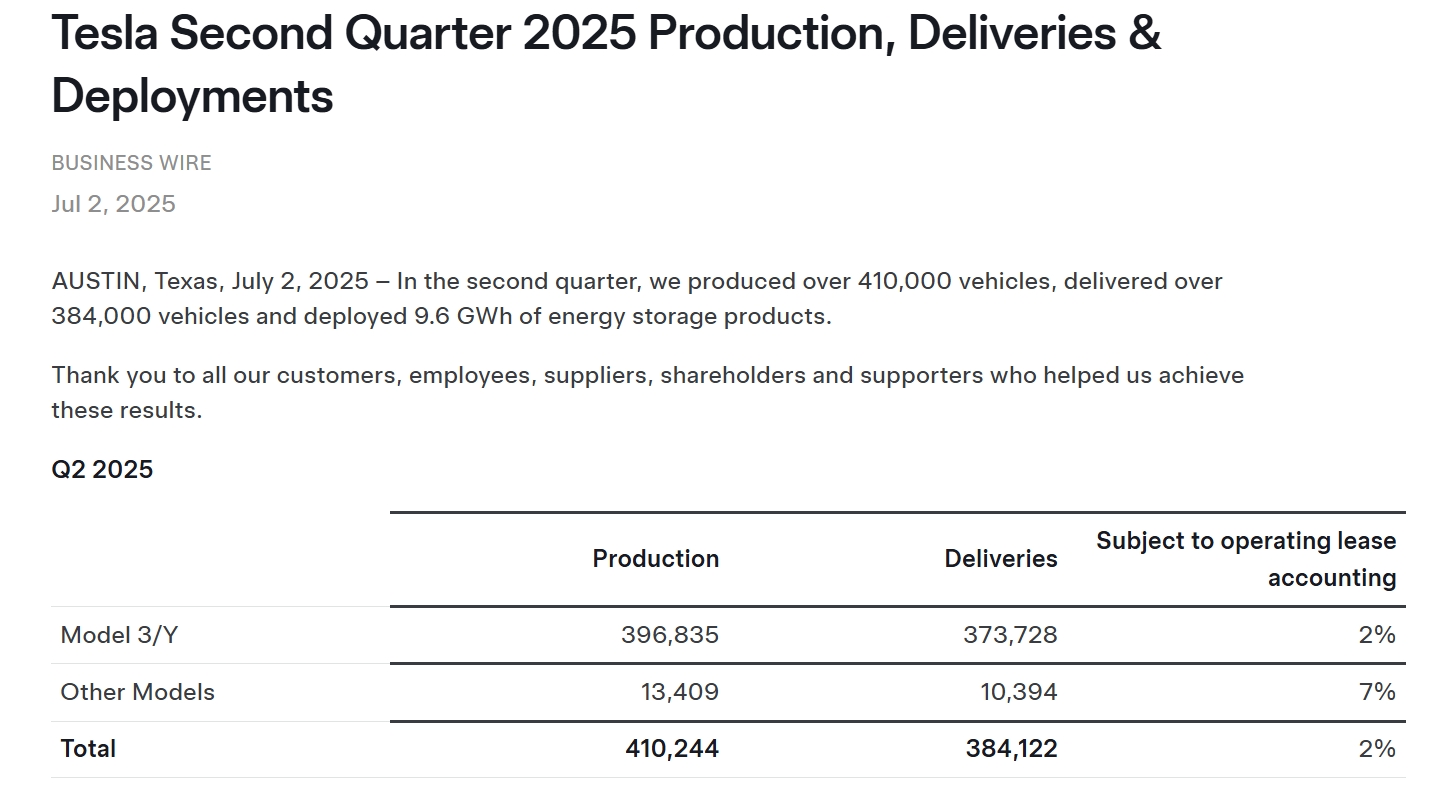
Tesla second quarter of 2025 results became a focal point for investors, owners and industry watchers alike. After a period of unrelenting growth, the numbers revealed both strengths and emerging weaknesses. On the one hand, production held near record levels, fueled by Giga Texas and Giga Berlin’s recent capacity gains; on the other, deliveries came in shy of some analyst forecasts, stoking fresh debate over market saturation, competitive pressure and the timing of Tesla’s next affordable model. For U.S. and European Tesla enthusiasts, understanding where deliveries landed—and why—offers critical insight into Tesla’s roadmap for the rest of 2025 and beyond.
Chapter I: Global & Regional Delivery Breakdown
Worldwide Totals
In Q2 2025, Tesla built roughly 410,000 vehicles and delivered approximately 384,000. While these figures remain among the highest in automotive history, they represented a year‑over‑year decrease of about 13.5 percent.
North America
The United States and Canada accounted for just over half of all deliveries. Model Y continued its reign as Tesla’s best‑selling vehicle, with the Long Range trim leading. Home delivery—branded “Tesla Direct”—expanded into new metro areas, shortening wait times for many buyers. Still, some markets noted slight lengthening of delivery windows as seasonal demand softened.
Europe
Europe’s story was more mixed. Although overall EV adoption in key markets like Germany and Norway remains strong, Tesla deliveries fell by more than a quarter compared to Q2 2024. Factors included heavier competition from local brands, rising interest rates suppressing financing deals, and back‑order logjams tied to homologation paperwork. Giga Berlin’s output uptick failed to fully offset congestion at ports and customs.
Asia (Ex‑China) and China
Outside China, Asia‑Pacific deliveries held steady, buoyed by Australia and South Korea. In Mainland China, independent trackers reported a late‑quarter rebound in Shanghai output after earlier H1 lockdown‑related dips, suggesting a gradual normalization of local supply and demand.
Model Mix Details
-
Model 3/Y Family: Represented roughly 97 percent of all deliveries, with the Model Y crossover outpacing the sedan segment by a ratio of nearly 2:1.
-
Model S and Model X: Continued as niche premium offerings, together accounting for under 3 percent of volume but delivering outsized profitability per unit.
-
Cybertruck (Initial Volumes): Early volumes trickled out of Giga Texas late in the quarter, adding a few thousand units to the headline tally.
Chapter II: Comparative Analysis
Year‑over‑Year Dynamics
Comparing Q2 2024 to Q2 2025, Tesla moved from roughly 444,000 deliveries to 384,000. That drop comes amid a more challenging macro environment, where global EV incentives tapered and consumer financing tightened in some regions.
Quarter‑over‑Quarter Trends
Sequentially, Tesla delivered about 337,000 vehicles in Q1 2025, rising to 384,000 in Q2. This 14 percent uptick reflects seasonality—spring buying patterns—and Moscow’s ramp of Model Y production. However, the spring surge gave way to a thinner summer order book for higher‑priced trims.
Competitive Landscape
Tesla’s market share plateaued in North America even as volume remained high, as Ford’s F‑150 Lightning and GM’s Chevy Blazer EV gained ground. In Europe, Tesla’s share slipped beneath the 1 percent mark in May, with Volkswagen, BYD and Renault all making market share gains.
Seasonal & Macroeconomic Headwinds
-
Interest Rates: Rising central‑bank rates in the U.S. and Eurozone made lease and loan financing costlier, cooling buyer enthusiasm.
-
Incentive Phase‑Outs: Some EU nations scaled back purchase subsidies as budgetary pressures rose.
-
Inventory Backlogs: Carry‑over from Q1 led to concentrated delivery windows, compressing some orders into tighter time frames.
Chapter III: Production & Logistics Factors
Factory Utilization
Tesla produced about 410,000 vehicles across Fremont, Giga Berlin and Giga Texas. Berlin saw utilization improve after earlier shipping delays; Texas held steady at record output levels thanks to megacasting advances.
Supply‑Chain Stabilization
Battery‑cell supply stabilized as Northvolt’s European factory ramped, and Tesla’s own 4680 dry‑electrode yields improved. Semiconductor constraints largely abated, though new tariffs on certain chips introduced modest cost pressures in Europe.
Delivery Workflow Innovations
“Tesla Direct,” the home‑delivery program, launched in additional U.S. metro areas, trimming dealer‑lot bottlenecks. Europe rolled out enhanced digital customs‑clearance tools, but cross‑border transport still added an average 7–10 days to some orders.
Chapter IV: Financial Market Response
Stock Performance
Tesla’s share price ticked up about 3 percent in after‑hours trading following the delivery release. Investors focused less on the modest miss versus analyst estimates and more on bullish commentary around upcoming robotaxi demos and AI software.
Analyst Reactions
-
Some firms trimmed their Q3 delivery forecasts to around 370,000 vehicles, citing softer EU demand and macro uncertainty.
-
Others maintained bullish longer‑term views, pointing to new product launches—particularly the rumored sub‑$30K model—as catalysts.
CEO Commentary
Elon Musk characterized Q2 as a “settling period,” emphasizing that true growth drivers lie in next‑gen products (robotaxi, affordable model) rather than legacy Model 3/Y volume.
Chapter V: Owner & Dealer Perspectives
Delivery Timelines & Satisfaction
-
U.S.: High‑demand trims (Performance, Long Range) saw 6–8 week waits; base Model 3 orders averaged under 4 weeks.
-
Europe: Typical waits ranged 8–10 weeks, with local homologation and tax paperwork cited as primary slowdowns.
Service‑Center & Mobile Service Expansion
Tesla boosted its North American mobile‑service fleet by around 12 percent, handling post‑delivery checks and minor fit‑and‑finish callbacks more efficiently. European service centers added evening and weekend slots to clear backlogs.
Customer Feedback Highlights
-
Owners praised the over‑the‑air 2025.24 software update’s smoother charging‑curve predictions.
-
Early Cybertruck recipients reported excellent driving feel, though minor panel‑gap inconsistencies emerged in a handful of vehicles.
Conclusion
Tesla Q2 2025 results underscore a powerful production engine running into a more complex demand environment. North America remains the bedrock of volume, even as Europe struggles with stronger local competition, tighter financing, and logistical hurdles. The stock market’s muted relief rally reflects confidence that Tesla’s future hinges on next‑generation offerings—robotaxi, Cybertruck, and an affordable mass‑market model—more than on legacy Model 3/Y performance. As we move into H2 2025, key metrics to watch include:
-
Timeline and pricing for Tesla’s rumored sub‑$30K vehicle.
-
Progress and user data from FSD Beta expansions.
-
Uptake and reliability of open‑access Superchargers in Europe.
-
Cybertruck production ramp and quality‑yield trends.
FAQ
1. How many vehicles did Tesla deliver in Q2 2025?
About 384,000 worldwide.
2. Which region saw the fastest growth?
North America remained strongest; Europe saw declines.
3. What supply‑chain factors mattered most?
Battery and chip supply stabilized, pointing to demand shifts rather than production constraints.
4. How did Tesla’s stock react?
Shares rose roughly 3 percent after hours on delivery day.
5. Are delivery windows tightening for autumn orders?
In the U.S., high‑spec trims are now pushing into late Q3; base models remain under 4‑week waits.