
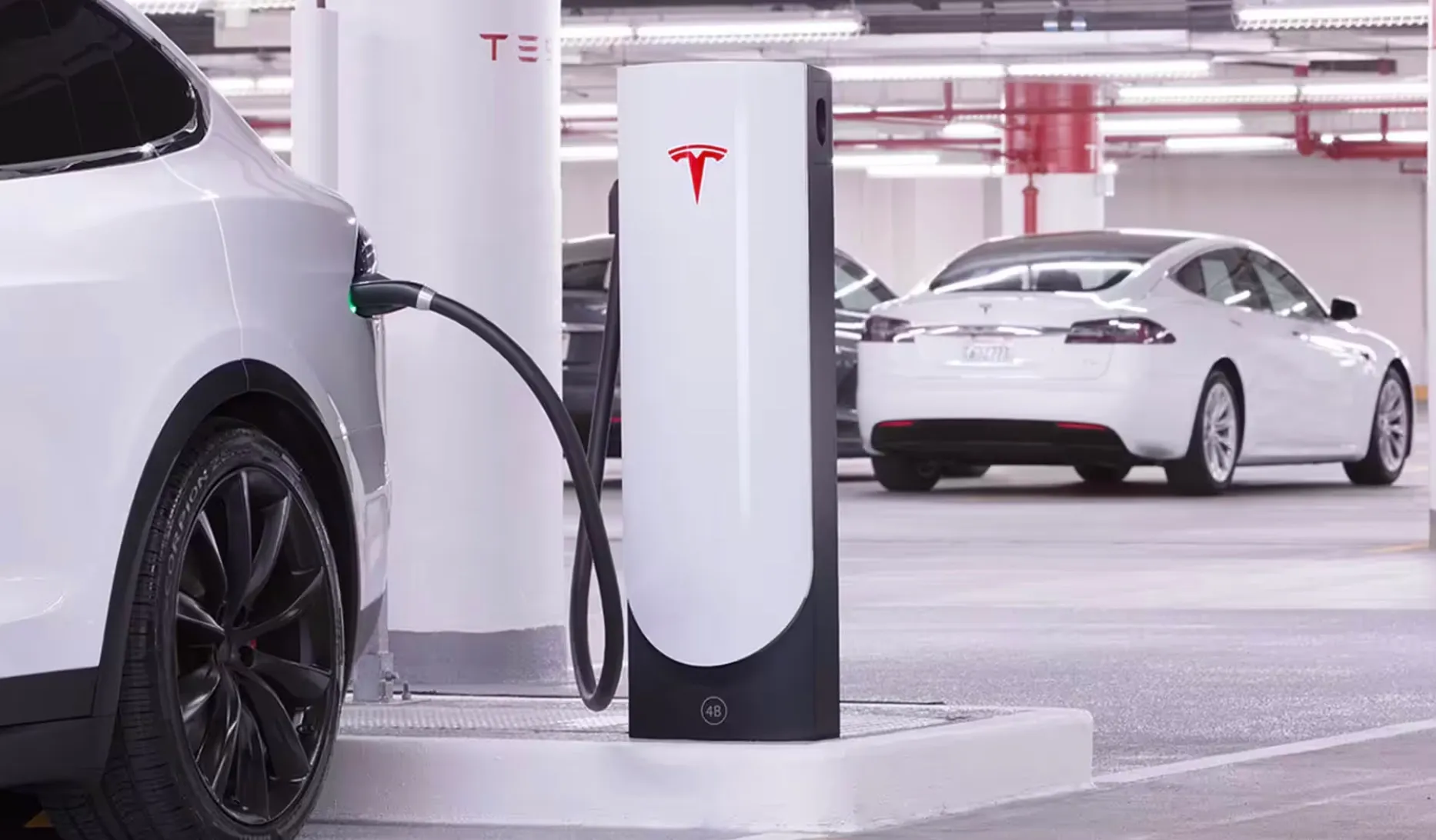
Tesla V4 Superchargers bring higher peak power, longer cables and non-Tesla access. Practical guide: speeds, costs, etiquette, where it’s live, and owner tips.
Quick summary: Tesla Supercharger V4 is the company’s next-generation fast-charging hardware with longer cables, on-post payment, and much higher potential peak power. At the same time Tesla is selectively opening parts of the Supercharger network to non-Tesla EVs (via NACS or CCS adapters/ports in Europe). For Tesla owners this means faster top-ups in ideal conditions, more convenient access for guests and loaner cars, and a busier, more commercialized network — plus a few new things to learn about etiquette, payments, and charging strategy.
1) Introduction — why V4 + an open Supercharger network matters
Tesla’s Supercharger network has been a competitive advantage since its inception: reliability, integration with navigation, and fast speeds helped Tesla owners road-trip with confidence long before third-party networks matured. The V4 generation (and associated cabinet upgrades) represents the next step: higher per-stall power density, longer cables and payment terminals that let non-Tesla EVs charge without the Tesla app or an adapter in many cases. At the same time, the industry-wide shift toward Tesla’s NACS standard in North America and selective CCS support in Europe means the Supercharger network is becoming an infrastructure platform rather than a single-brand convenience. That shift affects travel planning, resale value, and the day-to-day ownership experience for Tesla owners across the U.S. and Europe.
Below I break down how V4 differs from previous Supercharger generations, what owners should realistically expect in charging speeds, how and where non-Tesla cars can use the network, and practical steps to avoid headaches at busier stations.
2) What is Supercharger V4 — hardware, design goals and key specs
Tesla’s V4 is both a stall and cabinet architecture upgrade. Earlier deployed “V4” stalls were often paired with V3 cabinets (limiting output), but the full V4 cabinet rollout is intended to boost per-stall capabilities and deployment efficiency. Key hardware and design themes:
-
Higher peak capability: Tesla has stated V4 cabinet designs will enable much higher peak power per stall — public filings and press reporting show site-planning figures and Tesla’s claims of up to ~500 kW per stall in some configurations and up to 1.2 MW for Semis on specially provisioned sites. Early production and planning documents also referenced 350 kW to 500 kW available depending on grid and vehicle limitations.
-
Supports wider voltage range: V4 cabinets are designed to support vehicle architectures from ~400 V up to 1,000 V, which future-proofs the system for new platforms (e.g., trucks and higher-voltage EVs).
-
Longer, liquid-cooled cables: V4 stalls have substantially longer cables than V3, which makes it easier to plug vehicles with different parking geometries (important for non-Tesla EVs and larger vehicles). The cables remain liquid-cooled for high currents.
-
More stalls per cabinet & denser cabinets: V4 cabinet designs can power more posts per cabinet (examples talk about 6–8 stalls per cabinet), lowering footprint and permitting faster station rollouts.
-
On-post screens and payment terminals: V4 sites are being equipped with displays and contactless payment terminals (cards, mobile tap/QR) to simplify access for non-Tesla drivers and to comply with local charging regulations (e.g., transparency in pricing in the UK/EU).
Why these changes matter
The long cables and contactless payments reduce friction for non-Tesla cars and guests; higher cabinet power density lowers installation cost per stall and accelerates rollout; and support for higher voltage architectures positions V4 for future high-power EVs (and the Tesla Semi). Collectively, V4 is a network-scale optimization: faster charging potential, improved universality, and cheaper, quicker deployments for Tesla.
3) Real-world charging: how fast will your Tesla actually charge on V4?
It’s important to separate theoretical peak from real-world averages. Several factors determine how much power your car will draw:
A. Car hardware & battery voltage
Your Tesla’s battery pack voltage, architecture, and maximum accepted DC power (kW) set an upper bound. Older models and certain pack chemistries limit peak rates even on higher-power stalls. For example, some production V4 deployments are rated to 350–500 kW, but most consumer EVs (including many Tesla variants) will not sustain those peaks due to BMS/thermal limits.
B. State of charge (SoC)
Charging power typically peaks in the low-to-mid SoC window (roughly 10–40% for many batteries) and then tapers to protect battery health. On a long trip, the fastest strategy is to top up only enough to reach your next stop or final destination rather than charging to 80–100%. V4’s advantage is reducing top-up time within that efficient SoC window.
C. Thermal conditions
Battery temperature matters. Cold batteries charge much slower until pre-conditioning warms the pack; Tesla navigation often preconditions the battery when you route to a Supercharger, but if you plug in immediately from a cold start expect slower initial rates. Real-world users report V4 cables are stiffer in cold weather; cable stiffness doesn’t affect power but can influence plug handling.
D. Station load and power sharing
Some V4 cabinets power multiple stalls; if many cars charge at the same time, available power per stall can be reduced by dynamic power sharing. V4 cabinets are intended to increase per-cabinet throughput (allowing more stalls to run high power simultaneously), but congestion still reduces individual peak rates.
E. Realistic examples
-
Ideal case: A high-voltage platform with a cold-ready battery and low SoC might see 300+ kW peak from a fully provisioned V4 cabinet — enabling a very quick 15–20 minute 10–60% top-up in some scenarios.
-
Common case: Most Tesla Model 3/Y owners will see rates similar to V3 at many sites (~200–250 kW peaks) unless they drive newer high-voltage models that are optimized for higher power. Many V4 stalls currently operate with V3 cabinets or are limited by grid/site constraints to ~250–325 kW in practice.
Bottom line: V4 increases the potential charging speed and reduces friction (longer cables, on-post payment), but your actual speed depends on your vehicle, SoC, temperature, and station load. Expect faster sessions in ideal conditions; plan conservatively for typical travel.
4) Network opening: who can use Superchargers now and how (US vs Europe)
Tesla has moved from a closed, Tesla-only network to a model that supports other OEMs in two different ways depending on the region.
North America (NACS adoption & adapters)
-
NACS standard: Many North American automakers (Ford, GM, Hyundai/Kia, Rivian, Mercedes, BMW in announcements, etc.) have announced plans to adopt Tesla’s NACS port or to provide adapters. The adoption means an increasing number of non-Tesla EVs will be able to plug into Tesla Superchargers natively in the U.S. and Canada in coming model years. For cars that don’t have native NACS, Tesla and third parties have made adapters available.
-
Payment & access: Tesla’s official support pages confirm that select Superchargers are now open to non-Tesla EVs and that owners can check availability in the Tesla app or the Tesla support website. Non-Tesla access in North America typically requires NACS-equipped cars or an adapter + app/payment.
Europe (CCS2 compatibility & targeted pilots)
-
CCS2 ports on Tesla vehicles: European Teslas have used CCS2 ports for some time, and Tesla began selectively equipping V4 stations with CCS2 connectors (or adapters) to allow non-Tesla cars to charge without physical adapters. Tesla’s pilot programs began in the Netherlands and have expanded to countries including Germany, France, the UK and the Nordics.
-
On-post payment & regulations: European consumer regulations often require clear pricing and contactless payment; V4 stations include on-post terminals and transparent displays to comply and to make public charging straightforward for third-party drivers.
Operational nuance & limits
-
Not every station is open: Tesla is selective, often enabling non-Tesla access at new V4 sites or targeted existing sites, typically in areas with insufficient third-party charging. Check Tesla’s map and the Tesla app for real-time access listings.
-
Adapter and protocol caveats: In North America the move to NACS resolves much friction, but in markets where CCS2 is dominant (Europe), adapterless charging requires station CCS capability. Some non-Tesla cars may still need software updates from their OEMs to support certain high-power behaviors on Tesla hardware.
Practical implication for Tesla owners: The Supercharger network is increasingly a shared public utility. That’s good for overall EV adoption and for occasional non-Tesla guests, but it can increase congestion at popular sites — plan for busier stations, especially near tourist routes and motorway hubs.
5) Where V4 and open access are rolling out — patterns and examples
Tesla’s rollout is strategic: prioritizing high-traffic corridors, underserved regions, and locations where regulatory/commercial conditions favor opening. A few observed patterns:
-
Europe pilots first in test markets: Harderwijk (Netherlands) was an early V4 deployment proving long-cable designs and CCS compatibility. Tesla expanded pilots into Germany, France, the UK, and Scandinavia where CCS is standard and where governments encouraged interoperability.
-
North America focuses on NACS adoption & key corridors: With OEMs adopting NACS, Tesla has also prioritized high-demand interstate sites and convenience hubs. Several North American V4 posts were reported to deliver up to ~325 kW in practice while the full cabinets roll out.
-
Urban & commercial sites get payment terminals: Sites that expect a significant share of non-Tesla users (airport parking, urban hubs, shopping centers) are more likely to get on-post payment and CCS/NACS support early.
What to watch locally: Use the Tesla app’s station status, community maps (PlugShare, A Better Routeplanner) and Tesla’s support page to see which stations in your country accept non-Tesla cars. Availability changes as pilots expand.
6) How to charge at a V4 — practical tips to maximize speed and avoid surprises
Pre-trip planning
-
Route-to-charger with Tesla nav: If you drive a Tesla, the car will often precondition your battery when navigation routes to a Supercharger — ensure you start navigation early if planning a fast top-up. For non-Tesla cars relying on V4, pre-conditioning is OEM-dependent.
On arrival: what to do
-
Pick the best stall: If the station is busy, favor stalls with fewer adjacent charging cars (to reduce power-sharing effects). If you need a particular side for cable reach, choose a stall that avoids awkward parking angles. V4 longer cables help, but real parking geometry still matters.
-
Payment for non-Tesla cars: Use the on-post payment terminal or the Tesla app as guided; some European sites allow contactless card tap or QR-based pay. In North America, NACS-equipped cars may authenticate via the car OEM’s app or an adapter plus Tesla/third-party app depending on the site.
While charging
-
Monitor SoC & tapering: If you want to minimize time, stop charging once you have enough range (a 10–60% top-up is often the fastest per kWh). Let the car taper rather than insisting on 100% unless necessary.
-
Avoid peak congestion windows: Holiday weekends and commuter evenings are busiest. If possible, time your charge for midday or off-peak windows.
Post-charge etiquette
-
Move promptly: Many sites enforce idle/overstay fees — move your car when charging is finished to free the stall. Tesla’s app often notifies you when charging is complete
-
Report problems: If a cable is damaged, misbehaves, or a stall shows odd behavior, report via the Tesla app or station maintenance contact so the operator can fix it quickly.
7) Payments, pricing models, and idle fees
Pricing transparency
European regulation and consumer expectations have pushed Tesla to show pence-per-kWh or €/kWh pricing on on-post displays at many V4 sites. In North America, time-of-day rates and session fees may vary and Tesla’s app or on-post terminal typically shows current pricing. Expect pricing to vary by country, site, and time of day.
Idle and parking fees
To discourage stall hogging, Tesla enforces idle fees at many sites and may increase enforcement for open-access sites. Fees escalate the longer a car remains after charging completes. These penalties are intended to keep throughput high on busy corridors.
Billing mechanics for non-Tesla cars
-
Europe (CCS): Use on-post contactless/payment or Tesla app. Pricing is per kWh or per minute depending on local rules and operator choices.
-
North America (NACS): Native NACS cars may authenticate via OEM integrations; otherwise adapters + Tesla/third-party apps provide access. Card/phone payment options are being expanded at V4 sites.
8) Congestion, etiquette and avoiding conflicts
As Superchargers become a shared resource, etiquette matters more than ever.
Best practices
-
Plan ahead: Expect busier stations on holiday routes; check live status in the Tesla app and community tools.
-
Only charge as long as needed: For long journeys, plan shorter, frequent top-ups instead of long fills, especially at busy sites.
-
Don’t block EV-only lanes: Use appropriate parking spaces and don’t park in stalls you’re not using.
-
Swap politely: If asked by a waiting EV driver for a quick top-up to get to the next town, accommodate if possible. Many Tesla owners report community goodwill goes a long way.
Handling disputes
If someone parks and leaves a plugged-in car, take a photo, then contact station support via the Tesla app. Many owners handle disputes civilly; escalation to authorities is rarely helpful unless illegal parking is involved.
9) Impact on Tesla owners: resale, charging economics, and ownership experience
Resale value & network advantage
Supercharger access has historically supported Tesla resale values — a reliable fast-charging network is a key part of vehicle desirability. Opening the network levels the playing field somewhat (other brands gain access), but the integration and software experience (navigation, preconditioning, seamless billing for Tesla owners) still provide practical advantages that support Tesla’s residual values.
Charging economics
For owners who rely heavily on Superchargers, faster V4 top-ups can reduce trip time and potentially reduce cost per usable mile if pricing remains competitive. However, if non-Tesla demand causes congestion, wait times can increase — reducing the time benefit of higher peak power. Monitor pricing changes — opening the network also creates a new revenue stream for Tesla, and pricing strategies may evolve.
Ownership experience
Expect a more “public utility” feel at busy sites: more non-Tesla cars, on-post payments and greater enforcement of idle fees. Tesla owners still benefit from integration and app-based convenience, but should be prepared for occasional delays and to be flexible in station choice.
10) Troubleshooting and common V4 quirks owners report
A few practical issues owners and early testers have reported:
-
Stiff cables in cold weather: Liquid-cooled cables can become stiffer in low temperatures; handle carefully to avoid stress on connectors.
-
App/payment hiccups for non-Tesla drivers: Early pilots had occasional payment or authentication friction while OEM integrations matured; card tapping and on-post payment has reduced friction in many sites.
-
Power-sharing surprises: On multi-stall cabinets, a sudden nearby session can reduce your peak rate mid-charge; keep an eye on power and be prepared to swap stalls if needed.
-
Cable reach & parking angle: Despite longer cables, some awkward parking bays still cause reach issues; park deliberately and, if necessary, ask for another stall.
If you encounter persistent hardware faults, report them in the Tesla app so site maintenance can be notified quickly.
11) The roadmap — what to expect next from Tesla charging
-
Broader V4 cabinet rollout: Expect Tesla to continue deploying V4 cabinets where grid capacity and permits allow, gradually unlocking full 350–500 kW capability in more locations. Early rollouts often operate at lower power depending on grid & cabinet stage.
-
More OEM NACS adoptions in North America: As more automakers adopt NACS, native compatibility at Superchargers will increase, smoothing access and reducing adapter dependency.
-
Expanded CCS compatibility in Europe: Tesla will continue targeted openings with CCS2 connectors where it makes sense; local regulators and commercial agreements will shape the pace.
-
Integration with energy assets: Tesla may pair more stations with Megapack energy storage or solar to reduce grid strain and manage peak loads at high-power cabinets. Early planning documents showed Megapack integration at some V4 sites.
12) Conclusion — quick action checklist for Tesla owners
-
Update your navigation & app: Use Tesla’s route planner to trigger battery preconditioning.
-
Check site access before travel: Confirm whether your planned stations accept non-Tesla vehicles (if relevant) and whether they use CCS/NACS.
-
Top up efficiently: Aim for 10–60% top-ups on long trips to maximize time efficiency.
-
Avoid peak congestion & obey idle fees: Move promptly when done and consider off-peak scheduling.
-
Document unusual behavior: Report station issues via the Tesla app so operators can fix them quickly.
V4 and the open Supercharger network are a step toward a more capable, more widely useful EV charging infrastructure. For Tesla owners this brings faster top-ups in ideal cases and greater convenience for guests — with the tradeoffs of potentially busier sites and evolving pricing. Embrace the benefit, plan smartly, and keep your expectations grounded in the realities of vehicle hardware and site load.
13) Full FAQ — practical answers for Tesla owners
Q1: What is the practical peak power of a V4 Supercharger today?
A: Public documentation and reporting show V4 cabinets are designed for up to ~500 kW per stall in optimal conditions and up to 1.2 MW for Semis on special sites, but many deployed V4 stalls operate in the 250–350 kW range today depending on cabinet stage, grid limits, and vehicle compatibility. Expect higher peaks as full V4 cabinets roll out and site power permits are satisfied.
Q2: Will my current Tesla (Model 3/Y/S/X) benefit from V4 speeds?
A: It depends on your model and battery chemistry. Some vehicles will see modest improvements; others (especially older packs) may not reach the highest V4 peaks due to battery pack limits and thermal constraints. Newer high-voltage platforms and upcoming models are more likely to take full advantage.
Q3: Which Superchargers are open to non-Tesla EVs?
A: Tesla lists open-access stations on its support pages and app — availability varies by country. In North America, NACS adoption by OEMs makes native access more common; in Europe, Tesla pilots CCS2-enabled V4 sites in selected countries. Always check the Tesla map or app for real-time access.
Q4: Do I need an adapter to charge a non-Tesla EV at a Supercharger?
A: In North America, many newer OEMs plan to use NACS natively (eliminating adapters). For older models, adapters exist but functionality depends on site support. In Europe, CCS2-equipped V4 sites allow many non-Tesla cars to plug without adapters. Check your car OEM guidance and site type before travel.
Q5: How much will charging cost on a V4 Supercharger?
A: Pricing varies by country and site. Europe increasingly displays per-kWh pricing on site; North America may use per-kWh or per-minute pricing depending on local rules. Expect Tesla to adjust pricing as non-Tesla access expands. Use the Tesla app to view current site prices.
Q6: Are there idle/overstay fees at V4 sites?
A: Yes — Tesla enforces idle penalties at many locations to discourage occupying stalls after charging completes. Fees can escalate with time; moving promptly keeps throughput healthy.
Q7: Will opening the network make Superchargers more congested?
A: Likely in high-demand corridors. Tesla’s strategy is to deploy more stalls and higher throughput cabinets, but popular tourist routes and motorway hubs may see more demand. Plan accordingly and consider off-peak charging.
Q8: Does V4 support Tesla Semi or Cybertruck specifically?
A: V4 cabinet designs specifically mention higher voltage and substantially higher aggregate power (including configurations to support Semis). Cybertruck and other high-voltage vehicles are part of the rationale for V4 capability. Actual per-vehicle rates depend on OEM hardware and site provisioning.
Q9: My cable was stiff/awkward in cold weather — is that normal?
A: Liquid-cooled cables can feel stiffer in very cold conditions. Handle them carefully and avoid sudden pulls; report any hardware issues through the Tesla app.
Q10: How can I get the fastest possible charge on V4?
A: Arrive with low SoC (but not empty), allow navigation to precondition the battery, charge in the efficient 10–60% window, and choose a stall with fewer adjacent charging cars to limit power sharing.
Q11: Will the opening of Superchargers to other brands reduce Tesla resale values?
A: Not necessarily. While exclusivity was a perk, Tesla’s integrated charging experience and Supercharger reliability remain selling points. Wider network access helps overall EV adoption (a positive for market demand) though local congestion could affect convenience perceptions. Monitor local resale trends
Q12: If I drive a non-Tesla, which automakers support Superchargers?
A: Many OEMs have announced NACS adoption for North America (Ford, GM, Hyundai/Kia, Volvo/Polestar, Mercedes, BMW, Rivian and others) or adapters/partnerships. In Europe, CCS2 is common and some V4 sites provide CCS2 connectors enabling non-Tesla cars to charge.
Q13: How will charging etiquette change with mixed brand use?
A: Expect clearer enforcement of overstay fees, more frequent stall turnover, and a need for quicker charging sessions. Be considerate: move promptly, don’t block stalls, and use the app to plan.
Q14: Where can I find real-time info on which stations accept non-Tesla cars?
A: Use Tesla’s official Supercharger map & support pages, the Tesla app, and community maps (PlugShare, A Better Routeplanner). Tesla’s support page shows currently enabled non-Tesla stations and access requirements.