
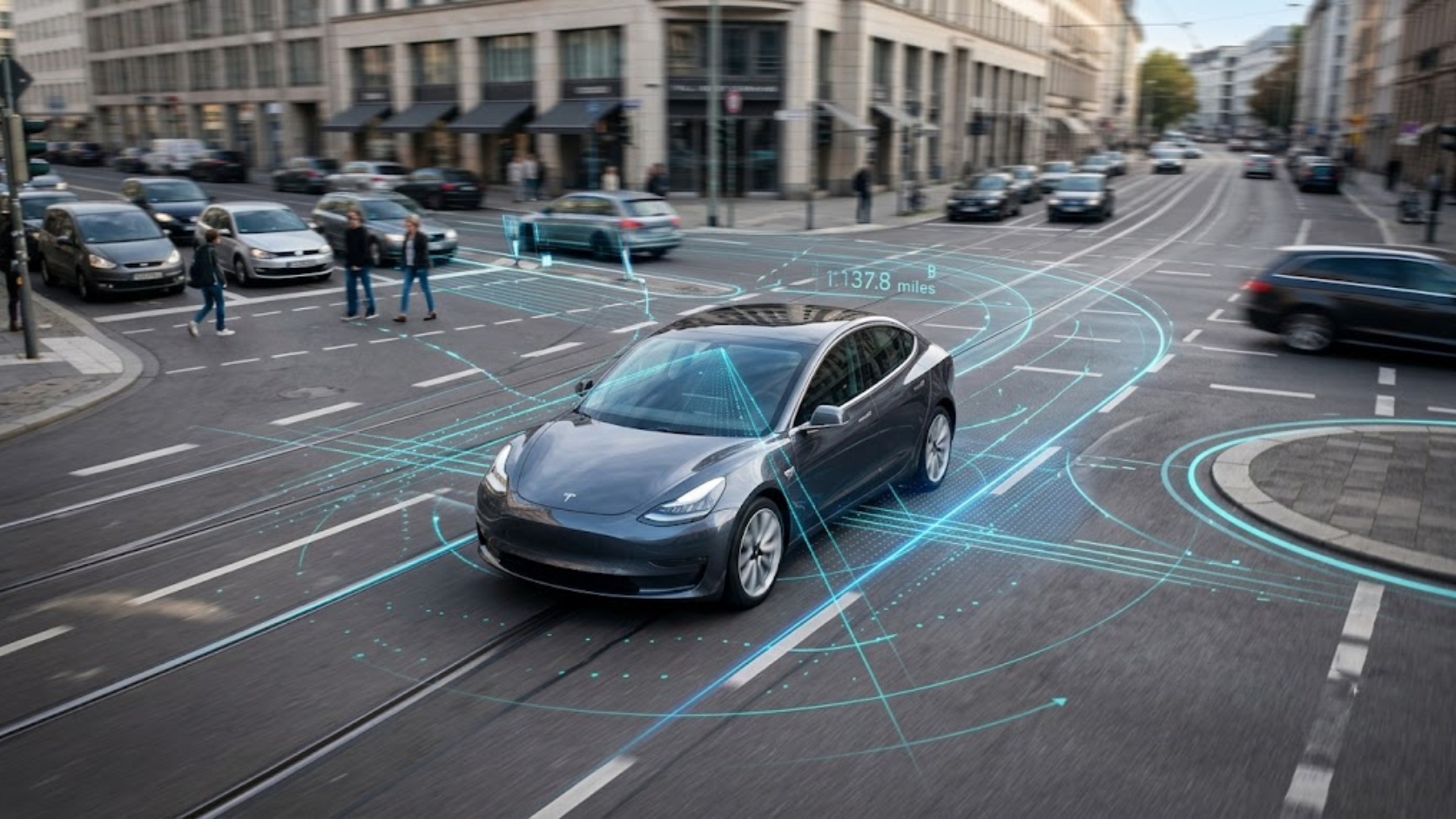
Introduction: The 13 Billion Mile Milestone
Tesla’s Full Self-Driving (FSD) Supervised program has reached a massive milestone: crossing 13 billion cumulative miles driven by real-world customer vehicles. The velocity of data collection has reached unprecedented levels, with the fleet accumulating roughly one billion new autonomous miles every two to three weeks.
Crucially, official data reveals that 5 billion of these 13 billion miles were driven specifically in complex urban environments—the hardest domain for autonomous systems. Supported by a subscriber base of over 1.5 million monthly active users across North America and expanding European territories, Tesla’s neural-network-driven autonomy program is operating at a scale unmatched in the automotive industry.
2. The Economics of $99/Month FSD Subscription Shift
A major driver of this rapid mileage expansion was Tesla's strategic decision to retire the legacy $8,000 upfront FSD purchase option in favor of a streamlined $99/month subscription model.
Lowering the Friction Barrier
By reducing the entry barrier from a substantial capital expenditure to a flexible monthly subscription, Tesla achieved a 56% year-over-year increase in active FSD users. Owners can activate the package for long summer highway trips or winter commutes and pause it during months of light driving. This recurring SaaS revenue model delivers predictable high-margin software income while continuously expanding the fleet of real-world test vehicles.
Expansion into European Regulatory Frameworks
With initial supervised rollouts gaining traction in select European regions under evolving UNECE driver-assist guidelines, European Tesla owners are beginning to experience end-to-end neural network driving. The $99/month pricing structure (and equivalent localized euro pricing) has driven strong trial adoption across key markets such as Germany, Norway, the Netherlands, and the UK.
3. FSD v14.x Neural Network Architecture & End-to-End AI
The technical engine behind the 13-billion-mile system is Tesla’s shift to end-to-end vision-based neural networks. In the FSD v14.x architecture, C++ heuristic code rules (e.g., explicit logic for speed limits, stop signs, and lane changes) are replaced with unified deep-learning models trained on millions of video clips.
Urban Complexity and Edge Cases
Navigating multi-lane roundabouts in Europe, urban construction zones in downtown Chicago, and unstructured drop-off lanes requires nuanced contextual awareness. Because Tesla’s neural networks ingest real-world driving data from 1.5 million active drivers daily, the system learns natural human responses to complex scenarios:
-
Softly nudge around illegally parked delivery vans without stopping dead in traffic.
-
Pre-emptively slow down when pedestrians near curb edges show body language indicating an intent to cross.
-
Smoothly negotiate unsignaled four-way stops by assessing eye contact and vehicle creeping behavior.
HW4 (AI4) Optimization vs. HW3 FSD v14 Lite
To maintain feature parity across vehicle generations, Tesla developed two distinct compiled outputs from its master neural net model:
-
AI4 Native Build: Leverages high-resolution cameras, accelerated NPU memory bandwidth, and uncompressed video frames for maximum spatial perception.
-
HW3 FSD v14 Lite: A parameter-compressed build tailored specifically for the compute constraints of Hardware 3. Delivered to HW3 vehicles across North America and international markets, this version preserves core neural driving capabilities while optimizing memory utilization.
4. Bridge to Robotaxi & Autonomous Fleet Operations
The data collected from 13 billion supervised miles directly feeds the development of Tesla’s unsupervised Cybercab and Robotaxi initiatives.
Real-world pilot testing in Austin, Dallas, Houston, and Florida markets serves as a testing ground for unsupervised fleet deployments. Disengagements logged in the supervised fleet highlight rare edge cases—such as extreme weather glare, ambiguous temporary traffic signs, or unusual road debris—which are immediately auto-flagged, uploaded, and retrained in Tesla's high-performance AI compute clusters.
5. Practical Guide for Tesla Owners
To get the most out of FSD Supervised while maintaining safety, owners should follow these operational best practices:
-
Keep Camera Enclosures Pristine: Clean the windshield camera housing area and side pillar glass regularly with non-abrasive microfiber cloths to prevent optical degradation.
-
Understand System Hand-offs: FSD Supervised requires active driver oversight. Keep hands resting lightly on the steering wheel rim to provide immediate rotational feedback when prompted.
-
Leverage the Disengagement Feedback Tool: When disengaging FSD due to suboptimal behavior, use the snapshot voice note feature to report precise context to Tesla’s data collection teams.
Conclusion
Crossing 13 billion miles proves that Tesla's vision-only, neural network strategy is scaling effectively. As the $99/month subscription model continues to expand the active driver base in both North America and Europe, Tesla's real-world data engine provides a foundation for the future of autonomous mobility.
Frequently Asked Questions (FAQ)
Q1: What is the primary difference between FSD (Supervised) and fully autonomous Robotaxis?
FSD (Supervised) requires a licensed driver in the driver’s seat who must keep their eyes on the road and be ready to take control at any instant. Unsupervised Robotaxis operate without a human safety driver behind the wheel in approved, geo-fenced test jurisdictions.
Q2: Does my HW3 Tesla receive the same software updates as newer AI4 vehicles?
Tesla deploys specialized "v14 Lite" builds optimized for HW3 compute limits, ensuring legacy vehicles benefit from safety and driving smoothness enhancements without overloading hardware components.
Q3: Can I transfer my FSD subscription between different vehicles in my Tesla account?
Subscriptions are currently tied to the specific Vehicle Identification Number (VIN) for the billing duration; however, Tesla occasionally offers promotional VIN-to-VIN transfer windows during trade-in campaigns.