
Introduction: The Quiet Exodus Before the Storm
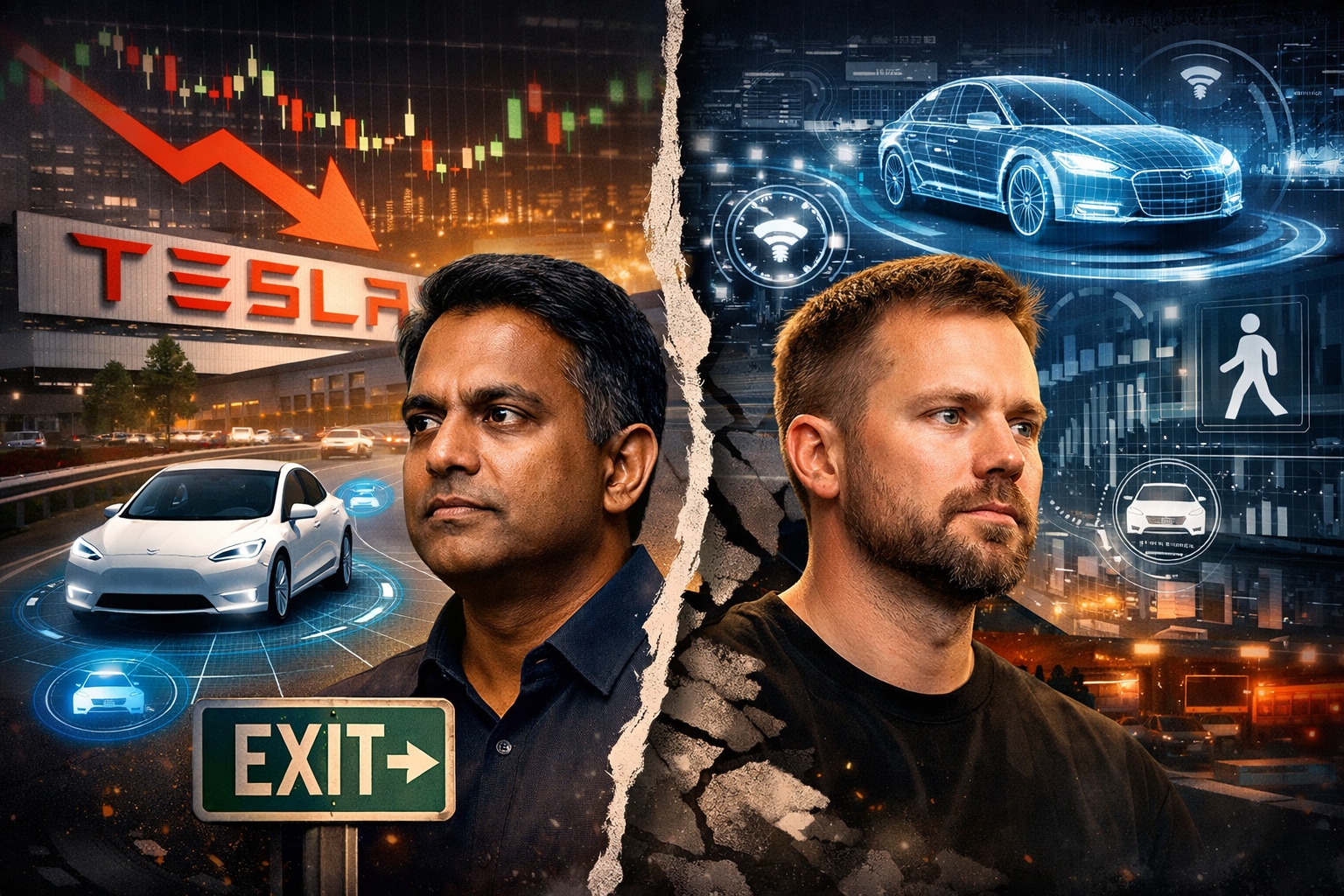
On March 8, 2026, the electric vehicle and clean energy landscape received two pieces of news that, on the surface, seemed like standard corporate updates. Sendil Palani, the Vice President of Finance who had been with Tesla since January 2009, announced his departure. Hours later, Thomas Dmytryk, an 11-year veteran who built the software backbone for the company's over-the-air (OTA) updates and the nascent robotaxi service, confirmed his exit via LinkedIn .
For the average observer, these are just names on a press release. But for the nearly 10 million Tesla owners globally, and specifically for the enthusiasts in the U.S. and Europe who form the core of the brand's identity, these departures resonate on a deeper frequency. Palani was the financial architect who helped Tesla survive the "production hell" of the Model 3 and the near-bankruptcy moments of the late 2010s. Dmytryk was the engineer who ensured your car feels brand new years after purchase, simply because of a Wi-Fi connection.
Section 1: The Architects of the Foundation
To understand the weight of these departures, one must first understand the magnitude of the work left behind.
Sendil Palani: The Financial Guardian
Sendil Palani's 17-year tenure at Tesla is almost a biography of the company itself. Joining in January 2009, Palani arrived when Tesla was a startup struggling to deliver the Roadster, long before it became the world's most valuable automaker. His roles spanned Engineering Finance, Manufacturing Finance, and Corporate Planning, eventually rising to VP of Finance .
Palani was not merely a number-cruncher; he was a strategic survivor. He played a pivotal role in Tesla's Series E and F fundraising rounds—those dark days when the company was burning cash and the public doubted its viability. He was instrumental in navigating the Department of Energy loan guarantees, a program that was politically contentious yet crucial for the company's early infrastructure. Most notably, he was on the team that executed Tesla's 2010 IPO, marking the first time a U.S. automaker had gone public since Ford in 1956 .
For European investors and owners, Palani's departure signals the exit of a figure who understood the delicate balance of spending on expansion while keeping the balance sheet solvent. His exit comes at a time when Tesla is announcing record capital expenditures—over $20 billion planned for 2026 alone—focused on AI and manufacturing capacity . The question is whether the new financial leadership will have the same risk-calibration instincts that Palani developed during the company's near-death experiences.
Thomas Dmytryk: The Software Sorcerer
If Palani kept the lights on, Thomas Dmytryk made them smart. Announcing his departure after 11 years, Dmytryk was the director who led the team that built Tesla's over-the-air update infrastructure . Today, this infrastructure serves a fleet approaching 10 million vehicles. It is the reason a Tesla can improve its braking distance, gain entertainment features, or even recover from a faulty component without ever visiting a service center.
In the context of the European market, where consumer protection laws are stringent and service expectations are high, OTA capability is a massive competitive advantage. Dmytryk's team effectively turned cars into evolving devices, a concept that traditional German automakers are still struggling to replicate.
More critically for Tesla's future valuation, Dmytryk recently oversaw the software backend for the Austin robotaxi ride-hailing service . This is the nerve center for Tesla's bet on autonomy. His departure, coming just weeks before Cybercab volume production is scheduled to begin, raises legitimate questions about the robustness of the platform's foundation.
Section 2: The Broader Exodus and the "Succession" Narrative
Palani and Dmytryk are not isolated incidents. They are the latest data points in a trend that has seen the departure of a "who's who" of Tesla's engineering and operational leadership.
The 2025-2026 Departure Timeline
To visualize the scale, consider the following verified exits:
-
Raj Jegannathan: The 13-year veteran VP of IT and Sales, who also oversaw the largest AI cluster, left in February 2026 .
-
Victor Nechita: The program manager for the Cybercab left in late February 2026, days after the first production unit rolled off the line at Giga Texas .
-
David Lau: The long-time head of software, departed in 2025.
-
Drew Baglino: The 18-year powertrain veteran, left in April 2024 .
-
Omid Afshar: VP of North American and European production operations.
-
Jenna Perua: North American HR lead.
-
Milan Kovac: AI strategy lead.
The Musk Defense and Organizational Structure
When confronted with the accelerating departures, Elon Musk's public response has been characteristically terse. On his social media platform, he remarked regarding the xAI and Tesla exodus, "很少出现令人感到后悔的人员离职," which translates to "Rarely are there departures of people that make me regretful" .
This statement, while seemingly dismissive, hints at a structural reality at Tesla. Unlike traditional hierarchical automakers, Tesla operates with a flat, matrixed organization. The theory is that the mission is bigger than any individual. For every senior leader who leaves, there are multiple directors and senior managers who have been trained in the "Tesla way" and are ready to step up.
However, the risk highlighted by analysts is the loss of "institutional memory." As Wolfe Research analyst Emmanuel Rosner notes, the robotaxi business is projected to lose roughly $500 million in 2026 before reaching breakeven in 2027 . Losing the architects of that system right as it tries to scale introduces "execution risk."
Section 3: The Market Context—Why This Feels Different (U.S. & Europe Focus)
Leadership changes at a growth company are normal. Leadership changes at a company facing its most severe sales contraction in history are scrutinized.
The U.S. Sales Reality
In the United States, Tesla's largest market, the numbers are stark. According to data from Motor Intelligence, U.S. sales fell by 11.8% in February 2026 to 38,500 units. This marks the fifth consecutive monthly year-over-year decline . Looking back at January, U.S. registrations were down about 17%, following a 10% decline in 2025 .
The reasons are multi-faceted. The loss of federal tax credits for some models has shifted the total cost of ownership equation. Furthermore, the lineup is aging. The Model Y, while still the best-selling EV globally, is facing fresher, often lower-priced competition from domestic rivals like Ford and GM, as well as established luxury players entering the EV space.
The European Collapse
The situation in Europe is arguably more alarming. Data from the European Automobile Manufacturers' Association (ACEA) for the first month of 2026 shows Tesla registrations down 13% year-over-year. This follows a brutal 2025 where full-year registrations tumbled nearly 50% from 2024 levels .
Europe presents a unique challenge for Tesla. It is a market traditionally loyal to domestic premium brands like BMW, Mercedes, and Audi, all of which have now launched credible EV lineups. Furthermore, European buyers are increasingly price-sensitive and value-oriented. The "halo" effect of the brand seems to be dimming as the novelty wears off and practical concerns about service and build quality take precedence.
The AI Investment Trade-Off
This sales slump provides the critical backdrop for the executive departures. Tesla is essentially asking investors to look past deteriorating auto fundamentals and focus on a future of AI, robotaxis, and the Optimus robot. This requires a different kind of leadership.
Palani and Dmytryk were experts in the "old" Tesla—the one that fought to build cars profitably and then made them smarter. The "new" Tesla requires leaders who understand silicon design, neural network training at scale, and the regulatory labyrinth of deploying unsupervised L4 autonomy. It is plausible, as some analysts suggest, that these departures are not a sign of dysfunction, but a natural churn as the skill sets required for the next phase differ from those that built the foundation .
Section 4: The Succession Bench and What Investors Are Watching
So, who is left to steer the ship? While Tesla has not announced direct replacements for Palani and Dmytryk in a public manner, the existing leadership team remains formidable:
-
Lars Moravy: VP of Vehicle Engineering. He remains the steady hand on hardware, overseeing the Cybertruck ramp and the next-generation platform.
-
Ashok Elluswamy: Director of AI. He leads the software team responsible for the FSD code that runs on the AI4 and future AI5/AI6 hardware.
-
Rebecca Tinucci: Senior Director of Charging Infrastructure. She is leading the charge on the Supercharger network expansion and the NACS standardization effort.
The Prediction Market Verdict
Wall Street and prediction markets are currently voting with skepticism. On Polymarket, bettors are giving a 78% chance that Tesla delivers fewer than 350,000 vehicles in Q1 2026, a significant drop from the 418,000 shipped in Q4 2025 . Furthermore, a contract on launching robotaxis in California by June 30, 2026, trades at just 16% .
This suggests that the market doubts whether the new leadership—or the remaining leadership—can execute on the aggressive timelines Musk has set. The loss of Dmytryk, specifically, hits the robotaxi narrative hard because he built the digital infrastructure for it.
Conclusion: Evolution, Not Revolution
The departure of Sendil Palani and Thomas Dmytryk is undoubtedly significant. It marks the end of an era for the "old guard" that built Tesla into a manufacturing and software powerhouse. However, framing this purely as a "brain drain" ignores the strategic pivot underway.
Tesla is attempting one of the most difficult maneuvers in corporate history: transitioning from a high-growth automotive manufacturer to an AI-platform company while simultaneously facing declining sales in its core markets (U.S. and Europe) and intense competition.
For the Tesla owner in Munich or San Francisco, the impact is not immediate. Your car will still receive updates. The Supercharger network will still work. But the medium-term question—whether the Cybercab becomes a reality, whether the Optimus robot enters the workforce—depends on whether the next generation of leaders can execute with the same intensity as the founders.
The "Strategic Shift" thesis holds weight. Tesla is swapping out leaders who optimized for scale for leaders who must optimize for intelligence. Whether this is a "Natural Cycle" or the beginning of a decline will be determined not by the exits themselves, but by the product launches that follow.
FAQ
Q: Are Sendil Palani and Thomas Dmytryk leaving because of the recent sales slump in the U.S. and Europe?
A: There is no official evidence linking their departures to the sales figures. Based on their departure announcements and company statements, the exits appear to be personal career decisions. However, the timing puts pressure on the remaining leadership to address the sales decline without the guidance of these long-tenured veterans .
Q: Who is now responsible for the robotaxi software backend?
A: Tesla has not officially named a successor to Thomas Dmytryk for the robotaxi software role. Given Tesla's flat structure, it is likely that senior directors within the AI and software divisions have absorbed his responsibilities. The company is expected to provide updates on organizational changes in future internal communications or regulatory filings .
Q: How does the loss of a finance VP affect my vehicle ownership experience?
A: In the short term, it does not. However, the finance team is responsible for capital allocation—deciding where to invest billions of dollars. Palani's departure could signal a shift in financial strategy, potentially impacting future investment in service center expansion, parts availability, or Supercharger network density, all of which indirectly affect the ownership experience.
Q: Has Tesla commented on the "brain drain" narrative?
A: Elon Musk has indirectly addressed similar concerns regarding departures at xAI and Tesla by stating that he rarely regrets people leaving, implying that those who remain are fully aligned with the mission. The company has not issued a formal press release specifically addressing the Palani and Dmytryk exits beyond acknowledging them .
Q: With these departures, should I be worried about the value of my Full Self-Driving (FSD) package?
A: The FSD package's value is tied to the performance of the neural networks, not a single executive. The remaining AI team, led by Ashok Elluswamy, is world-class. However, the loss of Dmytryk, who built the OTA pipeline that delivers those updates, could introduce friction in how quickly or smoothly future complex updates are rolled out .