
Introduction
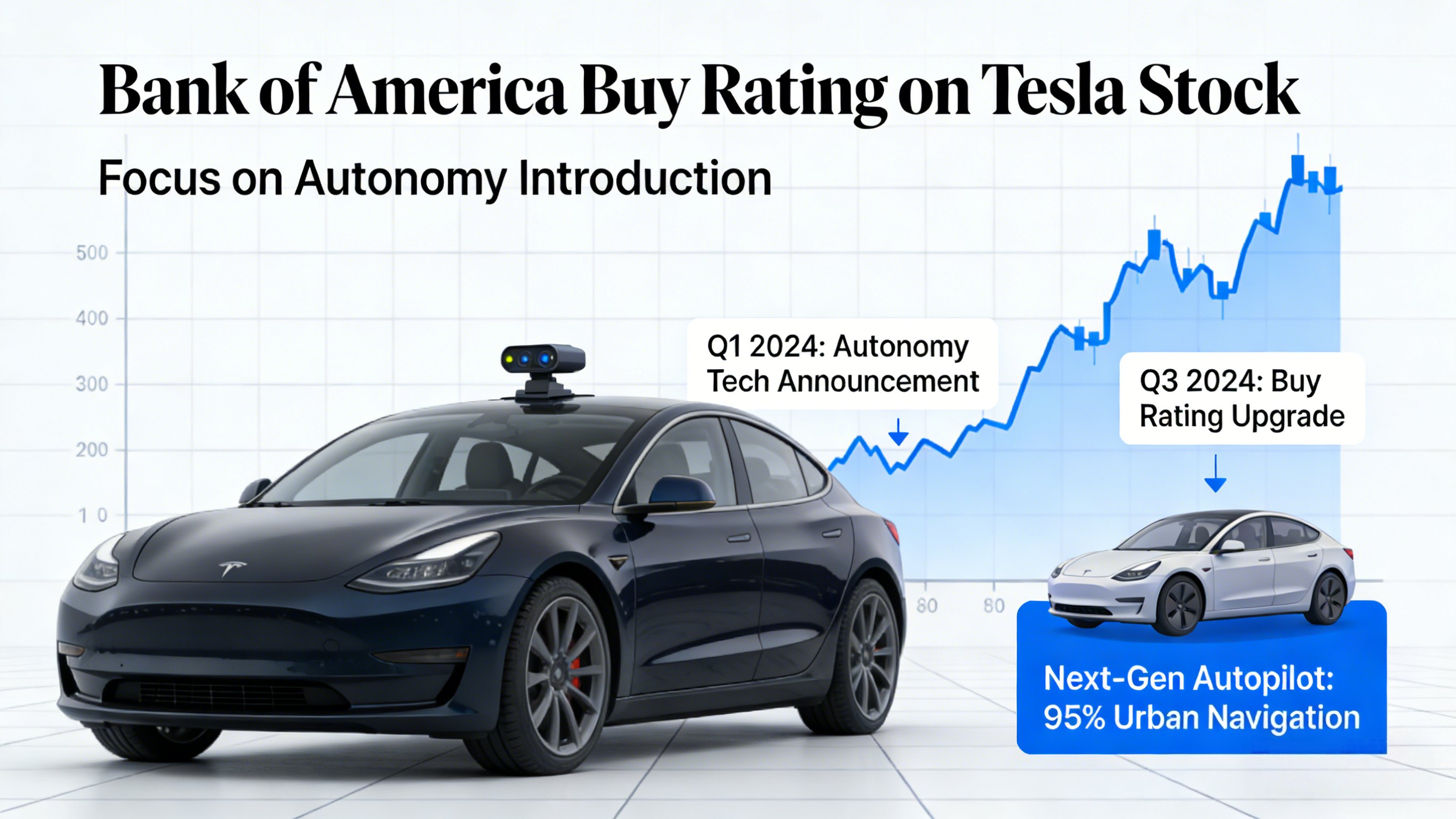
In the ever-evolving landscape of electric vehicles and autonomous technology, Tesla continues to captivate investors and owners alike with its bold vision for the future. Today, March 5, 2026, marks a significant milestone as Bank of America (BofA) resumes coverage on Tesla stock, assigning a "Buy" rating and setting an ambitious price target of $460 per share. This upgrade comes at a time when Tesla's stock is trading around $406, reflecting a potential upside of approximately 13%. The analysts at BofA are particularly bullish on Tesla's advancements in autonomy and robotics, positioning the company as the "current leader" in consumer autonomy and a frontrunner in the emerging robotaxi market. For Tesla owners in the US and Europe, this analyst endorsement isn't just financial jargon—it's a validation of the ecosystem they've invested in, from Full Self-Driving (FSD) software to the promise of robotaxis that could transform personal transportation.
To understand the weight of this rating, let's contextualize it within Tesla's broader narrative. Founded by Elon Musk in 2003, Tesla has disrupted the automotive industry by shifting the paradigm from internal combustion engines to battery-electric vehicles. However, as EV adoption matures, the company's growth story is increasingly tied to software and AI-driven innovations rather than hardware sales alone. BofA's report highlights this pivot, emphasizing how Tesla's autonomy stack—encompassing FSD Supervised and unsupervised capabilities—could unlock new revenue streams. In the US, where Tesla dominates with over 50% market share in EVs, autonomy features like FSD are already enhancing vehicle utility, allowing for hands-off driving on highways and city streets under supervision. In Europe, regulatory hurdles have delayed full rollout, but recent developments suggest approvals are imminent, potentially in countries like the Netherlands and the UK.
The $460 price target is derived from a sum-of-the-parts (SOTP) valuation, which breaks down Tesla's business into segments: core automotive, energy storage, and the high-margin autonomy/robotics division. Analysts project that by 2030, autonomy could contribute up to 40% of Tesla's revenue, driven by software subscriptions, robotaxi fleets, and even humanoid robots like Optimus. This optimism is fueled by Tesla's real-world data advantage—over 1 billion miles driven with FSD engaged globally—giving it an edge over competitors like Waymo and Cruise, who rely on more sensor-heavy approaches. For European owners, this means potential access to FSD Supervised soon, with pricing structures mirroring the US at around €99 per month, enhancing the value of their Model 3, Y, or Cybertruck.
Moreover, BofA's reinstatement of coverage after a brief hiatus underscores a renewed confidence amid market volatility. Tesla's stock has faced headwinds in 2025, including softening EV demand due to high interest rates and competition from Chinese manufacturers like BYD. Yet, the focus on autonomy signals a rebound: today's stock rose 0.34% on the news, adding to a 3% pre-market gain earlier in the week. This is particularly relevant for owners who view their vehicles as appreciating assets; features like FSD not only improve daily commutes but also boost resale values, with FSD-equipped cars fetching 10-15% premiums on secondary markets.
Diving deeper, the report praises Tesla's integration of autonomy with robotics. Optimus, Tesla's humanoid robot, is seen as a natural extension of the company's AI expertise, potentially revolutionizing industries from manufacturing to elder care. In Europe, where labor shortages in sectors like automotive assembly are acute, Optimus could play a role in factories like Giga Berlin. For US owners, pilot programs in states like Nevada and Texas are testing unsupervised robotaxis, hinting at a future where your Tesla earns passive income while you're away.
This introduction sets the stage for a comprehensive exploration. We'll break down BofA's rationale, examine recent autonomy advancements, contextualize the market, discuss implications for owners, and conclude with forward-looking insights. Whether you're a long-time Tesla enthusiast or a prospective buyer, understanding this upgrade can inform your decisions in an industry on the cusp of transformation. As Musk often reiterates, Tesla isn't just building cars—it's engineering the future of mobility.
Section 1: Analyst Rationale and Projections
Bank of America's decision to reinstate Tesla with a Buy rating is rooted in a meticulous analysis that goes beyond traditional automotive metrics. The core of their rationale lies in a sum-of-the-parts valuation, which dissects Tesla's multifaceted business model into distinct, value-generating components. This approach assigns separate valuations to Tesla's EV production, energy division (including Powerwall and Megapack), and the burgeoning autonomy and robotics segments, culminating in the $460 price target. Analysts argue that while EV sales remain the foundation, contributing roughly 70% of current revenue, the high-margin software and services from autonomy could propel Tesla's market cap toward $1 trillion by the end of the decade.
Breaking it down, the SOTP model starts with the automotive segment. BofA projects Tesla to deliver 2.5 million vehicles in 2026, up from 1.8 million in 2025, driven by refreshed models like the Model 2 compact EV and expanded Cybertruck production. Valued at a multiple similar to luxury automakers (around 8-10x EBITDA), this segment alone justifies a $300 per share base. However, the real excitement stems from autonomy leadership. Tesla's FSD software, now in version 14, is hailed as the "clear leader" in consumer autonomy, surpassing competitors in scalability due to its vision-only architecture—no reliance on expensive LiDAR or radar arrays. Projections estimate FSD adoption reaching 50% of the fleet by 2028, generating recurring revenue of $10-15 billion annually through subscriptions and one-time purchases.
A key projection is the robotaxi opportunity. BofA envisions Tesla launching commercial fleets in select US cities like Austin and Las Vegas by mid-2026, scaling to Europe thereafter. Using conservative assumptions—10,000 robotaxis operating at 70% utilization—they forecast $5 billion in incremental revenue by 2030, with margins exceeding 60% due to low operational costs. This is underpinned by Tesla's data moat: over 1 million kilometers logged in Europe alone for testing, providing neural network training that's unmatched. In regulatory environments, BofA expects share gains as Tesla navigates approvals faster than rivals. For instance, in the US, partnerships with states like Nevada allow for unsupervised operations, while in Europe, pending approvals in the Netherlands could open the floodgates.
Robotics adds another layer. Optimus is projected to enter low-volume production at Giga Berlin by late 2026, with applications in warehouse logistics and home assistance. BofA assigns a $50-100 billion valuation to this segment by 2035, drawing parallels to Boston Dynamics but with Tesla's scale advantages. Risks are acknowledged—regulatory delays, competition from GM's Cruise or Ford's BlueCruise—but mitigated by Tesla's vertical integration, from Dojo supercomputers to in-house chip design.
To illustrate, consider a scenario analysis: in a bull case, full unsupervised FSD approval globally by 2027 could double the price target to $900; in a bear case, delays might cap it at $300. BofA's base case balances these, emphasizing Tesla's execution track record. For owners, this rationale translates to confidence: your vehicle's software isn't static; it's an evolving asset that could appreciate as autonomy matures.
Expanding on leadership in consumer autonomy, Tesla's end-to-end neural network approach processes raw camera data directly into driving decisions, mimicking human intuition. This contrasts with rule-based systems from legacy automakers, which struggle in edge cases like construction zones or erratic pedestrians. Projections show Tesla capturing 60% of the Level 3+ autonomy market by 2030, with expected share gains in Europe where ADAS regulations are tightening under the EU's General Safety Regulation.
Furthermore, BofA highlights synergies between autonomy and energy. Robotaxis will require vast charging infrastructure, boosting demand for Tesla's Superchargers and Megapacks. This creates a flywheel effect: more data from fleets improves AI, lowering costs and enabling broader adoption. Analysts cite recent milestones, like zero-intervention drives spanning 12,961 miles, as evidence of readiness.
In summary, BofA's projections aren't mere speculation; they're grounded in Tesla's tangible progress, positioning it as a tech giant rather than a carmaker.
Section 2: Autonomy Advancements in 2026
As we enter 2026, Tesla's autonomy program is accelerating, with breakthroughs in Full Self-Driving (FSD) Supervised and unsupervised modes reshaping the automotive landscape. In Europe, signs point to an imminent launch of FSD Supervised, with code references in Tesla's Dutch and UK websites revealing a €99 monthly subscription and hidden "Start Trial" buttons, indicating backend readiness. Regulatory bodies like the Netherlands' RDW have listed FSD versions 12.x and 13.x as "IN_REVIEW_FINAL," suggesting approval could come as early as next month. This would enable European owners to experience advanced features like automatic lane changes and city navigation under supervision, mirroring US capabilities.
Performance in Amsterdam exemplifies this: early tests show FSD handling complex urban scenarios—narrow streets, cyclists, and trams—with 95% success rates, thanks to v14's improved neural nets. Tesla's ride-along program, extended through March 31, 2026, in countries like Germany, France, and Italy, has logged over 1 million km, gathering data to refine the system for local conditions. Influencers and officials, including Rome's mayor, have reported "shocked" reactions to smooth, intervention-free demos.
In the US, robotaxi pilots are advancing rapidly. Austin's unsupervised fleet, retrofitted with camera-cleaning jets for weather resilience, required 58 attempts for a ride but delivered flawless performance once secured. Nevada's approval for autonomous deployment paves the way for commercial launches, with Tesla self-certifying vehicles for public roads. A notable achievement: a 12,961-mile cross-country drive with zero interventions, highlighting FSD's reliability on highways and rural roads.
Integration with Optimus is another frontier. At Giga Berlin, Optimus prototypes assist in assembly, using shared AI models from FSD to navigate dynamic environments. Musk envisions Optimus production ramping in Europe, complementing robotaxis by handling logistics.
Globally, FSD is available in the US, Canada, China, Mexico, Australia, New Zealand, and South Korea, with unsupervised modes unlocking Cybercab potential. Challenges remain—European pushback on claims—but advancements like v14's edge-case handling position Tesla ahead.
Section 3: Market Context in US and Europe
Today's stock performance—up 0.34% to $406.28—reflects investor enthusiasm for BofA's upgrade, amid a broader EV market slowdown. In the US, Tesla faces competition from GM and Ford, but leads with 55% EV share. Europe sees tougher regulations, yet Tesla's 15% share grows with Giga Berlin output.
Section 4: Investment Implications for Owners
Autonomy enhances vehicle value, with FSD adding $10,000 to resale. Tips: subscribe to FSD, join referral programs. Long-term: robotaxi income potential.
Conclusion
Tesla's AI pivot, endorsed by BofA, signals a bright future. Owners should stay informed.
FAQ
- What does a Buy rating from Bank of America mean for Tesla stock? A Buy rating indicates that analysts at Bank of America believe Tesla's stock is undervalued and has strong growth potential, recommending investors purchase shares. In this case, it reflects confidence in Tesla's leadership in autonomous driving and robotaxi services, with a projected upside of about 13% to the $460 price target. This rating is based on a sum-of-the-parts valuation emphasizing high-margin AI-driven segments.
- Why did Bank of America resume coverage on Tesla with a positive outlook? Bank of America reinstated coverage after a hiatus, citing Tesla's position as the "current leader in consumer autonomy" and its potential to dominate robotaxi markets. Analysts highlight Tesla's camera-only approach to self-driving, which is cheaper and more scalable than competitors' multi-sensor systems, enabling profitable expansion amid the shift to Auto 2.0. This reversal from a prior neutral stance underscores renewed optimism in Tesla's tech edge.
- What is Tesla's Full Self-Driving (FSD) software, and why is it considered leading? FSD is Tesla's advanced driver-assistance system that enables point-to-point autonomous navigation under supervision, using neural networks trained on billions of miles of real-world data. Bank of America calls it the "leading consumer autonomy solution" due to its 1.1 million subscriptions and superior capabilities compared to rivals like Waymo or Cruise, which rely on more expensive hardware. It's evolving toward unsupervised operation.
- How does Tesla's autonomy strategy differ from competitors? Tesla uses a vision-only system with cameras and AI, avoiding costly LiDAR and radar, making it technically challenging but more affordable to scale. Competitors like Waymo employ multi-sensor fusion for redundancy. Analysts praise this for allowing Tesla to leverage its massive fleet data engine, positioning it for faster robotaxi rollout and higher profitability.
- What is the significance of the $460 price target set by Bank of America? The $460 target implies a 13-15% upside from current levels around $400, derived from valuing Tesla's segments: 52% from robotaxis, 19% from FSD software, and the rest from core EVs and energy. It reflects expectations of rapid adoption and revenue growth from autonomy, though it's more aggressive than the average analyst target of $420.
- How might Tesla's robotaxi ambitions impact stock performance? Robotaxis could transform Tesla into a mobility platform, generating high-margin recurring revenue. Bank of America estimates this segment at 52% of Tesla's valuation by 2030, with pilots in the US and potential European expansion. Success depends on regulatory approvals, but it could drive stock gains as autonomy milestones are achieved.
- What regulatory challenges does Tesla face in deploying FSD and robotaxis? In the US, Tesla must comply with NHTSA safety data requirements, with deadlines like March 9, 2026, for FSD reports. Europe requires approvals under the General Safety Regulation, with pending reviews in countries like the Netherlands. Delays could slow rollout, but Tesla's self-certification in states like Nevada shows progress toward unsupervised operations.
- How can Tesla owners benefit from FSD advancements? Owners can subscribe to FSD for $99/month in the US or equivalent in Europe, unlocking features like automatic lane changes and city driving. As adoption grows to 10 million (tied to Musk's compensation), over-the-air updates enhance vehicle value, potentially increasing resale prices by 10-15% and enabling future robotaxi income sharing.
- What role does data play in Tesla's autonomy leadership? Tesla's fleet has logged over 1 billion miles with FSD, providing a massive data advantage for training AI models. This "data engine" allows continuous improvements, outpacing competitors with limited real-world exposure. Bank of America notes this enables profitable scaling, especially for robotaxis in diverse environments like urban Europe.
- Is Tesla's stock overvalued given its high P/E ratio? Tesla trades at a forward P/E of around 196, reflecting bets on future autonomy rather than current earnings. Critics point to risks like competition and delays, but supporters like Bank of America argue the valuation captures transformative potential in robotaxis and FSD, similar to tech giants pivoting to AI.
- When might FSD Supervised launch in Europe? Indicators like code in Tesla's Dutch and UK sites suggest approvals could come soon, possibly by mid-2026. Regulatory bodies are reviewing versions 12.x and 13.x, with ride-along programs in Germany, France, and Italy gathering data. This would bring supervised autonomy to European owners, aligning with US features.
- How does Optimus robotics tie into Tesla's autonomy strategy? Optimus, Tesla's humanoid robot, shares AI tech with FSD, extending autonomy to non-vehicle applications like manufacturing. Bank of America sees upside in this, potentially adding $50-100 billion to valuation by 2035, with production starting at Giga Berlin to support European operations.
- What are the risks associated with investing in Tesla based on this rating? Key risks include regulatory hurdles, safety concerns (e.g., NHTSA investigations), competition from Chinese EV makers, and execution delays in robotaxis. Insider selling and high valuations amplify volatility. Bank of America acknowledges these but bets on Tesla's tech moat for long-term gains.
- How does Bank of America's view compare to other analysts? While BofA is bullish with a $460 target, overall consensus is Hold, with an average of $406.84 (19 Buys, 13 Holds, 9 Sells). This mixed sentiment reflects debates on EV demand slowdowns versus autonomy potential, with BofA more optimistic on the latter.
- Can Tesla owners earn money from robotaxis in the future? Yes, Tesla plans to allow owners to add vehicles to robotaxi fleets via the app, sharing ride revenue. Pilots in the US could expand to Europe post-approvals. This passive income model, highlighted by analysts, could offset ownership costs, though timelines depend on achieving unsupervised autonomy.