
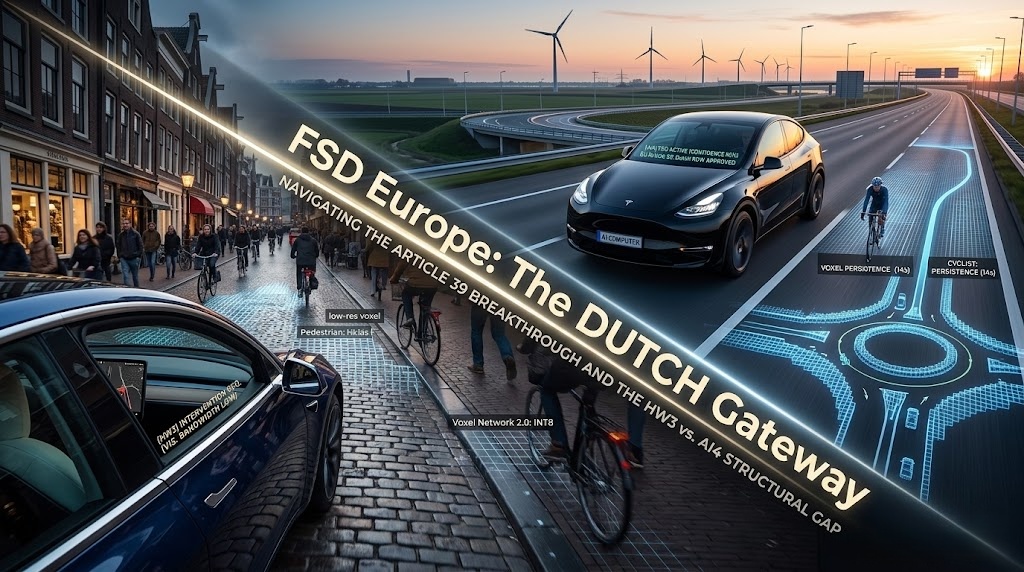
1. Introduction: Breaking the European Deadlock
For nearly a decade, the European Tesla experience has been one of "feature disparity." While owners in North America navigated complex city streets using the iterative leaps of Full Self-Driving (FSD), their counterparts in London, Berlin, and Amsterdam were restricted to a "sanitized" version of Autopilot—hampered by rigid UNECE regulations that limited steering torque and lane-change logic.
That era officially ended on March 17, 2026. Following months of intense technical demonstrations and a high-profile "Ride Along" program across nine Dutch cities, the RDW (Rijksdienst voor het Wegverkeer), the Netherlands Vehicle Authority, has signaled the final green light for FSD (Supervised). This is not just a software update; it is a geopolitical and regulatory masterstroke that uses the Netherlands as a "beachhead" to bypass the continental gridlock.
2. The Regulatory Masterstroke: Article 39 and the RDW Pathway
The primary barrier to FSD in Europe has always been UN Regulation No. 157 and its predecessors, which were written for simple lane-keeping systems, not end-to-end neural networks. Tesla’s breakthrough in 2026 did not come from waiting for the UN to rewrite its rulebook, but from a clever application of EU Article 39.
2.1 The National Exemption Strategy
Under Article 39 of EU Type-Approval regulations, an individual member state has the authority to grant "National Small Series" or "Innovative Technology" exemptions. By partnering with the RDW—long considered Europe’s most technically progressive regulator—Tesla secured a National Type Approval.
-
Mutual Recognition: Under EU law, once one member state (the Netherlands) approves a technology as safe, other member states can choose to "recognize" that approval through a fast-track process.
-
The Domino Effect: Already, authorities in Belgium and Ireland (which signed its own FSD framework on March 2, 2026) have signaled they will honor the RDW’s findings. This creates a "Coalition of the Willing" that effectively circumvents the slower, more conservative UNECE process.
2.2 The "Cognitive Unit" Validation
The RDW didn't just take Tesla's word for it. In early 2026, Tesla and RDW engineers developed a new validation protocol. Instead of checking if a specific line of code prevents a steering error, they treated the FSD v13 neural net as a "Cognitive Unit." They ran the system through millions of simulated scenarios—and thousands of real-world kilometers in Amsterdam and Rotterdam—to prove that its outputs consistently met or exceeded human safety benchmarks.
3. Technical Adaptation: Teaching AI the "European Way"
The FSD v13 rolling out in Europe via firmware 2026.8 is not a carbon copy of the US version. It has been specifically "Europeanized" through a specialized neural training branch.
3.1 The "Dutch Reach" and Cyclist Persistence
In cities like Amsterdam, cyclists are the primary "edge case." V13 features a dedicated Cyclist Persistence Module.
-
The 15-Second Buffer: Using the new Temporal Transformer architecture, the car "remembers" a cyclist who has disappeared into a blind spot or behind a parked delivery van.
-
Proactive Nudging: Unlike the US version, which might wait for a wide gap, the European FSD has been trained to "nudge" and communicate intent in dense traffic, mimicking the assertive yet safe driving style required in Paris or Rome.
3.2 Roundabout Mastery 2.0
While US FSD has struggled with complex multi-lane roundabouts, the European build was trained on the notorious "Magic Roundabouts" of the UK and the high-speed rotaries of France. The system now utilizes Voxel-based Occupancy Network 3.0 to identify not just vehicles, but the subtle lean of a motorcycle or the hand signals of a traffic officer, which are critical in European urban centers.
4. The Hardware Divergence: HW3 vs. AI4 in the EU
As the March 20th rollout approaches, a structural divide is appearing in the European fleet.
4.1 AI4 (Hardware 4) Superiority
Vehicles with AI4 (Model 3 Highland and Model Y Juniper) are seeing the most significant gains. With 5-megapixel cameras and native FP16 processing, these cars can resolve the smaller, more varied road signs found in Europe at much greater distances.
-
MBI (Miles Between Intervention): Initial Dutch fleet data shows AI4 vehicles achieving 400+ miles between disengagements on the A1/A2 motorways.
4.2 The HW3 "Quantization" Challenge
Owners of legacy HW3 vehicles (2019-2023) will still receive FSD (Supervised), but the model is "quantized" (compressed) to fit the older processor's memory bandwidth. This results in a slightly more "hesitant" driving style in complex rain or fog conditions common in Northern Europe. For the first time, European bloggers are discussing the potential for a "Hardware 5" retrofit or trade-in incentives as the software begins to outpace the silicon.
5. The Economic and Social Impact
The launch of FSD in the Netherlands is the first step toward the Tesla Cybercab arriving on the continent. By proving the software in the "Supervised" category first, Tesla is building the actuarial data needed to demand "Unsupervised" Level 4 approval by 2027.
-
Insurance Reductions: In the US, FSD usage has correlated with lower insurance premiums. European insurers are now watching the Dutch data closely to see if they can offer similar "AI-Safety" discounts to Tesla owners.
-
Resale Value: For the European used car market, a Tesla with "Full Self-Driving Capability" just became significantly more valuable, shifting from a speculative feature to a functional reality.
6. Conclusion: The Roadmap for the Rest of 2026
The Netherlands was the beachhead; the rest of the continent is the objective. Based on current regulatory movements:
-
Germany (KBA): Review is in progress, with approval expected by late April 2026.
-
United Kingdom: The new "Automated Vehicles Act" and progress in the Netherlands are expected to push UK approval to Q3 2026.
-
Nordics (Norway/Sweden): Likely to follow the Dutch lead by May 2026.
The launch of FSD (Supervised) in Europe is the most significant milestone for Tesla since the original Model S type-approval in 2013. It proves that Tesla isn't just a car company or an AI company—it is a regulatory pioneer capable of rewriting the rules of global mobility.
FAQ: European FSD Launch Essentials
Q: If I am in Germany, can I download FSD v13 today?
-
A: No. While the Dutch rollout begins March 20, German owners must wait for the KBA to recognize the RDW approval. This is expected within the next 4–6 weeks.
Q: Does European FSD allow "Hands-Off" driving?
-
A: No. Under the current "Supervised" framework, the driver must maintain attention. However, the system is much less "naggy" than the old Autopilot, utilizing the cabin camera for driver monitoring instead of requiring constant steering wheel torque.
Q: Will FSD work on narrow, cobblestone streets?
-
A: V13 is remarkably capable on unstructured roads, but Tesla recommends extreme caution in historical "Old Town" centers where road rules are often ambiguous.