
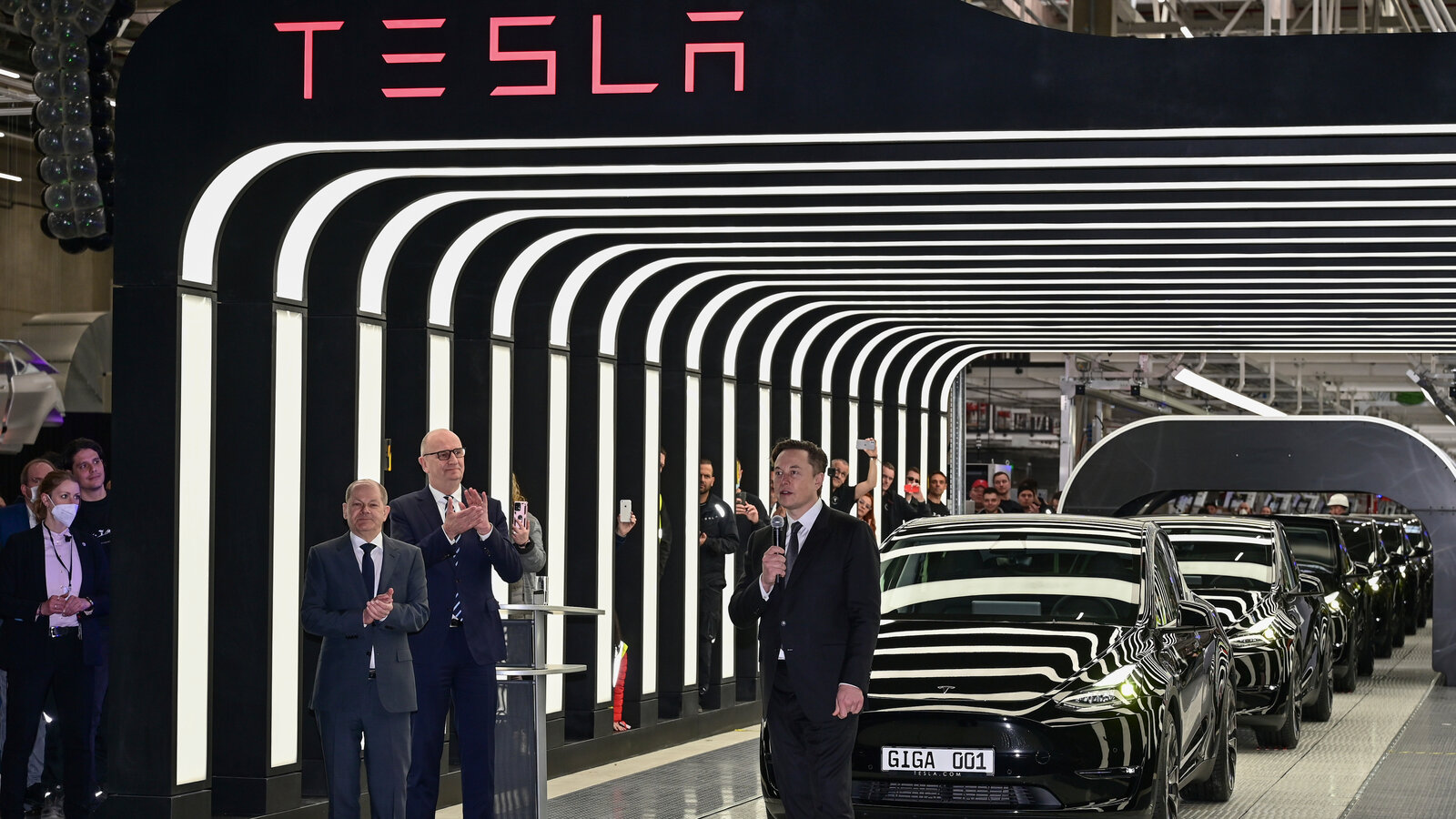
In the quiet pine forests of Grünheide, just outside Berlin, stands a structure that is as much a statement as it is a factory. The stark, colossal, and relentlessly modern architecture of Gigafactory Berlin-Brandenburg rises from the German soil like a Silicon Valley spaceship that has landed in the sacred heartland of the global automobile industry. This is the historic turf of Mercedes-Benz, BMW, and Volkswagen—titans of engineering whose brand names are synonymous with the very concept of "Made in Germany." For a century, this seal has represented the pinnacle of automotive quality, precision, and prestige. Tesla's Gigafactory is here not just to challenge that legacy, but to shatter its foundations.
This facility is not merely a regional outpost for assembling American cars for a European market. It is a beachhead. It represents a direct and audacious assault on the very principles of how Europe builds cars. Tesla is not competing with a better luxury brand or a more iconic design; it is waging a war with a better process. The core thesis of this article is that Gigafactory Berlin's true impact cannot be measured in its weekly production volume alone. Its significance lies in the seismic shockwaves it sends through the boardrooms, R&D labs, and assembly lines of every legacy automaker on the continent. It is forcing a century-old industry to confront its own deeply rooted manufacturing inefficiencies, re-evaluate its dangerously fragile global supply chains, and fight a desperate new war for the brightest minds in engineering.
This is the story of a modern industrial blitz. We will explore the key fronts on which this battle is being fought. We will dissect the revolution in manufacturing methods, from colossal Giga Presses to structural batteries, that are making traditional car plants look like museums. We will analyze the strategic compression of the supply chain into a resilient, vertically integrated campus. We will investigate the escalating war for talent, which is pulling the center of German automotive engineering gravity toward Berlin. We will examine how Tesla is weaponizing sustainability as a competitive advantage. And finally, we will look at the frantic, high-stakes response from the established giants as they awaken to the existential threat building in their own backyard.
Chapter 1: The "Machine that Builds the Machine": A New Manufacturing Paradigm
The traditional automotive assembly line, a concept perfected over a century, is a marvel of linear logic. A bare metal frame enters at one end, and through thousands of sequential steps—welding, bonding, painting, and the installation of countless components—a finished car emerges at the other. Gigafactory Berlin operates on a different philosophy, one derived from first-principles thinking: the factory itself is the primary product. The mission is not to optimize the existing line, but to reinvent it. Elon Musk calls it "the machine that builds the machine," and in Berlin, we see its most advanced iteration yet.
The most visually and conceptually stunning innovations are the IDRA Giga Presses. These are city-block-sized die-casting machines, the largest in the world, that exert over 6,000 tons of clamping pressure to form the entire front and rear underbody structures of the Model Y from a single piece of molten aluminum alloy. In a traditional car factory, these complex structures are painstakingly assembled from 70 to 100 different stamped metal parts, requiring a small army of hundreds of robots to weld, rivet, and bond them together in a precise but time-consuming ballet. The Giga Press replaces this entire sub-assembly line in a single, 90-second cycle.
The cascading benefits of this single innovation are staggering. The part count plummets, which means fewer suppliers to manage, less inventory to hold, and a dramatically smaller factory footprint. The elimination of hundreds of robots saves capital and reduces complexity and maintenance points. The resulting single-piece casting is lighter than its multi-part predecessor, yet significantly stiffer. This increased torsional rigidity improves crash safety and provides a more solid foundation for the suspension, directly enhancing the vehicle's handling and ride quality. It is a masterstroke of manufacturing elegance, simplifying the process while simultaneously creating a superior product.
This philosophy of radical simplification extends to the very foundation of the car. The next revolutionary step on the Berlin assembly line is the integration of the structural battery pack. Traditionally, automakers build a complete, empty car body and then, late in the assembly process, install large, pre-assembled battery modules into it. Tesla has re-engineered this entire concept. At Giga Berlin, the 4680 battery cells (named for their 46mm diameter and 80mm height) are filled and sealed into a pack casing that is designed from the outset to serve as the structural floor of the vehicle. This pack then acts as a connecting bridge between the front and rear Giga Castings. The seats and center console are mounted directly onto it before the upper body of the car is lowered and fixed into place.
Like the Giga Press, this delivers a cascade of advantages. It eliminates the redundant material and weight of separate battery modules and a traditional floor pan, further lightening the vehicle and reducing cost. It simplifies the general assembly line into fewer, larger steps. By placing the heavy mass of the battery as low as possible and making it an integral part of the chassis, it dramatically lowers the car's center of gravity and improves its structural integrity, again yielding benefits in both safety and handling.
These fundamental innovations are what enable Giga Berlin's astonishing production speed. While legacy automakers measure the time to build a car in 20 to 30 hours, Tesla's target is 10 hours. The factory's ramp-up has been a testament to this efficiency. After a contentious but ultimately successful launch, production has climbed relentlessly, recently achieving a run-rate equivalent to over 350,000 cars per year from its first assembly line. This isn't just producing cars faster; it's a new paradigm of manufacturing that legacy competitors are now scrambling to comprehend and, if they can, to copy.
Chapter 2: Squeezing the Supply Chain: Localization and Vertical Integration
For decades, the global auto industry has been run on the principle of "just-in-time" (JIT) manufacturing. It was a system that prized efficiency above all, relying on a complex and sprawling web of global suppliers to deliver parts to the assembly line at the precise moment they were needed. The recent polycrisis of a global pandemic, a crippling semiconductor shortage, and geopolitical conflicts has brutally exposed the Achilles' heel of this system: its extreme fragility. A single delayed container ship from Asia or a lockdown in one country could halt production lines thousands of miles away.
Gigafactory Berlin is engineered around a different principle: resilience through localization and vertical integration. It is not designed as a standalone plant but as the heart of a self-sufficient industrial campus. The goal is to shorten the supply chain from thousands of miles to a few hundred meters wherever possible.
The crown jewel of this strategy is the massive, co-located battery cell factory. This facility is slated to become one of the largest of its kind in Europe, producing the advanced 4680 cells that power the Berlin-made Model Ys. This is perhaps the most significant strategic move Tesla has made in Europe. The battery is the single most expensive and supply-constrained component of any electric vehicle. By manufacturing its own cells on-site, Tesla insulates itself from the brutal competition for battery contracts from Asian giants like CATL, LG, and Panasonic. It gains control over its own supply, its own technology roadmap, and its own cost structure.
The economic and environmental benefits are immense. It completely eliminates the enormous cost and carbon footprint associated with shipping millions of heavy battery cells from China or South Korea to Germany. It allows for a tighter feedback loop between cell design and vehicle engineering. And it shields the company from the geopolitical risks of relying on a supply chain that stretches across contentious international borders.
This philosophy extends beyond the battery. The very presence of Giga Berlin is forcing a geographical realignment of the entire European automotive supply chain. Major Tier 1 suppliers in areas like seating, plastics, and electronics are being strongly encouraged to build new facilities in the surrounding Brandenburg region to serve the factory. This is creating a new, vibrant automotive hub from the ground up, one that is built around the needs of EV manufacturing, not retrofitted from the age of internal combustion.
Furthermore, Tesla has always shown a greater willingness than its rivals to vertically integrate—to in-source the production of components that other automakers traditionally outsource. While a legacy automaker might see itself as an expert in engines and final assembly, relying on suppliers for seats, dashboards, and countless other subsystems, Tesla takes a different view. By producing its own seats, for example, it maintains absolute control over the design, materials, cost, and quality, and it never has to worry about a seat supplier halting its production line. This level of vertical integration is capital-intensive and complex, but it provides a degree of control and resilience that legacy automakers, with their deeply entrenched supplier relationships, find nearly impossible to replicate. The Giga Berlin campus is the physical manifestation of this strategy, designed to be a fortress of manufacturing, immune to the shocks of a volatile world.
Chapter 3: The War for Talent: Berlin's New Center of Gravity
For a century, the career path for an ambitious German automotive engineer was clear. You went to the technical universities in Stuttgart, Munich, or Aachen, and you aimed for a prestigious job at the R&D centers of Mercedes-Benz, Porsche, BMW, or Audi. These industrial heartlands were the undisputed centers of gravity for automotive talent, not just in Germany, but globally. Gigafactory Berlin has, in a few short years, created a powerful new force of attraction, a "magnetic north" that is pulling the industry's brightest minds in a new direction.
This is not just about offering competitive salaries. Tesla is winning a cultural war for talent. The company attracts a new generation of engineers who grew up with the internet, not the internal combustion engine. These are experts in software, AI, robotics, and material science who are drawn to Tesla's mission-driven narrative of accelerating the world's transition to sustainable energy. They want to work in a culture defined by Silicon Valley's speed, flat hierarchies, and a "fail fast, learn faster" mentality.
To many of these young engineers, the traditional German automakers, with their rigid hierarchies, slow decision-making processes, and siloed departmental structures, feel like relics of a past era. The prospect of working on a Giga Press that revolutionizes car manufacturing or developing the AI for the Optimus robot is infinitely more exciting than spending five years designing a slightly more efficient fuel injector.
The result has been a palpable "brain drain" effect. There is a well-documented trend of highly experienced and respected engineers and managers leaving senior positions at established German automakers to take on new challenges at Giga Berlin. Public LinkedIn profiles and industry reporting are filled with stories of veterans from VW, BMW, and Mercedes who have made the jump. They are motivated by a desire to escape the bureaucratic inertia that can stifle innovation at a large, legacy corporation. They seek the freedom to make quick decisions, the responsibility to own a project from start to finish, and the chance to work on technology that is years ahead of the competition.
This influx of talent is creating a powerful ecosystem effect. The arrival of thousands of highly skilled, international engineers and manufacturing experts in the once-quiet Brandenburg region is fostering a vibrant new tech community. It is a cross-pollination of ideas, bringing a Silicon Valley mindset into direct contact with Germany's legendary manufacturing prowess. This new ecosystem is not just a benefit to Tesla; it is transforming the region into a hotbed of innovation in e-mobility, battery technology, and advanced manufacturing, putting further pressure on the traditional automotive strongholds in the south of the country to keep pace. The war for the future of the automobile is a war for talent, and Giga Berlin is Tesla's most effective recruiting tool.
Chapter 4: Sustainability as a Competitive Weapon
In Europe, sustainability is not a marketing buzzword; it is a core social and political value that is increasingly embedded in consumer choice and government regulation. The conversation has matured beyond a simple focus on tailpipe emissions. A sophisticated and growing segment of the European market now scrutinizes the entire "lifecycle" carbon footprint of a product. How a car is made, and the sustainability of the supply chain that supports it, is becoming just as important as the fact that it runs on electricity. Tesla understands this deeply and has engineered Gigafactory Berlin to use sustainability as a sharp competitive weapon.
The factory itself has been designed with ambitious environmental targets. Its vast roof is being covered with solar panels, with the goal of generating a significant portion of its own electricity needs. The company has also committed to sourcing 100% of its remaining energy from renewable sources, a critical factor in a market where the carbon intensity of the electrical grid is a major concern.
One of the most contentious issues during the factory's approval process was its water usage. Located in a region with concerns about water scarcity, Tesla faced intense scrutiny from local environmental groups. In response, the company invested in a state-of-the-art water management system. Giga Berlin utilizes a closed-loop water recycling system and advanced techniques that allow it to use significantly less fresh water per vehicle produced than almost any other car factory in the world. By turning a potential public relations crisis into a showcase of environmental engineering, Tesla demonstrated its ability to meet and even exceed Europe's stringent standards.
However, the factory's greatest sustainability advantage lies in its localized, vertically integrated model. As discussed, the on-site battery cell production and the co-location of key suppliers in the Brandenburg area create a massive reduction in the "transportation carbon cost" embedded in each vehicle. A Model Y built in Berlin does not carry the hidden environmental debt of a battery shipped from China, a powertrain from Poland, and electronics from Taiwan. Its components travel a fraction of the distance compared to those of its rivals.
This allows Tesla to construct a powerful marketing narrative: a car "Made in Europe, for Europe, Sustainably." This story resonates powerfully with the target demographic for EVs, which is often highly educated and environmentally conscious. Beyond marketing, this strategy offers a crucial hedge against future regulation. The European Union is actively developing policies like the Carbon Border Adjustment Mechanism (CBAM), which will effectively tax imported goods based on their embedded carbon footprint. Competitors who continue to rely on long, carbon-intensive global supply chains could face significant financial penalties, while Tesla's localized model will be at a distinct advantage. In this context, Giga Berlin is not just a factory; it's a strategic asset for a new era of carbon-conscious global trade.
Chapter 5: The Awakening Giants: The Scramble to Respond
The initial reaction of Germany's automotive giants to Tesla's arrival was a predictable cocktail of public dismissal and private alarm. For years, executives had downplayed Tesla's build quality and scoffed at its production struggles, confident in their own century of manufacturing expertise. The speed with which Gigafactory Berlin was built and the radical innovations it contained served as a brutal wake-up call. The "Tesla Shock" rippled through the industry, forcing a painful realization: the upstart from California was no longer just a competitor in the EV market; it was now a direct threat to their core industrial identity. Dismissal has rapidly turned into a frantic race to imitate.
The response from the legacy automakers has been swift and substantial, representing the most significant strategic shift in the European industry in decades. The clearest example is Volkswagen's "Trinity" project. In a move that would have been unthinkable five years ago, VW's leadership announced a €2 billion investment in a completely new, state-of-the-art factory to be built near its historic headquarters in Wolfsburg. The project's explicit goal is to match Giga Berlin's manufacturing efficiency, with a target production time of just 10 hours per car. It is a direct admission that VW's existing plants cannot be easily retrofitted to compete and that a fresh start, based on Tesla's principles, is required.
Similarly, Mercedes-Benz has launched a comprehensive overhaul of its global manufacturing network. The company is investing billions to retool its historic plants, like the flagship facility in Sindelfingen, for an "electric-only" future. It is developing new, dedicated EV platforms, such as the upcoming MMA architecture, which are specifically designed for simplified production and component sharing—a clear departure from its previous, more complex platforms. The focus is on reducing complexity and increasing efficiency, lessons learned directly from observing Tesla's success.
BMW has articulated its response through its new "iFACTORY" vision, a manufacturing blueprint that it describes as "lean, green, and digital." The three pillars of this strategy—highly flexible production, sustainability throughout the value chain, and deep digitalization of processes—are a direct echo of the core principles that define the Tesla production system. BMW's new plant in Debrecen, Hungary, is being built from the ground up to embody this vision and will be the first to produce cars on its next-generation "Neue Klasse" platform.
However, the true barrier for these awakening giants is not capital or engineering talent; it is culture. Can these massive, century-old organizations, with their entrenched bureaucracies, complex relationships with powerful labor unions, and a corporate culture that has historically prioritized consensus over speed, truly transform themselves? Building a new factory is one thing; building a new mindset is another. They must learn to move at the speed of software, to embrace risk, and to empower their engineers in the same way Tesla does. The race is on, but it is far from certain that they can shed the weight of their own history quickly enough to keep pace.
Conclusion
Gigafactory Berlin-Brandenburg is far more than a triumph of industrial architecture or a node in a global production network. It is an agent of change, an accelerator of a revolution that was already brewing. Its true product is not just the thousands of Model Ys that roll off its lines each week, but a new, unavoidable, and urgent standard for manufacturing excellence in the 21st century.
The "Giga Effect" has fundamentally altered the competitive landscape of the European automobile. The battle for supremacy is no longer being fought solely in design studios, on the Nürburgring, or through glossy marketing campaigns. The new, decisive battlefield is the factory floor. The metrics that now matter most are production time per vehicle, manufacturing cost per unit, and the resilience and carbon footprint of the supply chain. In this new arena, Tesla has a formidable head start.
The monolith in the German forest has breached the walls of the European automotive fortress. It has challenged the industry's most deeply held assumptions and exposed vulnerabilities that were hidden in plain sight. The ideas it represents—radical simplification, vertical integration, and a culture of relentless innovation—are now spreading, forcing an entire continent's industrial champions into a period of profound and uncomfortable self-reflection. The awakening has been rude, but it is real. The titans of the European auto industry now face a stark choice: adapt and embrace the principles of this new manufacturing war, or risk becoming magnificent relics in the museum of a bygone industrial era.
FAQ Section
1. How many cars is Giga Berlin producing right now? As of late 2025, Gigafactory Berlin has successfully ramped up production to a stable run rate of over 7,000 vehicles per week, which equates to an annual production capacity of over 350,000 cars. The factory is continuing to optimize its lines with a goal of eventually reaching 500,000 units per year before the next phase of expansion begins.
2. What is a Giga Press, and why don't other car companies use them? A Giga Press is a massive high-pressure die-casting machine that molds the entire front or rear underbody of a car from a single piece of aluminum. Other companies haven't used them because it's a very new, capital-intensive technology that requires a complete rethinking of vehicle design and assembly. Legacy automakers have decades of investment in traditional multi-part stamping and welding facilities. However, seeing Tesla's success, many, including Volvo and Toyota, are now investing in their own Giga Press technology.
3. Wasn't there a lot of controversy about Giga Berlin's environmental impact? Yes, during its construction and approval phase, there was significant local opposition and media scrutiny, particularly concerning water usage and deforestation. Tesla addressed these issues by clearing only plantation pine forests (not native hardwoods) and by engineering a sophisticated water recycling system that allows it to use less water per vehicle than most other German auto plants. While some concerns remain, the factory operates under very strict environmental permits.
4. How does a structural battery pack make a car better? By making the battery case a structural part of the car's chassis, it eliminates redundant parts, which reduces weight and manufacturing cost. This lower weight improves the car's range and performance. It also creates a stronger, stiffer chassis and a lower center of gravity, which significantly improves the vehicle's handling, responsiveness, and safety in a collision.
5. Are European carmakers like VW and BMW really that far behind Tesla in manufacturing? In terms of pure EV manufacturing efficiency and innovation, yes, they are currently behind. Industry experts estimate Tesla has a multi-year lead in areas like large-scale casting, structural batteries, and software-driven production. However, companies like VW and BMW are massive industrial powers with deep engineering talent and are now investing billions to close that gap with new factories and platforms designed to compete directly with Tesla's methods.
6. Will cars "Made in Germany" by Tesla be cheaper for European buyers? Initially, the primary benefit is faster delivery times and avoiding import tariffs. While localized manufacturing significantly reduces Tesla's production and logistics costs, those savings may not immediately translate into major price cuts for consumers. Instead, they provide Tesla with higher profit margins, which can be used to fund further R&D or be strategically deployed for price adjustments in response to market competition.