
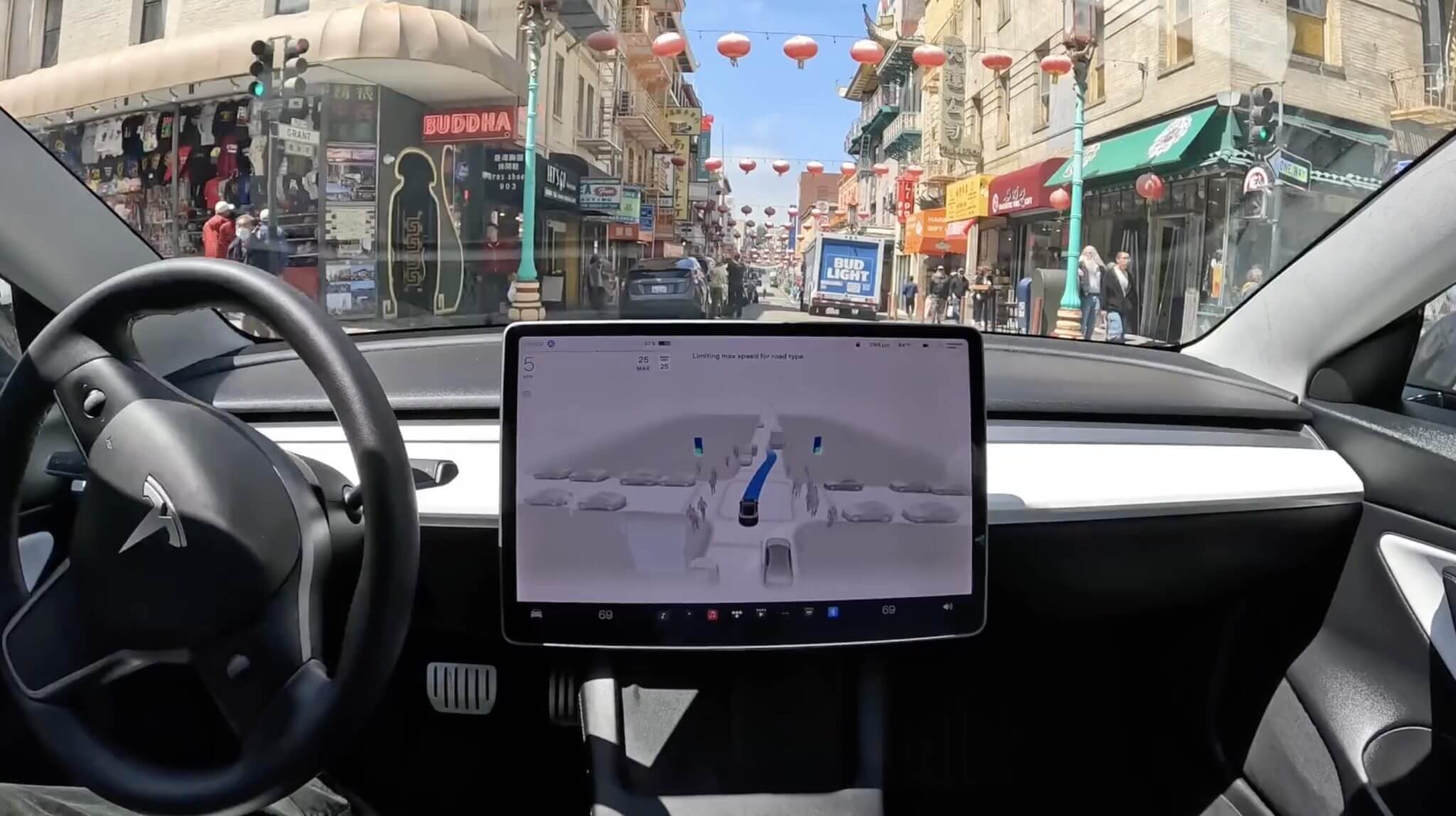
Imagine getting into your car and, instead of relying on millions of lines of pre-programmed code to navigate the world, it drives based on learned experience, much like a human. It watches, it learns, it anticipates. This is the radical promise of Tesla’s Full Self-Driving (FSD) V12, an update that ripped up the rulebook of autonomous driving. And now, with the latest iteration, Tesla FSD V12.5, beginning its rollout to the fleet, the central question for every Tesla owner and tech enthusiast is: is this the "mind-blowing" update Elon Musk promised? Is this the moment the software graduates from a fascinating tech demo to a truly confident and capable co-pilot?
After spending an intensive week and over 500 miles with the latest FSD Beta build, I can say this: V12.5 is not just an incremental improvement. It's a leap in character and competence. This Full Self-Driving review will break down the profound changes, the on-road experience, the lingering frustrations, and what this all means for the future of the autonomous driving experience.
From Code to Neurons: The FSD V12 Revolution
To truly appreciate V12.5, one must first understand the seismic shift that V12 represented. For years, FSD (and virtually all other autonomous systems) operated on a complex, human-written codebase. Engineers would write explicit rules for every conceivable situation: "IF a traffic light is red, THEN brake," or "IF a car signals to merge, THEN create space." The problem with this approach is the near-infinite number of "edge cases" in the real world. You can't write a rule for every unpredictable pedestrian, every confusing construction zone, or every oddly shaped piece of road debris.
FSD V12 threw out over 300,000 lines of that control code. In its place, Tesla substituted a single, powerful concept: the end-to-end neural network driving model. Instead of being told how to drive, the system is shown what good driving looks like. It has been trained on millions of miles of video from the Tesla fleet, learning the subtle relationships between steering, acceleration, braking, and the visual data from its cameras. It learns the "language" of driving, much like a large language model learns the patterns of human text. This makes the system inherently more adaptable and capable of handling novel situations it has never encountered before. V12 was the proof of concept; V12.5 is its first major refinement.
What's New in V12.5? The On-Road Experience
The difference between FSD V11 and V12 was like night and day. The difference between V12 and V12.5 is more nuanced but equally significant. It’s a jump in maturity. The driving style feels less robotic and far more... natural.
One of the most immediate improvements is the smoothness. The "robotic jerkiness" that sometimes plagued earlier versions is virtually gone. Acceleration from a stop is gentle and progressive. Braking for a red light is no longer a sudden, last-minute affair but a smooth, human-like deceleration. On the highway, lane changes are more decisive and confident. Where V12 might have occasionally hesitated, V12.5 assesses the gap, signals, and executes the maneuver with a newfound assertiveness that inspires driver confidence.
The real test, however, is in complex urban environments. I took the car through dense city streets, navigated chaotic multi-lane roundabouts, and tackled the bane of many autonomous systems: unprotected left turns across busy traffic. Here, the improvements in the FSD V12 vs V12.5 comparison become crystal clear. On an unprotected left, previous versions might "creep" forward indecisively, sometimes missing clear gaps. V12.5 exhibits a more sophisticated patience. It waits, accurately judges the speed of oncoming traffic, and when it identifies a safe window, it accelerates through the turn smoothly and without hesitation. I experienced multiple instances where I, as the human supervisor, was tensing up, ready to intervene, only for the car to execute the maneuver perfectly.
This latest Tesla software update also shows marked improvement in handling edge cases. During a heavy downpour, where visibility was significantly reduced, the system remained engaged and drove cautiously, tracking lane lines that were barely visible to my own eyes. It navigated a confusing construction zone, where lanes were shifted and cones were scattered, by slowing down and following the path of the car in front, a very human-like behavior. The number of times I felt the need to disengage the system dropped by at least 70% compared to my experience with early V12 builds. This is the essence of supervised FSD becoming less of a chore and more of a genuine convenience.
The Lingering Challenges and "Phantom Braking"
As transformative as V12.5 is, it is crucial to state that this is not yet "Level 4" or "Level 5" autonomy. The "Beta" moniker is still very appropriate, and the "S" in supervised FSD remains non-negotiable. The driver's attention is paramount.
The infamous "phantom braking" issue—where the car brakes suddenly for no apparent reason—has been drastically reduced but not entirely eliminated. I experienced one instance on an open highway where the car briefly and sharply braked, seemingly in response to a dark shadow cast by an overpass. While far less frequent, a single occurrence is enough to keep you on high alert.
The system can also still exhibit moments of uncertainty. On a narrow road with cars parked on both sides, it slowed to a crawl, seemingly unsure how to proceed, until I nudged the accelerator to give it "permission" to continue. It's a reminder that while the neural net is powerful, it can still lack the assertive, predictive judgment of an experienced human driver in certain ambiguous scenarios.
These interventions, however, are a critical part of the process. Every time a driver disengages FSD or corrects its behavior, that data is fed back to Tesla's servers. This creates a continuous feedback loop, where the system learns from its mistakes on a fleet-wide scale. The car you drive today is actively training the improved version of the software you'll receive in a few weeks. It's a powerful, self-improving data engine.
Conclusion: The Future is Here, But Patience is Required
After 500 miles, my verdict on Tesla FSD V12.5 is clear: it is, without a doubt, the most impressive and capable consumer-level autonomous driving system on the planet. The leap in naturalistic driving, confidence in complex scenarios, and overall smoothness makes it feel like a generational advance. It delivers on the "mind-blowing" promise not by being perfect, but by demonstrating that the neural network approach is unequivocally the right path toward a fully autonomous future.
It transforms the daily commute from a tedious chore into a more relaxed and futuristic experience. It handles stop-and-go traffic flawlessly and manages long highway stretches with ease, significantly reducing driver fatigue. However, it still demands your respect and your attention. It's a brilliant but adolescent driver, one that needs supervision, guidance, and the understanding that it is still learning.
The autonomous driving experience promised by science fiction is no longer a distant dream. With every Tesla software update, it inches closer to reality. FSD V12.5 is the biggest step yet. It proves that the car in your driveway isn't just a static piece of hardware; it's an evolving intelligence, and we are all witnessing its education in real time.