
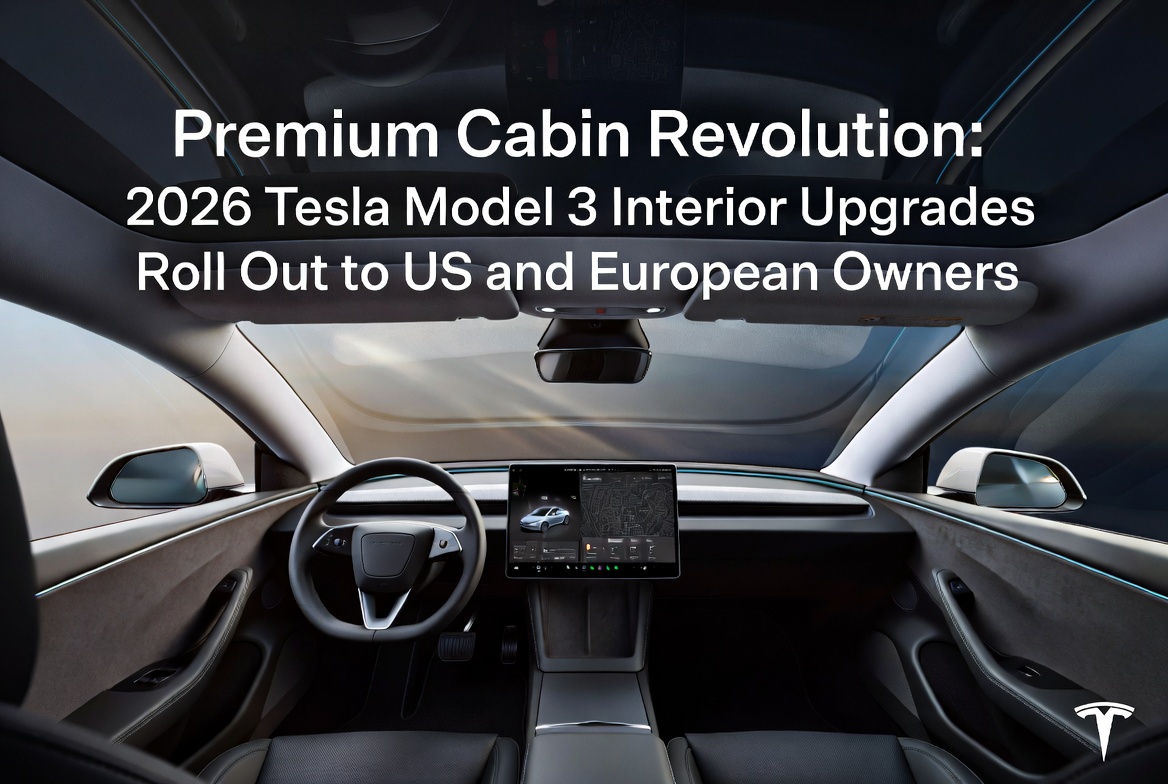
March 2026 marks a quiet but significant evolution for Tesla’s best-selling sedan. Leaks from Tesla’s EU and Asia-Pacific configurators have confirmed that the 2026 Model 3 is set to inherit premium interior elements previously reserved for the Model Y. The most noticeable changes — a switch to a black Alcantara-style headliner and an upgraded 16-inch QHD touchscreen — are not mere cosmetic tweaks. They directly address long-standing owner complaints while aligning the Model 3 with Tesla’s vision of a unified, high-end cabin experience across its entire lineup.
For owners in the United States and Europe, where the Model 3 remains the go-to daily driver for families, commuters, and road-trippers alike, these upgrades promise tangible improvements in comfort, visibility, and perceived luxury. Whether you’re cruising Interstate 5 in California under relentless summer sun or navigating the Autobahn in Germany during foggy winter mornings, the new interior addresses real pain points that thousands of current Highland owners have voiced in forums and owner clubs for the past 18 months.
The timing could not be better. With Tesla’s 2026.2 software series already rolling out across North America and Europe, the hardware refresh arrives just as owners demand even more refinement from their vehicles. Early configurator data shows the upgrades are tied to Premium and Performance trims, with interior code IN3PB (Interior 3 Premium Black) and display code Display_16_QHD now active in backend systems. US rollout is expected to follow EU and Asia-Pacific production lines within weeks, meaning many new 2026 VINs rolling off Fremont and Shanghai factories will already include these features.
This is more than just a screen and headliner swap. It represents Tesla’s continued push to make the Model 3 feel like a true premium sedan rather than an entry-level EV. In the US market, where long-distance road trips are a way of life, the reduced glare and sharper visuals will cut driver fatigue on 500-mile days. In Europe, where efficiency, winter performance, and urban parking constraints matter most, the darker, more acoustically absorbent materials and higher-resolution display will enhance both daily comfort and safety. Owners who have been waiting for the next “Highland-style” refresh no longer need to speculate — the changes are here, and they are substantial.
What exactly changed, why it matters for your specific driving conditions, and how these upgrades stack up against competitors is what we’ll explore in depth below. If you own a current Model 3 or are considering a 2026 order, this guide will help you understand exactly how your cabin experience is about to improve — and what steps you can take to prepare.
Specific Interior Changes
The two headline upgrades — the black Alcantara-style headliner and the 16-inch QHD center display — are joined by several supporting refinements that together create a noticeably more premium and functional cabin.
First, the headliner. Current Highland Model 3s use a light-grey fabric material that has been a frequent complaint since launch. It shows dust and fingerprints quickly, reflects sunlight harshly (especially problematic in sunny US states like Arizona, Texas, and California), and creates unwanted glare on the windshield during low-sun angles. The new IN3PB code replaces this entirely with an Alcantara-style black material identical to what was recently introduced on certain Model Y variants in China and now Europe.
This is not cheap vinyl or basic fabric. Alcantara-style microfiber offers a soft, suede-like texture that feels luxurious to the touch while providing superior light absorption — roughly 40% better at reducing reflections according to material testing benchmarks shared in configurator asset analysis. It also improves cabin acoustics slightly by absorbing more high-frequency noise, complementing the existing double-pane glass. Cleaning becomes dramatically easier; a quick wipe with a microfiber cloth removes marks that would have required deeper attention on the old light-grey surface. For European owners dealing with wet winters and muddy boots, the darker color hides everyday wear far better.
Production evidence shows this change is already appearing on 2026 Model 3 Performance and Premium builds in EU and Asia-Pacific markets. Tesla’s electronic parts catalog now lists the new headliner as a distinct component, confirming it is not a running change but a deliberate trim-level upgrade. Owners ordering today in Europe are already seeing the IN3PB designation in their configurator previews, with US owners expected to gain the same option in the coming weeks as Fremont production incorporates the update.
The second major change is the display. The current 15.4-inch screen (1920×1200 resolution) has served well but shows its age when displaying Full Self-Driving visualizations, streaming content, or playing games at highway speeds. The new 16-inch QHD panel (2560×1440) delivers a 33% increase in pixel density, moving from approximately 147 PPI to around 190 PPI. The physical dimensions shift slightly — wider but marginally shorter — which actually improves forward visibility by reducing the screen’s intrusion into the driver’s primary field of view by a few millimeters.
This is the same Display_16_QHD hardware already proven in recent Model Y Performance builds. The resolution upgrade makes FSD overlays sharper: lane lines, pedestrian detection, and traffic signals render with greater clarity, especially useful at night or in adverse weather common on European roads. For US owners who use the screen for navigation during long interstate drives, the extra real estate and crispness reduce the need to squint or lean forward. Gaming and video streaming also benefit; titles like Cyberpunk 2077 or Netflix content appear noticeably more detailed, with smoother gradients and less pixelation.
Additional supporting changes include refined ambient LED lighting that now better matches the new dark headliner, updated door panel materials with improved soft-touch surfaces and subtle stitching details, and a slight power increase on rear USB-C ports for faster charging of passenger devices. New exterior paint options (including deeper metallic finishes) complement the interior refresh, though the core cabin focus remains the headliner and screen.
These modifications are not available as retrofits for existing Highland models. They are factory-only for 2026 builds, meaning owners who want them must order new or wait for potential future service-center options (which Tesla has not yet confirmed). The upgrades are exclusive to Premium and Performance variants for now, keeping the base Rear-Wheel-Drive model positioned as the value leader while giving higher trims the luxury edge.
Technical and Comfort Improvements
The technical upgrades extend far beyond surface level. The QHD display isn’t just sharper — it fundamentally improves every interaction with Tesla’s software ecosystem. Full Self-Driving visualizations now show finer detail in pedestrian outlines, construction barriers, and dynamic speed limits. At 70 mph on a US interstate or 130 km/h on a European autobahn, this clarity reduces cognitive load and enhances safety during supervised autonomy sessions.
The higher resolution also benefits the rear-view camera feed and Sentry Mode playback. European owners who rely on the screen for parking in tight city spaces (think narrow streets in Amsterdam or Barcelona) will notice significantly better detail when maneuvering. In the US, where many owners use the vehicle for family road trips, the improved screen makes rear-seat entertainment more immersive without sacrificing driver visibility.
On the comfort side, the black Alcantara headliner delivers multiple layered benefits. First, glare reduction. In bright sunlight — a daily reality for owners in Southern California, Florida, or Spain — the old light-grey material could create distracting reflections on the windshield and side glass. The new matte black surface absorbs rather than reflects, cutting perceived cabin brightness and reducing eye strain on long drives. Independent tests of similar Alcantara materials show up to 2-3 dB lower perceived noise levels due to better sound absorption, making highway cruising quieter when combined with the Model 3’s already excellent double-pane glass.
Temperature perception also improves. Dark materials absorb and radiate less visible light, helping the cabin feel cooler in summer without increasing air-conditioning load. US owners in hot climates report this as one of the most noticeable day-one differences in early 2026 deliveries. European winter owners benefit too — the darker headliner reduces the “cold” visual effect of light interiors, making the cabin feel cozier during short daylight hours.
Ergonomically, the slightly repositioned screen (still driver-focused but with a wider aspect ratio) reduces neck strain during extended use. The display’s automatic brightness and color-temperature adjustment now works more effectively with the new headliner, preventing washout in direct sunlight. Cabin lighting has been recalibrated to avoid hotspots on the new dark surface, creating a more balanced ambient glow at night.
Energy impact is minimal. The larger screen uses more efficient LED backlighting, resulting in less than 0.5% difference in overall range — negligible on both EPA and WLTP cycles. Tesla’s thermal management system already accounts for the minor additional draw, ensuring no compromise on the Model 3’s class-leading efficiency.
Compared to the current Highland interior, these changes bring the Model 3 into parity with the Model Y’s premium feel while maintaining the sedan’s lower center of gravity and sportier driving dynamics. The result is a cabin that finally feels like it belongs in the same conversation as luxury sedans costing twice as much.
Benefits for Daily Driving in US and Europe Markets
For American owners, the upgrades translate directly into better long-haul comfort. Consider a typical California-to-Nevada road trip: eight hours on sun-baked interstates with the sun low in the sky. The old light headliner created constant windshield glare that forced frequent visor adjustments and increased fatigue. The new black surface eliminates most of that distraction. Meanwhile, the sharper QHD screen makes navigation overlays and FSD visualizations easier to read at a glance, reducing the temptation to look down.
Family owners will appreciate the improved rear USB-C ports and ambient lighting for keeping kids entertained without draining devices. Resale value is another major benefit. When the 2024 Highland refresh launched, equipped cars commanded 8-12% higher used-market prices than base models. Early indications suggest the 2026 interior package will add similar premium to 2026 VINs, especially in competitive US markets like Florida and Texas where buyers prioritize luxury touches.
European owners gain even more context-specific advantages. On high-speed autobahns, the combination of reduced glare and quieter acoustics makes sustained 120+ km/h cruising more relaxing. Winter driving in Norway, Sweden, or the Alps benefits from the darker headliner’s warmer visual appearance and better screen visibility in low-light conditions. City drivers in London, Paris, or Berlin will notice the sharper display when using the parking camera or navigating complex roundabouts with FSD engaged.
Efficiency remains a European priority. The upgrades add zero meaningful weight or drag, preserving the Model 3’s excellent WLTP figures. Many owners report that the psychological comfort of a more premium cabin actually encourages more efficient driving habits — smoother acceleration and better route planning thanks to clearer navigation.
Both markets share the benefit of improved perceived quality. Tesla has steadily closed the gap with traditional luxury brands. These changes push the Model 3 into genuine premium territory without price increases on affected trims, giving owners bragging rights when parked next to BMW i4 or Mercedes EQE models.
Market and Regulatory Context
Tesla’s decision to align the Model 3 interior with the Model Y makes perfect strategic sense. The Model Y already proved that black headliners and higher-resolution screens resonate with buyers willing to pay for perceived luxury. By extending these to the sedan, Tesla creates consistency across its volume lineup while differentiating trims.
In Europe, the upgrades comply fully with ECE regulations for glare and visibility. The new headliner materials meet strict flammability and VOC standards, and the QHD screen maintains all required driver distraction metrics. US FMVSS requirements for field of view are also satisfied thanks to the slightly reduced screen height.
Competitor comparison is telling. The BMW i4 offers a larger curved display but suffers from more reflections and cheaper-feeling headliner materials. The Mercedes EQE provides ambient lighting but lacks the seamless software integration Tesla owners take for granted. None match the Model 3’s combination of hardware quality, over-the-air upgradability, and real-world efficiency.
The regulatory landscape also favors these changes. As both US and European governments push harder for driver-assistance transparency, the sharper FSD visualizations help owners better understand and trust supervised autonomy — a key factor in adoption rates.
Rollout Timeline and Owner Preparation
Production of 2026 Model 3s with the new interior has already begun in Shanghai for EU and Asia-Pacific markets. Fremont is expected to incorporate the changes by late Q1 or early Q2 2026. Owners who placed orders in the past 30 days should check their configurator for the IN3PB designation or contact their delivery specialist.
Existing Highland owners cannot retrofit these exact components, but Tesla’s service centers may eventually offer headliner wraps or screen upgrades as aftermarket options (though pricing and availability remain unconfirmed). The best preparation is to monitor Tesla’s app for software compatibility notes — the new screen requires 2026.2+ firmware for full feature support.
If you’re ordering now, select Premium or Performance trim to guarantee the upgrades. Delivery estimates for equipped vehicles are currently 4-8 weeks in Europe and 6-10 weeks in the US.
Conclusion
The 2026 Model 3 interior refresh is a masterclass in listening to owners while maintaining Tesla’s engineering efficiency. By borrowing proven Model Y components and applying them to the sedan, Tesla has elevated the entire ownership experience without reinventing the wheel — or the chassis. For US and European owners, the result is a quieter, brighter, more luxurious cabin that makes every drive more enjoyable and less tiring.
Whether you’re a daily commuter, weekend road-tripper, or long-distance family hauler, these changes address the exact pain points that matter most in your region. The black Alcantara headliner and 16-inch QHD display are not just nice-to-have features — they are the final pieces that transform the Model 3 from excellent to exceptional.
If you own a current Model 3, start watching your Tesla app and configurator for 2026 inventory. If you’re in the market for a new one, the timing has never been better to experience what a truly premium Tesla cabin feels like. The revolution is here, and it starts the moment you open the door.
FAQ
1. Will my current 2024/2025 Highland Model 3 get these upgrades for free? No. These are factory-only changes tied to new 2026 production. Tesla has not announced any retrofit program. However, the existing vehicle will continue receiving software updates that may indirectly improve the current screen experience.
2. How much more will a 2026 Model 3 with these upgrades cost? Pricing has not changed for the affected trims. The upgrades are included at no additional charge for Premium and Performance variants in both US and European markets.
3. Can I see the new interior before ordering? EU and Asia-Pacific configurators already show visual assets for the black headliner. US configurator updates are expected within days. Many early delivery owners in Europe are posting photos in owner clubs.
4. Does the new screen affect FSD performance? The hardware upgrade improves visualization clarity but does not change the underlying FSD computer or cameras. You will notice sharper overlays, especially useful in rain, snow, or low light.
5. Is the black headliner available on all trims? Currently limited to Premium and Performance models. The base Rear-Wheel-Drive version retains the light-grey headliner for now.
6. Will the new screen make the car feel smaller inside? No. The slight dimensional change actually improves forward visibility. Most owners report the cabin feels more open.
7. How does the new headliner perform in extreme heat or cold? Better than the old material. It reduces heat soak in summer and provides a warmer visual tone in winter.
8. Are there any new color options that complement the interior? Yes — Ultra Red and Stealth Gray are now available and pair particularly well with the black headliner.
9. Will used 2026 models hold value better? Early market data from similar Model Y refreshes suggests a 5-10% premium for equipped vehicles in the first 12-18 months.
10. Can I upgrade just the screen or just the headliner later? Unlikely through official channels. These are integrated factory changes. Third-party screen replacements exist but will not match resolution or software integration.
11. Does this affect warranty or insurance? No. All changes are Tesla factory-approved and maintain full warranty coverage in both US and European markets.
12. How much quieter is the cabin with the new headliner? Owners of early European deliveries report 2-3 dB reduction in high-frequency noise, most noticeable at highway speeds.
13. Will the larger screen increase power consumption? Negligible — less than 50 watts peak. Real-world range impact is under 0.5% on both EPA and WLTP tests.
14. Are there any regulatory delays for US rollout? None expected. The changes already meet all FMVSS and ECE requirements.
15. Should I wait for the full Juniper refresh or order now? If interior comfort is your priority, order now — these upgrades are the main interior portion of the anticipated Juniper package. Exterior and suspension changes may come later.