
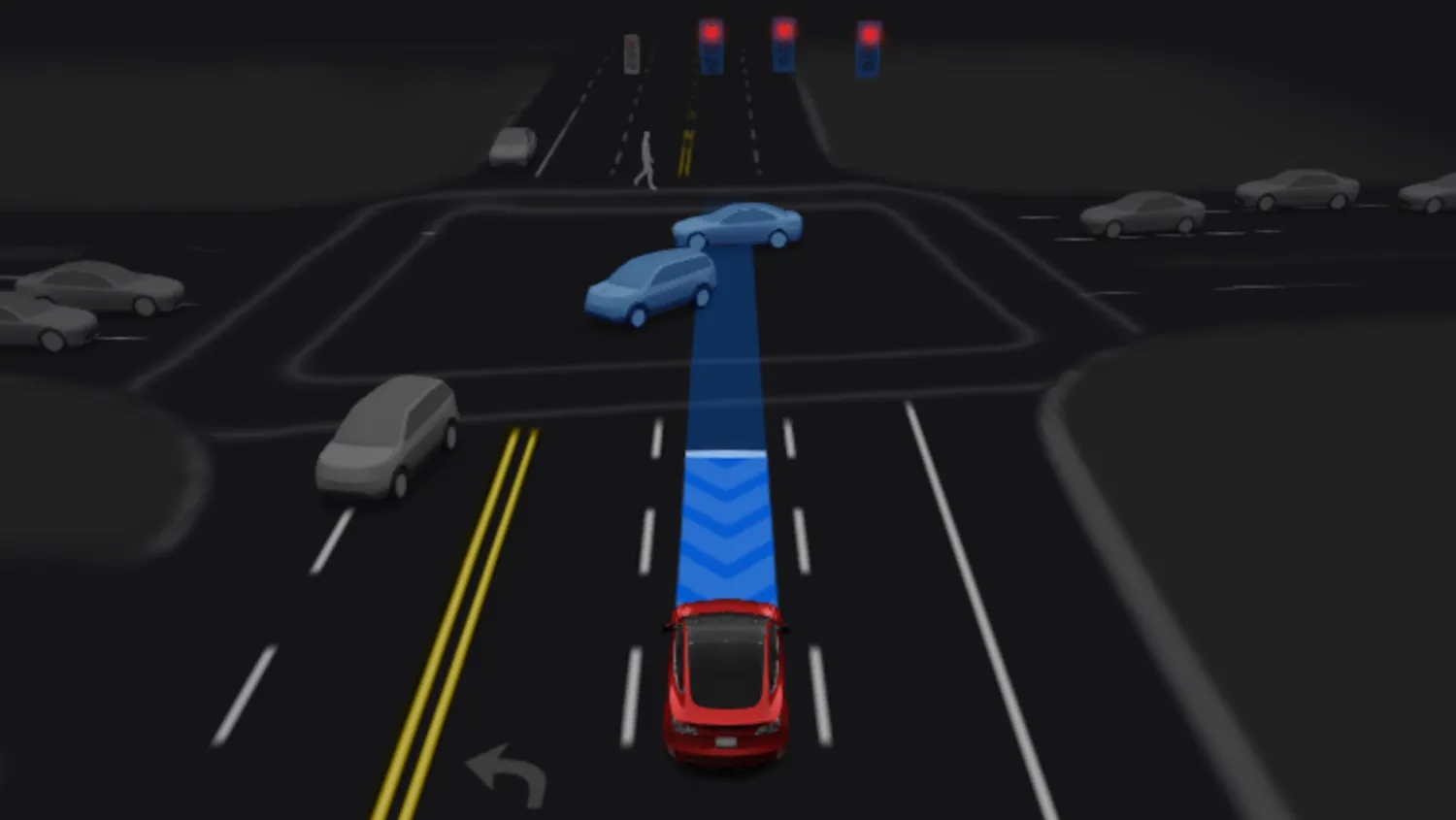
The automotive world is watching as Tesla deploys its most advanced autonomous software yet, but the reception is starkly different on opposite sides of the Atlantic. While Full Self-Driving (FSD) Version 12.5 represents a monumental step towards a self-driving future based on pure AI, its rollout highlights a growing chasm between rapid tech innovation in the US and the cautious, regulation-first approach of Europe. For any Tesla owner, this divergence is the single most important story in autonomous driving today.
For years, the promise of true self-driving has been the holy grail of the automotive industry. It’s a core part of Tesla’s identity and a key justification for its lofty valuation. With the wider release of FSD V12.5 in North America, we are witnessing what might be the most significant public beta test in history. This isn't just an incremental update; it's a fundamental architectural shift that redefines how a car perceives and navigates the world. Yet, as American drivers experience this leap, their European counterparts remain largely on the sidelines, held back by a formidable wall of regulations. This is a tale of two continents, two philosophies, and the uncertain future of how we will all eventually get from point A to point B.
Unpacking the Technology: What Makes FSD V12.5 a Game-Changer?
To understand the significance of V12.5, one must first grasp the technological leap it represents. Previous versions of FSD, while impressive, relied on a more traditional software approach. Tesla engineers wrote over 300,000 lines of explicit C++ code to govern the car's behavior. They had to manually code for countless scenarios: how to react to a stop sign, when to yield at an intersection, how to interpret a cyclist's hand signal. This approach is incredibly complex and brittle; it’s impossible to write a rule for every conceivable event on the road.
FSD V12.5 throws that rulebook out the window. It is built on a radical new foundation: end-to-end artificial intelligence. Instead of relying on hard-coded instructions, the system operates on a single, massive neural network. Tesla has fed this network millions of video clips of exemplary human driving. The network "watches" and "learns" the implicit rules of the road—the subtle nuances of human decision-making that are nearly impossible to code.
The concept is best described by Elon Musk’s simple phrase: "photon in, controls out." The car's eight cameras provide a constant stream of photons—raw visual data. This data is fed directly into the neural network, and the output is not an interpretation for another system to act on, but the direct commands for the car: steering angle, acceleration, and braking. It is a paradigm shift from a car that is programmed to drive to a car that has learned to drive.
The improvements in V12.5 are palpable for those who have experienced it. Early reports from the expanded North American beta test are filled with descriptions of a more confident, smoother, and remarkably "human-like" driving style. The system shows less hesitation at complex intersections, navigates busy roundabouts with newfound assertiveness, and demonstrates a more intuitive understanding of pedestrian and cyclist movements. It’s the difference between a student driver rigidly following instructions and an experienced driver with an innate feel for the flow of traffic.
The View from America: A Cautiously Optimistic Embrace
In the United States and Canada, the FSD Beta program has become a defining feature of the Tesla ownership experience. The wider rollout of V12.5 has amplified this, turning tens of thousands of owners into pioneers on the frontier of autonomy. Social media platforms and Tesla forums are flooded with videos and testimonials, many expressing astonishment at the software's capabilities. Drivers showcase their cars navigating complex urban environments, from the chaotic streets of San Francisco to unmarked country roads, often with zero interventions.
This "mind-blowing" factor is critical. It reinforces the narrative that Tesla is years ahead of the competition and that the future promised is tangible. However, this optimism is rightly tempered with caution. Tesla is adamant that the system, despite its name, is a Level 2 driver-assist system (ADAS). The driver must remain fully attentive and prepared to take control at any moment. This is not a legal footnote; it's a critical safety requirement. To enforce this, Tesla utilizes the in-cabin camera to monitor driver attention, issuing warnings and eventually disengaging the system if the driver is not looking at the road. This creates a fascinating human-machine dynamic, where trust in the AI must be balanced with constant human oversight.
The European Gauntlet: Why FSD Stays on a Leash
Across the Atlantic, the situation could not be more different. A European Tesla owner with FSD capability has access to a system that is a shadow of its North American counterpart. The reasons for this are rooted in a deeply entrenched regulatory philosophy that prioritizes pre-emptive safety standards over iterative, data-driven development.
The primary roadblock is a set of rules from the United Nations Economic Commission for Europe (UNECE), specifically Regulation UN R79 which governs steering systems, and the newer R157 concerning Automated Lane Keeping Systems (ALKS). These regulations, adopted by the EU and the UK, place strict limitations on what an automated system can do. They dictate, for example, the maximum steering input an automated system can apply and mandate that many maneuvers, like lane changes, must be initiated by the driver. Essentially, they legally cap advanced systems at a "supervised" Level 2, preventing the kind of city-street navigation that FSD Beta performs in the US.
Compounding this is the General Data Protection Regulation (GDPR), Europe's stringent data privacy law. Tesla's neural network development relies on a "data engine"—the collection and processing of vast amounts of real-world driving video from its fleet. GDPR imposes strict rules on the collection, storage, and use of personal data, and video footage of public streets can fall under this umbrella. This makes it significantly more complicated for Tesla to gather the massive datasets in Europe that are essential for training and refining its AI.
Finally, the EU employs a "type approval" system for vehicles. Before a car—or a significant feature like an advanced ADAS—can be sold, it must be certified by a national authority as meeting all applicable regulations. This is a long and arduous process, starkly contrasting with the US system of self-certification, where automakers declare compliance and are held accountable by post-market surveillance and potential recalls.
A Tale of Two Futures: Convergence or Divergence?
This transatlantic divide raises critical questions for the future. Is FSD in Europe destined to be a permanently diluted product? Tesla’s strategy remains unclear. The company could attempt to develop a separate, regulation-compliant version for Europe, though this would fragment its development efforts. Alternatively, it may engage in long-term lobbying to try and influence a change in regulations, arguing that its data-proven safety metrics should be the primary consideration.
In the meantime, European automakers like Mercedes-Benz are pursuing a different path. Mercedes has already achieved certification for a "Level 3" system, Drive Pilot, which allows for hands-off, eyes-off driving in limited conditions (heavy traffic on certain highways). They achieved this by working within the rigid UNECE framework, designing a system that meets the letter of the law. It’s less ambitious than FSD in scope but is legally sanctioned for a higher level of autonomy in its specific domain.
Ultimately, the story of FSD V12.5 is a powerful case study in the global friction between technological disruption and societal regulation. For Tesla owners and the industry at large, the path forward is uncertain. The road ahead for FSD in Europe is not a tech problem but a policy one. The ultimate success of Tesla's global autonomous strategy, and the dream of a car that can truly drive itself anywhere, will depend on its ability to navigate this complex regulatory maze. The risk for European drivers is that while Americans are test-driving the future, they may be left in the slow lane.