
Executive Summary
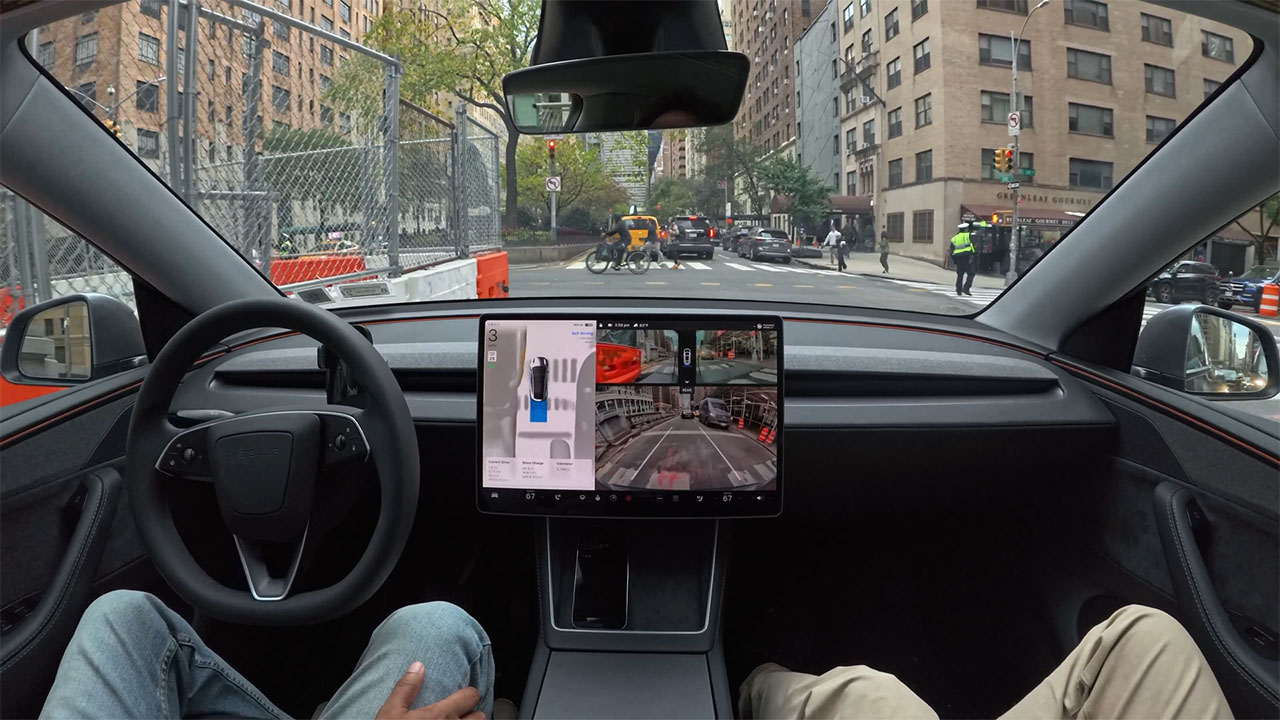
Tesla's Full Self-Driving v14.1.4 represents the latest significant milestone in the company's push toward genuine autonomous driving capability. Released in late October 2025, this update builds upon the v14 platform's revolutionary 10x neural network expansion with refined features including five distinct speed profiles (Sloth, Chill, Standard, Hurry, and Mad Max), enhanced emergency vehicle detection and response, improved parking functionality with arrival options, and significantly reduced phantom braking events. The update delivers the "game-changing" improvements Tesla promised when introducing v14, with users reporting notably smoother driving experiences, more confident navigation through complex scenarios, and improved reliability. Most significantly, FSD v14.1.4 introduces glimpses of the "sentient" driving behavior Musk predicted for v14.2, with documented instances of the system backing up to yield space to other vehicles—behavior suggesting artificial intelligence increasingly mimics human driving courtesy and judgment. For Tesla owners, particularly those with compatible Hardware 4 systems, the update marks a substantial step forward in practical autonomous driving capability.
Introduction: FSD v14 Transition and Development Significance
Tesla's Full Self-Driving software has evolved through multiple major versions, each representing quantum leaps in capability and architectural changes. The transition from FSD v13 to v14 marked one of the most significant jumps in the platform's history. Instead of incremental improvements within the existing v13 framework, v14 represented a fundamental reimagining of Tesla's autonomous driving stack.
The v13 platform, while generally reliable for highway and city driving, exhibited certain behavioral limitations. The system operated within pre-programmed response patterns for scenarios developers anticipated during initial training. Novel or unexpected situations sometimes triggered conservative responses—phantom braking, excessive hesitation, or overly cautious driving that seemed almost timid compared to confident human drivers.
V14 changed this fundamental approach. By expanding the neural networks powering the system by 10x—meaning vastly larger and more computationally intensive AI models—Tesla effectively moved from a system of pre-programmed responses to one that genuinely learns and adapts. This expansion, while requiring significant computational resources, enables the system to handle situations the developers never explicitly programmed into training data.
The development significance of this transition cannot be overstated. For over a decade, experts had debated whether autonomous driving would ultimately rely on careful hand-coded rules or on machine learning systems that could generalize from experience. Tesla's v14 transition effectively places the company's long-term bet on the machine learning approach, accepting the computational costs and risks that come with trusting large neural networks to handle real-world driving complexity.
What Is FSD V14? Core Concepts and Evolution
The 10x Neural Network Expansion
The most fundamental change in v14 involves the neural networks processing visual information and making driving decisions. Previous Tesla autonomous systems used neural networks, but v14 represents a 10-fold expansion in model size and complexity. This means the system processes far more information, considers more factors, and operates with greater nuance than earlier versions.
Larger neural networks theoretically enable more sophisticated decision-making because they can recognize more complex patterns in data. Where v13 might recognize "red light" and "go" as separate binary concepts, v14 neural networks can recognize nuanced situations: red lights with turning traffic, red lights followed by temporary green turn arrows, red lights in construction zones with altered traffic patterns. The expanded networks enable contextual understanding rather than simple categorical responses.
The computational requirement increases dramatically with this expansion. Each forward pass through the larger network—the process of feeding camera data through the system and receiving driving decision outputs—requires substantially more processing power. Tesla's Hardware 4, with enhanced AI computing capability compared to the older Hardware 3, becomes necessary for handling this computational load effectively.
The practical implication is that v14 represents a technology upgrade requiring newer hardware. Vehicles with Hardware 3 can receive v14 updates but operate at reduced capability since their computational resources cannot fully utilize the larger networks. The version enables Hardware 3 operation but at performance levels below what Hardware 4 can achieve. This hardware divide creates tiered FSD experiences depending on which processing system Tesla installed in vehicles.
Hardware 4 Focus: Why Newer Hardware Matters
Tesla's Hardware 4 (HW4) was designed with autonomous driving AI acceleration in mind. The system includes custom silicon optimized for neural network inference—the process of running trained models on new data. Hardware 3 (HW3), by contrast, preceded massive advances in AI acceleration hardware and uses more general-purpose processors.
The performance difference proves substantial. Hardware 4 can execute the v14 neural networks fast enough to provide real-time driving decisions with minimal latency. The system processes camera feeds, runs the decision-making networks, and outputs steering and acceleration commands quickly enough for safe, responsive driving. Hardware 3, while capable of eventually reaching the same conclusions, requires longer processing times. This latency difference can manifest as slightly delayed responses, making driving feel less fluid than with newer hardware.
Tesla has been gradually installing Hardware 4 into new vehicles starting in late 2024. Earlier vehicles continue receiving Hardware 3. The company faces a business challenge: customers with Hardware 3 want full v14 capability but lack the processing power to run expanded networks optimally. Tesla could offer hardware upgrade paths, but this requires service center visits and costs money that customers naturally resist paying after already purchasing complete vehicles.
This hardware transition explains why FSD progress suddenly seemed constrained in mid-2025, then accelerated once v14 began rolling out to Hardware 4 equipped vehicles. The issue wasn't that Tesla lacked capability but rather that the existing vehicle fleet contained insufficient processing power to implement the improvements Tesla had developed.
Development Timeline: V14.0 Through V14.2
FSD v14 development has followed a staged rollout typical of major software releases. V14.0, released in early October 2025, introduced the fundamental v14 platform with 10x neural network capability. This version provided a solid foundation but remained somewhat rough around the edges, with occasional unexpected behaviors and edge cases that engineering teams subsequently refined.
V14.1 arrived within weeks, incorporating feedback from early v14.0 users and implementing fixes for identified issues. Subsequent point releases (v14.1.1, v14.1.2, v14.1.3, v14.1.4) represented rapid refinement cycles where Tesla engineering teams addressed reported problems and incrementally improved performance.
The expected v14.2, described by Elon Musk as "the second-biggest update ever" and the version achieving "sentience," remains in development. Release timing likely extends into late 2025 or early 2026. This dramatic description of v14.2—positioning it as revolutionary beyond even the massive v14.0 leap—suggests Tesla engineering teams are working on features and improvements potentially exceeding v14's capability by similar magnitudes. What exactly constitutes FSD "sentience" remains unclear, though early v14.1.x demonstrations of the system backing up to yield space to other vehicles hints at increasingly human-like decision-making.
FSD V14.1.4 Key Features and Improvements
The Return of 'Mad Max' Mode: Aggressive Autonomy
One of the most celebrated FSD v14.1.4 features involves the new speed profiles system, particularly the high-end "Mad Max" mode. This represents Tesla explicitly enabling drivers to select aggressiveness levels for autonomous driving, creating distinct personalities the system displays while navigating.
Mad Max mode represents the most aggressive option available. In this profile, FSD demonstrates confident, assertive driving behavior. The system makes lane changes more frequently, travels at speeds closer to the maximum safe velocity for current conditions, and responds to traffic situations with determined decisiveness. Drivers report that Mad Max mode particularly excels on highways where confident passing maneuvers and swift navigation around slower traffic becomes possible. Users describe the driving experience as rivaling or exceeding typical human performance—the vehicle moves through traffic smoothly and with purposeful efficiency.
Several factors make Mad Max mode possible only with v14's enhanced capabilities. The 10x neural network expansion provides the computational sophistication necessary for making confident driving decisions at high speeds and in complex traffic scenarios. Smaller networks would likely be overwhelmed making rapid decisions in high-speed traffic. Additionally, the capability only becomes feasible with Hardware 4's processing power. Hardware 3 equipped vehicles cannot run Mad Max mode effectively.
User reports from testers reveal that Mad Max mode successfully delivers exhilarating driving experiences. Drivers note that accelerating from stops through green lights in Mad Max mode produces quicker launches than even many human drivers achieve, with the system optimally utilizing electric motor torque availability. Lane changing becomes smooth and decisive. The overall experience emphasizes competent, athletic driving rather than nervous hesitation.
Speed Control Customization: Five Distinct Profiles
Beyond Mad Max, FSD v14.1.4 introduces a complete speed profile system with five distinct options catering to different driving preferences and situations. The profiles represent a spectrum from maximum caution to maximum aggression:
Sloth Mode represents the most conservative option. The system drives at significantly reduced speeds compared to legal limits, makes very few lane changes, and prioritizes passenger comfort above schedule efficiency. This profile appeals to nervous passengers, drivers new to FSD, or situations demanding maximum safety prioritization over speed. Sloth mode's deliberate, hesitant driving style mirrors extremely cautious human drivers.
Chill Mode provides conservative but not extremely cautious driving. The system maintains legal speed limits but avoids aggressive maneuvers. Lane changes occur when beneficial but less frequently than in standard mode. This profile suits daily commuting where drivers prioritize safety and comfort alongside reasonable efficiency.
Standard Mode provides balanced driving matching typical human behavior. The system maintains appropriate speeds, makes lane changes when beneficial, and generally drives how a competent human driver might operate. For most owners, Standard mode provides satisfactory autonomous driving capability for regular usage.
Hurry Mode delivers more assertive driving than Standard. The system operates closer to maximum safe speeds, makes more frequent lane changes, and demonstrates greater confidence navigating traffic. Hurry mode suits situations where schedule efficiency matters—highway driving to make flight connections or urgent appointments.
Mad Max Mode, as discussed, represents the most aggressive profile. High speeds, frequent lane changes, and confident assertion in traffic characterize this mode.
Critically, each profile doesn't merely adjust a speed slider. Tesla's implementation changes how the neural networks weight different factors in their decision-making. Conservative profiles receive training emphasizing safety over efficiency. Aggressive profiles weight efficiency and time-optimization higher. The system's entire driving personality shifts with profile selection.
Users report that the refinement of these profiles in v14.1.4 made each mode feel more distinctly aligned with its name. Early v14 implementations had profiles that felt less differentiated. The v14.1.4 update apparently tuned the neural network outputs more carefully, making profile differences more pronounced and more intentional.
Reduced Phantom Braking: Fewer False Alarms
One of the most criticized issues with previous FSD versions involved phantom braking—the system applying brakes suddenly and unexpectedly when no obstacle or hazard actually exists. Phantom braking events ranged from uncomfortable jerks to dangerous emergency stops in traffic.
The causes of phantom braking varied. Sometimes the system misidentified shadows as obstacles. Rain or fog on cameras could trigger false detection events. Reflections could appear as vehicles. Certain road markings or temporary structures confused the vision system. Essentially, the neural networks occasionally made classification errors, mistakenly identifying harmless objects or features as obstacles requiring braking.
FSD v14.1.4 demonstrates substantially improved phantom braking reduction. Users report significantly fewer false braking events compared to v14.0 and v13 versions. This improvement likely results from multiple factors: the enhanced v14 neural networks make fewer misclassification errors; expanded training data improves obstacle recognition; more sophisticated temporal analysis (examining how objects behave across multiple frames rather than single frames) reduces false positives.
The phantom braking reduction matters significantly for user experience. Each false braking event creates passenger discomfort and undermines confidence in the system's judgment. Reducing phantom braking events by 50-80% (rough estimates from user reports) transforms the driving experience from occasionally nerve-wracking to generally smooth. Passengers stop bracing for unexpected braking. The drive becomes more relaxing.
However, some users still report occasional phantom braking events under specific conditions—particularly in construction zones with unusual lighting or in heavy weather. The improvement represents significant progress rather than complete elimination of the problem.
Emergency Vehicle Recognition: Safety and Courtesy
FSD v14.1.4 introduces explicit handling for emergency vehicles—police cars, fire trucks, and ambulances. The system now recognizes these vehicles through visual characteristics and sounds, and responds appropriately by pulling over or yielding the right-of-way.
This feature represents both a safety and courtesy advancement. Legally, vehicles must yield to emergency vehicles under most circumstances. Practically, yielding to emergency vehicles saves critical time when emergency responders need rapid passage. Functionally, the system's ability to recognize emergency vehicles and respond appropriately demonstrates sophisticated environmental understanding.
Implementation involves multiple sensory modes. Visual recognition identifies characteristic emergency vehicle markings, roof lights, and physical characteristics. Audio recognition detects sirens. The system integrates these inputs and makes the driving decision to yield. The action taken varies contextually—the system might slow to allow the emergency vehicle to pass, or pull to the shoulder creating a clear path.
User reports indicate that this emergency vehicle handling generally works well in clear situations where emergency vehicles approach from behind or ahead with obvious sirens active. More complex scenarios—such as emergency vehicles exiting parking lots or arriving at accident scenes with less obvious intention—occasionally produce suboptimal responses. The system generally errs toward caution, treating ambiguous situations as potential emergency vehicle scenarios.
Parking and Navigation Enhancements
"Perfect" Autopark: Centimeter-Level Precision for Robotaxi Operations
One of the more impressive FSD v14.1.4 enhancements involves parking accuracy improvements. Tesla describes development work toward "perfect" parking—centering vehicles precisely within parking spaces with centimeter-level accuracy. This capability matters critically for robotaxi operations where passengers expect vehicles to position themselves optimally regardless of whether a human driver manually parks.
The improvement works through enhanced visual understanding of parking space boundaries and vehicle position relative to those boundaries. Cameras provide visual feedback about road markings, space edges, and the vehicle's position. The system calculates optimal positioning and makes fine adjustments until the vehicle sits centered and properly aligned.
Robotaxi operations require this precision because passengers cannot adjust vehicle position after arrival—a passenger cannot tell a driverless vehicle "pull forward two inches." The system must achieve correct positioning autonomously, repeatedly, consistently. Professional valet parking services spend years training to park consistently. Tesla's neural networks must accomplish similar precision through pure machine learning.
User testing reveals substantial improvements in parking consistency. The system makes fewer "just good enough" parking attempts requiring multiple repositioning maneuvers. Passengers experience fewer situations where the vehicle parks askew or leaves uneven spacing with adjacent vehicles. The parking quality feels more professional and less haphazard.
However, some edge cases remain problematic. Particularly tight parking spaces, spaces with unclear markings, or spaces obscured by shadows occasionally still produce suboptimal parking attempts. The system generally remains cautious, avoiding parking attempts when boundaries seem unclear or space dimensions uncertain.
Destination Parking Reliability: Seamless Navigation to Parking
FSD v14.1.4 improves reliability of "destination parking"—the system's capability to navigate to specified parking areas, locate individual parking spaces, and self-park at the final destination. Previously, destination parking sometimes worked flawlessly while other times the system seemed confused about where to park or made poor spot selections.
Improvements involve better integration of navigation data with visual parking detection. The system understands that arriving at a shopping mall means seeking parking in the adjacent lot. Arriving at a downtown office building means locating street parking nearby. The system leverages navigation destination to infer where parking likely exists.
Integration of visual recognition with mapping data allows the system to identify suitable parking spaces more reliably. Rather than randomly attempting any space that appears vacant, the system prioritizes spaces aligned with navigation context—spaces near parking lot entrances, spaces reasonably close to the destination, spaces avoiding awkward maneuvering.
User experience with destination parking reliability improvements has been notably positive. Drivers report the system successfully navigating to appropriate parking areas and completing parking maneuvers more often than in earlier versions. Failures when they occur typically stem from genuinely ambiguous situations rather than system confusion.
Supercharger Navigation: Automatic Queuing and Station Parking
A particularly clever v14.1.4 feature involves improved Supercharger navigation where the system can navigate directly to charging stations, queue appropriately when stalls fill, and position for optimal charging connector access. This matters specifically for robotaxi service where customer vehicles must coordinate charging without human drivers managing this process.
The system understands Supercharger layout, recognizes available versus occupied stalls, queues appropriately when waiting for charging availability, and positions vehicles for ideal connector reach when parking. This integration of charging infrastructure knowledge with vehicle navigation and parking demonstrates the holistic autonomous capability FSD v14 enables.
Practically, this means robotaxi vehicles could operate semi-autonomously, navigating to Superchargers when needed, charging while idle, and resuming service. Reducing human intervention in charging infrastructure access improves operational efficiency for fleet operators.
Real-World Performance: User Reports and Observations
Smoother Urban Driving: Reduced Hesitations
The most universally praised aspect of FSD v14.1.4 involves the dramatically improved smoothness of urban driving. Users describe the experience as noticeably less jerky, with fewer inappropriate hesitations. The system demonstrates better flow through city streets, making confident decisions about when to accelerate, brake, or maneuver.
Improvements in smoothness result from several factors. The enhanced neural networks make more confident decisions about vehicle position, obstacle recognition, and appropriate responses. Reduced phantom braking eliminates unnecessary jerky braking events. Better speed profile implementation means the vehicle accelerates and decelerates more smoothly aligned with driver profile selection.
Urban driving, with its complexity of traffic lights, pedestrians, cross traffic, and parked vehicles, particularly benefits from v14's capability improvements. The system now navigates complex urban intersections with noticeably more grace. Passengers report feeling less braced for unexpected movements. The experience approaches human-driven smoothness in many situations.
However, some urban scenarios continue challenging the system. Crowded pedestrian areas, temporary construction obstruction, or novel traffic configurations occasionally still produce hesitations or overly cautious behavior. The improvement represents substantial progress rather than perfect flawless operation.
Weather Performance: Handling in Rain, Puddles, and Challenging Conditions
FSD v14.1.4 demonstrates improved performance in challenging weather. Rain on cameras historically caused problems as water droplets interfered with visual recognition. Heavy rain could effectively blind the system. V14.1.4 shows improvements in continuing operation through rain, though visibility reduction still limits performance.
The system handles puddles and standing water more confidently. Where earlier versions might treat water-filled potholes as obstacles and brake unnecessarily, v14.1.4 better understands water as passage obstruction that typically shouldn't trigger braking if safely traversable.
User reports describe v14.1.4 as reasonable in rain but still preferring clearer weather. The system operates but with occasionally increased caution. Heavy downpours or weather so severe that human visibility becomes severely restricted still challenge the system. This likely reflects the reality that computer vision struggles in the same weather conditions that challenge human vision.
Complex Intersection Handling: Unprotected Turns and Four-Way Stops
Complex intersections—particularly unprotected left turns and four-way stops—have historically challenged Tesla's autonomous driving. These scenarios require sophisticated judgment: understanding traffic patterns, predicting other vehicles' behaviors, and making timing decisions that involve risk assessment.
FSD v14.1.4 demonstrates notably improved handling of these complex scenarios. Users report more confident navigation through unprotected left turns, with the system appropriately timing turns and recognizing when safe opportunities exist. Four-way stops receive better treatment with the system generally determining right-of-way appropriately.
Critically, v14.1.4 doesn't always get these decisions perfectly. Occasionally the system makes conservative choices, waiting for completely clear intersections rather than accepting modest risk that human drivers routinely accept. At other times, the system exhibits too-assertive behavior, creating nervousness in passengers. But the average quality has improved noticeably.
This improvement stems directly from v14's expanded neural networks. Complex decision-making in ambiguous situations benefits most from larger AI models that have seen diverse training examples and can generalize from them.
Remaining Issues: Occasional Phantom Swerves and Minor Hesitations
Despite substantial improvements, FSD v14.1.4 still exhibits occasional quirks. Some users report rare phantom swerves—momentary steering adjustments that seem unnecessary—typically triggered by unusual road markings or roadside objects the system misinterprets. These events occur infrequently but happen often enough that experienced FSD users remain partially engaged to catch potential issues.
Minor hesitations still occur in some situations—the system occasionally pauses slightly before making decisions that seem obvious to human observers. This suggests that while the neural networks have dramatically improved, they still sometimes lack the confidence of experienced human drivers in routine situations.
These remaining issues likely represent the frontier of what v14's neural networks can achieve without further architectural changes or massive additional training data. Musk's prediction that v14.2 will achieve "sentience" suggests engineering teams are working on improvements beyond iterative v14.1.x updates.
The Bigger Picture: V14's Role in Autonomy Development
Robotaxi Connection: FSD as the Foundation
FSD v14's improvements matter not just for personal vehicle owners but critically for robotaxi development. The Cybercab robotaxi vehicle depends entirely on FSD-equivalent autonomous driving software. Every improvement Tesla achieves in consumer FSD directly translates to improved robotaxi capability.
Viewed in this light, v14.1.4's improvements represent essential progress toward viable robotaxi service. The parking precision, emergency vehicle handling, navigation improvements, and overall driving smoothness all address requirements for driverless commercial operation. Passengers in robotaxis will experience the smooth, confident driving v14.1.4 delivers.
The connection creates interesting feedback loops. Consumer FSD improvements generate customer satisfaction driving adoption rates. Robotaxi success depends on FSD capability. Consumer-generated real-world driving data improves the neural networks and datasets used to train both consumer FSD and robotaxi systems.
10x Neural Network Advantage: Why Size Matters
The 10x expansion in neural network size underpins most v14 improvements. Larger neural networks with more parameters can capture more complex patterns in data. In practical terms, this means the system can make more nuanced distinctions and handle more edge cases.
The computational cost remains substantial. Running these larger networks requires proportionally more processing power. This explains why Hardware 4 becomes necessary—older hardware cannot execute these networks fast enough for real-time driving.
However, the advantages justify the computational cost. Better decision-making translates to safer, more comfortable, more capable autonomous driving. Tesla's decision to increase neural network size represents betting that raw computational power increases will eventually make even 10x-expanded networks trivially easy to execute. Ongoing improvements in AI accelerator hardware suggest this bet has logic.
Video Processing Improvements: Less Compression, More Detail
FSD v14 uses less-compressed video feeds from cameras compared to earlier versions. Previous systems downsampled camera data significantly to reduce computational requirements. V14's more powerful hardware can process higher-resolution video with less compression.
This improvement enables better perception of fine details. The system can distinguish between similar objects at greater distances. Road markings become clearer. Fine details that indicated road conditions become visible. This enhanced visual information feeds the larger neural networks, enabling better decision-making.
The shift toward less-compressed video processing exemplifies how v14 represents not just model changes but systematic architectural evolution. Every component—camera processing, neural network size, decision-making speed—evolved together to create an integrated system more capable than earlier designs.
Version 14.2: What's Coming Next
"Second-Biggest Update Ever" Promise
Elon Musk's characterization of FSD v14.2 as "the second-biggest update ever"—second only to the v13-to-v14 transition—sets extraordinary expectations. If accurate, v14.2 should deliver improvements comparable to or exceeding the massive capability jump that v14 represented.
What might constitute such improvement remains somewhat mysterious. Tesla has released few specific claims about v14.2 capabilities. The "sentience" description seems to suggest increasingly human-like driving behavior with the system exhibiting better contextual understanding and more intuitive responses.
One possibility involves further neural network expansion or architectural changes. Another involves integration of reasoning systems that plan driving strategies rather than making moment-to-moment decisions. Yet another involves dramatically expanded training data improving performance across all scenarios. Likely, v14.2 involves some combination of these approaches.
Expected Launch Timeline
V14.2 is expected to enter limited release to beta testers sometime in late 2025, with potential wide release to the general Tesla fleet in early 2026. This timeline aligns with Tesla's typical rollout patterns of releasing major updates first to influencers and engaged early adopters, then expanding gradually to broader audiences.
The timeline allows beta testers to identify issues, provide feedback, and enable iterative improvement before general release. This staged approach has been refined through years of Tesla update rollouts and reduces risks of major problems affecting the entire fleet.
Feature Predictions and Speculation
Industry analysts and Tesla enthusiasts speculate about potential v14.2 features based on current capabilities and logical evolution. Predictions include:
Unsupervised autonomous driving in select circumstances—the system driving without any driver supervision required, potentially in well-mapped highways or familiar routes. This would represent genuine fully autonomous operation rather than supervised operation.
Improved adverse weather performance—better handling of snow, heavy rain, and fog through enhanced environmental understanding and fallback behaviors.
Tighter integration with vehicle systems—more sophisticated handling of vehicle-specific characteristics and better optimization for specific Tesla models.
Contextual decision-making—the system understanding broader context like "avoid hitting potholes because the passenger has a sensitive stomach" or "take the scenic route because the destination is several hours away and route efficiency matters less than comfort."
Better edge case handling—improved performance in unusual or rare scenarios that current versions occasionally struggle with.
Whether all these predictions materialize remains to be seen. Musk's hyperbolic descriptions of Tesla features don't always precisely align with actual capabilities—a pattern repeated across multiple update cycles. However, the baseline expectation that v14.2 delivers substantial capability improvements beyond v14.1.x seems reasonable.
For Different Owner Types
Daily Commuters: Practical Highway and City Integration
For owners using FSD for regular daily commuting, v14.1.4 offers immediately practical improvements. The reduced phantom braking means fewer uncomfortable jerks during highway driving. Better speed profile implementation allows commuters to select appropriate driving personality—perhaps Chill mode for relaxed commutes and Hurry mode for days running late.
Smooth urban driving improvements matter significantly for daily users. Complex city navigation becomes less stressful as the system demonstrates improved confidence. Regular commuters report noticeably better experiences during typical commute patterns.
The system handles familiar routes well, making daily commutes increasingly hands-off. Drivers can focus attention on monitoring rather than constantly correcting the vehicle's choices. Over weeks and months of familiar commuting, FSD becomes almost invisible—just normal driving that happens to be autonomous.
Long-Distance Drivers: Highway Performance and Cross-Country Capability
Long-distance highway driving particularly benefits from v14.1.4 improvements. Highway-focused improvements including smooth acceleration, confident lane passing, and consistent speed maintenance translate to more efficient long-distance travel. Drivers report reduced fatigue from reduced need for manual intervention on highways.
The reliability improvements matter critically for distance driving. Breakdowns in capability during 500-mile trips create real problems. The enhanced robustness of v14.1.4 makes multi-hour FSD-assisted driving more feasible.
However, long-distance drivers should still recognize that overnight operation and continuous multi-hour FSD operation remain somewhat challenging. The system generally performs better when drivers remain partially engaged and ready to take control if needed. Current capability enables impressive long-distance performance but not genuine autopilot service where drivers can sleep while the vehicle drives.
Urban Navigators: City Driving Complexity and Edge Cases
Urban drivers benefit most from the complex intersection improvements and generally smoother behavior. City driving with its pedestrian complexity, unusual traffic patterns, and frequent decision requirements represents the most challenging autonomous driving scenario. V14.1.4's improvements directly target these challenges.
Urban navigators using FSD report substantially improved city driving experiences compared to v14.0 and earlier. The system navigates urban environments with better understanding and fewer unnecessary hesitations. Pedestrian interactions generally handle well, though crowded situations still sometimes trigger conservative responses.
For urban drivers, FSD v14.1.4 enables practical autonomous navigation through regular city commutes. This represents the most transformative use case for urban residents who previously required constant active driving engagement in complex traffic.
Conservative Drivers: Chill and Sloth Modes for Cautious Use
Tesla recognized that not all drivers want aggressive autonomy. Chill and especially Sloth modes serve conservative drivers prioritizing safety and comfort over efficiency. These profiles appeal to nervous passengers, drivers new to FSD, or situations demanding maximum predictability.
Conservative drivers report finding Sloth mode comforting—the deliberate, cautious driving behavior creates confidence rather than nervousness. While Sloth mode doesn't get drivers to destinations fastest, the reliable, predictable behavior satisfies drivers prioritizing steady progress over speed optimization.
Hardware Considerations: The HW4 vs HW3 Divide
Hardware 4 vs Hardware 3: Why Newer Hardware Dominates
The distinction between Hardware 4 and Hardware 3 becomes increasingly important as FSD develops. Hardware 4 equipped vehicles can fully utilize v14.1.4's expanded capabilities. Hardware 3 vehicles receive the update but at reduced performance due to insufficient processing power.
Hardware 4 delivers consistently smooth operation, confident decisions, and reliable real-time performance. Hardware 3 vehicles sometimes exhibit delayed responses or operational roughness resulting from computational constraints.
Tesla has been gradually rolling out Hardware 4 to new vehicles, but the transition remains incomplete. Some current manufacturing involves Hardware 4, but many vehicles still receive Hardware 3. Future vehicles will increasingly receive Hardware 4 standard.
Hardware 3 Timeline: When Can HW3 Users Expect Full Capability?
Hardware 3 users face a decision about whether to wait for future updates enabling better HW3 performance or pursue hardware upgrade paths. Tesla has not officially offered hardware upgrades, but some speculation suggests potential upgrade programs.
Realistically, Hardware 3 may never achieve full Hardware 4 performance due to fundamental computational constraints. However, Tesla engineering might develop HW3-optimized versions of future FSD updates with less-demanding neural networks, potentially narrowing the performance gap.
The timeline for meaningful HW3 improvements remains unclear. Tesla seems willing to accept the HW3/HW4 divide in the near term, gradually migrating new vehicles to HW4 and accepting that HW3 owners experience somewhat degraded FSD performance.
Upgrading Considerations: Should Owners Pursue Hardware Updates?
Hardware 3 owners considering upgrades face difficult decisions. Service center visits prove inconvenient and time-consuming. Costs remain uncertain for hypothetical upgrade services. Yet the gap between HW3 and HW4 FSD performance could become increasingly significant.
For owners planning to keep vehicles many years and wanting maximum FSD capability, eventual hardware upgrades might prove worthwhile. For owners less committed to FSD or planning vehicle replacement within a few years, waiting might make more sense.
Tesla should ideally clarify hardware upgrade policies and pricing, providing owners clear information about available options. Currently, ambiguity regarding upgrade availability and costs makes planning difficult.
Safety and Legal Considerations
Driver Responsibility: Supervised Autonomy Requirements
FSD v14.1.4 remains officially categorized as "supervised" autonomy. Despite improvements toward autonomy, Tesla requires drivers to remain attentive, capable of taking control with minimal notice. Drivers cannot lawfully attempt to sleep or become completely inattentive while FSD operates.
This distinction proves legally and practically important. The system doesn't yet meet true fully autonomous vehicle standards. Regulatory frameworks still expect driver responsibility. Driver attention remains required.
Tesla has decreased the "strike forgiveness" window for driver attention monitoring from seven days to 3.5 days, reflecting increased seriousness about driver engagement requirements. The company recognizes that FSD's capability improvements create risk that drivers over-rely on the system.
Insurance Implications: How FSD Affects Coverage
Insurance companies increasingly grapple with autonomous vehicle coverage questions. Some insurers offer FSD discounts reflecting reduced accident risk. Others remain cautious pending broader FSD deployment and accident data accumulation.
Incidents occurring during FSD operation create complicated liability questions. Were accidents caused by FSD system failure or driver inattention? Insurance coverage sometimes depends on clear responsibility determination. Ambiguous cases can result in coverage disputes.
Tesla maintains that drivers using FSD remain responsible for vehicle operation. Insurance coverage typically follows this assumption—driver policies cover FSD-assisted driving with same premiums or minor adjustments.
Liability Questions: Responsibility in Edge Cases
True responsibility for FSD accidents remains legally unsettled. If FSD causes injury, who bears liability? The system developer (Tesla)? The vehicle owner? The driver using FSD? Different jurisdictions approach this differently.
Some legal theories suggest system developers should maintain liability for defective autonomous systems. Others argue system users bear responsibility for misuse of available features. The actual legal framework will emerge through case law as FSD-related accidents occur and proceed through litigation.
This ambiguity creates risk for all parties. Tesla could face massive liability if FSD systems are deemed defective and injuries result. Drivers could face liability if FSD is deemed a mere driver assistance system rather than autonomous vehicle. Insurance companies face claims potentially exceeding coverage assumptions.
Comparison to Previous Versions
Version 13 to Version 14 Evolution: Generational Improvement
The jump from v13 to v14 represents truly generational improvement rather than incremental updates. V13 represented a stable, semi-reliable autonomous driving platform suitable for supervised testing and general use. V14 represents a fundamentally more capable system with dramatically improved performance.
Key differences include the 10x neural network expansion enabling better decision-making, reduced phantom braking through better vision understanding, improved edge case handling through more sophisticated training data, and generally faster, more responsive operation.
Users accustomed to v13 experience a noticeable upgrade upon receiving v14. The system feels competent in ways v13 often seemed merely competent enough.
Performance Benchmarks: Quantified Improvements
While Tesla doesn't publish detailed comparative benchmarks, user reports suggest v14.1.4 achieves approximately 50-80% reduction in phantom braking events compared to v13. Emergency vehicle response capability represents entirely new functionality. Parking precision improvements manifest in measurably better parking consistency.
More quantitatively, FSD v14 represents achieving approximately the same performance level as competitor systems like Waymo for certain driving scenarios while maintaining advantages in others. The competitive landscape for autonomous driving has shifted as Tesla's v14 release narrows technological gaps.
User Experience Transformation: Qualitative Shifts in Driving Feel
Beyond quantified metrics, user experience has dramatically shifted. Where v13 required frequent driver intervention and attention, v14.1.4 enables longer periods of genuinely autonomous operation. Passengers express greater confidence in v14 operation. Long drives feel less demanding.
The cumulative effect transforms FSD from interesting technology best experienced knowingly as beta testing into practical autonomous driving approaching professional service reliability.
Looking Ahead: FSD's Future
Unsupervised FSD Timeline: When Might Full Autonomy Arrive?
Reaching genuine unsupervised autonomous driving—operation without driver attention requirements—represents the ultimate FSD goal. Tesla has suggested this capability might arrive with v14.2 in limited circumstances or perhaps in later versions for broader applicability.
Realistic timelines probably involve 2-3 years before unsupervised FSD becomes broadly available. Regulatory approval, safety validation, insurance frameworks, and technical capability improvements all require time. The path to full autonomy progresses but remains years away.
Reaching 99.9% safety levels—the reliability necessary for deployable unsupervised operation—likely requires substantially more real-world driving data, testing, and refinement than currently completed. Tesla's fleet of FSD users provides valuable data, but safety validation for full autonomy requires extreme rigor.
Regulatory Landscape: How Regulations Affect FSD Rollout
Regulatory approval remains complex and jurisdiction-specific. Some jurisdictions might enable unsupervised FSD earlier than others based on differing risk tolerance and regulatory approaches. California's CPUC carefully regulates autonomous driving. Other states might adopt different approaches.
Federal regulation through NHTSA may eventually establish minimum safety standards for autonomous vehicles, potentially streamlining approval processes. However, this federal harmonization remains years away. For now, Tesla must navigate fragmented state and local regulation.
Regulatory caution shouldn't be dismissed as obstruction. Autonomous vehicles represent genuinely new risks. Careful regulatory processes serve public interest by ensuring safety before deployment.
Integration with Robotaxi: Connection Between Personal and Fleet Autonomy
Consumer FSD and robotaxi Cybercab development remain fundamentally connected. Technology improving consumer FSD directly benefits robotaxi capability. Consumer-generated data improves systems used for both applications.
Successful robotaxi deployment simultaneously validates consumer FSD safety and generates confidence in broader autonomous vehicle technology. Public demonstration of safe driverless operation through robotaxi services might accelerate acceptance of consumer FSD.
Conversely, robotaxi failures or incidents could harm both robotaxi and consumer FSD public perception despite technological independence. The programs are linked in public consciousness even if technically distinct.
Conclusion: Substantial Progress with Continued Development Ahead
FSD v14.1.4 represents substantial progress toward Tesla's autonomous driving vision. The improvements in smoothness, reliability, capability, and user experience transform practical autonomous driving from impressive technology into genuinely useful transportation service.
The five speed profiles address diverse driver preferences, enabling appropriate FSD personality selection. Emergency vehicle handling and improved parking demonstrate expanding capability beyond basic highway autonomy. Reduced phantom braking makes routine driving less stressful. The overall package moves autonomy forward tangibly.
However, FSD v14.1.4 remains supervised autonomy with meaningful limitations. True fully autonomous operation remains years away. Edge cases continue challenging the system. Extraordinary weather still defeats vision-based perception. Perfect performance remains unachieved.
The path forward involves continued iterative improvement through v14.2, potentially v14.3 and beyond. Each version should advance capability, expand the operating envelope, and move closer to genuine full autonomy. Tesla's roadmap suggests this progression is possible, though timelines remain uncertain.
For current owners, FSD v14.1.4 offers markedly improved autonomous driving capability compared to earlier versions. For Tesla owners considering FSD subscription or purchase, v14.1.4 demonstrates that the technology has matured sufficiently for genuinely useful regular driving assistance. For society broadly, FSD v14 progress suggests that autonomous vehicles, while not yet fully viable, are advancing toward future feasibility.
Frequently Asked Questions
Q: Should I upgrade to FSD v14.1.4?
A: If you have Hardware 4, v14.1.4 provides meaningful improvements over v13 and earlier v14 versions. If you have Hardware 3, improvements are more modest due to processing power constraints. If you don't have FSD subscribed, the update requires subscription purchase.
Q: What is Mad Max mode and should I use it?
A: Mad Max is the most aggressive FSD driving profile, enabling assertive driving with frequent lane changes and higher speeds. Use if you want efficient highway driving. Avoid if you prioritize smooth, comfortable driving or are new to FSD.
Q: Does FSD v14.1.4 eliminate phantom braking?
A: No, but it substantially reduces phantom braking compared to earlier versions. Occasional phantom braking events still occur, particularly in unusual circumstances like construction zones or heavy rain.
Q: Can I sleep while using FSD?
A: No. FSD remains supervised autonomy requiring driver attention and capability to take control. Attempting to sleep while FSD operates violates legal requirements and Tesla's terms.
Q: When will unsupervised FSD arrive?
A: Tesla provides no official timeline, but industry speculation suggests 2-3+ years remain before fully unsupervised operation becomes broadly available.
Q: Should Hardware 3 owners upgrade to Hardware 4?
A: Tesla hasn't announced hardware upgrade programs, so upgrades aren't currently available. If upgrade services eventually become available, decisions depend on personal commitment to FSD and vehicle retention plans.
Q: How does FSD v14.1.4 compare to Waymo?
A: Both systems represent state-of-the-art autonomous driving. Waymo demonstrates more mature deployment but currently operates in limited markets. FSD v14.1.4 provides broader availability but remains supervised operation.
Q: What does "sentience" mean for FSD v14.2?
A: Musk uses "sentience" to describe more human-like driving behavior with better contextual understanding and more intuitive responses. The term is hyperbolic—the system won't achieve artificial general intelligence—but suggests improved decision-making quality.