
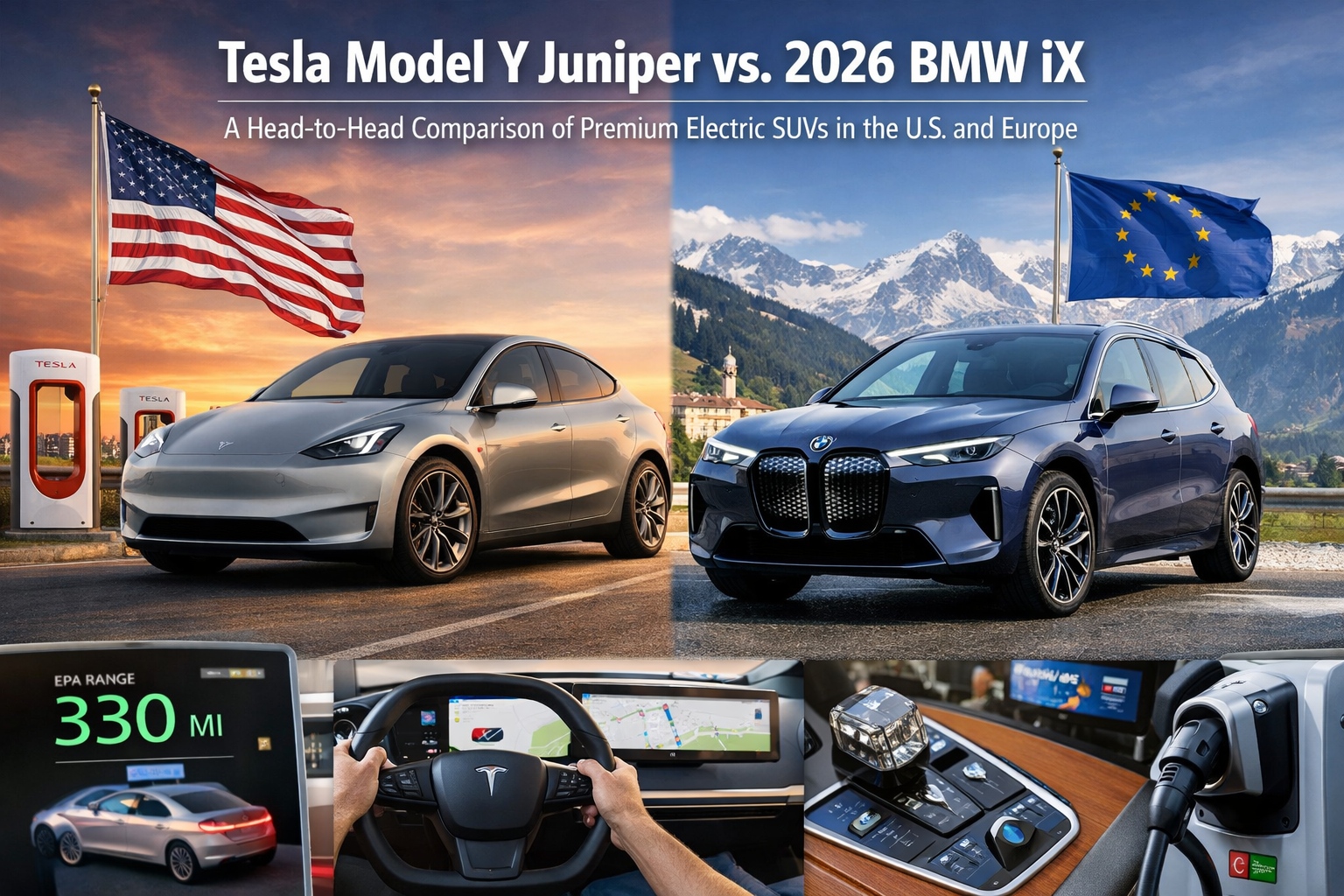
A Tale of Two Philosophies in the Age of the Refresh
The electric SUV market in 2026 has reached an inflection point. It is no longer a race of simply "who has the longest range" or "who charges the fastest." The conversation has matured, and buyers on both sides of the Atlantic are asking more nuanced questions. For the tech-forward family in California or the style-conscious commuter in Munich, the choice is increasingly coming down to two very different interpretations of what a premium electric vehicle should be.
On one side, we have the Tesla Model Y "Juniper," the recently refreshed version of the world's best-selling electric vehicle. It represents the Silicon Valley approach: continuous improvement, software integration, and minimalist design, all wrapped in a package that has proven its mass-market appeal. On the other side stands the 2026 BMW iX, the flagship electric SUV from Germany's automotive powerhouse. Fresh off its "Life Cycle Impulse" (LCI) refresh, the iX doubles down on luxury, traditional craftsmanship, and engineering refinement, even introducing a more accessible entry-level trim to lure buyers away from the American upstart.
This is not merely a comparison of specs. It is a clash of philosophies. It is the answer to the question every premium EV buyer is asking today: Do I want a computer on wheels that happens to be a great car, or a car with a great computer that happens to be electric? With both vehicles available for order now in the US and Europe, and deliveries ramping up through the second quarter of 2026, there has never been a better time to put them head-to-head
Chapter 1: The Contenders – Setting the Stage for 2026
The Tesla Model Y Juniper: Evolution, Not Revolution
Tesla’s approach with the "Juniper" refresh is classic Silicon Valley: iterate constantly, announce rarely. The 2026 Model Y is not a ground-up redesign, but rather a meticulous refinement of a winning formula. Codenamed "Juniper," this update addresses the most persistent criticisms of the outgoing model while enhancing its core strengths.
The most significant changes lie beneath the skin. Tesla engineers have completely retuned the suspension system, adjusting damping coefficients and spring rates to strike a new balance between the Model Y's trademark responsive handling and the ride comfort expected by family buyers. Early reviewers note that the "go-kart" feel has been tamed just enough to absorb rough pavement without sacrificing the connection to the road that enthusiasts appreciate.
Inside, the changes are immediately visible. The cabin now features ventilated front seats—a first for the Model Y in many markets—offering three-zone climate control for improved comfort during long summer road trips. Rear-seat passengers are no longer second-class citizens, thanks to the integration of an 8-inch touchscreen mounted between the front seats, allowing control of climate and entertainment. A new 256-color ambient lighting system has been discreetly woven into the dashboard and door panels, creating an evening atmosphere that subtly challenges BMW's traditional dominance in interior mood-setting.
Importantly for European buyers, Tesla has streamlined the lineup. The short-lived Launch Series has been retired in favor of three core trims: the entry-level Rear-Wheel Drive (RWD) starting at €44,990, the Long Range RWD at €49,990, and the Long Range All-Wheel Drive (AWD) at €52,990—the latter actually €2,000 cheaper than its predecessor. In the US, pricing remains competitive, with the Long Range AWD version coming in at $48,990 before incentives, undercutting most luxury rivals by a significant margin.
The 2026 BMW iX: The Bavarian Counter-Punch
If Tesla’s update is about refinement, BMW’s 2026 iX refresh is about expansion. The iX has always been a technological tour de force, but with this LCI update, BMW has made it a more formidable competitor by doing something unexpected: offering a cheaper model.
The headline news for 2026 is the introduction of the iX xDrive45. This new entry-level trim starts at $75,150 in the US (or €75,000 in Europe), representing a price cut of over $10,000 compared to the cheapest iX available last year. This move is a direct assault on the premium end of the Model Y's customer base, acknowledging that Tesla's value proposition cannot be ignored.
But the iX is not just about price. The xDrive45 uses a 100.1 kWh battery pack, significantly larger than the Model Y's undisclosed but smaller pack, and produces a combined 402 horsepower. It achieves an estimated 312 miles of EPA range, making it a credible long-distance cruiser from the moment you step up to the base model. For those wanting more, the xDrive60 bumps the battery to 113.4 kWh, pushing range to an estimated 340 miles and power to 536 horsepower. At the top sits the iX M70, a 650-horsepower beast that can sprint to 60 mph in just 3.6 seconds, yet still manages an estimated 302 miles of range.
Underpinning all of this is a significant technological leap: the iX is the first BMW production model to use silicon carbide semiconductor components in its inverters. This improves efficiency during energy transfer from the battery to the electric motor, contributing to the range gains without a commensurate increase in battery size. It is a classic BMW move—engineering sophistication over brute force.
Chapter 2: Powertrain and Real-World Efficiency
When comparing these two SUVs, the specification sheets tell only part of the story. The numbers are important, but how they translate to the daily driving experience in America and Europe is what truly matters.
The Tesla Advantage: Doing More with Less
Tesla has always adhered to a philosophy of efficiency through integration. The Model Y Juniper continues this tradition. While Tesla has not officially released the battery capacity for the Juniper, it is widely believed to be in the neighborhood of 75-80 kWh for the Long Range versions. Yet, the WLTP range for the Long Range RWD in Europe is an impressive 600 km (approximately 373 miles). The US EPA rating for the Long Range AWD is expected to land around 327 miles.
How does Tesla achieve this with a smaller battery? It comes down to weight, aerodynamics, and thermal management. The Model Y is significantly lighter than the iX, a difference felt not just in efficiency but in the car's agility. The coefficient of drag remains class-leading, and the heat pump system, now standard across the lineup, ensures that cold European winters have a minimal impact on range.
For the owner, this translates to lower electricity bills for the same distance traveled. In regions like Germany, where residential electricity rates are among the highest in the world, the Model Y's efficiency is a tangible, recurring financial benefit.
The BMW Approach: Leveraging Mass
The 2026 iX takes a different approach. With its massive battery packs, the iX is unapologetically heavy. The xDrive45 tips the scales at 5,567 pounds, while the M70 approaches 5,849 pounds. This weight is immediately apparent behind the wheel; the iX feels planted, substantial, and vault-like in a way the Model Y does not.
The efficiency gains from the new silicon carbide inverters are real, allowing BMW to claim a 10% range improvement over the previous models. However, even with these improvements, the iX requires more energy to move its mass. A real-world comparison conducted by GO Car Journal on a highway loop showed that while BMW's range estimates are generally accurate, the energy consumption per kilometer is higher than thot of lighter rivals.
The trade-off is capability. The iX xDrive60's 340-mile EPA range is achieved with a battery that is nearly 50% larger than the Model Y's. For buyers who prioritize maximum range above all else—perhaps those in remote parts of the American West—the sheer capacity of the iX provides a psychological safety net that efficiency alone cannot match.
Chapter 3: The Interior Experience – Minimalism vs. Sanctuary
Step inside these two vehicles, and the philosophical divide becomes visceral. You are not just entering a cabin; you are entering a statement about the future of automotive design.
Tesla's Digital-First Cockpit
The Model Y Juniper's interior is a study in considered reduction. The centerpiece remains the 15.4-inch central display, which controls virtually every function of the vehicle. There is no instrument cluster behind the steering wheel; all driving information is presented on the central screen or, optionally, via the steering wheel scroll wheels.
For 2026, the upgrades are focused on tactility and comfort. The new ventilated seats are a game-changer for hot climates, addressing a long-standing omission. The materials feel marginally more premium, with softer touchpoints on the door panels and center console. The 256-color ambient lighting allows for personalization that was previously absent in Tesla's stark interiors.
However, the philosophy remains unchanged: the interface is the car. Every adjustment, from mirror positioning to glovebox opening, flows through the touchscreen. For tech enthusiasts, this is a feature; for traditional luxury buyers, it can be a frustration. The rear 8-inch screen is a welcome addition for families, allowing rear passengers to control their own climate and media without bothering the driver.
BMW's Sanctuary on Wheels
In contrast, the BMW iX feels like a meticulously curated space. The 2026 models retain the stunning, lounge-like atmosphere that defined the iX from the start, but with critical improvements. The most important update is to the seats themselves. BMW has addressed previous complaints about thigh support by redesigning the front seats with enhanced bolstering and longer cushions, ensuring that taller drivers remain comfortable on cross-continent journeys. The headrests have also been redesigned to eliminate discomfort for shorter passengers.
The iX's curved display, combining a 12.3-inch instrument cluster and a 14.9-inch infotainment screen, presents information with a clarity and richness that Tesla's single screen cannot replicate. Crucially, BMW retains physical controls for essential functions, including the iDrive rotary controller on the center console. This allows the driver to navigate menus without taking their eyes off the road, a nuance that luxury buyers appreciate.
Material choices in the iX range from microfiber and Sensatec to natural leathers and a unique wool blend, offering a warmth and texture that feels genuinely premium. The optional Bowers & Wilkins Diamond surround sound system remains one of the best in the automotive world, transforming the cabin into a concert hall on wheels.
Chapter 4: Technology, UI, and the Digital Experience
If the interiors represent the soul of each vehicle, the technology represents the brain. Both are advanced, but they think in fundamentally different ways.
Tesla's Vertical Integration
Tesla's technological advantage lies in its end-to-end control. The Model Y Juniper runs on Tesla's own software, developed in-house and optimized for the specific hardware in the car. This allows for over-the-air (OTA) updates that not only fix bugs but fundamentally improve vehicle performance, add features, and even enhance range over time.
The user interface is lightning-fast, intuitive, and constantly evolving. The integration with the Tesla ecosystem—from the mobile app that allows remote climate control and "summon" features, to the trip planner that automatically routes you through Superchargers—is seamless. The navigation system, with satellite view and live traffic, is widely considered the best built-in system available.
For 2026, Tesla continues to offer "Full Self-Driving (Supervised)" as an option. While the name remains controversial, the capability is undeniable. The v12 software stack, now rolling out more widely, represents a paradigm shift. It uses "end-to-end neural networks," meaning the car makes driving decisions based on learned behavior from millions of videos, rather than hard-coded rules. The result is a more human-like, fluid driving experience, albeit one that still requires constant driver supervision.
BMW's Software-Defined Future
The 2026 iX is BMW's first vehicle built on a truly software-defined architecture. This is a significant moment for the German automaker. Unlike previous BMWs, where software was layered onto existing hardware, the iX's electrical system was designed from the ground up to be updateable. Four central computing clusters control everything from driver assistance to infotainment, allowing for far more significant OTA updates than before.
iDrive 8.5 with QuickSelect is a massive improvement over earlier BMW systems. It retains the depth and configurability that power users demand while becoming more accessible to casual users. Wireless Apple CarPlay and Android Auto are seamlessly integrated, displaying apps directly within the BMW interface.
The optional Highway Assistant is BMW's answer to Tesla's Autopilot. It allows for hands-free driving at speeds up to 85 mph on limited-access highways. The system uses a camera to monitor driver attention, and a glance at the side mirror is enough to initiate a lane change. It is a polished, confidence-inspiring system that narrows the gap with Tesla's offering.
However, a critical development in late 2025 reshaped this comparison entirely: BMW EVs officially gained access to the Tesla Supercharger network. Starting in December 2025, BMW iX drivers in North America can access over 25,000 Tesla Superchargers using a CCS-to-NACS adapter (with official BMW adapters arriving in Q2 2026). This single move neutralizes what was once Tesla's most significant advantage. The iX now enjoys "Plug & Charge" functionality at Superchargers, with billing handled seamlessly through the My BMW app and Shell Recharge account.
Chapter 5: Charging, Range, and the Road Trip Reality
For buyers in both the US and Europe, the ability to travel long distances without anxiety is the ultimate test of an electric SUV. This is where the two vehicles' strategies diverge most sharply.
The Supercharger Network: Now Shared, But Not Equal
The opening of the Supercharger network to BMW is a seismic shift. For the iX owner, it means that the anxiety of finding reliable CCS charging is largely eliminated. They can now plan routes with the confidence that the vast Tesla network is available to them.
However, there are nuances. Tesla owners still enjoy a superior experience. They pay lower rates per kWh (unless BMW owners subscribe to a membership plan), and they can use the network without an adapter, as Tesla vehicles have the native NACS port. Furthermore, Tesla's "Plug & Charge" is slightly more seamless on a Tesla, as it doesn't require the intermediary step of a third-party billing account.
The iX does fight back with raw charging speed. The xDrive60 can charge at up to 195 kW, while the xDrive45 maxes out at 175 kW. Tesla's V3 Superchargers can deliver up to 250 kW, but the Model Y's charging curve is optimized to hold peak power for less time. In a back-to-back comparison, the difference in 10-80% charging times is often measured in minutes rather than hours, with the BMW sometimes edging ahead due to its larger thermal mass and aggressive charging curve.
Real-World Usability
The iX's larger battery provides a distinct advantage for the "one-shot" long-distance trip. Starting with a full charge, the iX xDrive60 can cover significantly more ground before its first stop than a Model Y Long Range. For the driver who lives in a remote area or frequently travels through regions with sparse charging infrastructure, this matters.
Conversely, the Model Y's superior efficiency means that once you are on the road, your energy cost per mile is lower. In Europe, where motorway charging can be expensive, this efficiency advantage translates directly to savings. The Model Y's trip planner is also more mature, seamlessly integrating Supercharger stops based on real-time occupancy and your state of charge, a feature BMW is still developing.
Chapter 6: The European Perspective – Practicality and Pricing
The European market presents unique challenges and opportunities for both vehicles. Narrow streets, high fuel (and electricity) costs, and a preference for smaller vehicles mean that the battle here is fought on slightly different terms.
Tesla's Tactical Moves in Europe
Tesla has been aggressively positioning the Model Y Juniper for European dominance. The recent launch of the seven-seater option for the Long Range AWD, available for an additional €2,500, is a bid to capture the family market. Deliveries are expected to begin in April, just as the spring selling season heats up.
However, this move has been met with skepticism by industry observers. The third row in the standard-wheelbase Model Y is, by all accounts, tiny. It adds two forward-facing seats in the cargo area, resulting in legroom that is only suitable for small children. The real prize for European families is the Model YL, a stretched version with a 150mm longer wheelbase that offers a genuine third row with captain's chairs. The Model YL has already received EU type approval and has been spotted testing near the Nürburgring, yet Tesla is pushing the standard seven-seater in the interim. This creates a confusing value proposition for buyers who need three-row capability.
Pricing remains a strong suit. With the Long Range AWD now priced at €52,990—a €2,000 reduction—the Model Y is more affordable than ever. In Germany, France, and the Netherlands, this pricing undercuts the iX by a margin that is difficult for many families to ignore.
BMW's Home Field Advantage
The iX, produced at BMW's Dingolfing plant in Germany, carries the cachet of a domestic product. For European buyers, "Made in Germany" still carries weight, particularly in the premium segment.
The introduction of the xDrive45 at a lower price point is a direct response to Tesla's success. At roughly €75,000, it is still significantly more expensive than the Model Y, but it offers a level of luxury and refinement that the Tesla cannot match. For the European executive who wants an EV for the daily commute but also values prestige and interior quality, the iX is the compelling argument.
The charging landscape in Europe is more fragmented than in the US, but the Supercharger network's presence is growing. The fact that BMW owners can now access it removes a major barrier to purchase for those considering the iX.
Chapter 7: The Verdict – Which One Is Right for You?
After thousands of words and countless data points, the choice between the Tesla Model Y Juniper and the 2026 BMW iX comes down to a fundamental question of priorities.
Buy the Tesla Model Y Juniper If:
You are a technology enthusiast. You want the most advanced software, the best user interface, and a vehicle that improves over time via OTA updates.
Efficiency and operating costs are your primary concern. The Model Y does more with less, translating to lower electricity bills and a smaller environmental footprint per mile.
You value simplicity and minimalism. The clean, uncluttered interior and single-screen interface will feel like a breath of fresh air.
Budget is a consideration. The Model Y, particularly in Europe, undercuts the iX by tens of thousands of euros/dollars, offering incredible value for its capabilities.
You are a family with young children. The new ventilated seats, rear screen, and optional (if cramped) third row cater to family needs.
Buy the 2026 BMW iX If:
Luxury and craftsmanship are non-negotiable. You want a cabin that feels special, with premium materials, physical controls, and exquisite attention to detail.
You prioritize isolation and comfort. The iX is heavier, quieter, and more composed. It wafts down the road in a way the Model Y cannot replicate.
Maximum range is your top priority. The iX xDrive60's larger battery provides a higher total range, offering peace of mind for truly epic journeys.
You want the best of both charging worlds. With Supercharger access now available, the iX combines BMW's luxury with Tesla's infrastructure.
You are a driving enthusiast. The M70, with its 650 horsepower and 3.6-second 0-60 time, is a genuine performance machine that happens to be an SUV.
Conclusion: The Winner Is the Buyer
In the history of automotive competition, there has rarely been a choice as stark and as satisfying as this. The Tesla Model Y Juniper represents the future as imagined by Silicon Valley: democratic, efficient, and technologically radical. The 2026 BMW iX represents the future as interpreted by Bavaria: luxurious, refined, and engineered without compromise.
For years, Tesla held the unassailable position of having the best technology and the best charging network. With BMW's Supercharger access, that advantage has been neutralized. The battle is now truly about the vehicles themselves.
The Model Y is the sensible, intelligent choice for the forward-thinking family. It is the car that makes the most sense on paper and, for many, will be the most satisfying in daily life. The iX is the emotional choice for the discerning driver. It is the car you walk back to in a parking lot just to look at one more time.
Both are excellent. Both are worthy of your consideration. And both prove, beyond any doubt, that the future of driving is not only electric—it is brighter than ever.
Frequently Asked Questions (FAQ)
1. Can the 2026 BMW iX use Tesla Superchargers?
Yes. As of December 2025, BMW EVs in North America have access to the Tesla Supercharger network. Current iX models with CCS ports require a CCS-to-NACS adapter, which BMW will offer as an accessory starting in Q2 2026. The charging session supports "Plug & Charge," with billing handled through the My BMW app.
2. Which vehicle has more range?
The BMW iX xDrive60 offers the highest range, with an estimated 340 miles (EPA). The Tesla Model Y Long Range AWD is estimated at 327 miles (EPA). The base iX xDrive45 offers 312 miles, while the Model Y RWD offers slightly less but with higher efficiency.
3. Is the seven-seat Model Y worth it?
For most buyers, probably not. The third row in the standard Model Y is very small and only suitable for children. If you genuinely need three-row seating, waiting for the Model YL (extended wheelbase version), which has EU approval and offers proper captain's chairs, is a better strategy.
4. Which car is cheaper to buy?
The Tesla Model Y is significantly cheaper. In the US, the Model Y Long Range AWD starts at $48,990, while the new entry-level BMW iX xDrive45 starts at $75,150. In Europe, the Model Y Long Range AWD is €52,990, while the iX xDrive45 starts around €75,000.
5. Does the BMW iX qualify for US tax credits?
Eligibility depends on the specific trim and current regulations. Buyers should check the latest IRS guidelines, as rules regarding battery sourcing and final assembly (Germany) can affect eligibility. Tesla models often qualify for the full $7,500 credit depending on the buyer's income and the vehicle's price cap.
6. Which car has better self-driving technology?
Tesla's FSD (Supervised) is more feature-rich and ambitious, offering city-street driving and a wider range of capabilities. However, it requires constant supervision. BMW's Highway Assistant offers a more limited but highly polished hands-free experience on mapped highways. It is a trade-off between breadth and polish.