
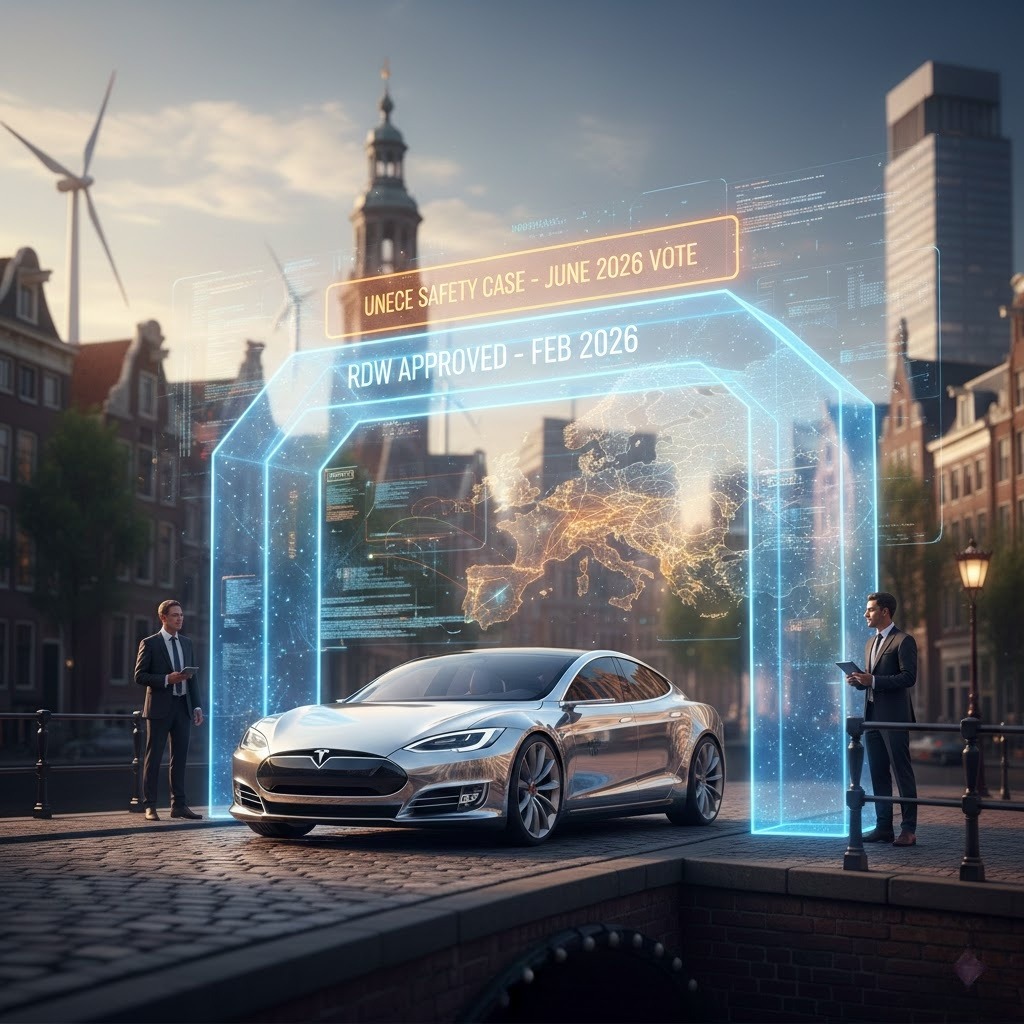
Executive Summary
Today, February 12, 2026, the global Tesla community is witnessing a potential tectonic shift in the European automotive landscape. After years of regulatory gridlock and local restrictions that have seen European Tesla owners using a "watered-down" version of Autopilot, the Dutch vehicle authority (RDW) is entering a critical demonstration phase. This month—February 2026—was long ago marked as the "deadline" for Tesla to prove that its neural-network-driven Full Self-Driving (Supervised) system can safely navigate the complex, high-density infrastructure of the European Union.
As of today, the dialogue has shifted from "if" to "how." With the UNECE (United Nations Economic Commission for Europe) recently adopting a draft global regulation for Automated Driving Systems (ADS) on January 23, 2026, the framework for approval has fundamentally changed. We are no longer looking at rigid, prescriptive rules from the 1950s, but a modern "Safety Case" approach. This article provides a deep-dive analysis into the RDW's current testing status, the nuances of EU Regulation 2018/858, and what this "Gateway" means for Tesla owners from Berlin to Barcelona.
I. The February 2026 RDW Milestone: Testing the "Brain" on Dutch Soil
For the better part of two years, Tesla’s engineering team in Palo Alto and its regional regulatory team in Amsterdam have been preparing for this exact week. The RDW (Rijksdienst voor het Wegverkeer), the Netherlands' vehicle authority, is the primary "Type Approval" body for Tesla in Europe. Because Tesla operates under a whole-vehicle type approval granted by the Dutch, the RDW is the gatekeeper for the entire continent.
1. The Demonstration Phase
As of today, February 12, 2026, Tesla is actively conducting "supervised demonstration drives" for RDW officials. These are not merely PR stunts but rigorous, data-logged sessions designed to satisfy the Admittance Procedure for Connected and Automated Vehicles. Unlike previous years where regulators relied on simulations, the RDW is now evaluating how FSD v13+ handles specifically "European" scenarios:
-
Narrow Urban Streets: Navigating the tight canals of Amsterdam and the cobblestone streets of Haarlem.
-
Unstructured Intersections: Managing roundabouts with multiple exits and shared-space cycling lanes (the "Dutch Reach" scenario).
-
Signage Variation: Recognizing and adhering to the diverse speed limit and warning signs that vary slightly across EU borders.
2. The "Article 39" Exemption Strategy
Tesla is currently pursuing a "National Exemption" under EU Regulation 2018/858. This is a strategic masterstroke. Rather than waiting for every single EU member state to agree on a permanent law, Tesla is asking the Netherlands to grant a temporary, national-level approval for "new technologies not covered by existing regulations."
-
The Goal: To allow FSD (Supervised) to operate without the restrictive "lane-change confirmation" prompts and the rigid steering torque requirements of current DCAS (Driver Control Assistance Systems) rules.
-
The Domino Effect: Once the RDW grants this exemption, the Netherlands can petition the European Commission. If a majority of EU members approve the Dutch petition, the exemption becomes valid across the entire EU.
II. Decoding the UNECE "Safety Case" Framework
The biggest roadblock to FSD in Europe has historically been the prescriptive nature of UN regulations. Older rules required that a car must do "X" when it sees "Y." However, neural networks (AI) are probabilistic, not deterministic. You cannot write a line of code for every possible scenario in Paris or Rome.
1. The Shift to Outcome-Based Validation
On January 23, 2026, the UNECE Working Party (GRVA) adopted a draft that establishes a "Safety Case" methodology. This is the "Golden Ticket" Tesla has been waiting for.
-
Safety Management System (SMS): Instead of checking boxes on features, the RDW will now audit Tesla’s entire software development lifecycle. They are looking at how Tesla identifies "edge cases," how it labels data, and how it validates software updates before they are pushed over-the-air (OTA).
-
Validation through Data: Tesla’s 10-billion-mile fleet data is finally being accepted as a legitimate safety proof. The RDW is reviewing data showing that FSD (Supervised) has a lower intervention rate per kilometer than a human driver in similar European urban environments.
2. The WP.29 Vote in June 2026
While the RDW can grant a national "pass" this month, the permanent, pan-European legal certainty depends on the WP.29 World Forum for Harmonization of Vehicle Regulations session scheduled for June 23-26, 2026. If the RDW demonstration this week is successful, it will serve as the primary "Evidence Pack" for the June vote.
III. Regional Fragmentation: The German Skepticism vs. UK Speed
Despite the RDW's progress, the "Gateway" is not without friction. Europe is a patchwork of opinions on AI safety.
1. Germany’s KBA and "Explainable AI"
The German KBA (Kraftfahrt-Bundesamt) has expressed concerns about the "Black Box" nature of Tesla’s end-to-end neural networks. German regulators traditionally demand to know why a car made a decision. Tesla’s move to v13, which relies less on human-coded logic, makes this "explainability" harder.
-
The Tension: If the Netherlands approves FSD but Germany remains skeptical, we could see a scenario where FSD "geofences" itself at the German border—a feature already spotted in recent fleet code updates (the "Border Crossing Detection" logic).
2. The UK’s Post-Brexit Leap
Interestingly, the UK is moving faster. Having separated from the EU regulatory bureaucracy, the UK’s Automated Vehicles Act has provided a clearer liability framework. Tesla has been spotted testing right-hand-drive (RHD) FSD builds in London and Manchester throughout early 2026, potentially aiming for a UK launch alongside the Dutch approval.
IV. Technical Challenges of the "European Build"
European owners often ask: "Why can't I just have the US version?" The answer lies in the physics of European infrastructure.
-
The "Shadow" Limit: European lanes are, on average, 20-30% narrower than US lanes. FSD v13 has had to be retrained to prioritize "centering" with a much higher precision to avoid clipping mirrors on parked cars.
-
Traffic Light Diversity: Unlike the standard vertical stacks in the US, European lights can be horizontal, mounted on low pedestals, or integrated into complex tram-signaling systems. Today’s testing by the RDW includes "vulnerability tests" at tram crossings—a major hurdle for vision-only systems.
Conclusion: The Road Ahead
The "Dutch Gateway" is the most significant regulatory milestone for Tesla since the original Model S launch in Europe. If the RDW issues its favorable report following this week's tests, the "supervised" leash will finally be lengthened.
We anticipate that by Q3 2026, "FSD (Supervised)" will be a downloadable reality for most Western European owners, albeit with a "probationary" period where certain high-speed maneuvers still require hands-on-wheel. For the Tesla blogger and owner, the message is clear: the hardware is ready, the AI is trained, and the "Red Tape" is finally being cut by the RDW in the Netherlands.
FAQ
Q1: If the RDW approves FSD today, can I use it immediately in France or Italy?
-
A: Not instantly. The RDW's "National Approval" initially applies to the Netherlands. However, under EU reciprocity, other countries can "opt-in" to recognize this approval almost immediately. Expect a country-by-country rollout over 3-6 months.
Q2: Does my car need Hardware 4 (AI4) for the European FSD?
-
A: While HW3 is supported, the RDW's safety audit is heavily focused on the redundancy and high-resolution cameras of AI4. There is a possibility that "full" P2P (Park-to-Park) in Europe may require the increased processing power of AI4.
Q3: Is FSD in Europe still "Level 2"?
-
A: Yes. Even with the new UNECE framework, the current approval is for "Supervised" driving. You remain the legally responsible party. Level 3 (where Tesla takes liability) is expected to be a separate, more rigorous filing in 2027.