
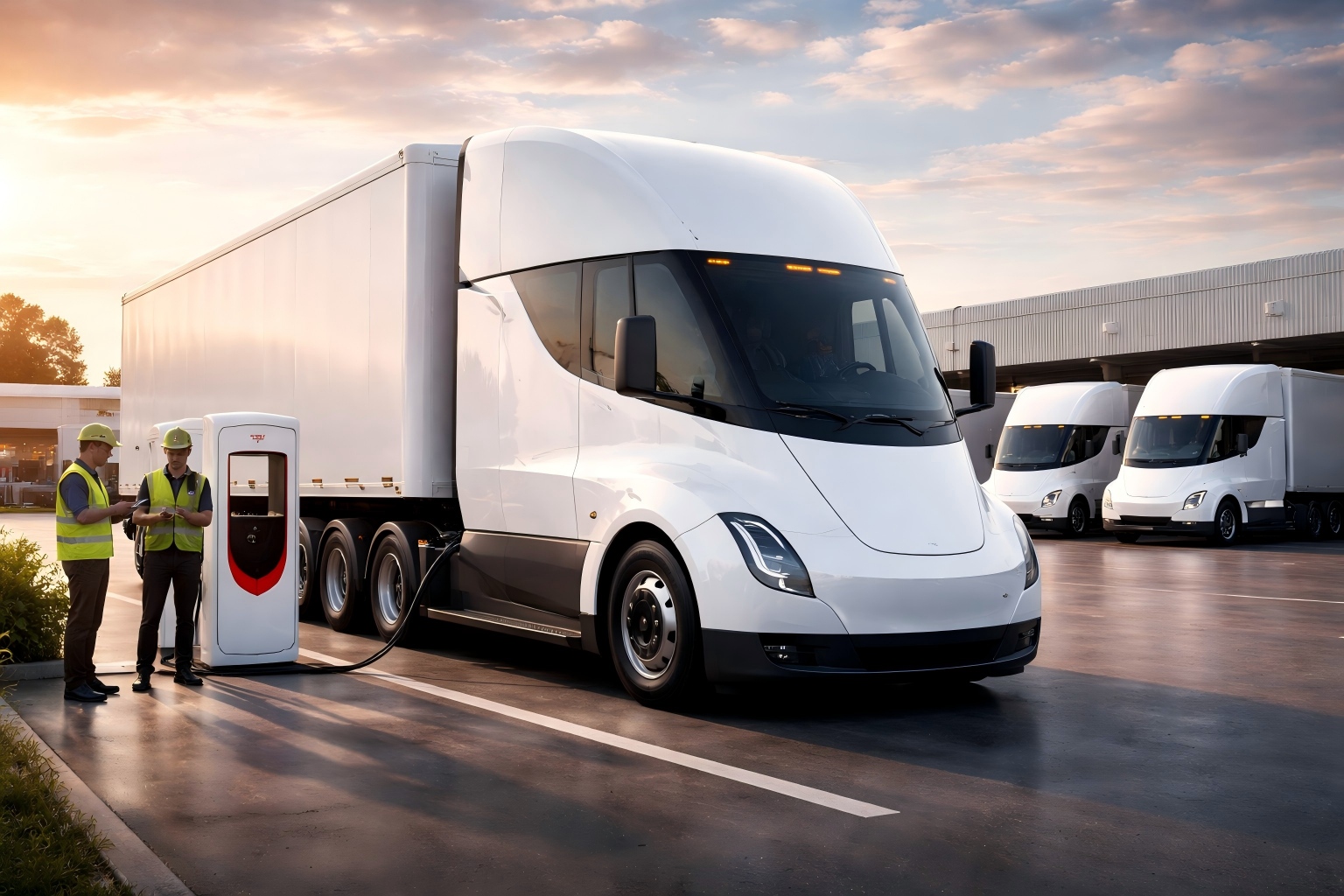
Introduction: The Long-Awaited Arrival
For nearly a decade, the Tesla Semi existed in a strange limbo—a spectacular promise unveiled on a theatrical stage in 2017, a vehicle that seemed perpetually stuck in the “coming soon” category while Tesla’s passenger vehicles conquered global markets. Fleet operators watched with cautious optimism, logistics analysts speculated about production timelines, and Tesla skeptics dismissed the Semi as yet another Muskian overpromise destined for perpetual delay.
But 2026 has rewritten that narrative.
In March of this year, Tesla officially confirmed that the Semi has entered volume production at Gigafactory Nevada, with the first wave of fleet customer deliveries now underway . This is not a pilot program with a handful of vehicles; this is the beginning of a production ramp designed to reach 50,000 units annually. The Semi has moved from prototype purgatory to commercial reality, and the implications for the North American trucking industry—already the backbone of the continent’s economy—are profound.
The timing could not be more critical. Diesel prices, while lower than their 2022 peaks, remain volatile. Carbon regulations are tightening across California and beyond. And fleet operators are facing unprecedented pressure to modernize their aging diesel fleets while maintaining the razor-thin margins that define the trucking business. Into this landscape arrives a vehicle that Tesla claims can deliver lower total cost of ownership, comparable payload capacity to diesel rigs, and a driving experience that fundamentally rethinks what a Class 8 truck can be.
Chapter 1: Engineering the Uncompromised Electric Truck
The Weight Problem That Defined Electric Trucking
Before examining the Tesla Semi’s engineering architecture, it is essential to understand the fundamental challenge that has plagued every electric truck project to date: weight.
A Class 8 diesel tractor weighs approximately 17,000 to 19,000 pounds. The trailer adds another 10,000 pounds. Combined, a typical long-haul rig weighs around 28,000 pounds empty, leaving roughly 52,000 pounds of payload capacity under the standard 80,000-pound gross vehicle weight limit (GVWR) that governs US highways.
Now introduce a battery pack large enough to deliver 500 miles of range. At current energy densities, such a pack weighs between 10,000 and 15,000 pounds. Suddenly, that 52,000-pound payload capacity shrinks by thousands of pounds, eating directly into a fleet operator’s revenue. A truck that cannot carry as much freight as a diesel equivalent is, for most carriers, a non-starter regardless of its environmental credentials.
Tesla’s engineering team, led by Semi Program Director Dan Priestley, approached this problem with unusual clarity. Instead of accepting the weight penalty as inevitable, they treated weight reduction as the primary engineering objective from the very beginning .
The 1,000-Pound Breakthrough
The most significant weight reduction achievement in the production-ready Semi is a 1,000-pound decrease compared to earlier pilot vehicles. This was accomplished through a combination of structural optimization, component consolidation, and the strategic deployment of technologies developed for other Tesla vehicles .
The 48-volt low-voltage architecture, first introduced on the Cybertruck, plays a crucial role here. Traditional Class 8 trucks rely on a 12-volt electrical system that requires thick, heavy copper wiring runs throughout the vehicle. By switching to 48 volts, Tesla dramatically reduces the current required for any given power load, which in turn allows for significantly thinner wiring. Across a vehicle as large as a Class 8 tractor, this translates into hundreds of pounds of copper weight eliminated .
The 48-volt architecture also enables fully electric steering—a departure from the hydraulic steering systems that have dominated heavy truck design for decades. The electric power steering system eliminates the hydraulic fluid, pumps, and associated plumbing, further reducing weight while also improving reliability and reducing maintenance requirements .
The Cybertruck Technology Transfer
Tesla’s decision to leverage existing in-house technologies rather than developing everything from scratch for the Semi reflects a pragmatic engineering philosophy that has accelerated the vehicle’s path to production.
The Semi shares its 4680 battery cells with the Cybertruck and the energy storage division’s Megapack products. These cylindrical cells, first unveiled at Battery Day in 2020, represent a fundamental redesign of the lithium-ion battery architecture. The larger format reduces the number of cells required for any given pack capacity, simplifies cooling, and enables structural integration where the battery pack becomes a load-bearing element of the vehicle chassis .
The inverter technology, motor design, and thermal management systems likewise draw heavily from Tesla’s existing vehicle programs. This commonality not only reduces development time but also creates economies of scale that benefit all of Tesla’s product lines.
The Dual-Axle Drive Architecture
One of the more innovative engineering decisions in the Semi concerns its drivetrain configuration. Unlike most electric trucks, which simply replace a diesel engine with a single electric motor, the Semi employs a dual-drive axle architecture with independent control .
The front axle handles heavy-load starts, steep grades, and low-speed maneuvering—the conditions that demand maximum torque. Once the vehicle reaches highway cruising speeds, the front axle automatically disconnects, eliminating the parasitic drag that would otherwise reduce efficiency. The rear axle takes over for sustained highway driving, operating in its most efficient regime.
This intelligent torque management system effectively eliminates the need for a multi-speed transmission—a complex, heavy, and maintenance-intensive component that represents one of the more failure-prone elements in conventional diesel trucks. By eliminating the transmission entirely, Tesla reduces both weight and mechanical complexity.
Aerodynamics: The 0.4 Barrier
For any vehicle, aerodynamic drag becomes the dominant energy consumer at highway speeds. For a Class 8 truck with its bluff front profile, the stakes are even higher. A 7 percent reduction in drag coefficient translates directly into measurable range improvements and, more importantly, lower operating costs .
The production-ready Semi achieves a drag coefficient of 0.4—a remarkable figure for a vehicle of this size and configuration. To put this number in perspective, a typical Class 8 diesel truck has a drag coefficient between 0.55 and 0.65. The reduction was achieved through extensive computational fluid dynamics modeling, wind tunnel testing, and iterative design refinements visible in the vehicle’s sculpted front end, flush surfaces, and carefully managed airflow around the trailer gap .
Cabin Ergonomics for the Working Driver
Beyond the engineering metrics, the production Semi also incorporates practical refinements that reflect real-world operating requirements. The windows now fully retract, allowing drivers to easily exchange paperwork at loading docks, navigate security checkpoints, and interact with weigh stations without opening the cab door—a small detail that has outsized impact on driver convenience and operational efficiency .
The cabin layout, while minimalist by traditional truck standards, prioritizes driver comfort and visibility. The central driving position provides an unobstructed view of the road, while the digital instrument cluster presents all critical vehicle data in a format that is immediately legible. The absence of a conventional engine tunnel frees up interior space that would otherwise be occupied by a massive diesel powertrain.
Chapter 2: The Economics That Matter to Fleet Operators
Real-World Operating Cost Data
Engineering achievements are interesting to engineers. For fleet operators, what matters is the bottom line: cost per mile, total cost of ownership, and return on investment.
Tesla has been gathering real-world operating data from its pilot fleet—primarily PepsiCo, which has been running Semi vehicles out of its Frito-Lay facility in Modesto, California since 2022—and the numbers are now publicly available. The data shows that the Tesla Semi delivers a 50 percent reduction in operating costs compared to diesel equivalents in California, where electricity rates and diesel prices create a particularly favorable economic case for electrification .
Nationally, the advantage is somewhat smaller but still substantial. Based on current national average electricity rates (approximately 18.9 cents per kilowatt-hour) and diesel prices, the Semi’s per-mile operating cost is approximately 20 percent lower than comparable diesel trucks . For a fleet operating 100 trucks, each covering 120,000 miles annually, that 20 percent savings translates into millions of dollars per year.
Breaking Down the Cost Advantage
The operating cost advantage derives from three primary sources: fuel, maintenance, and regulatory compliance.
Fuel Costs: The Semi consumes approximately 1.7 kilowatt-hours per mile under typical operating conditions. At the national average industrial electricity rate of 18.9 cents per kilowatt-hour, this yields fuel costs of roughly 32 cents per mile. By comparison, a diesel truck achieving 6.5 miles per gallon at $3.80 per gallon yields fuel costs of 58 cents per mile. The gap widens further in California, where electricity rates for commercial fleets are often locked in at favorable long-term contracts while diesel prices remain elevated .
Maintenance: Electric powertrains are fundamentally simpler than diesel engines. There are no oil changes, no fuel filters, no emissions aftertreatment systems (DPF, SCR, DEF), no turbochargers, and no transmission servicing. The regenerative braking system dramatically extends brake life; early pilot data suggests brake pad replacements occur at roughly one-third the frequency of diesel trucks. Tesla’s data indicates that the Semi’s battery pack is designed for 1 million miles of service life—roughly equivalent to the expected lifespan of a long-haul truck .
Regulatory Compliance: For fleets operating in states with carbon pricing or emissions compliance requirements, the Semi offers immediate compliance without the administrative overhead of emissions credits, reporting requirements, or the risk of non-compliance penalties.
The Payload Parity Achievement
Perhaps the most significant economic achievement is payload parity. For years, skeptics argued that electric trucks would never match diesel payload capacity because of battery weight. The production Semi has proven them wrong.
Through a combination of the 1,000-pound weight reduction, the 2,000-pound federal weight exemption for electric commercial vehicles (which allows them to exceed the 80,000-pound limit by up to 2,000 pounds to accommodate battery weight), and careful engineering optimization, the Semi’s effective payload now matches diesel equivalents. Fleet customers are already reporting daily payloads of 45,000 pounds—the standard load for a fully loaded Class 8 tractor-trailer .
Capital Costs: Understanding the Price
The financial analysis would be incomplete without addressing the upfront capital cost. The Semi is not inexpensive. The Long Range model, offering 500 miles of range, carries a base price of $290,000. The Standard Range model, with 325 miles of range, is priced at $260,000 .
At first glance, these numbers appear daunting compared to a diesel truck, which can be purchased for $150,000 to $180,000. However, two factors substantially alter this calculus.
First, the US Inflation Reduction Act provides a commercial EV tax credit of up to $40,000 per vehicle, reducing the effective price to between $220,000 and $250,000 depending on the model and configuration. Second, the total cost of ownership calculations already described—with lower operating costs over the vehicle’s lifespan—typically produce a breakeven point between 150,000 and 200,000 miles. Beyond that mileage, the Semi delivers superior lifetime economics even with the higher purchase price .
Moreover, the Semi’s pricing is highly competitive within the electric truck segment. Industry data shows that comparable electric Class 8 trucks from other manufacturers carry average prices of $435,000—nearly 50 percent higher than the Semi’s Long Range model .
The Million-Mile Battery
One of the more consequential economic implications concerns the battery pack’s design life. The Semi’s 4680-based battery architecture is engineered for 1 million miles of service before reaching 80 percent of original capacity . This aligns the battery lifespan with the typical useful life of the truck itself, eliminating the prospect of a mid-life battery replacement—a cost that would otherwise undermine the economic case for electrification.
For fleet operators accustomed to retiring diesel trucks at 800,000 to 1 million miles, this alignment is crucial. It means the truck can be operated for its full useful life without a major capital-intensive component replacement, preserving the economic advantages throughout.
Chapter 3: The Megacharger Network-Building the Infrastructure for Electric Trucking
Beyond the Vehicle
No electric truck can succeed without charging infrastructure. Fleet operators cannot deploy vehicles if they cannot reliably charge them. Recognizing this reality, Tesla has been quietly building a Megacharger network that is now beginning to take shape.
As of March 2026, Tesla has three operational Megacharger sites in the United States. The first two—at Gigafactory Nevada and in Carson, California—were primarily dedicated to Tesla’s internal fleet and pilot partners. The third, located at 4265 East Guasti Road in Ontario, California, represents the first site explicitly opened to Semi customers .
The Ontario location was strategically selected for its position in the Inland Empire—one of the nation’s busiest freight corridors at the junction of Interstate 10 and Interstate 15. This location serves the critical route connecting the ports of Los Angeles and Long Beach with the massive distribution centers that dot the region. For any fleet engaged in drayage or regional freight operations, this charging hub represents a crucial piece of the operational puzzle .
66 Sites and Counting
What makes the Ontario opening significant is not the site itself but what it represents: the first visible manifestation of a much larger network.
In February 2026, Tesla updated its “Find Us” map with 64 new Megacharger locations across 15 US states, bringing the total planned network to 66 sites. Texas leads with 19 planned locations, reflecting both the state’s central role in freight logistics and its favorable regulatory environment for EV infrastructure. California follows with 17 sites, concentrated along major freight corridors including I-5, I-10, and I-15 .
The planned network is designed to cover the continent’s busiest freight routes: the West Coast I-5 corridor connecting California, Oregon, and Washington; the transcontinental I-10 and I-40 corridors linking Southern California with the Southeast and East Coast; and the I-95 and I-75 corridors serving the Eastern Seaboard and Midwest.
The Pilot Travel Centers Partnership
Tesla has also forged a strategic partnership with Pilot Travel Centers, the largest operator of truck stops in North America. The agreement calls for Tesla to install Megachargers at select Pilot locations across California, Georgia, Nevada, New Mexico, and Texas, with construction expected to begin in the first half of 2026 and the first stations opening by summer 2026 .
Each Pilot hub will feature four to eight charging stations, all utilizing Tesla’s V4 charging technology capable of delivering up to 1.2 megawatts per station. Importantly, the partnership initially provides for exclusive use by Tesla Semi customers, though the agreement contemplates potential future opening to third-party electric trucks—a model that would mirror the evolution of Tesla’s Supercharger network for passenger vehicles .
Charging Capabilities
The Megacharger’s technical specifications are as impressive as the network scale. Each station can deliver up to 1.2 megawatts of power—enough to recharge a Semi’s battery pack to 60 percent of its capacity in approximately 30 minutes .
This charging speed is operationally significant because it aligns with mandatory driver rest periods. Under federal hours-of-service regulations, truck drivers are required to take a 30-minute break after 8 hours of driving. A 30-minute charge session that restores 300 miles of range effectively eliminates any net time penalty for charging compared to diesel refueling, provided the charging infrastructure is located where drivers would otherwise be taking their mandated breaks.
Currently, the Ontario Megacharger site is operating at 750 kilowatts rather than the full 1.2 megawatts, reflecting either grid constraints or the early stage of deployment. However, the infrastructure is designed for the full power output, and future upgrades are expected to deliver the maximum charging speed .
The Competitive Landscape
Tesla is not the only player in the electric truck charging space. An industry standard known as the Megawatt Charging System (MCS) is gaining traction across Europe and North America, with major manufacturers including Daimler, Volvo, and Scania committing to the standard for their forthcoming electric trucks. The MCS standard theoretically supports up to 3.75 megawatts of charging power, though no vehicles currently in production can accept that level of power .
Tesla’s competitive advantage in this space is twofold. First, the company already has trucks on the road generating real-world operational data and revenue. Second, the Megacharger network is being built and deployed now, while competitors are largely still in the planning and prototype phases. In an industry where fleet operators need to see proven infrastructure before committing to vehicle purchases, this first-mover advantage is significant.
Chapter 4: The Competitive Landscape and Market Outlook
US Market Context
The Tesla Semi enters a US Class 8 truck market that is slowly but steadily electrifying. In 2025, approximately 1,500 electric Class 8 trucks were registered in the United States—a small fraction of the 280,000 total Class 8 trucks sold annually, but a meaningful increase from prior years. Industry analysts project that 2026 sales will reach approximately 2,500 units, with the Tesla Semi capturing a significant portion of that volume .
The market’s growth is constrained by two factors that will likely persist for the next several years. First, the upfront cost of electric trucks remains a barrier for smaller fleets with limited capital access, even when total cost of ownership favors electrification. Second, the charging infrastructure network remains sparse outside the major freight corridors, limiting electric trucks to regional operations rather than true long-haul applications.
Tesla’s strategy appears calibrated to these constraints. By focusing initial production on the Standard Range model (325 miles) for regional distribution and drayage operations—exactly the use case where the existing pilot fleets have proven successful—Tesla can build production volume and operational experience before tackling the more demanding long-haul market.
The Chinese Alternative
While the Semi captures headlines in North America, a different approach to truck electrification is taking shape in China, the world’s largest commercial vehicle market. Chinese manufacturers are pursuing a more diversified strategy that includes not only pure battery electric trucks but also hybrid and hydrogen fuel cell solutions for long-haul applications .
In January 2026, China’s new energy truck sales reached 16,100 units—more than ten times the projected US market for the entire year. The penetration rate reached 30 percent, meaning that nearly one in three trucks sold in China now carries some form of electrified powertrain .
Chinese manufacturers are also exploring alternative technologies that could eventually challenge Tesla’s approach. Hybrid trucks, combining diesel engines with battery electric systems, are gaining traction for long-haul applications where pure electric range remains insufficient. Hydrogen fuel cell trucks, supported by government subsidies and an emerging hydrogen infrastructure, are also being deployed in demonstration fleets.
The divergence between the US and Chinese approaches reflects different market conditions and policy environments. In China, the government has aggressively subsidized new energy vehicle adoption across all segments. In the US, policy support is less consistent and more concentrated at the state level, leading to a more fragmented market.
Production Capacity and Scale
Tesla’s production plans for the Semi are ambitious. The dedicated manufacturing facility adjacent to Gigafactory Nevada is designed for an annual capacity of 50,000 vehicles . Achieving that scale would represent a fundamental shift in the electric truck market, moving from niche to mainstream volumes.
However, the timeline for reaching full capacity remains uncertain. Tesla’s recent investor communications have removed specific capacity targets that previously appeared in public documents, suggesting that the ramp will be gradual and market-driven rather than a predetermined schedule .
The practical reality is that the electric truck market in 2026 is unlikely to absorb 50,000 units annually. More realistic projections suggest US demand of 5,000 to 10,000 units over the next several years, with additional demand from Canada, Mexico, and eventually Europe. Tesla’s production capacity likely exceeds near-term demand, but the company is positioning itself for the eventual market growth that industry analysts expect later in the decade.
The European Market
The Tesla Semi has also attracted significant attention in Europe, where it was displayed at the IAA Transportation show in Hanover, Germany in 2024. However, Tesla representatives have indicated that the European market debut is likely delayed by at least two years, meaning 2028 at the earliest .
This delay reflects both regulatory differences and the need to adapt the vehicle to European standards. European trucks operate under different weight limits, different charging standards, and different infrastructure realities than their US counterparts. Tesla has hired a Head of Business Development for the EMEA region to address these challenges, suggesting that the European launch remains a priority even if the timeline has slipped .
Chapter 5: Operational Realities for Fleet Owners
The Driver Experience
For the drivers who will operate these vehicles, the Semi represents a significant departure from conventional trucks. The central driving position, unobstructed visibility, and nearly silent operation create an environment that early pilot drivers have consistently praised.
In a recent interview, Tesla Semi Program Director Dan Priestley described the driving experience as fundamentally different from a diesel truck. The instant torque response eliminates the need for downshifting on grades; the regenerative braking system provides controlled deceleration without riding the service brakes; and the low center of gravity contributes to stability that drivers report feeling immediately .
The 48-volt architecture enables fully electric steering that eliminates the hydraulic lag and steering wander characteristic of conventional trucks. Combined with the dual-axle drive system that automatically optimizes torque distribution, the Semi reportedly handles more like a passenger vehicle than a 80,000-pound commercial truck.
Maintenance and Uptime
One of the more compelling operational metrics to emerge from the pilot program is uptime. The Semi test fleet has accumulated over 13.5 million miles of real-world operation with a 95 percent uptime rate—comparable to well-maintained diesel fleets and substantially better than the industry average .
The maintenance advantages derive from fundamental design differences. Diesel trucks contain thousands of moving parts in the engine, transmission, and aftertreatment systems. The Semi’s electric powertrain contains a fraction of those components. There are no oil changes, no fuel filter replacements, no turbocharger failures, no diesel particulate filter regenerations, and no selective catalytic reduction system maintenance.
For fleet operators, these differences translate directly into lower maintenance costs and, more importantly, higher vehicle availability. Every hour a truck spends in the shop is an hour it is not generating revenue. The Semi’s simplified maintenance profile means more time on the road and less time in the service bay.
Charging Logistics
Fleets adopting the Semi will need to adapt their operations to accommodate charging logistics. The basic structure is similar to diesel refueling but with important differences.
Charging can be integrated into the driver’s mandated rest breaks, potentially eliminating any net time penalty. However, this requires careful route planning to ensure that charging infrastructure is available at the appropriate points in the journey. For regional fleets operating out of a central depot, overnight charging at the depot may be sufficient. For longer routes, strategic Megacharger stops become essential.
Fleets will also need to consider whether to install their own charging infrastructure. For large fleets with dedicated terminals, installing on-site Megachargers may be more economical and more convenient than relying on public infrastructure. The capital costs of such installations are significant but can be amortized across the fleet.
Conclusion: A New Chapter for Freight
The Tesla Semi’s entry into volume production marks a genuine inflection point for the trucking industry. After nearly a decade of promises and delays, a production-ready electric Class 8 truck is now being delivered to customers. The vehicle delivers on the core promises that matter to fleet operators: lower operating costs, comparable payload, and reliability that matches—and in some respects exceeds—diesel equivalents.
The broader significance of the Semi extends beyond the vehicle itself. It represents Tesla’s entry into the largest commercial vehicle market in the world, a market that has been slow to electrify but is now beginning to move. It validates the electric truck concept in the demanding environment of real-world freight operations. And it establishes a charging infrastructure network that will support not only Tesla’s trucks but potentially the entire electric truck industry.
For fleet operators, the decision calculus is shifting. The question is no longer whether electric trucks are viable but rather when to begin the transition and how to structure it for maximum economic benefit. The early adopters—PepsiCo, Walmart, and others—have already demonstrated the viability of the approach. The next wave of adoption will come from fleets that are watching those pioneers and preparing their own transition plans.
The Tesla Semi is not a perfect vehicle, and the electric truck market is not yet mature. Charging infrastructure remains limited outside major corridors. The upfront cost, while competitive within the electric truck segment, remains higher than diesel equivalents. And the long-term durability of the battery packs has not yet been proven across the full million-mile lifecycle.
But for the first time, a comprehensive solution exists: a production-ready vehicle, a growing charging network, and a business case that works for many applications. For fleet operators willing to be early adopters, the Semi offers a genuine competitive advantage. For those who wait, the competitive landscape may look very different when they finally make the transition.
FAQ
Q: What is the actual range of the Tesla Semi in real-world operations?
A: The Long Range model delivers approximately 500 miles at 82,000 pounds gross combination weight under typical operating conditions. The Standard Range model delivers 325 miles. Early pilot data suggests these figures are achievable in real-world operations with conservative driving and favorable conditions. Cold weather, aggressive driving, and steep grades will reduce range as they would with any vehicle.
Q: How much does the Tesla Semi cost?
A: The Long Range model starts at $290,000, and the Standard Range model starts at $260,000. After applying the federal commercial EV tax credit of up to $40,000, effective prices range from $220,000 to $250,000 depending on configuration and eligibility.
Q: Can small fleets or independent owner-operators purchase the Semi?
A: Yes, Tesla is accepting orders from businesses of all sizes. However, delivery priority may be given to larger fleets that can maximize infrastructure utilization. Individual owner-operators should expect longer wait times.
Q: How long does it take to charge a Tesla Semi?
A: With a 1.2-megawatt Megacharger, the Semi can charge to 60 percent of range in approximately 30 minutes. A full charge to 100 percent takes longer and is typically done overnight. The charging curve is optimized for rapid replenishment during driver rest periods.
Q: What warranty does the Tesla Semi come with?
A: The battery and drivetrain are covered by an 8-year, 1-million-mile warranty, aligning the battery lifespan with the expected useful life of the truck. Additional components are covered by standard commercial vehicle warranties.
Q: Is the Tesla Semi eligible for government incentives?
A: Yes, the Semi qualifies for the Inflation Reduction Act commercial EV tax credit of up to $40,000 per vehicle, provided the vehicle is placed in service in the United States and meets domestic content requirements. Some states offer additional incentives for commercial EV purchases.
Q: Where can I charge a Tesla Semi today?
A: As of March 2026, operational Megacharger sites are located at Gigafactory Nevada, Carson, California, and Ontario, California. An additional 63 sites are planned across 15 states, with construction underway at many locations.
Q: Can the Tesla Semi be used for long-haul cross-country routes?
A: Currently, the Semi is best suited for regional operations and dedicated routes where charging infrastructure is available at both ends. For true long-haul cross-country operations, the charging network is not yet sufficiently developed to support the route without careful planning and extended charging stops.