
Introduction
The definition of automotive software has undergone a paradigm shift with the deployment of Tesla’s mobile application update accompanied by vehicle firmware version 2026.20.6.1. For years, mobile vehicle applications served as glorified secondary remotes, restricted to basic telemetry query loops such as triggering climate pre-conditioning, monitoring state of charge (SoC), or unlatching door mechanisms.
However, as of July 7, 2026, Tesla has systematically overhauled this interface, transforming it into an enterprise-grade fleet telematics command center. The introduction of a live, glowing blue "Self-Driving" trajectory map and state indicator directly within the smartphone app marks a monumental shift. No longer is vehicle visualization confined to the localized Media Control Unit (MCU) screen inside the cabin. Instead, full operational telemetry is being securely streamed off-board in near real-time.
Section 1: Architectural Breakdown of the Remote FSD Indicator
The mechanical execution of streaming real-time vehicle visualization from an edge-computing platform (the vehicle) to a remote hand-held device requires a highly efficient networking architecture. Early telemetry systems deployed by legacy automotive original equipment manufacturers (OEMs) relied on intermittent polling protocols, where the smartphone app would ping a central server every 30 to 60 seconds via an HTTP REST API to pull static coordinate points. This method is entirely inadequate for visualizing an autonomous vehicle moving at highway speeds.
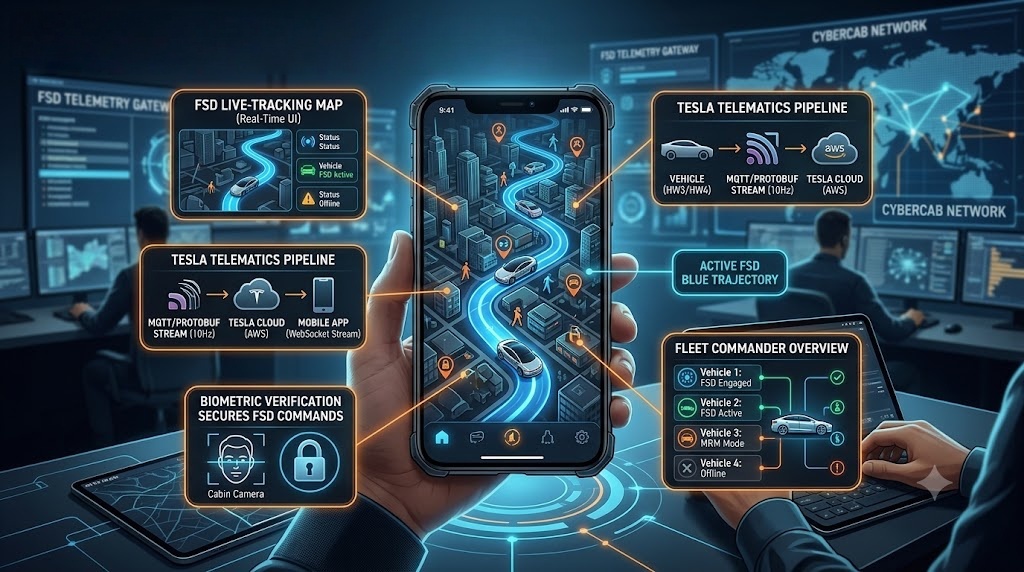
Tesla's implementation relies on a persistent bidirectional communication pipeline built upon a highly optimized WebSocket protocol layered over a customized MQTT (Message Queuing Telemetry Transport) broker architecture. When a vehicle running firmware 2026.20.6.1 engages Full Self-Driving, the localized Telemetry Gateway module inside the car begins publishing compressed Protocol Buffers (Protobuf) binaries at an ultra-high frequency of up to 10Hz (ten updates per second). These binaries contain exact spatial vector coordinates, current lateral and longitudinal acceleration matrices, target vector paths, and object classification hashes identified by the occupancy network.
This data stream is ingested by Tesla’s localized cloud nodes, which serve as regional proxy hubs across North America and Europe to minimize geographic latency. The cloud nodes mirror the incoming telemetry and forward it directly to the active user session on the Tesla app via a secure TLS-encrypted WebSocket channel. This architecture limits end-to-end network latency to less than 120 milliseconds under stable 5G or LTE cellular conditions.
Crucially, real-world teardowns and field reports from early software deployments have confirmed that this feature operates flawlessly across both Hardware 3 (HW3) and Hardware 4 (HW4/AI4) vehicles. While HW3 relies on a twin custom-designed FSD chip configuration manufactured on a 14nm process node, its localized memory bandwidth is fully capable of compiling the downsampled vector data required for the remote application render.
On the application side, the smartphone does not attempt to render raw camera feeds or computationally heavy 3D point clouds. Instead, the application's graphic engine parses the incoming Protobuf data packets to draw the iconic glowing blue path and path vectors dynamically over an vector-based map interface. This abstraction ensures that the feature is highly responsive without draining the smartphone’s battery or overwhelming cellular data limits.
Section 2: The Infrastructure for the Autonomous Cybercab Network
To understand why Tesla dedicated significant engineering capital to building a live remote autonomy tracker, one must look beyond the immediate novelty for individual retail owners. This software update is a direct, calculated foundational piece of infrastructure for the commercial launch of the Tesla Network—the autonomous ride-hailing fleet colloquially centered around the Cybercab.
When an individual owner opts their personally owned Model 3, Model Y, or Model S into the autonomous ride-hailing network, the dynamic between user and vehicle shifts from operator-and-machine to enterprise-and-asset. A fleet operator cannot remain blind to what an asset is doing while it is miles away generating revenue. The mobile application, in essence, becomes an iOS and Android compatible Fleet Management Dashboard.
Consider a multi-vehicle fleet scenario. By utilizing the real-time FSD indicator, a fleet owner can instantly verify whether an un-crewed vehicle is actively following its optimal routing algorithm or if it has encountered an edge-case anomaly forcing it into a minimal risk maneuver (MRM).
The blue trajectory line tells the operator exactly what the car intends to do over the next several hundred meters, such as preparing for an upcoming highway split or adjusting for a lane blockage. If a vehicle gets trapped in an unmapped construction zone or encounters a complex police checkpoint, the remote operator can monitor the vehicle’s behavioral hesitation patterns remotely before stepping in via forthcoming remote guidance protocols.
Furthermore, this telemetry pipeline plays an indispensable role in localized insurance actuary calculations. Because Tesla operates its own proprietary, data-driven insurance product across multiple US states, the real-time synchronization of FSD engagement metrics allows the underwriting algorithms to accurately segment risk profiles.
If a vehicle is operating on FSD 100% of the time during commercial ride-hailing hours, its risk coefficients are calculated radically differently compared to a vehicle being manually driven in high-density urban corridors. The live indicator acts as an immutable, audited record of autonomous operation, providing a cryptographic proof-of-engagement that safeguards both the vehicle owner and the platform operator in the event of an extraordinary third-party liability incident.
Section 3: Biometric Verification and Cybersecurity Safeguards
As vehicles transition into cloud-connected autonomous robots, the attack surface for malicious actors expands exponentially. The ability to track a vehicle's autonomous route remotely introduces profound security concerns: What prevents an adversary from intercepting this telemetry stream? Worse, what prevents an unauthorized individual from remotely commanding a vehicle to engage FSD and drive to an arbitrary destination?
Tesla’s countermeasure, uncovered via reverse-engineering of the application’s latest installation manifest, is a rigorous biometric identity verification protocol that leverages the vehicle's internal Cabin Camera. Under this upcoming security layer, before Full Self-Driving or remote-hailing commands can be fully authorized through the ecosystem, the vehicle's localized vision processing unit must match the facial biometrics of the occupant in the driver's seat with the authorized user profiles cryptographically stored in the vehicle's secure enclave hardware module.
The cabin camera does not transmit raw images of the driver to Tesla’s servers—a practice that would flag severe infractions under the European Union’s General Data Protection Regulation (GDPR). Instead, the localized vision network parses the infrared facial feed to extract a mathematical vector map of distinct facial landmarks. This tokenized map is compared locally against the primary owner's credential token. If an unrecognized operator attempts to engage FSD in a manner that deviates from standard parameters, or if a remote command is issued without a corresponding biometric handshake from the master device, the vehicle instantly enters a localized lockdown state.
From a network security perspective, the entire telemetry pipeline utilizes end-to-end encryption employing Elliptic Curve Cryptography (ECC) with ephemeral session keys. Even if an adversary intercepts the WebSocket stream via a man-in-the-middle (MitM) attack on a public cellular tower, the data packet payload looks like randomized cryptographic noise. The unique session keys are rotated every time the vehicle cycles its power or switches cell towers, ensuring that a compromised key yields no historic or future access to the vehicle's position or intent data.
Conclusion
The 2026.20.6.1 application update is not a superficial UI enhancement; it is a profound structural evolution. By successfully bridging edge-computed autonomous telemetry with low-latency remote visualization, Tesla has laid the digital tracks for its global autonomous ride-hailing network.
The application successfully transitions the Tesla ownership experience from passive monitoring to active fleet command, while cutting-edge biometric verification and hardware-level encryption ensure that this hyper-connected ecosystem remains impervious to external threats. For the Tesla owner and enthusiast in the West, this update serves as concrete proof that the line between personal transport and a decentralized autonomous utility provider has officially evaporated.
Frequently Asked Questions (FAQ)
Q: Does the live FSD tracker work on Hardware 3 (HW3) legacy vehicles?
A: Yes, field telemetry has verified that the update is fully compatible with HW3 vehicles. The downsampling of localized vector data happens prior to transmission, meaning the older 14nm FSD chips are not bottlenecked by the streaming process.
Q: How much cellular data does the live streaming of self-driving telemetry consume?
A: Because the system uses highly compressed Protocol Buffers (Protobuf) instead of streaming video, data consumption is incredibly low, averaging roughly 1.5 megabytes per hour of continuous driving, which is easily absorbed by Tesla's standard Premium Connectivity packages.
Q: Will the cabin camera biometric verification interfere with sunglasses or nighttime driving?
A: No. The cabin camera utilizes high-intensity near-infrared (NIR) LEDs located in the rearview mirror housing. This allows the localized vision system to read facial geometry accurately through polarized sunglasses and in pitch-black driving environments without causing visible glare inside the cabin.