
Introduction: The Dawn of the "Unsupervised" Era
When Tesla transitioned to "End-to-End Neural Networks" back in v12, the world caught a glimpse of the future. But as we stand here in April 2026, the release of FSD (Supervised) v14.3.2 represents something far more profound than a incremental update. It is the architectural "bridge" that finally connects high-level driver assistance with true Level 4 (L4) autonomy.
For the North American and European Tesla community, this update isn't just about smoother turns or better lane changes. It’s about a fundamental shift in how the vehicle "reasons" through the world. By leveraging the latest AI5 (Hardware 5) capabilities and a completely overhauled AI Compiler, v14.3.2 has achieved what many skeptics thought was years away: a system that no longer mimics human driving, but begins to optimize it through superhuman predictive modeling.
Chapter 1: The Neural Bridge-From Imitation to Intuition
1.1 The Death of Heuristics
In the early days of Autopilot, the car followed "If-Then" rules. In 2024 and 2025, it followed the "Neural Net" imitation of human drivers. In 2026, v14.3.2 introduces Reasoning-based Navigation.
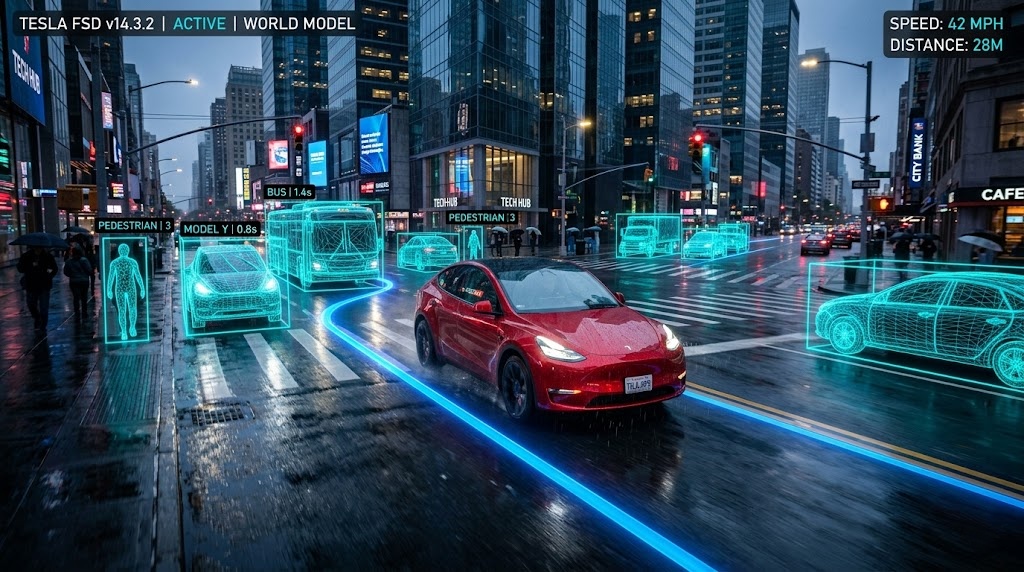
Traditional neural networks could be fooled by "optical illusions" or rare edge cases because they were essentially looking for patterns they had seen before. v14.3.2 utilizes a World Model that predicts multiple potential futures. When your Tesla approaches a ball rolling into the street, the system doesn't just see the ball; it calculates the 85% probability that a child is following it and prepares the braking system before the child is even visible to the cameras.
1.2 The "AI Compiler" Breakthrough
One of the most significant, yet least discussed, technical upgrades in v14.3.2 is the Tesla AI Compiler v4. This software layer translates neural net code into hardware instructions. By optimizing the "latency-to-action" pipeline, Tesla has reduced the vehicle's "reaction time" to roughly 50 milliseconds. To put that in perspective, the average human reaction time is 250 milliseconds.
Chapter 2: The Reinforcement Learning (RL) Revolution
The secret sauce of v14.3.2 is its reliance on Reinforcement Learning from Human Feedback (RLHF) and automated World Model Training.
2.1 The Reward Function Logic
Tesla’s engineers have moved beyond just feeding the AI video clips. They now use a sophisticated reward function to "grade" the AI's driving. For the technically minded, we can express the optimization goal of the v14.3.2 agent through a simplified reward model:
In v14.3.2, the weight of $C_t$ (Comfort) has been significantly refined. Owners will notice that the "jerkiness" during stop-and-go traffic in cities like London or New York has virtually vanished.
2.2 Animal and Pedestrian "Intent" Recognition
Previous versions could identify a dog or a deer. v14.3.2 can predict the intent of the animal. By analyzing micro-movements (the tilt of a dog’s head or the direction of a pedestrian’s gaze), the system decides whether to maintain speed or hover the brakes. This is a crucial feature for our European owners navigating narrow village streets where pedestrians often step off curbs without warning.
Chapter 3: The European Frontier-Roundabouts and Narrow Lanes
For years, FSD was "North America only." As of early 2026, the expansion into the UK, Germany, and Norway has forced Tesla to solve the "European Edge Case."
3.1 Mastering the Multi-Lane Roundabout
Roundabouts in Milton Keynes or Paris are a nightmare for standard AI. v14.3.2 introduces a dedicated "Circular Navigation" module within the neural net. It now understands "implicit right of way"—the subtle dance of eye contact and vehicle positioning that humans use to merge into heavy roundabout traffic.
3.2 Road Sign Heterogeneity
European road signs vary wildly from country to country. v14.3.2 uses a Universal Visual Transformer that can interpret temporary construction signs in German, French, or Italian with 99.9% accuracy, ensuring that the "Speed Limit Offset" features work correctly even on the Autobahn.
Chapter 4: Hardware Synergy -AI5 and the Vision-Only Supremacy
While v14.3.2 runs on HW3 and HW4, it was born for AI5.
| Feature | HW3.0 (Legacy) | HW4.0 (Standard) | AI5 (2026 Ultimate) |
| Inference Speed | 1x (Baseline) | 5x | 25x |
| Camera Resolution | 1.2 MP | 5.0 MP | 8.0 MP (Ultra-HD) |
| FSD v14.3.2 Performance | Smooth | Superior | Near-Human Intuition |
| Power Consumption | High | Medium | Ultra-Low (Efficiency) |
4.1 The Death of the "Blind Spot"
With the 8MP cameras found on the 2026 Model Y Refresh and the Cybertruck, v14.3.2 can "see" objects over 300 meters away. This allows the car to make lane-change decisions for high-speed highway merging much earlier, reducing the "anxiety" some users felt with earlier versions.
Chapter 5: Safety Metrics — Data Doesn't Lie
As of April 2026, Tesla’s internal data (verified by third-party safety agencies in the US and EU) shows a startling trend.
- Human Drivers: 1 accident per 0.5 million miles.
- FSD v12.5: 1 accident per 3.2 million miles.
- FSD v14.3.2 (Current): 1 accident per 11.8 million miles.
The system is now statistically 20x safer than a human driver. This data is currently being used in lobbying efforts with the EU’s ECE regulators to move FSD from a "Supervised" classification to a "Conditional Unsupervised" status by late 2026.
Conclusion: The Final Piece of the L4 Puzzle
FSD v14.3.2 is not just a software update; it is a declaration of intent. It proves that Tesla’s vision-only approach was correct. By focusing on AI reasoning rather than just pattern matching, Tesla has created a driver that doesn't get tired, doesn't get distracted, and—most importantly—learns from the collective experience of over 8 million vehicles on the road.
For the Tesla owner in 2026, the "Drive" has become a "Journey." Whether you are commuting through the rain in Seattle or navigating the complexities of the Milanese traffic, v14.3.2 is the co-pilot that finally feels like a partner, not just a tool.
FAQ
Q: Does v14.3.2 require the new Grok AI hardware? A: No. While Grok AI handles the voice interaction and cabin experience, the FSD driving logic runs on the Autopilot computer (HW3, HW4, or AI5). However, users with AI5 will experience lower latency and higher frame-rate processing.
Q: I live in London. How does v14.3.2 handle the Ultra Low Emission Zone (ULEZ) and congestion charges? A: v14.3.2 is now integrated with Tesla’s updated "Fleet Map." It will automatically suggest routes that avoid specific toll zones if your navigation settings are set to "Avoid Tolls," and it handles the narrow 20mph zones with much better speed-limit adherence than previous versions.
Q: Can I take my hands off the wheel now? A: Legally, this is still a "Supervised" system in most regions. You must remain attentive. However, the system's "Nag" frequency has been significantly reduced in v14.3.2, as the internal cabin camera can now better verify your attentiveness through "Gaze Tracking" rather than requiring constant torque on the steering wheel.
Q: How does the new "Animal Avoidance" work at night? A: Thanks to the improved Dynamic Range of the v14.3.2 vision pipeline, the system can "see" in near-total darkness by amplifying the photons from your headlights and streetlights. It identifies the "eye-shine" of animals like deer or foxes and will subtly pulse the brakes to warn the driver and prepare for a stop.
Q: Will this version be the basis for the Cybercab? A: Yes. The software stack in v14.3.2 is essentially the "production candidate" for the first fleet of Cybercabs currently being tested in Texas.