
Chapter 1: The Q4 2025 Earnings Fallout—A Redefinition of Value
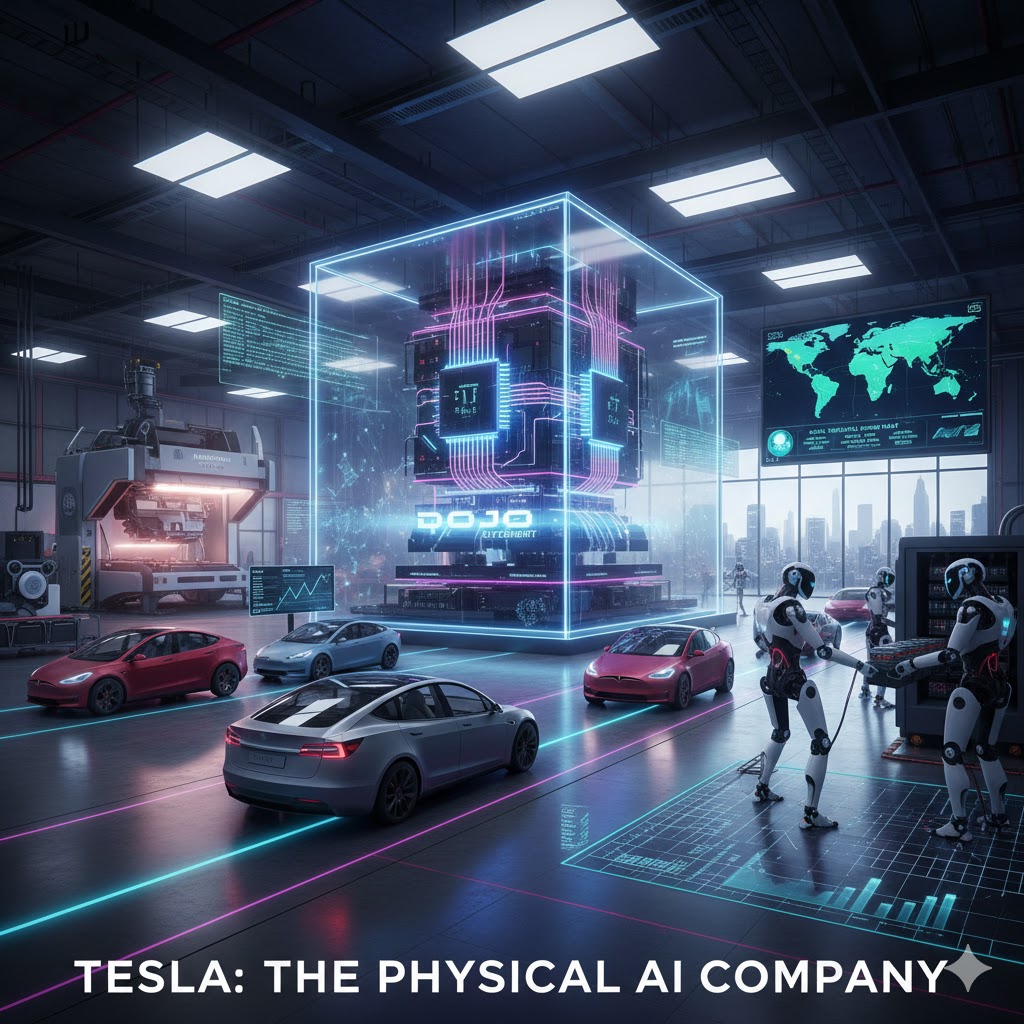
The fourth-quarter 2025 earnings call, held in late January 2026, sent ripples through the financial markets, not because of a catastrophic miss, but because of a deliberate, strategic shift in Tesla's narrative. For years, analysts had fixated on vehicle delivery numbers, gross margins per car, and market share in the electric vehicle (EV) segment. However, CEO Elon Musk, alongside key executives, explicitly reframed Tesla’s identity: "We are no longer primarily an automotive company. We are a Physical AI company."
This declaration was not a sudden revelation but the culmination of years of iterative development in artificial intelligence, robotics, and energy storage. The modest decline in vehicle sales growth, which traditionally would have triggered alarm bells, was instead presented as a conscious trade-off, allowing for a reallocation of capital and engineering talent towards what Tesla views as the ultimate prize: general-purpose AI embedded in the physical world. The market’s initial confusion quickly gave way to a deeper contemplation of Tesla's long-term vision, forcing a re-evaluation of its valuation metrics from a traditional industrial manufacturing multiple to a high-growth technology and AI enterprise multiple. This pivotal moment marked the official transition from a company that uses AI to build cars to a company that builds AI that happens to manifest in cars, robots, and energy systems.
Chapter 2: Defining "Physical AI"—The Car as an AI Chassis
To understand Tesla’s 2026 pivot, one must grasp the concept of "Physical AI." This isn't just about advanced driver-assistance systems (ADAS) or predictive maintenance. Physical AI, in Tesla’s lexicon, refers to autonomous, intelligent agents designed to operate and interact within the real, unpredictable world, learning and adapting through continuous data ingestion and neural network training.
The Vehicle as an AI Robot
For Tesla, the electric car is no longer merely a means of transportation; it is the most sophisticated, commercially deployed robot on wheels. Each Tesla vehicle, equipped with a suite of cameras, ultrasonic sensors, and increasingly, radar (re-integrated into the Hardware 4.0 stack), acts as a data-gathering node, feeding billions of miles of real-world driving scenarios back to Tesla's Dojo supercomputer. The Full Self-Driving (FSD) stack is the purest manifestation of this Physical AI. It is an end-to-end neural network that perceives the environment, predicts the actions of other agents (pedestrians, other vehicles), and autonomously plans a safe and efficient path. The human driver, when present, acts primarily as a supervisor, rather than the primary operator.
Beyond FSD: Optimus and Energy Storage
The "Physical AI" paradigm extends far beyond the car. The Optimus humanoid robot, a project that accelerated significantly in 2025, is a general-purpose bipedal robot designed to operate in unstructured human environments. Its development directly leverages the same AI foundational models, simulation tools, and data pipelines used for FSD. The ability to autonomously navigate a factory floor, manipulate tools, and learn new tasks from human demonstration is a direct transfer of the "eyes and brains" developed for cars.
Similarly, Tesla Energy’s Megapack and Powerwall systems, increasingly managed by sophisticated grid-level AI, represent Physical AI in the realm of distributed energy. These systems autonomously respond to grid fluctuations, optimize energy arbitrage, and coordinate with virtual power plants (VPPs), learning optimal charge/discharge cycles based on weather forecasts, energy prices, and consumption patterns. The underlying intelligence that balances a multi-gigawatt-hour battery array is a direct cousin of the AI that navigates a Tesla on a highway.
Chapter 3: Dojo and the Compute War—Tesla’s $20B Capex Plan for 2026
The ambitious transition to a Physical AI company necessitates an equally ambitious investment in compute infrastructure. Tesla’s $20 billion capital expenditure plan for 2026 is overwhelmingly dedicated to scaling its AI training capabilities, with a significant portion allocated to the Dojo supercomputer project.
The Rise of Dojo
Dojo is not just another data center; it’s a custom-built, purpose-designed supercomputer engineered from the ground up to train massive neural networks for vision-based AI. Its custom D1 chips and ExaPOD architecture offer unprecedented throughput for video data processing, allowing Tesla to rapidly iterate on its FSD models. The 2026 investment will see the deployment of multiple ExaPODs, dramatically expanding Dojo's computational power to process the ever-growing torrent of real-world driving data. This scaling is crucial for achieving truly generalized AI capabilities, moving beyond specific scenarios to handle the "long tail" of unforeseen events in the physical world.
The Inference at Scale Challenge
Beyond training, Tesla is also heavily investing in inference at scale. This refers to the ability to run these complex AI models efficiently and reliably on the edge—inside every Tesla vehicle and Optimus robot. The Hardware 4.0 (HW4) and upcoming Hardware 5.0 (AI5) compute platforms in Tesla vehicles are meticulously designed to execute the FSD neural networks with minimal latency and power consumption. This synergy between massive centralized training (Dojo) and efficient distributed inference (in-car hardware) is the backbone of Tesla's Physical AI strategy. The $20B Capex plan reflects a commitment to dominating this compute continuum, viewing it as a strategic choke point for any competitor attempting to replicate their AI capabilities.
Chapter 4: The Revenue Shift—From Hardware Margins to High-Margin Software
The pivot to a Physical AI company fundamentally alters Tesla’s revenue model and margin profile. For decades, automotive companies have relied on selling high-volume, relatively low-margin hardware. While Tesla initially disrupted this with higher gross margins on its vehicles, the long-term vision shifts towards high-margin recurring software services and AI-driven revenue streams.
FSD Subscriptions and the Robotaxi Network
The most immediate and obvious shift is the increasing importance of Full Self-Driving subscriptions. As FSD capabilities mature and gain regulatory approval across more regions (e.g., the European FSD breakthroughs discussed in Topic 1), the monthly subscription fee becomes a pure software revenue stream with astronomical margins. Furthermore, the deployment of a fully autonomous Robotaxi network (Cybercab) represents the ultimate monetization of FSD. Instead of selling cars, Tesla will sell miles, or even autonomous hours, effectively operating a vast, AI-driven transportation as a service (TaaS) platform. This will unlock entirely new profit pools, making the upfront sale of the vehicle merely the enabler for a continuous, high-value service.
Optimus and AI as a Service (AIaaS)
Looking further ahead, Optimus robots are not just for Tesla’s factories. As Optimus matures, Tesla envisions selling these robots as Physical AI-as-a-Service (PAIaaS) to other industries. Imagine Optimus robots performing hazardous tasks in logistics, manufacturing, or even domestic settings, with Tesla earning a recurring fee for their operational intelligence, maintenance, and software updates. This model mirrors the FSD subscription but expands it to a broader range of physical tasks. The underlying AI foundation (perception, manipulation, navigation) is transferable, creating a powerful leverage point for diversified revenue.
Energy Management and Virtual Power Plants
Tesla Energy’s pivot is less about selling Megapacks as hardware and more about selling grid stability and optimized energy flows as a service. Through AI-powered Virtual Power Plants (VPPs) and intelligent grid management software, Tesla can generate revenue by balancing energy demand, participating in energy markets, and providing ancillary services to utilities. The hardware (Megapacks, Powerwalls) becomes the infrastructure for these high-margin, software-driven energy services. This strategic shift transforms Tesla from a hardware seller to a comprehensive "Physical AI solutions provider," where the value resides in the intelligence and autonomy embedded within its products.
Chapter 5: Why Wall Street is Revaluing Tesla as a Robotics Firm
The initial market skepticism following the Q4 2025 earnings call quickly gave way to a deeper understanding, prompting a significant revaluation of Tesla by astute investors. The key lies in recognizing Tesla not as an automaker, but as a leading-edge robotics and AI company with a unique, vertically integrated strategy.
The Data Moat
Tesla possesses an unparalleled data moat. Billions of miles of real-world driving data, continuously collected and fed into Dojo, provide an advantage that traditional automakers, reliant on simulation or limited fleet testing, simply cannot match. This real-world data is the lifeblood of robust, generalizable AI, and it compounds with every vehicle sold and every mile driven. This data moat is a critical factor in Wall Street's re-evaluation, as it represents an almost unassailable competitive advantage in the AI race.
Vertical Integration and Iteration Speed
Unlike fragmented industry players, Tesla’s vertical integration—from chip design (D1, HW4/5) to software (FSD stack) to hardware (cars, robots, batteries) to manufacturing (Giga Factories, Unboxed Process)—allows for unprecedented iteration speed. Changes in the AI model can be pushed over-the-air to millions of vehicles globally within days, and feedback loops are incredibly tight. This agile development cycle, characteristic of software companies, is alien to the traditional automotive world. Wall Street recognizes that this speed of innovation is crucial for winning the AI race.
The Market for Generalized AI
The ultimate bet is on generalized AI in the physical world. If Tesla can truly develop AI that can navigate complex real-world environments and perform a myriad of tasks autonomously (whether in a car or a humanoid robot), the market opportunity is orders of magnitude larger than just selling cars. This is the intellectual property and capability that AI companies like Google DeepMind, OpenAI, and NVIDIA are striving for. Tesla's unique position of having millions of "robots" already deployed in the wild, constantly gathering data, gives it a distinct advantage in this frontier. Wall Street is beginning to price in the potential for Tesla to become a foundational Physical AI platform, rather than just a car company.
Conclusion: The Future is Autonomous, and It's Physical
Tesla's official pivot to a Physical AI company in early 2026 is more than a rebranding; it's a strategic declaration of intent. It signals a shift from viewing cars as products to viewing them as platforms for advanced AI, and from manufacturing as an end to manufacturing as a means to deploy autonomous systems. This transformation is driven by an unprecedented investment in compute infrastructure (Dojo), a relentless pursuit of high-margin software revenues (FSD, Robotaxi), and a visionary expansion into general-purpose robotics (Optimus).
The journey ahead will undoubtedly face challenges—regulatory hurdles for FSD, the complexities of scaling humanoid robot production, and the inherent difficulties of bringing truly generalized AI to fruition. However, by explicitly embracing its identity as a Physical AI company, Tesla is asking the world to re-evaluate its potential through a new lens. The dashboard is just the beginning; the entire physical world is Tesla's arena for the next generation of artificial intelligence.
FAQ: Your Questions on Tesla’s Physical AI Pivot Answered
Q: Does this mean Tesla will stop caring about car quality or design? A: No, quite the opposite. The car becomes the "chassis" for the AI. A robust, reliable, and aesthetically pleasing physical platform is essential for the seamless operation and public acceptance of Physical AI. Quality will remain paramount, but its purpose is reframed: to provide the best possible operational environment for the AI.
Q: What is the role of xAI in this pivot? A: xAI, Elon Musk's separate AI venture, focuses on foundational large language models (LLMs) and generalized artificial general intelligence (AGI). While xAI and Tesla are separate entities, there is expected to be synergy. Tesla's FSD and Optimus projects can leverage advancements from xAI's research in reasoning and understanding, while Tesla's real-world data and deployment platforms offer xAI an unparalleled proving ground for its theoretical models. The goal is a symbiotic relationship where both benefit from shared knowledge and potentially shared compute resources.
Q: Will my 2022 Model 3 benefit from this "Physical AI" pivot? A: Yes, significantly. Older vehicles equipped with HW3 or HW4 will continue to receive over-the-air FSD updates, benefiting from the advancements made on Dojo. While newer hardware platforms (like HW5/AI5) will offer even greater capabilities, the continuous software improvements ensure that your existing Tesla becomes smarter and more autonomous over time, enhancing its value as a Physical AI agent.
Q: Is Tesla abandoning the traditional automotive market? A: No, but it's redefining its engagement. Tesla will continue to design, manufacture, and sell vehicles, but the primary value proposition will shift. The car will be marketed less as a mode of transport and more as an intelligent, upgradeable, and ultimately self-driving robot. The focus will be on the software and AI capabilities enabled by the hardware, rather than just the hardware itself.
Q: What are the biggest risks to this "Physical AI" strategy? A: Several significant risks exist: * Regulatory Hurdles: Gaining widespread regulatory approval for truly unsupervised FSD and autonomous robot deployment is complex and varies by region. * Ethical Concerns: Public acceptance of autonomous systems, especially humanoid robots, raises ethical questions regarding job displacement, safety, and accountability. * Competition in AI: While Tesla has a data moat, other tech giants and automotive players are also heavily investing in AI, potentially narrowing Tesla's lead. * Execution Risk: Scaling Dojo and Optimus production while maintaining high standards for AI performance and safety is an enormous undertaking.