
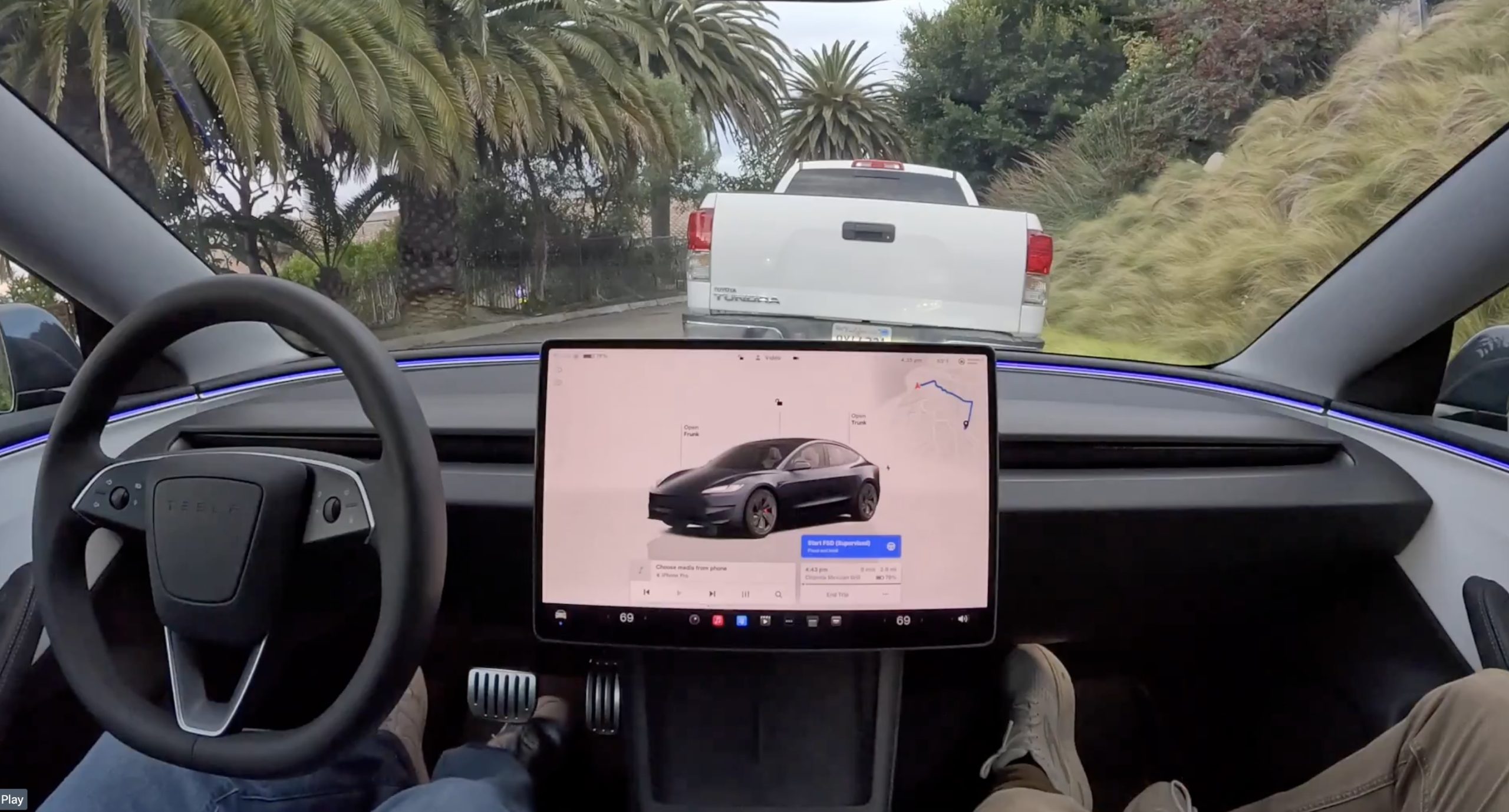
For Tesla owners, the "Holiday Update" is an annual ritual comparable to Apple’s WWDC. But this year, the precursor to that event—the wide release of FSD (Supervised) V13.2.1—is stealing the spotlight.
As of the morning of November 26, 2025, data aggregators like TeslaFi and NotATeslaApp confirm that the floodgates have opened. V13.2.1 is no longer limited to the "OG" tester group; it is hitting mainstream HW4 (AI4) vehicles across North America.
This is not just a bug fix. V13.2 represents a foundational architectural shift: the completion of the "End-to-End" neural network on highways. It is the bridge between the fragmented code of the past and the unified AI future of 2026. This article deconstructs the release notes, analyzes the neural net performance, and addresses the growing elephant in the room: the performance gap for Hardware 3 owners.
I. The "End-to-End" Highway Revolution
The headline feature of V13.2 is the retirement of the legacy highway stack.
For years, Tesla’s FSD operated with a split personality. On city streets, it used the advanced V12 "End-to-End" neural nets (where photons in = control out). But the moment you merged onto a highway, the car would silently switch to the "V11" stack—a hybrid of older neural nets and tens of thousands of lines of C++ "heuristic" code. This is why highway driving often felt robotic, centering itself rigidly in lanes and changing lanes with jerky, mathematical precision.
V13.2 changes everything.
-
Unified Stack: Today’s release marks the first time the "City Streets" neural network has been fully trained to handle high-speed highway driving at scale.
-
Natural Merging: Early tests from the V13.2 rollout show a dramatic improvement in merging behavior. Instead of waiting for a mathematically perfect gap, the car now "negotiates" with traffic, adjusting speed subtly to slot in—mimicking human intuition.
-
Construction Zones: The legacy V11 stack struggled with shifting lanes in construction zones (the "cone confusion"). The V13.2 vision-only network handles these undefined lanes with significantly more confidence, as it is driving based on visual drivable space, not map data.
II. The "Chuck Cook" Left Turn: Solved?
One of the most famous benchmarks for FSD performance is the "Unprotected Left Turn" (UPL), popularized by tester Chuck Cook. This maneuver involves crossing three lanes of high-speed traffic to enter a median, pausing, and then merging into the far lanes.
V13.2 includes specific training updates for this scenario.
-
Median Aggressiveness: The car is now willing to "creeper" further into the intersection to gain visibility.
-
Acceleration Profiles: A major complaint in V12.5 was the "hesitation" in the middle of the road. V13.2 appears to have a higher "commitment threshold." Once the neural net decides to go, it accelerates briskly, matching the flow of traffic rather than dawdling.
This improvement suggests that Tesla’s "Data Engine" has been heavily fed with clips of successful human interventions at busy intersections over the last three months.
III. The Hardware War: HW3 vs. HW4
We must address the controversy brewing in the community today. While HW4 (AI4) owners are celebrating the V13.2 rollout, many HW3 owners are still waiting, or receiving a slightly different build.
The Compute Bottleneck Elon Musk admitted earlier this year that optimizing the massive V13 models for the older HW3 chips requires "extra effort." Today’s rollout confirms that the gap is widening.
-
Model Pruning: Technical analysis suggests that the model running on HW3 is a "distilled" version. It has fewer parameters than the HW4 model.
-
Resolution Differences: HW4 cameras feed higher resolution and dynamic range into the network. V13.2 on HW4 can see "further" and with more clarity in low light. HW3 is working with lower fidelity input.
The Implication: While HW3 is not obsolete, V13.2 feels different on the older hardware. HW3 owners report slightly more "jitter" in complex scenarios and slower UI rendering of the FSD visualizations. It is becoming clear that to run the "Unsupervised" future (Robotaxi specs), HW4—or the upcoming HW5—will be the baseline. V13.2 is the software that finally exposes the limits of the 2019-era HW3 silicon.
IV. Natural Language Navigation & Smart Summon
V13.2 isn't just about driving dynamics; it's about usability.
Natural Language Inputs You no longer need to type an exact address. V13.2 integrates a Large Language Model (LLM) layer into the navigation. You can now tell the car: "Take me to that coffee shop near the pier that we went to last Tuesday." The car parses your history and the fuzzy location data to set the route.
ASS (Actually Smart Summon) Integration Previously, "Smart Summon" was a separate app feature. In V13.2, the neural nets for low-speed parking lot maneuvering are now partially merged with the FSD driving stack. This means the car transitions more seamlessly from "Driving" to "Parking." The "drop-off" experience—where the car pulls up to the curb—is significantly smoother, no longer mounting the sidewalk (a regression seen in V12.5).
V. The Setup for the Holiday Update
Why release V13.2 on November 26? This is clearly a "Stability Candidate" for the big December release.
Tesla historically freezes the code base in early December to prepare for the "Holiday Update" (usually released around Dec 20-24). V13.2 is likely the stable foundation.
-
Prediction: The Holiday Update will not bring a massive new driving overhaul (V14). Instead, it will bundle V13.2 with "fun" features (new games, UI customization, light shows) and perhaps the official "Banish" (Reverse Summon) feature for autonomous parking.
-
The "Stable Branch": By pushing V13.2 wide now, Tesla ensures that the millions of cars updating on Christmas morning won't be bricked by a buggy FSD beta.
VI. Conclusion
FSD V13.2 is the most "human" the car has ever felt. By finally killing the legacy highway code, Tesla has created a singular driving intelligence that handles 80 MPH freeways and 15 MPH parking lots with the same neural architecture.
For HW4 owners, today is a good day. The car drives with a confidence that borders on boredom—which is exactly what we want. For HW3 owners, the update is an improvement, but it serves as a reminder that the hardware ceiling is approaching fast.
As we look toward December, V13.2 proves that the "March of 9s" (reliability) is continuing. It’s not perfect, but for the first time, the "intervention-free" drive is becoming the norm, not the exception.
VII. Frequently Asked Questions (FAQ)
Q1: I have a 2018 Model 3 with HW3. Will I get V13.2? Yes, but likely on a delayed timeline compared to HW4 vehicles. Tesla needs to validate the "compressed" model on HW3 to ensure it doesn't cause computer overheating or frame-rate drops. Expect it in roughly 1-2 weeks.
Q2: Does V13.2 fix the "nag" (steering wheel pressure)? V13.2 relies heavily on the Cabin Camera for driver monitoring (DMS). If you are wearing sunglasses or a hat that blocks your eyes, you will still get steering wheel nags. However, if your eyes are clearly visible, the "hands-free" duration is significantly longer than in V12.
Q3: Is this the version that drives in the rain? V13.2 has improved weather training, but it is still cautious. Heavy rain will likely trigger a "degraded performance" warning, prompting you to take over. The "End-to-End" network is better at traction control on wet surfaces, but visibility remains the limiter.
Q4: How do I know if I have HW3 or HW4? Go to your car's screen: Controls > Software > Additional Vehicle Information. Look for "Autopilot Computer."
-
"Full Self-Driving Computer" = HW3.
-
"Full Self-Driving Computer 4" = HW4 (AI4).
Q5: Will this update improve my range? Technically, yes. The "End-to-End" highway driving is smoother, with less unnecessary braking and acceleration than the old V11 stack. Smoother driving equates to better efficiency, though the difference may be negligible (1-2%).
References & Citations
-
Release Notes: Tesla Firmware V13.2.1 Official Release Notes / In-Car Display (Nov 26, 2025).
-
Fleet Data: https://www.google.com/search?q=TeslaFi.com & NotATeslaApp.com Firmware Trackers (Nov 26, 2025).
-
Technical Analysis: "Dr. Know-it-all" & "AI DRIVR" Analysis of V13 Neural Net Architecture (Nov 26, 2025).
-
Hardware Specs: Tesla Official Service Manuals (HW3 vs HW4 Camera Resolution Specs).
-
Community Testing: "Chuck Cook" Unprotected Left Turn (UPL) Test Results - V13.2 Preliminary Runs (Nov 26, 2025).