
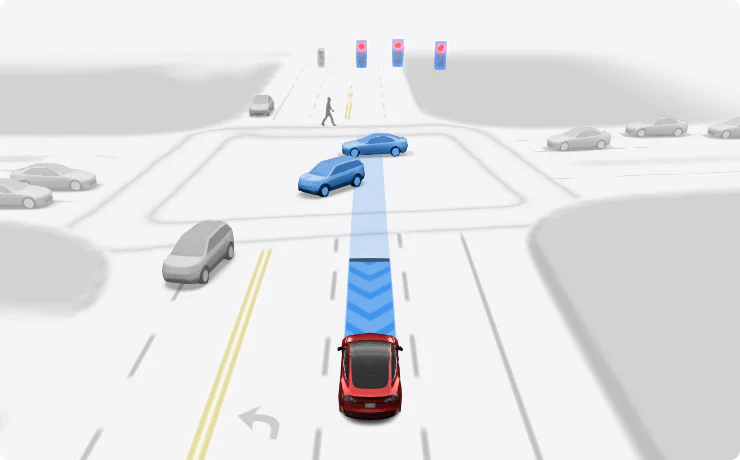
The Breakthrough Moment
Tesla stands on the precipice of a significant milestone in autonomous vehicle development as Full Self-Driving (FSD) version 14.2 approaches wide release to the company's fleet of Hardware 4 (HW4) equipped vehicles before the end of October 2025. CEO Elon Musk confirmed on social media that v14.2 will serve as the broad public release version, marking the culmination of months of intensive development, testing, and refinement by Tesla's artificial intelligence and autonomous driving teams. This development milestone represents one of the most significant advances in Tesla's autonomous driving capability to date, with early testers reporting that approximately 95 percent of the hesitant lane changes and braking behaviors that previously characterized FSD performance have been eliminated.
The progression from v14.0 through v14.1.2 to the anticipated v14.2 release demonstrates Tesla's commitment to continuous improvement and iterative development of autonomous capabilities. Rather than attempting to perfect each version before release, Tesla's approach involves rolling out new versions to progressively larger user audiences, gathering real-world performance data, identifying edge cases and failure modes, and rapidly iterating on improvements based on fleet-wide telemetry and user feedback. This development methodology, while potentially creating short-term user frustration due to occasional performance regressions, has proven effective at accelerating autonomous driving capability improvements and addressing identified issues systematically.
The v14.2 wide release carries particular significance because it marks the transition of FSD capabilities from a limited early-access program featuring primarily tech-savvy early adopters to a much broader audience of mainstream Tesla owners. The psychological and practical importance of this transition cannot be overstated—if FSD v14.2 delivers on the performance improvements promised, the wide release could represent a genuine inflection point in consumer acceptance of autonomous driving technology and validation of Tesla's technical approach.
The Path to v14.2: Development Milestones and Improvements
Version 14.1 Launch and Initial Performance
Tesla initiated the rollout of FSD v14 to selected early access program members, social media influencers, and YouTube content creators in early October 2025. The v14.1 release represented the first significant version advancement from v13, incorporating architectural improvements, neural network refinements, and behavioral algorithm enhancements that address long-standing challenges in FSD performance. The decision to concentrate initial rollout on early adopters, influencers, and testers reflected Tesla's desire to gather real-world performance data and user feedback from experienced FSD users before broader deployment.
Early reports from FSD v14.1 users were notably positive, with testers reporting meaningful improvements in driving smoothness, decision-making responsiveness, and passenger comfort. Users reported fewer instances of sudden acceleration changes, less frequent hesitant lane changes, and improved behavior in complex driving scenarios including highway merging, parking, and traffic navigation. These qualitative improvements, while important to user experience, represented quantifiable advances in the underlying autonomous driving algorithms and decision-making processes.
The 95 Percent Hesitation Elimination Achievement
The most significant reported improvement in FSD v14.1.2 is the claimed 95 percent reduction in hesitant lane changes and braking behaviors. This statistic, while potentially subject to different interpretations regarding what constitutes "hesitant" behavior, represents a genuine breakthrough in FSD algorithm refinement. Previously, users and observers frequently criticized FSD for sudden or inconsistent behavior in lane change decisions and braking—the vehicle would sometimes execute lane changes smoothly and other times would hesitate, accelerate, brake, and then accelerate again in patterns that seemed indecisive and made passengers uncomfortable.
The elimination of hesitant behavior likely reflects improvements in multiple algorithm components: (1) improved confidence assessment in trajectory planning, allowing the vehicle to commit more decisively to maneuvers once initiated; (2) reduced sensitivity to noise in sensor inputs that previously caused erratic decision-making; (3) improved prediction of surrounding vehicle behavior, allowing more confident decision-making regarding lane changes and merging; and (4) refined cost functions in the decision-making system that weight the comfort and efficiency implications of alternative courses of action.
Musk's Confirmation and v14.2 Designation
Elon Musk's confirmation that v14.2 represents the "next wide release" builds on historical precedent from the FSD v13 development cycle, where v13.2 marked the transition from limited early access to broader public release. This version numbering convention suggests that Tesla is following a consistent methodology: develop and test new major versions with early access participants, identify and remediate issues through intermediate point releases (v14.1, v14.1.1, v14.1.2), and then release the stabilized version to the broader customer base once quality and performance targets have been achieved.
The confirmation of v14.2 as the wide release target is significant because it signals Tesla's confidence that the autonomous driving capability has reached a maturity level appropriate for mainstream release. Unlike previous beta programs where Tesla acknowledged known limitations and solicited user patience with continuing development, the v14.2 release positioning suggests Tesla believes the product is ready for the broader market and general consumer usage.
Hardware 4 Requirement and Legacy Hardware Questions
HW4 Architecture and Capabilities
FSD v14.2 will be available exclusively on vehicles equipped with Tesla's Hardware 4 (also referred to as AI4) self-driving computer. Hardware 4 represents the latest generation of Tesla's autonomous driving computational platform, featuring significantly more processing power, refined sensor suite configuration, and optimized neural network inference capabilities compared to the previous Hardware 3 generation. The processing power advantage of HW4 over HW3 is substantial, allowing more complex neural networks, higher real-time inference frequency, and better handling of edge cases and complex driving scenarios.
The Hardware 4 specification requirement reflects the computational demands of FSD v14. The underlying neural networks and decision-making algorithms have grown increasingly complex, requiring more computational resources to evaluate in real-time as the vehicle encounters novel driving scenarios. The advanced algorithms that produce the 95 percent reduction in hesitant behavior likely require the additional processing capability of Hardware 4 to execute at acceptable latency, necessitating the HW4 requirement.
Hardware 3 Legacy Vehicle Challenge
The limitation of FSD v14.2 to Hardware 4 vehicles creates a challenging situation for approximately 1 to 1.5 million existing Tesla vehicles equipped with Hardware 3 computers. These vehicles remain stuck on FSD v12.6.4, having not received a major FSD version update for nearly a year. Tesla has provided no official timeline for when or if Hardware 3 vehicles will receive FSD v14 capability, creating significant customer frustration and raising questions about the fairness and equity of the technology upgrade strategy.
Many Hardware 3 vehicle owners paid for Full Self-Driving capability, often at prices ranging from $8,000 to $15,000, with the expectation that they would receive ongoing capability improvements and access to new features. The apparent abandonment of Hardware 3 vehicles in favor of Hardware 4 raises difficult questions regarding Tesla's commitments to existing customers and whether the company should implement hardware upgrade programs or provide other forms of customer compensation.
Tesla could theoretically develop a Hardware 3 compatible version of FSD v14 with reduced capability or computational demands, allowing legacy hardware to participate in the autonomous driving advancement. However, the company has evidently made the strategic decision that the additional engineering effort required to support two distinct hardware platforms is not justified, choosing instead to concentrate development efforts on Hardware 4 and newer platforms exclusively.
Cybertruck FSD Rollout Timing
Cybertruck owners represent another group awaiting FSD v14 access. Despite being Hardware 4 equipped, Cybertrucks have not yet received FSD v14 due to the unique sensor configuration and vehicle geometry of the Cybertruck requiring specialized algorithm tuning. Tesla's AI Chief Ashok Elluswamy indicated that Cybertruck FSD v14 rollout is targeted for "most likely by the end of this month" (October 2025), suggesting that Cybertruck-specific calibration and testing is approaching completion.
The delay in Cybertruck FSD availability reflects the challenging problem of adapting neural network-based perception and decision-making systems to different vehicle platforms. While the underlying algorithms and neural networks are largely platform-agnostic, the specific sensor mounting positions, field-of-view configurations, and vehicle dynamics characteristics vary between Model 3/Y and Cybertruck, requiring tuning and recalibration before autonomous capabilities can be safely deployed.
Performance Improvements and Technical Advancement
Neural Network Improvements
The advancement from FSD v13 to v14 likely involved substantial improvements to the underlying neural networks that process sensor inputs and generate driving decisions. Tesla's autonomous driving system relies on multiple neural networks specialized for different aspects of driving decision-making: (1) perception networks that identify objects (vehicles, pedestrians, cyclists, traffic signs, road markings); (2) prediction networks that anticipate the future motion of other traffic participants; (3) planning networks that generate trajectory proposals for the vehicle's motion; and (4) decision networks that select among trajectory options based on safety, comfort, and efficiency criteria.
Improvements to these networks could involve (1) larger training datasets incorporating more real-world driving scenarios; (2) improved network architectures incorporating recent advances in deep learning research; (3) refined training methodologies that better capture edge cases and corner scenarios; (4) ensemble approaches that combine predictions from multiple networks to improve robustness; or (5) improved handling of ambiguous or adversarial scenarios where multiple interpretations of the driving situation are plausible.
Real-World Performance Data Utilization
Tesla's fleet of vehicles continuously collects telemetry data—video, sensor readings, vehicle state information—from real-world driving scenarios. This fleet data represents an invaluable resource for training and improving autonomous driving algorithms, providing diversity and scale of real-world examples far exceeding what competing companies can access. Tesla's decision to enable human feedback loops where users can flag disliked behaviors or provide input on driver preferences further enriches the training data available for algorithm improvement.
The transition from v14.1 to v14.2 likely incorporated learnings from tens of millions of miles of FSD-assisted driving across diverse driving conditions, geographies, and scenarios. This accumulated fleet intelligence represents a competitive advantage Tesla possesses over most autonomous vehicle developers, enabling the company to learn from collective experience of its user base.
Behavioral Algorithm Refinement
Beyond neural network improvements, the 95 percent reduction in hesitant behavior likely reflects refinements to the vehicle control algorithms and decision-making heuristics that govern moment-to-moment behavior. Specific improvements might include: (1) refined lane change initiation criteria that set higher thresholds for confidence before committing to lane changes; (2) improved prediction of following vehicle behavior reducing false lane change aborts; (3) refined acceleration and braking profiles that avoid sudden changes; or (4) improved handling of edge cases where the vehicle's confidence in the driving situation is ambiguous.
These algorithmic refinements, combined with neural network improvements, collectively create the behavioral improvements that users experience when operating FSD v14.2.
Competitive Landscape and Technological Comparison
Waymo and Autonomous Vehicle Competition
Tesla's FSD advancement must be evaluated within the competitive context of other autonomous vehicle programs. Waymo, an Alphabet subsidiary, operates a robotaxi service in multiple U.S. cities (San Francisco, Phoenix, Los Angeles) providing fully autonomous ride-hailing services to the public. Waymo's approach differs materially from Tesla's—Waymo uses hardware-based LiDAR sensors in addition to cameras, operates highly detailed pre-mapped environments, and focuses on fully autonomous operation (no human safety driver) rather than supervised autonomous driving.
Tesla's camera-only, learning-based approach contrasts sharply with Waymo's multi-sensor, pre-mapped approach. Waymo achieves impressive autonomous driving capability within its defined operating domains but faces scaling challenges due to the capital intensity of LiDAR hardware, the computational requirements of multi-sensor fusion, and the necessity of extensive pre-mapping. Tesla's approach, while currently achieving less impressive fully autonomous performance, offers greater potential for rapid scaling, cost reduction, and expansion to new geographic markets without extensive pre-mapping efforts.
Legacy Automaker Autonomous Driving Programs
Established automakers including BMW, Mercedes-Benz, General Motors, and Volkswagen are developing autonomous driving capabilities, though most remain several years behind Tesla in practical deployment. GM's Cruise program, which was pursuing robotaxi services similar to Waymo, faced challenges and setbacks requiring recapitalization and strategic refocus. Traditional automakers' programs generally emphasize quality, safety, and regulatory compliance over rapid deployment, resulting in slower development cycles but potentially higher product maturity.
Tesla's FSD program, by contrast, emphasizes rapid iteration, continuous improvement, and willingness to accept incremental capability gains and occasional performance regressions in exchange for faster overall advancement. This development philosophy appeals to Tesla's technology-focused user base but is controversial among safety experts who question whether continuous improvement can achieve the reliability and safety required for fully autonomous operation in unrestricted environments.
Chinese Autonomous Vehicle Development
Chinese automakers and technology companies are investing heavily in autonomous driving development. Companies like BYD, NIO, and Xpeng are advancing autonomous driving capabilities, though most remain behind Tesla in supervised autonomous driving performance. Chinese government support for autonomous vehicle research and development, combined with massive domestic markets, is driving rapid advancement in the Chinese context.
Regulatory and Safety Considerations
NHTSA Investigation and Regulatory Environment
Tesla's FSD program faces ongoing regulatory scrutiny from the National Highway Traffic Safety Administration. Recent NHTSA investigations have examined safety incidents involving FSD-equipped vehicles, including accidents and instances where the autonomous driving system may have contributed to safety incidents. NHTSA has maintained an open investigation into Tesla autonomous vehicle safety, and the upcoming v14.2 release will occur within this regulatory environment.
The regulatory stance toward FSD remains evolving, with no clear federal regulations specifically governing supervised autonomous driving technology like Tesla's implementation. This regulatory ambiguity creates both opportunities and risks for Tesla—the company can innovate with relatively fewer regulatory constraints, but faces potential enforcement action or restrictions if regulators become concerned about safety implications.
Safety Validation and Testing
Tesla has not disclosed detailed safety validation data for FSD v14.2, making it difficult for external observers to assess the true safety implications of the new version. The company likely conducted internal testing and validation establishing that v14.2 represents a safety improvement compared to v13, but the absence of published, independent safety validation creates lingering uncertainty among critics and regulators.
Leading autonomous vehicle safety experts have called for increased transparency and independent validation of autonomous driving systems, arguing that manufacturers' internal safety assessments are insufficient to ensure public safety. The v14.2 release occurs against this backdrop of calls for greater safety rigor and independent validation.
Consumer Adoption and Usage Implications
User Experience Improvements
For Tesla owners with Hardware 4 equipped vehicles and active FSD subscriptions, the v14.2 release promises substantial improvements in autonomous driving user experience. The 95 percent reduction in hesitant behaviors should translate into smoother, more comfortable driving and increased confidence in the system's decision-making. These experience improvements will likely drive increased usage of FSD features and higher customer satisfaction among subscribers.
The improved user experience may also translate into increased FSD subscription adoption among Tesla owners who previously considered the system too immature for regular use. Each percentage point increase in FSD subscription penetration translates into meaningful recurring revenue for Tesla, creating financial incentives for continued capability improvement.
Subscription Economics and Revenue Implications
FSD is sold as a subscription service (typically $12-15 per month in the US market) or as a one-time purchase option ($8,000-15,000 depending on timing). The v14.2 release, if it delivers on promised capability improvements, could drive increased subscription adoption and improve subscription retention rates. From Tesla's perspective, each incremental improvement in FSD capability enhances the value proposition of the subscription, justifying price maintenance or potential price increases.
The recurring revenue from FSD subscriptions represents an increasingly important component of Tesla's financial model. The company has transitioned from a pure vehicle manufacturing model to a software and services model where ongoing subscriptions and feature releases generate predictable recurring revenue. This business model transformation, if successful, could meaningfully improve Tesla's valuation multiples and profitability metrics.
Future Roadmap and Long-Term Vision
Path to Unsupervised Autonomous Driving
Tesla's stated goal is to eventually achieve fully unsupervised autonomous driving—operation of vehicles without a human driver monitoring the system or ready to intervene. The supervised autonomous driving of current FSD versions requires a human driver to monitor the system's performance and intervene if necessary. The transition from supervised to unsupervised operation represents the ultimate goal of Tesla's autonomous driving program and has profound implications for transportation, employment, and society broadly.
Achieving unsupervised autonomous driving requires demonstrably superior safety performance compared to human driving, regulatory approval, and technological advancement including improved perception in challenging weather conditions, better handling of edge cases and novel scenarios, and robust error recovery mechanisms. Tesla has not provided detailed timeline for unsupervised autonomous driving, though Elon Musk has previously suggested that the transition could occur in 2025 or 2026. Most expert observers consider this timeline optimistic given the technical challenges remaining.
Robotaxi Service Deployment
Tesla has announced plans to deploy a robotaxi service using autonomous vehicles, potentially starting with a limited pilot in specific geographies before expanding to broader markets. The robotaxi service would represent a transformational business model for Tesla, potentially generating revenue from ride-hailing services rather than vehicle manufacturing alone. However, the robotaxi business model depends on achieving fully autonomous operation and overcoming regulatory, insurance, and liability challenges that remain unresolved.
The v14.2 release and continued FSD advancement represents progress toward the technological requirements for robotaxi deployment, but substantial work remains before the service can be launched commercially.
Hardware Evolution and Next-Generation Platforms
Tesla's autonomous driving roadmap includes planned advances to the underlying autonomous driving hardware architecture. While Hardware 4 currently provides the computational capability needed for FSD v14, future algorithm and model improvements may require even more computational power. Tesla is likely already designing Hardware 5 and beyond, planning for multi-generational advancement of autonomous driving capabilities.
The potential for future hardware generations to render current Hardware 4 systems obsolete mirrors the Hardware 3 situation, creating ongoing questions about how Tesla will manage the transition and whether Hardware 4 owners will eventually face the same fate as Hardware 3 owners.
Conclusion: An Important Milestone in Autonomous Driving Development
The impending FSD v14.2 wide release represents a significant milestone in Tesla's autonomous driving program and a notable achievement in autonomous vehicle development more broadly. The 95 percent reduction in hesitant behavior, if validated through real-world performance, demonstrates meaningful progress in autonomous driving capability. The expansion from limited early access to broad public release, contingent on Hardware 4 availability, reflects Tesla's confidence in the new version's maturity and readiness for mainstream deployment.
However, important questions and challenges remain: the fate of Hardware 3 vehicle owners, the timeline to fully unsupervised autonomous operation, regulatory acceptance and safety validation, and the ultimate feasibility of robotaxi service deployment all remain uncertain. The v14.2 release represents progress along Tesla's autonomous driving journey, but not the destination.
For Tesla shareholders and customers, the v14.2 release offers both promise and caution. The promise derives from genuine capability improvements and validation of Tesla's technical approach to autonomous driving development. The caution reflects the many uncertainties and challenges that remain, and the possibility that Tesla's autonomous driving vision may prove more difficult to achieve than the company's leadership has suggested.
The months and years ahead will provide clarity regarding whether FSD v14.2 represents a genuine breakthrough toward practical fully autonomous vehicles, or simply another incremental improvement in Tesla's ongoing autonomous driving development journey. The answer will have profound implications for Tesla's competitive position, valuation, and long-term strategic direction.