
Introduction
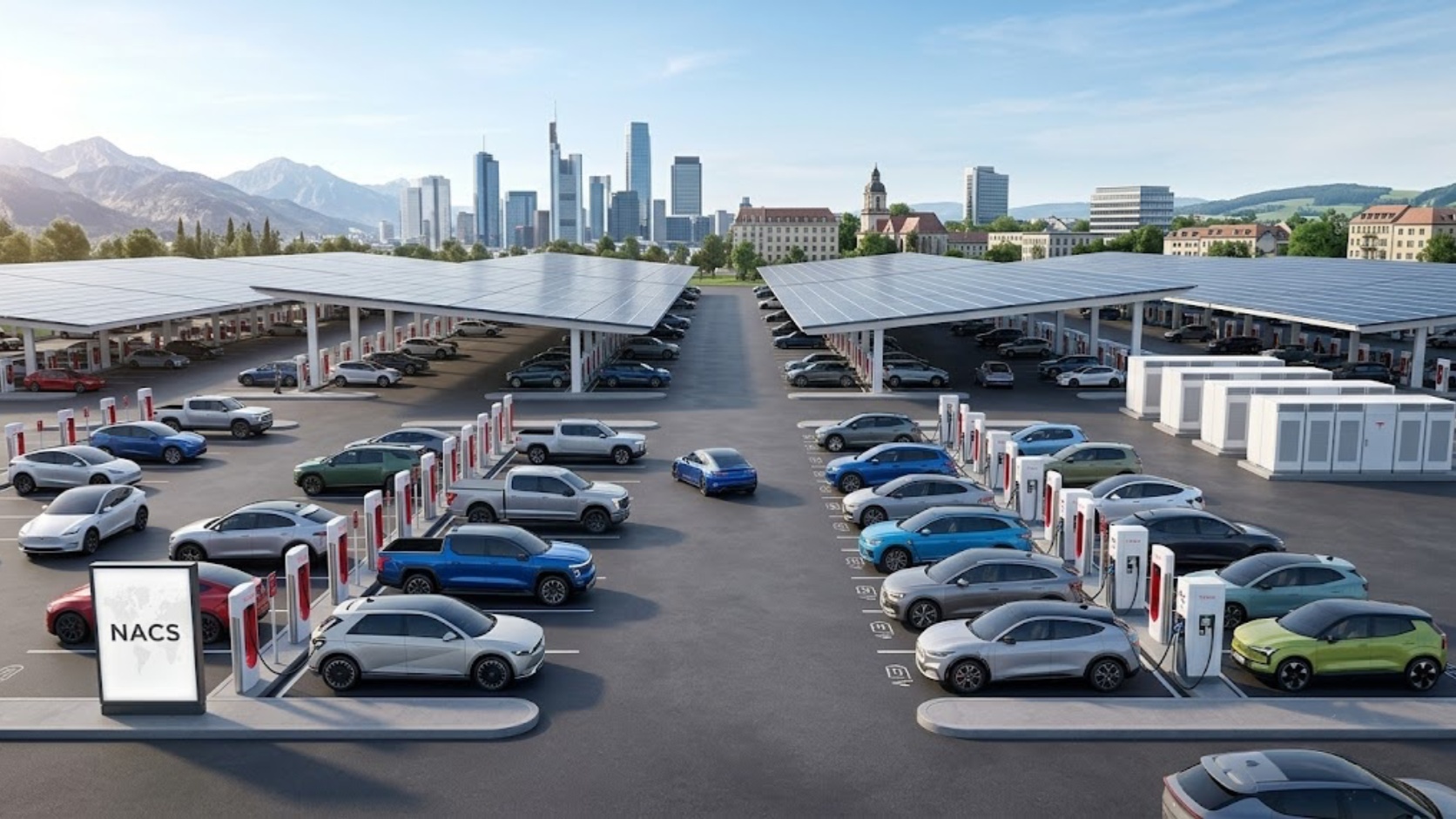
Charging infrastructure is the lifeblood of electric vehicle adoption. In 2026, Tesla’s Supercharger network has transitioned from a proprietary perk reserved exclusively for Tesla owners into the undisputed global backbone for EV fast-charging. Through the maturation of the North American Charging Standard (NACS) and the rapid installation of V4 Supercharger hardware across Europe, Tesla maintains its competitive edge in charging reliability and operational scale.
North American NACS Transition Maturity
In North America, NACS is now the standard fast-charging interface. Major automakers—including Ford, General Motors, Rivian, Hyundai, and Volvo—have fully integrated native NACS ports into their 2026 production vehicles.
To accommodate non-Tesla vehicles with varying charge port locations, Tesla has scaled site management through intelligent routing, longer V4 cable booms, and dynamic stall allocation algorithms within the Tesla App.
European V4 Supercharger Ecosystem
Because Europe mandated CCS2 connectors early on, European Tesla owners have long enjoyed open access to public chargers. However, Tesla’s European V4 Supercharger expansion introduces key performance benefits tailored to the region:
800V Architecture Support: Native support for high-voltage architecture allows models like Cybertruck and third-party 800V EVs to charge at maximum theoretical speeds (up to 350kW+).
Integrated Megapack Storage: European hubs are increasingly constructed alongside utility-scale Tesla Megapacks and solar canopies. This buffers local electrical grids during peak hours, keeping charging costs stable.
Contactless Payment Terminals: Compliant with European Alternative Fuels Infrastructure Regulation (AFIR) mandates, V4 stalls feature credit card terminals for seamless plug-and-pay access.
Operational Best Practices for Owners
To minimize time spent at fast chargers and protect long-term battery health, owners should follow three core practices:
In-Route Preconditioning: Always set the Supercharger as a destination in the vehicle's navigation system. This allows the thermal management system to bring the battery chemistry to the optimal temperature (approx. 40°C/104°F) prior to plugging in.
Charge Curve Optimization: Arrive at the charger with a low State of Charge (10–15%). Electric vehicle batteries accept energy fastest at lower charge levels; charging past 80% slows down significantly.
Supercharger Etiquette: Park in stalls that do not force non-Tesla EVs to stretch cables across multiple bays, ensuring high traffic throughput at busy sites.
Conclusion
Tesla’s charging network continues to set global industry benchmarks for uptime, efficiency, and scale. By pairing NACS ubiquity in North America with advanced V4 800V infrastructure across Europe, Tesla delivers an unmatched cross-continental road-tripping experience.
Frequently Asked Questions (FAQ)
Q1: Can non-Tesla vehicles charge at all European Superchargers?
Most V3 and V4 Supercharger locations across Europe are open to non-Tesla EVs equipped with standard CCS2 ports via the Tesla App or on-site contactless payment terminals.
Q2: Does charging at 350kW V4 Superchargers accelerate battery degradation?
Tesla’s onboard Battery Management System (BMS) dynamically controls voltage and current based on battery cell temperature and health, protecting long-term longevity.
Q3: Why is preconditioning necessary before arriving at a Supercharger?
Preconditioning ensures the battery pack reaches the ideal thermal window to immediately accept peak kW charge rates, cutting total session time by up to 30%.