
I. Introduction: A New Product for a New Crisis
While Tesla is most famous for its electric vehicles, its energy business—which includes products like Powerwall and Megapack—is a critical, and often overlooked, component of the company's long-term strategy. The launch of the new Megablock, an upgraded, utility-scale energy storage product, marks a significant milestone. This is not an incremental product update but a revolutionary solution positioned to solve a looming global crisis: the insatiable energy demands of AI data centers and the broader need for grid stability. This report will reveal how the Megablock signifies Tesla's strategic pivot to become a foundational energy provider for the AI revolution, positioning the company as a major force far beyond the automotive industry.
II. The Megablock: Technical Innovations for Rapid Deployment
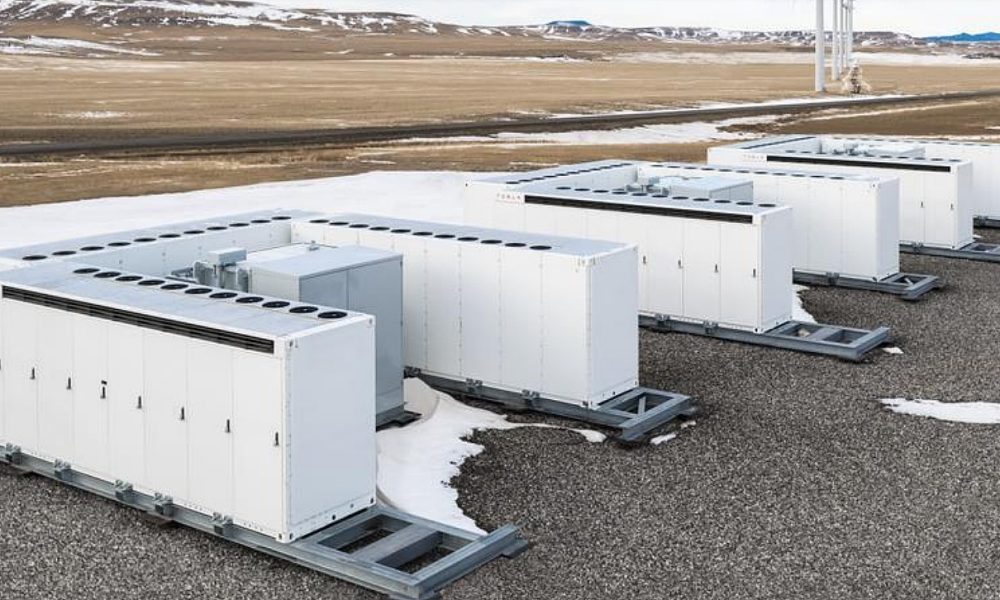
The new Megablock is an upgraded version of the company’s flagship Megapack product, designed to help developers build larger energy-storage projects more quickly and efficiently. Its unique architecture bundles four Megapack 3 units with an integrated transformer and switchgear into a single, pre-engineered, "plug-and-play" package. Each unit holds a substantial 20 megawatt-hours (MWh) of AC storage capacity.
The Megablock's design offers significant efficiency breakthroughs that set it apart from previous-generation products and competitors. The integrated design minimizes the amount of electrical work required in the field, streamlining a process that previously required dozens of individual connections per pack. Tesla claims this streamlined process allows developers to deploy a 1 gigawatt-hour (GWh) facility in just 20 business days—an "astonishing" rate of deployment. This efficiency is also expected to reduce construction costs by as much as 40% compared to traditional methods.
| Feature | Tesla Megapack 2.0 | Tesla Megablock | Competitor (e.g., Fluence Gridstack) |
| Capacity |
Up to 3.9 MWh |
20 MWh per unit |
Varies; typically up to 7 MWh |
| Design | Individual pack |
Bundles four Megapacks with an integrated transformer |
Modular solution, but requires on-site electrical work |
| Deployment |
Slower; requires extensive on-site electrical work |
1 GWh in 20 business days |
Slower; dependent on on-site labor and permits |
| Cost Savings | N/A |
Up to 40% reduction in construction costs |
Varies |
| Target Market |
Utility-scale storage, but less streamlined |
Utility-scale, data centers, and AI infrastructure |
Utility-scale storage |
III. The Broader Context: The AI Power Crisis
The Megablock's launch comes at a time of a looming global crisis: the escalating energy demands of AI computing. An analysis from a RAND report indicates that AI data centers could require 68 GW of power globally by 2027, representing a near doubling of global data center power requirements since 2022. This rapid growth is putting an immense strain on power grids worldwide. As AI models become more complex, the scaling constraints are shifting from chips to a fundamental bottleneck: electricity generation and voltage transformers.
The Megablock is not a product for the general market; it is a direct, targeted solution to the most critical bottleneck facing the AI industry. Elon Musk has repeatedly stated that AI will eventually become electricity-constrained. The Megablock, with its integrated transformer and ability to provide "fast power" and "buffer spiky loads" for AI training and inference clusters, directly addresses this problem. It is the physical hardware that enables the continued growth of the AI revolution. This strategic synergy connects Tesla's energy business directly to the future of technology, creating a powerful ecosystem where the company’s different verticals reinforce one another.
IV. Competitive Landscape and Market Disruption
The Megablock's cost and speed advantages are poised to disrupt the utility-scale energy storage market. While companies like Fluence, CATL, and other major players are dominant in the energy storage space, the Megablock's pre-engineered, "plug-and-play" design fundamentally changes the competitive dynamic. The value proposition shifts from a simple hardware sale to a comprehensive, rapid deployment service.
This new approach forces competitors to innovate beyond just battery chemistry and into integrated, systemic solutions to keep up. The battleground has shifted from who has the best battery to who can get a functional, high-capacity system online the fastest and cheapest to support new, demanding applications like AI data centers.
V. Conclusion: A Trillion-Dollar Vertical Beyond the Car
The Megablock is an elegant solution to a massive, emerging problem. It addresses a critical pain point in the energy transition while simultaneously creating a new, highly profitable vertical for Tesla. If the company can successfully execute its production ramp-up at the Houston Megafactory as planned, the Megablock could become the next "trillion-dollar vertical" for the company, cementing its position as a powerhouse far beyond the automotive industry and establishing it as a foundational player in the future of energy and artificial intelligence.
VI. FAQ Section
What is the Tesla Megablock, and what problem does it solve? The Megablock is a new utility-scale energy storage system that combines four Megapack 3 units with an integrated transformer and switchgear. It is designed to solve the problem of scaling up energy storage infrastructure to meet the rapidly growing power demands of the global energy grid, particularly for energy-intensive applications like AI data centers.
How is the Megablock different from the previous Megapack? While the Megapack is a single battery unit, the Megablock is a complete, pre-engineered system that bundles multiple Megapacks with a transformer. This integrated design significantly reduces the amount of on-site electrical work, leading to faster deployment and lower construction costs.
How fast can the Megablock be deployed? Tesla claims that the Megablock's design allows for an astonishingly rapid deployment rate, enabling developers to deploy a 1 gigawatt-hour facility in just 20 business days.
How does the Megablock relate to the growth of AI? The Megablock is designed to address the energy bottleneck that is beginning to constrain the growth of AI. It is capable of providing fast power and buffering the "spiky loads" required by AI training and inference clusters in data centers, making it an ideal solution for the industry's power needs.
Who are Tesla's main competitors in the energy storage market? Tesla's main competitors in the utility-scale energy storage market include companies like Fluence, CATL (Contemporary Amperex Technology Co. Limited), Powin Energy, and other players such as LG Energy Solution and BYD. The Megablock is forcing these competitors to innovate on a system-level basis, not just in battery chemistry.