
Introduction
In the rapidly evolving landscape of electric vehicles and artificial intelligence, few announcements have the potential to reshape the ownership experience of Tesla vehicles quite like the one that dropped just days ago on March 21, 2026. Elon Musk, speaking from the historic Seaholm Power Plant in Austin, Texas, unveiled Terafab—a monumental joint venture between Tesla, SpaceX, and xAI. This isn't just another factory; it's a vertically integrated semiconductor fabrication powerhouse designed to produce more than one terawatt of AI compute capacity annually, dwarfing the entire global chip industry's current output of roughly 20 gigawatts per year. For Tesla car owners across the United States and Europe, Terafab represents the missing link that could accelerate Full Self-Driving (FSD) capabilities, deliver more frequent and powerful over-the-air (OTA) updates, and future-proof your vehicle for the autonomous era ahead.
To understand the stakes, consider the context. Tesla's current AI chips—primarily the AI4 hardware powering today's FSD Supervised and the upcoming unsupervised autonomy features—rely on external suppliers like Samsung and TSMC. These partners have been instrumental, but Musk has been vocal about their limitations: "There’s a maximum rate at which they’re comfortable expanding. That rate is much less than we’d like." Global demand for edge-inference AI chips, the kind optimized for real-time decision-making in vehicles and robots, is exploding. Tesla alone projects needing chips for millions of vehicles, hundreds of thousands of Robotaxis, and potentially billions of Optimus humanoid robots in the coming decade. Without internal production at unprecedented scale, the bottleneck could delay everything from smoother FSD performance in rainy European highways to lightning-fast inference in busy US urban corridors.
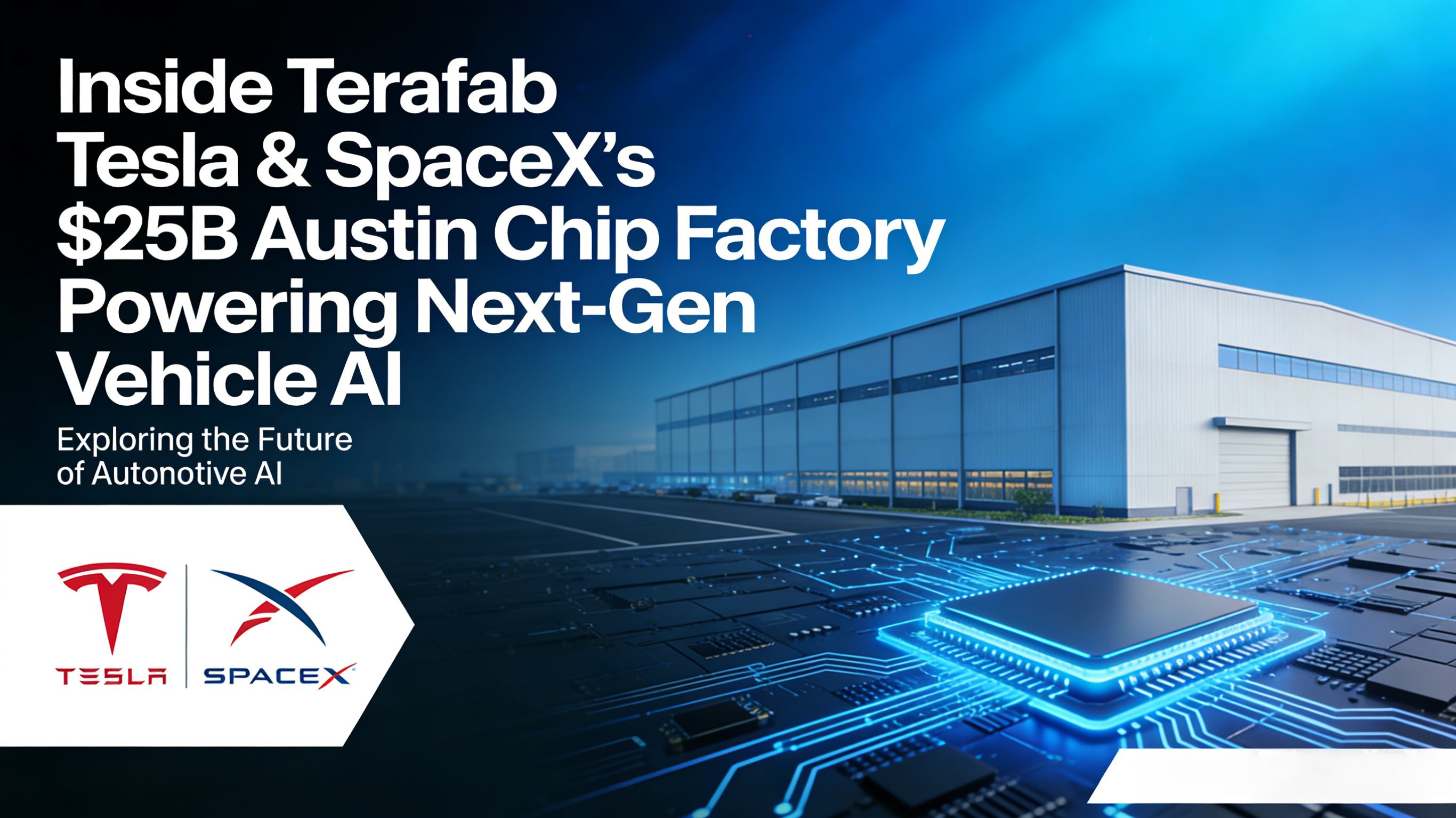
Terafab changes that equation entirely. Located initially as a prototype "Advanced Technology Fabrication" facility on the North Campus of Giga Texas in Austin, the project will expand into a full-scale operation spanning around 100 million square feet—larger than Giga Texas itself and equivalent to 15 Pentagons or three Central Parks in New York City. Initial costs are estimated at $20-25 billion, notably excluded from Tesla's 2026 capital expenditure guidance, signaling a shared investment across Musk's ecosystem. This isn't a speculative dream; construction photos already show activity north of Giga Texas, and Tesla has begun hiring for Terafab roles ranging from process engineers to supply chain counsel.
For everyday Tesla owners—whether you're piloting a Model Y Long Range in California traffic, a Model 3 Performance on Germany's Autobahn, or a Cybertruck hauling gear through the Rockies—Terafab promises tangible upgrades. Imagine FSD that processes complex scenarios with 40-50 times the compute performance and nine times the memory of current hardware, all while sipping less power to preserve range. Or OTA updates that roll out new autonomy features weekly because the silicon supply chain is no longer a constraint. This article dives deep into Terafab's architecture, its technical ambitions, and—most importantly—its direct benefits for you as a Tesla vehicle owner. We'll explore how this factory positions Tesla not just as an EV leader but as the dominant force in AI-driven mobility, with implications that extend from US regulatory approvals to European Union safety certifications.
The announcement comes at a pivotal moment. As of March 2026, Tesla's FSD adoption is surging in North America, with unsupervised testing expanding in Texas and California. In Europe, regulatory hurdles for Level 4 autonomy are easing, but hardware readiness remains key. Terafab ensures Tesla controls its destiny, reducing reliance on foreign foundries and accelerating the timeline for widespread Robotaxi deployment. Musk called it "the most epic chip-building exercise in history by far" and the "final missing piece of the puzzle" for turning science fiction into everyday driving reality. By the end of this deep dive, you'll see why Terafab isn't hype—it's the strategic bet that could add thousands of dollars in long-term value to your Tesla, enhance safety, and unlock new revenue streams like Robotaxi participation.
This isn't just about chips; it's about redefining what your Tesla can do on the road today and tomorrow. Let's break it down step by step.
Section 1: What Exactly is Terafab
Terafab is far more than a semiconductor plant—it's a fully vertically integrated AI hardware ecosystem engineered to eliminate every friction point in chip production. Announced officially on March 21, 2026, and formalized in a joint presentation involving Tesla, SpaceX, and xAI leadership, the project consolidates chip design, lithography, wafer fabrication, memory integration, advanced packaging, and rigorous testing all under one roof. This end-to-end control is unprecedented in the industry and directly addresses the supply chain vulnerabilities that have historically slowed Tesla's AI ambitions.
At its core, Terafab is a response to explosive demand across Musk's companies. Tesla needs edge-inference processors for FSD in millions of vehicles and Optimus robots. SpaceX requires radiation-hardened chips for satellite constellations and orbital data centers. xAI drives training-scale compute for next-generation models. Current global fabrication capacity falls woefully short—Musk noted that all existing fabs combined produce only about 2% of what his ventures will soon require. "We either build the Terafab or we don’t have the chips, and we need the chips, so we build the Terafab," he emphasized during the Austin event.
The project kicks off with a prototype "Advanced Technology Fabrication" facility right at Giga Texas. This isn't a scaled-down pilot; it's a fully functional mini-fab capable of complete chip manufacturing cycles on-site. Engineers can design a chip, produce photomasks, fabricate wafers, test them, iterate the design, and repeat—all within days rather than the weeks or months required when shipping between distant suppliers. No other chip facility worldwide offers this closed-loop iteration speed. Initial output targets 100,000 wafer starts per month, scaling eventually to 1 million. Long-term, the full Terafab aims to yield 100-200 billion custom AI and memory chips annually.
Physically, the site is ambitious. The prototype sits on Giga Texas's North Campus in Austin, Texas, with the full-scale Terafab requiring thousands of acres and over 10 gigawatts of power—power levels that could rival small cities. The building itself is projected to dwarf Giga Texas, already one of the largest structures on Earth. While the exact full-scale location remains TBD, Austin's ecosystem—proximity to Tesla's vehicle and battery production, SpaceX's Starship operations, and a deep talent pool—makes it the logical hub.
Ownership structure reinforces the synergy: Tesla leads terrestrial applications, while SpaceX and xAI handle orbital and large-scale training compute. Funding is shared, keeping the burden off Tesla's balance sheet for 2026. This joint model allows cross-pollination: lessons from space-hardened chips improve automotive reliability, and vehicle-scale production efficiencies benefit robotics.
For context, Terafab pursues leading-edge 2-nanometer process technology—the most advanced node currently viable at scale. This shrinks transistors to enable higher density, lower power consumption, and faster inference. The first chips rolling out will include Tesla's AI5, an edge-inference processor with massive leaps over AI4: up to 50x compute performance and 9x memory bandwidth. AI6 variants will follow for even more demanding Optimus workloads. A parallel line will produce D3 chips, optimized for the vacuum of space with extreme radiation tolerance and thermal management.
Hiring is already underway. Tesla's careers page lists Terafab-specific roles in process integration, module engineering, and infrastructure CapEx. This signals rapid momentum—construction activity was visible as early as March 24, 2026, just days after the announcement.
Why does this matter beyond the headlines? For Tesla owners, Terafab breaks the dependency cycle. No more waiting for supplier allocations during global shortages. No more compromises on chip performance due to external priorities. Instead, Tesla can tailor silicon precisely for FSD's neural networks, optimizing for the exact sensor fusion, path planning, and end-to-end AI models running in your car. In Europe, where data privacy and safety regs like UNECE are stringent, in-house control speeds certification. In the US, it aligns with domestic manufacturing incentives under the CHIPS Act.
Critics might point to Tesla's lack of traditional semiconductor experience, but the company has been designing its own AI hardware since the HW3 days in 2019. Dojo supercomputers already train models at scale; Terafab extends that expertise to inference at the edge. Optimus demand alone is the biggest driver—Giga Texas could eventually produce 10 million robots yearly, requiring 20 million chips, six times current automotive needs. Scale that to hundreds of millions or billions of units, and the math demands a facility like Terafab.
In short, Terafab is Tesla's declaration of independence in the AI hardware wars. It's not just building chips; it's building the foundation for autonomous mobility at planetary scale. As one analyst noted, this could match 70% of TSMC's total global output at full ramp. For owners, that translates to faster innovation cycles and hardware that evolves with your vehicle through software alone.
Section 2: Technical Specifications & Scale
Diving into the engineering blueprint reveals why Terafab is poised to redefine AI compute. The facility's vertical integration is its superpower: every process step happens in one location, slashing latency, costs, and risks. Traditional fabs like TSMC's in Taiwan ship wafers across continents for packaging; Terafab eliminates that, enabling the rapid "make, test, revise" cycle Musk highlighted.
Key specifications start with process node: 2nm-class lithography using extreme ultraviolet (EUV) tools, pushing transistor density to new heights. This allows AI5 chips to pack billions more transistors than predecessors, delivering inference speeds that handle the massive neural nets in FSD v13+ and beyond. Memory integration is co-located—on-package high-bandwidth memory (HBM) stacks directly with logic dies, reducing data movement bottlenecks that plague discrete solutions.
Wafer starts provide the scale metric. Prototype: 100,000 per month initially. Full Terafab: 1 million monthly. Each wafer yields dozens to hundreds of dies, depending on design. At peak, expect 100-200 billion chips yearly. Compute output? Over 1 terawatt annually—50 times current global AI fab capacity. Roughly 20% goes to terrestrial uses (vehicles, robots); 80% to orbital data centers, where solar power is constant and cooling is free in the void.
Chip variants are purpose-built. The edge-inference family (AI5/AI6) prioritizes low latency, power efficiency, and real-time safety for vehicles: think 40-50x the performance of AI4 with 9x memory. These aren't training monsters; they're inference engines optimized for the 10-20 trillion operations per second needed for end-to-end FSD in split-second decisions. Power draw per chip drops dramatically, preserving your Tesla's range even during intensive autonomy sessions—crucial for long European road trips or US cross-country hauls.
The space variant (D3) adds hardening: radiation shielding, error-correcting code redundancy, and thermal resilience for vacuum extremes. These power Starlink V3 satellites and xAI's orbital clusters, but spillover benefits automotive chips with proven reliability in harsh conditions.
Scale comparisons are staggering. Today's largest fabs (TSMC Arizona or Samsung Texas) top out at hundreds of thousands of wafer starts monthly across multiple nodes. Terafab's single-focus design—one chip per fab line—streamlines everything. Musk noted two parallel fabs: one terrestrial, one space-oriented. Energy needs exceed 10 GW, likely sourced from Tesla Megapacks and solar, aligning with the company's energy business.
Timeline is aggressive but grounded. Small-batch AI5 production starts late 2026 from the prototype. Volume ramps in 2027 as full Terafab comes online. This aligns with Tesla's Robotaxi unveilings and Optimus deployments. Morgan Stanley estimates meaningful output by mid-2028 at earliest, but Musk's track record—Gigafactory ramps, 4680 cells—suggests acceleration is possible.
Challenges exist: semiconductor manufacturing is notoriously complex, with yields starting low and improving over iterations. Terafab's on-site prototyping mitigates this, allowing daily tweaks. Supply chain for EUV machines (ASML) and rare materials remains global, but vertical control reduces exposure.
For Tesla vehicle tech, this means HW5 (AI5-equipped) vehicles arriving sooner with superior silicon. Existing HW3/HW4 owners benefit indirectly through software optimizations tuned to new capabilities, plus potential retrofit paths. In Europe, where FSD regulatory approval lags the US, native 2nm chips could expedite type approvals by demonstrating unmatched safety margins.
Quantitatively, if Optimus scales as projected, Terafab's output supports not just cars but a robotics revolution. Vehicle owners gain from shared R&D: robot navigation algorithms refine FSD, and vice versa. Power efficiency gains could add 5-10% effective range in autonomy mode, a game-changer for fleet economics and personal use.
Terafab's scale isn't vanity—it's necessity. Musk's "quantity has a quality all its own" philosophy applies here: massive output drives down per-chip costs, making advanced autonomy affordable and ubiquitous. For US and European owners, it cements Tesla's lead in a market where competitors like Waymo or Mercedes rely on third-party silicon with slower iteration.
Section 3: Direct Benefits to Tesla Vehicle Owners
The real excitement for Tesla owners lies in how Terafab translates silicon into superior driving experiences. Start with FSD performance. AI5 chips enable inference at scales previously impossible in a consumer vehicle. Your Model Y or Model 3 could process 10-20 trillion operations per second natively, handling edge cases—like unpredictable European cyclists or dense US highway merges—with human-plus reliability. Latency drops to microseconds, making interventions smoother and safer.
OTA updates accelerate dramatically. Today, FSD improvements require careful validation against supplier chip constraints. With in-house production, Tesla can push major neural net upgrades monthly. Imagine waking up to v14 with city streets navigation refined overnight, or Europe-specific adaptations for narrow roads and roundabouts. For US owners in supervised FSD states, this means quicker unsupervised rollout; for Europeans awaiting approvals, hardware readiness removes a key barrier.
Range and efficiency improve too. Lower-power AI inference means less drain on the battery during autonomy. Early estimates suggest 5-15% better efficiency in FSD mode, extending real-world range by 20-40 miles on a Model Y—vital for cross-country US trips or Germany's long hauls without frequent Supercharging.
Robotaxi implications are profound. Once regulatory green lights hit (already advancing in Texas and California, with EU pilots following), your parked Tesla could earn income via the fleet. Terafab's chip abundance ensures enough hardware for millions of vehicles without shortages. Owners might opt into revenue-sharing, turning idle time into passive income—potentially $10,000+ annually per car in high-utilization areas.
Hardware longevity increases. Custom silicon tuned for Tesla's stack means fewer compatibility issues and better thermal management, reducing degradation over 200,000+ miles. Resale values could rise 10-20% as Terafab-enabled vehicles demonstrate proven autonomy leadership.
For existing owners without HW5, benefits cascade via software. Tesla has history of unlocking capabilities post-purchase; Terafab's data will refine models for HW4 and even HW3, extending their viable lifespan. European owners facing stricter emissions and safety rules gain compliance advantages from efficient, locally optimized chips.
Safety data will shine. Tesla's FSD already outperforms human drivers in some metrics; Terafab amps this with more robust inference. Expect public reports showing accident rates dropping further, bolstering insurance discounts in the US and EU.
Community impact: Supercharger networks see higher utilization as autonomous driving encourages longer trips. Owner forums buzz with real-world tests of new features powered by Terafab-optimized software.
In Europe specifically, Terafab supports compliance with GDPR data handling (on-device inference minimizes cloud reliance) and Euro NCAP ratings. US owners benefit from CHIPS Act-aligned domestic production, potentially qualifying for incentives.
Bottom line: Terafab doesn't just upgrade your car—it transforms ownership from transportation to intelligent mobility partnership. Your Tesla becomes more capable, valuable, and future-proof every quarter.
Section 4: Industry Trends & Comparisons
Terafab arrives amid a semiconductor arms race. Nvidia dominates training GPUs, but inference at the edge—Tesla's focus—demands different optimization. Competitors like Waymo use custom silicon from Google, yet lack vertical integration at this scale. Intel and AMD push foundry services, but geopolitical risks (Taiwan tensions) favor US-based production like Terafab.
TSMC, the world's largest contract manufacturer, leads at 2nm but expands conservatively. Samsung trails. Terafab leapfrogs by focusing solely on AI inference/memory, achieving economies no generalist foundry matches. Output targets rival 70% of TSMC's global capacity in specialized AI—unheard of for a newcomer.
xAI and SpaceX add unique edges: orbital compute sidesteps earthly power/land limits, feeding data back to vehicle AI. This closed ecosystem contrasts with open supply chains at GM or Ford, who partner with Mobileye or Qualcomm.
Trends favor vertical integration. Apple designs its own chips for iPhones; Tesla extends this to vehicles and robots. AI demand is projected to grow 10x by 2030; Terafab positions Tesla to capture it without margins lost to suppliers.
Skeptics cite execution risk—Musk's timelines slip—but Gigafactory and Starship successes counter this. Analysts like Morgan Stanley project 2028 ramp, yet prototype speed suggests earlier wins.
For owners, this means Tesla outpaces rivals in autonomy timelines. While competitors grapple with chip shortages, your vehicle iterates faster. Industry-wide, Terafab could spur US/EU reshoring, benefiting the broader EV ecosystem.
Conclusion
Terafab isn't merely a factory—it's Tesla's boldest stride yet toward autonomous abundance. From its Austin prototype to terawatt-scale ambitions, this $20-25 billion venture secures the silicon future for FSD, Robotaxi, and beyond. For US and European Tesla owners, the payoff is faster, safer, more efficient driving; higher resale; and new opportunities in the mobility economy. As Musk envisions, it's a step toward a galactic civilization—starting with your driveway. The chips are coming. Your Tesla is ready.
FAQ
1. When will Terafab impact my existing Tesla's FSD? Small-batch AI5 production begins late 2026, with software optimizations rolling out via OTA as early as Q4 2026. Full benefits accelerate in 2027. Existing HW3/HW4 vehicles see immediate gains through refined models.
2. Will this require hardware upgrades for current owners? No mandatory upgrades. Software leverages new training data; optional retrofits may emerge for HW5-level performance in older models.
3. How does Terafab affect Robotaxi timelines in the US vs. Europe? US (Texas/California) sees faster unsupervised rollout by 2027. Europe follows with regulatory alignment, potentially 2028, aided by domestic chip provenance.
4. What about power consumption and range? AI5's efficiency improvements could add 5-15% range in FSD mode, depending on model and conditions.
5. Is Terafab funded solely by Tesla? No—joint with SpaceX/xAI, minimizing Tesla CapEx impact.
6. How does this compare to Dojo? Dojo focuses on training; Terafab on edge inference and memory for vehicles/robots.
7. Any risks to timelines? Yield ramp-up is standard in semis, but on-site iteration mitigates delays.
8. Benefits for European owners specifically? Faster EU approvals, GDPR-friendly on-device processing, and compliance with local manufacturing incentives.
9. Could this lower Tesla vehicle prices long-term? Yes—internal chip production reduces costs, potentially flowing to affordability.
10. Where can I follow Terafab updates? Tesla and SpaceX X accounts, plus official Terafab.ai site.