
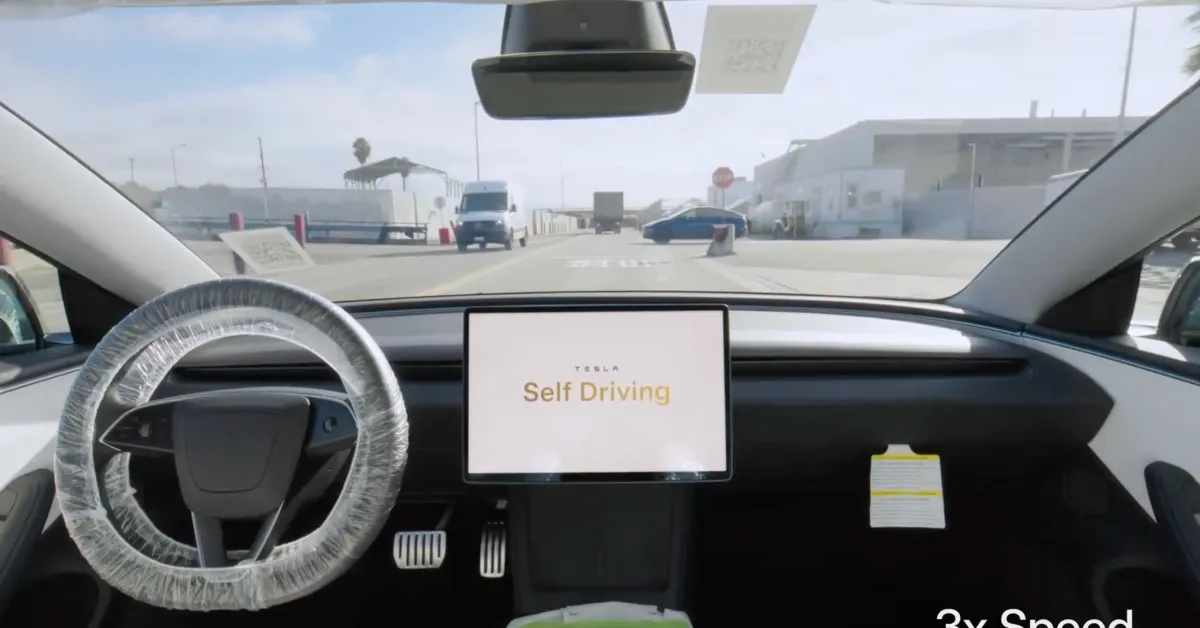
The electric vehicle industry was set ablaze on November 6, 2025, when Tesla CEO Elon Musk made stunning announcements at the company's Annual Shareholder Meeting that fundamentally shifted the timeline and scope of the company's full self-driving ambitions. During the meeting, Musk disclosed that Tesla could enable drivers to text while their vehicles operate autonomously in "a month or two," and that unsupervised Full Self-Driving (FSD) capabilities could reach select U.S. cities "a few months away" from late 2025. These declarations mark a critical turning point for the world's most valuable automaker, though they also resurrect skepticism from an industry that has heard similar promises repeatedly over the past six years.
For Tesla owners in the United States and Europe, these announcements carry profound implications. Currently, FSD (Supervised) requires drivers to maintain hands-on-wheel engagement and continuous attention to the road, effectively making human intervention the safety net for any system failures. Unsupervised FSD would represent a fundamental shift in vehicle responsibility, where Tesla's algorithms would assume primary control and liability for vehicle operation. The tantalizing prospect of "texting and driving" legally adds another layer of complexity and controversy to an already contentious technology landscape.
What makes this moment historically significant is not just the technical achievements Tesla claims to have made, but the broader trajectory they represent. Over the past six years, Musk has repeatedly promised "unsupervised" autonomous driving by year-end, each time missing the deadline and pushing timelines further into the future. Yet 2025 has genuinely seen measurable improvements in FSD capability, evidenced by successful deployments of Robotaxi services in Austin and the San Francisco Bay Area, where vehicles operate with minimal or no human intervention in defined geographic areas. The question isn't whether Tesla is making progress—it clearly is—but whether the timelines Musk articulated are realistic or merely aspirational.
This comprehensive exploration examines the technical, regulatory, and practical realities behind Tesla's latest FSD announcements, distinguishing between what the company claims it can achieve and what the actual pathway to regulatory approval and real-world deployment actually entails. For Tesla owners considering their next vehicle purchase or potential software upgrade investments, understanding the nuances of these announcements is essential for making informed decisions.
CHAPTER 1: THE SHAREHOLDER MEETING BOMBSHELL
The 2025 Annual Shareholder Meeting on November 6 served as the platform for Musk to recalibrate investor expectations around Tesla's autonomous driving capabilities. The timing was significant—Tesla's stock had faced recent volatility, and the company needed to articulate compelling growth narratives beyond traditional automotive sales. FSD and robotaxi expansion represented exactly that narrative.
According to multiple reports from the shareholder meeting, Musk stated that Tesla is "a few months away" from deploying unsupervised FSD to select U.S. cities by year-end 2025. This timeline would place initial deployments in November-December 2025, though Musk also acknowledged that some expansion might push into 2026. Critically, he emphasized that these would be limited to "select cities" rather than nationwide availability, and would likely begin with the Model Y, the vehicle with the most refined FSD training data.
The more controversial claim came when Musk suggested that Tesla could enable "texting and driving" capabilities within "a month or two," effectively by late December 2025 or early January 2026. While initially presented without context, this statement generated immediate industry concern. Texting while driving is illegal in virtually all U.S. states and European Union member nations, with penalties ranging from traffic fines to license suspension. The statement raised immediate questions: How could Tesla legally enable this feature? What regulatory pathway exists for drivers to abdicate attention requirements?
The shareholder meeting also provided updated safety data that Tesla uses to defend its FSD capabilities. According to company presentations, Tesla vehicles with FSD engaged experience statistically fewer accidents than human drivers operating in the same conditions. The company's methodology involves comparing miles driven with FSD engaged against control groups of human drivers across similar road types and traffic conditions. While third-party verification of these statistics remains limited, the data Tesla presented suggested FSD incident rates that were approximately one-quarter to one-third of human driver rates.
When asked about the previous six years of missed "unsupervised FSD by year-end" promises, Musk acknowledged that timelines have been optimistic in the past. He attributed delays to underestimating the complexity of edge cases—unusual driving scenarios that occur infrequently but require flawless handling. He also noted that regulatory approval processes take longer than originally anticipated, and that Tesla's approach evolved from the initial "full self-driving" vision toward a staged rollout model where capabilities are tested extensively in limited geographies before expansion.
The stock market reacted positively initially to these announcements, though skepticism emerged within 24 hours as analysts contemplated the regulatory and technical challenges. Tesla stock experienced volatility as institutional investors reassessed timelines and execution risks, with some acknowledging that Musk has consistently overestimated autonomous driving capabilities while simultaneously delivering genuine incremental progress.
CHAPTER 2: UNDERSTANDING FSD SUPERVISED VS. UNSUPERVISED
To meaningfully evaluate Musk's announcements, a technical understanding of the distinction between current FSD (Supervised) and the promised FSD (Unsupervised) is essential. These aren't minor software updates—they represent fundamentally different operational paradigms with profound legal, regulatory, and safety implications.
FSD Supervised, available today in the United States through subscription or purchase, intelligently guides vehicle steering, throttle, and braking for most driving tasks. The system can navigate highways, execute lane changes, manage city street driving, and perform parking maneuvers autonomously. However, the driver retains ultimate responsibility and must remain attentive with hands available to take control at any moment. Tesla's fleet learns from hundreds of millions of miles of driving data collected from active FSD users, continuously improving algorithm performance.
The technical architecture of FSD Supervised involves multiple redundant camera systems providing 360-degree awareness, sophisticated neural network AI that predicts vehicle and pedestrian behavior, and decision-making algorithms that execute driving maneuvers. Tesla abandoned lidar (light detection and ranging) sensors years ago, instead relying purely on vision-based systems supplemented by radar and ultrasonic sensors. This camera-only approach provides certain manufacturing cost advantages but also concentrates risk—if the vision systems fail or are deceived, backup sensing is limited.
FSD Unsupervised would operate without meaningful driver involvement. While regulatory frameworks are still being developed, autonomous driving levels are defined by the Society of Automotive Engineers (SAE) standard:
-
SAE Level 2 (Current FSD Supervised): Vehicle controls steering, acceleration, and deceleration. Driver must monitor and intervene.
-
SAE Level 3: Vehicle handles all dynamic driving tasks in specific conditions. Driver must be ready to intervene if requested.
-
SAE Level 4: Vehicle handles all driving tasks in most conditions without human intervention. Human intervention not required.
-
SAE Level 5: Vehicle handles all driving tasks in all conditions. Human control optional.
Tesla's stated goal for unsupervised FSD appears to be Level 3 capability initially, with progression toward Level 4 as the technology matures. Level 3 automation remains somewhat ambiguous legally—who is responsible if something goes wrong? Is it the driver (who might not be paying attention), the vehicle manufacturer, or the infrastructure? This ambiguity has proven to be the stickiest regulatory challenge.
From a technical standpoint, advancing from Supervised to Unsupervised requires solving several categories of challenges. First is edge case handling—those infrequent scenarios like debris in the road, malfunctioning traffic lights, or aggressive lane-cutting drivers that occur perhaps once per thousand miles but must be handled perfectly. Second is robustness to sensor degradation—rain, snow, dirt, or damage to cameras must not compromise safety. Third is safe failure modes—if the system detects a problem it cannot solve, it must safely degrade to human control.
Tesla's approach has been to collect real-world driving data from millions of active FSD users, analyzing videos and driving telemetry to identify edge cases, then training neural networks to recognize and properly handle these situations. The validation process involves multiple stages: testing on recorded data, testing with engineering vehicles in controlled scenarios, testing with employee drivers, and finally selective rollout to "early access" users before broader public availability.
The distinction becomes critical when considering liability. With Supervised FSD, responsibility clearly rests with the driver, who must remain attentive. With Unsupervised FSD, liability shifts toward Tesla and the vehicle's insurance, which transforms the risk calculus entirely. This is why regulatory approval is so challenging—regulators must be confident that Tesla's system is genuinely safer than human drivers before ceding responsibility.
CHAPTER 3: THE "TEXTING WHILE DRIVING" PARADOX
Perhaps no statement from Musk generated more immediate skepticism and concern than his casual suggestion that Tesla could enable "texting and driving" capabilities. The statement encapsulates both the promise of autonomous vehicles and the profound regulatory and legal contradictions that surround them.
Texting while driving is prohibited in all 50 U.S. states, with penalties including fines ranging from $50 to $500, points on driving records, and in some jurisdictions, license suspension. The prohibition is based on decades of highway safety data demonstrating that handheld device use dramatically increases accident risk. The National Highway Traffic Safety Administration (NHTSA) identifies distracted driving as a leading cause of motor vehicle accidents.
European regulations are similarly strict. EU nations implement "hands-free" requirements, with smartphone use while driving prohibited unless via hands-free systems. The prohibition is so comprehensive that rental cars frequently disable cellular connectivity while the vehicle is in motion.
So how could Tesla legally enable this feature? The answer lies in a crucial distinction: responsibility and legal liability transfer. If Tesla's FSD system is genuinely capable of handling all driving decisions without human intervention (Level 4 autonomy), then the driver isn't really "texting while driving"—the driver is a passenger, and the vehicle is driving. From a legal standpoint, this is profoundly different.
The regulatory framework for this exists in a handful of jurisdictions. Nevada, Arizona, and California have created specific regulatory pathways for autonomous vehicles that don't require human drivers to maintain attention. Nevada, for instance, allows fully autonomous vehicles to operate with no human in the driver's seat at all. California's regulations are more nuanced, requiring a "remote operator" or safety monitor in certain conditions but not requiring active driver engagement.
However, deploying this capability nationwide would require either a fundamental change in traffic laws—which would face massive political and safety lobbying opposition—or limiting the feature to specific jurisdictions where regulatory approval exists. Musk's timeline of "a month or two" seems wildly optimistic for regulatory frameworks that typically take months to years to develop and implement, even when regulatory bodies are eager to accommodate autonomous vehicles.
The liability question also remains unclear. If a Tesla with FSD Unsupervised and texting-enabled capability crashes, is Tesla liable? The driver? The vehicle owner's insurance? The answer determines whether insurance companies will even offer coverage for such vehicles. Current discussions with insurance companies suggest they're not prepared for this scenario.
Furthermore, federal agency dynamics add complexity. NHTSA sets federal safety standards, but states regulate licensing and road rules. A feature that's legal in Nevada might be illegal in Texas despite both states using identical highways. This patchwork creates operational complexity that challenges the concept of a "national rollout."
Musk's statement appears to have been intentionally provocative—designed to generate media coverage and make clear Tesla's ambitious vision. But the actual implementation faces genuine barriers that timelines measured in months cannot overcome. More likely, Tesla will implement a geographically limited version in permissive jurisdictions, carefully framed as a feature for Level 4 autonomy in specific conditions rather than as a general "texting while driving" capability.
CHAPTER 4: THE DATA BEHIND FSD SAFETY CLAIMS
Tesla's defense of FSD rests fundamentally on accident statistics. The company claims that FSD-engaged miles result in dramatically lower accident rates than control groups of human drivers. At the shareholder meeting, Musk presented data suggesting that FSD accidents occur at approximately one-quarter the rate of human drivers, a claim that, if accurate, would be revolutionary.
Understanding how Tesla generates these statistics is essential for evaluating their accuracy. Tesla collects detailed telemetry from all vehicles equipped with FSD, including video from multiple cameras, vehicle speed, steering angle, throttle and brake position, and accident data including police reports when available. The company then compares accident rates from miles driven with FSD engaged against statistical control groups of human drivers in similar conditions.
The methodology appears rigorous in principle, but several limitations deserve scrutiny. First, Tesla doesn't release raw data or methodology to third-party researchers, making independent verification impossible. Second, Tesla's FSD user base likely differs from the general population—FSD requires active purchase or subscription, suggesting owners are more affluent, higher-skilled, and more engaged with technology than average drivers. This self-selection bias means comparing FSD users to all drivers (not matched pairs) creates misleading comparisons.
Third, the geography where FSD operates affects statistics. Tesla disproportionately deploys FSD in favorable conditions—relatively clear weather, well-marked roads, and lower-complexity urban environments initially. Comparing accident rates in favorable conditions to nationwide averages is inherently misleading. A more honest comparison would pit FSD against the best human drivers in identical conditions (perhaps other Tesla owners) rather than against aggregate statistics.
Fourth, accident definitions matter enormously. Tesla likely includes minor fender-benders and door-ding-parking scenarios in raw data, while comparing to police-reported accidents, which misses many minor incidents. This could systematically make FSD appear safer.
Despite these methodological concerns, the trajectory of FSD improvement is genuinely impressive. Review of video footage from FSD Beta releases over the past 18-24 months shows substantially improved handling of complex scenarios—handling unexpected pedestrian movements, dealing with unusual traffic patterns, and managing tricky multi-vehicle interactions. The improvement is visible even without access to detailed statistics.
Recently released FSD v14.1.4 footage from operation in Quebec, Canada during heavy snow demonstrated competent navigation in genuinely hazardous conditions. This level of robustness to weather represents a genuine leap from earlier FSD versions that struggled with snow-covered lane markings.
The evidence suggests that FSD is substantially safer than it was 18 months ago, likely safer than average human drivers in ideal conditions, but probably not yet safe enough for fully unsupervised operation in all conditions. This creates the regulatory bind—regulators are probably willing to approve limited geographies and specific conditions, but nationwide blanket approval for all conditions remains years away.
CHAPTER 5: PRODUCTION TIMELINE REALITY CHECK
Understanding why Musk's previous predictions consistently missed timelines is essential for evaluating current claims. From 2019 onward, Musk made nearly annual declarations that "unsupervised FSD" would be available to customers by year-end. 2019's promise failed. 2020's promise failed. 2021 through 2025, the cycle repeated.
These aren't failures of effort—Tesla's engineers have genuinely labored extensively on FSD development. Rather, they reflect how deeply Musk underestimated the complexity of the problem. Autonomous driving in all conditions across all road types is an extraordinarily difficult problem that currently remains unsolved by any company globally.
The key challenge is what the industry calls "long tail" or "edge cases"—those unusual situations that don't occur in your first million miles but must be handled perfectly whenever they do occur. Imagine a traffic light with a malfunctioning red signal, or debris in the driving lane, or an aggressive driver weaving through traffic, or a pedestrian standing on the curb but not yet crossing. Each scenario occurs infrequently, but collectively, edge cases represent the vast majority of driving complexity.
Tesla's current approach addresses this through data collection from millions of active FSD users. Rather than trying to predict every possible scenario, the company collects video footage of real-world driving situations, identifies scenarios where FSD made mistakes or behaved unpredictably, and retrains neural networks on that data. This empirical approach is fundamentally more effective than trying to code rules for every possible scenario.
However, this approach has a critical limitation: it's fundamentally slower than initially apparent. Identifying edge cases requires them to occur in the real world, getting captured by cameras, being flagged by humans as problematic, and then being fed back into retraining pipelines. The process is iterative and lengthy. There's no way to substantially accelerate it without accepting greater safety risks.
Current timelines suggest that unsupervised FSD capability in limited geographies might actually be achievable by late 2025 or early 2026, but this would likely be:
Highly geographically constrained: Probably Austin, Texas (where Robotaxi already operates) and possibly one or two additional cities with favorable regulatory environments. Nationwide deployment would take years.
Condition-constrained: Probably limited to specific weather conditions, time-of-day constraints (daylight), and road type constraints (freeways and major surface streets, not complex multi-way intersections or severe weather).
Model-constrained: Likely limited to Model Y initially, the vehicle platform with the most extensive FSD training data.
Liability-constrained: Probably structured as "Tesla assumes liability if FSD causes accidents" rather than traditional vehicle insurance, at least initially. This creates significant financial risk that might limit rollout pace.
These constraints are substantial but realistic. They align with both regulatory expectations (agencies want limited rollouts to prove safety before expansion) and engineering realities (limited deployment reduces edge case discovery rate pressure).
The five-year pattern of missed timelines suggests appropriate skepticism toward any Musk prediction measured in months. However, the genuine progress Tesla has made, particularly with Robotaxi in Austin, suggests that progress toward unsupervised capability is real, just slower than Musk typically acknowledges.
CHAPTER 6: COMPETITIVE LANDSCAPE AND ALTERNATIVE APPROACHES
Tesla's FSD approach isn't the only pathway to autonomous vehicles. Competitors are pursuing different technical strategies and deployment models, each with distinct advantages and limitations.
Waymo (Alphabet subsidiary) developed autonomous vehicles from first principles using highly detailed maps and supplementary lidar sensors alongside cameras. Waymo's robotaxi services operate in San Francisco, Phoenix, and Los Angeles. Their approach emphasizes building comprehensive maps of service areas, then extensively testing in those areas before commercial deployment. This is slower than Tesla's approach but potentially safer for limited geographies. Waymo faces the advantage of not carrying consumer vehicles, simplifying the liability and insurance questions.
Cruise (formerly GM subsidiary) pursued a similar approach to Waymo but faced setbacks, including a 2023 accident involving a pedestrian that triggered regulatory investigations. The company is rebuilding and refocusing on commercial delivery rather than passenger robotaxis.
Aurora, a startup backed by Uber and others, is developing technology for trucking, not passenger vehicles. Their focus on long-haul trucking sidesteps some of the urban complexity that plagues passenger AV development.
Traditional automakers like BMW, Mercedes-Benz, and others are implementing incremental autonomy features but pursuing Level 3 capability (vehicles that can drive themselves but with driver ready to intervene) rather than Tesla's more ambitious Level 4 goals. This middle-ground approach might actually be commercially viable sooner than either Waymo's or Tesla's more extreme visions.
Chinese competitors including Baidu, Nio, and XPeng are developing autonomous driving capabilities, with Baidu particularly aggressive. XPeng's autonomous highway assistance in China operates in multiple provinces with real-world deployment that, while limited, suggests genuine capability.
Competitively, Tesla faces a peculiar position. Its FSD is available today (though limited by supervision requirements), which no competitor can claim. But competitors' more geographically concentrated approaches (Waymo, Cruise, Aurora in specific cities/applications) might actually achieve commercial viability before Tesla's broader push. A Waymo robotaxi that operates perfectly in San Francisco might generate revenue before an unsupervised FSD that operates with limitations everywhere.
This competitive landscape suggests that the autonomous vehicle market will likely see multiple winners, each serving different niches. Tesla's approach of continuously updating consumer vehicles might dominate personal vehicle ownership, while specialized services like Waymo robotaxi dominate commercial ride-hailing. The "winner takes all" narrative often associated with tech rarely applies to automotive, where regulatory fragmentation and different use cases support multiple competitors.
CONCLUSION
Tesla's announcement at its November 2025 shareholder meeting marks a genuine inflection point in autonomous vehicle deployment, even if it overstates the immediacy of change. The company has genuinely achieved substantial technical progress in full self-driving capability. Robotaxi services operating with minimal human intervention in Austin and the Bay Area demonstrate real capability, not vaporware. The trajectory of FSD capability improvements is compelling, with recent releases showing competence in challenging scenarios.
However, the timelines Musk articulated—"a few months" for unsupervised FSD deployment and "a month or two" for texting-while-driving capability—almost certainly overstate achievable near-term deployment. Based on regulatory timelines, technical validation requirements, and the pattern of previous delays, realistic expectations should be:
Late 2025 to early 2026: Limited unsupervised FSD capability in select geographies (probably Austin initially), under strict conditions, on specific vehicle models, with Tesla assuming liability for accidents.
2026-2027: Gradual expansion to additional cities and conditions as safety data accumulates and regulatory approval widens.
2027+: Nationwide deployment with geographic and conditional limitations.
"Texting while driving" would require fundamental changes to traffic laws or severe geographic and conditional limitations. Deployment of even limited versions probably won't occur until 2026 at the earliest, and then only where regulatory frameworks specifically permit it (Nevada, Arizona, etc.).
For current Tesla owners, FSD Supervised represents genuine value today, particularly for long-distance driving. The question of upgrading to unsupervised capability should wait for actual deployment announcements in specific geographies, not Musk's prediction timelines.
For prospective Tesla buyers, FSD Supervised is worth considering as a feature, while treating promises of unsupervised capability as forward-looking aspirations rather than near-term expectations. The technology trajectory is genuinely positive, but real-world deployment timelines will likely exceed Musk's stated expectations.
For the industry, Tesla's progress validates the viability of vision-based autonomous driving approaches and demonstrates consumer appetite for incremental autonomy features. However, competitors' more focused geographic approaches (Waymo), more conservative liability structures (commercial services without consumer responsibility), or more intermediary technological levels (Level 3 rather than Level 4) might achieve commercial success sooner.
The autonomous vehicle revolution is genuinely underway. Tesla is authentically at the forefront of advancing it. But the actual timeline for meaningful consumer deployment remains years away, not months, despite the compelling vision Musk articulates.