
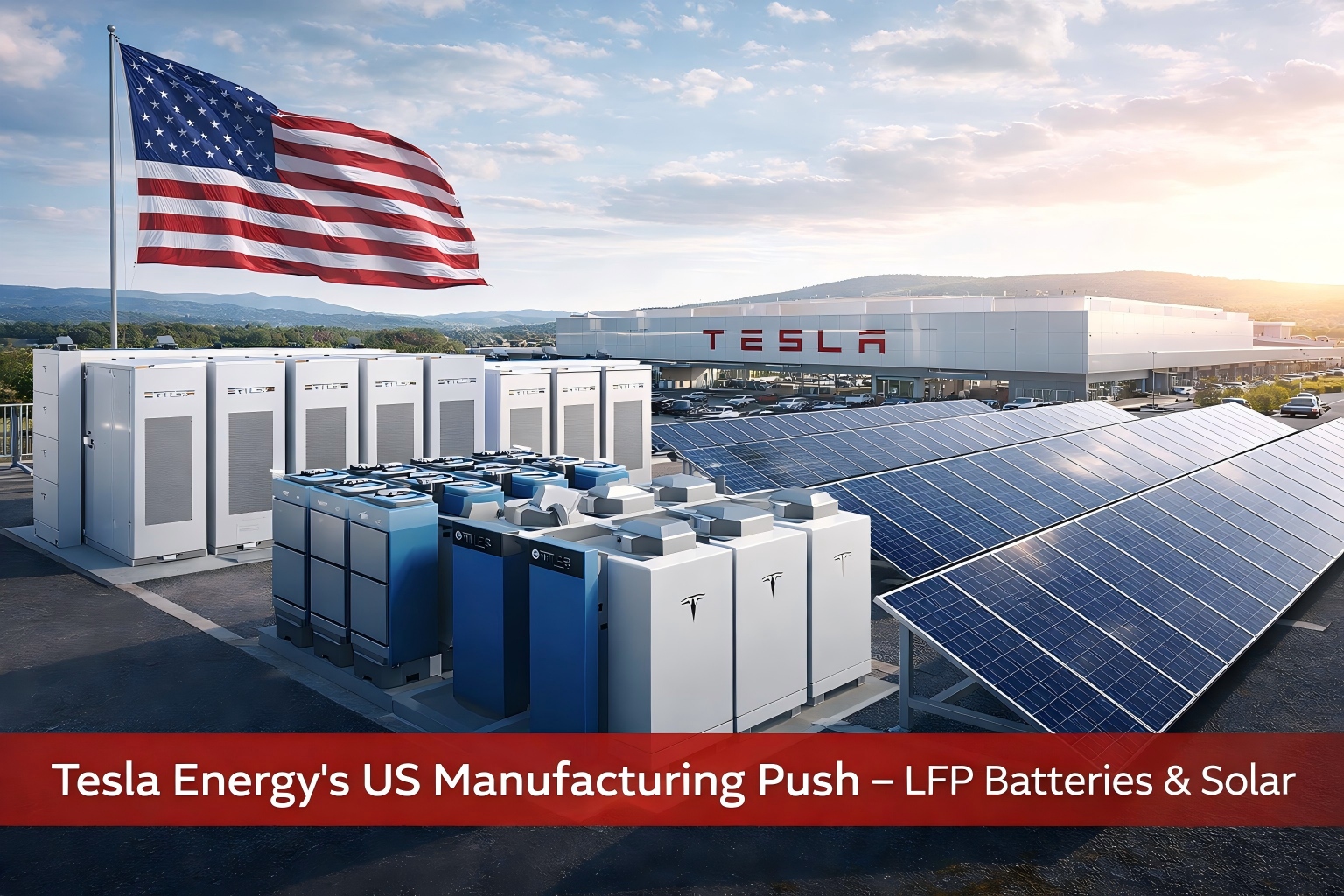
Executive Summary
In March 2026, the United States Department of the Interior formally confirmed what industry analysts had suspected for months: Tesla has entered into a $4.3 billion partnership with LG Energy Solution to establish domestic lithium iron phosphate (LFP) battery production in Lansing, Michigan. This announcement came alongside news that Tesla is negotiating $2.9 billion in solar manufacturing equipment purchases from Chinese suppliers, destined for a new 100-gigawatt solar factory in Texas.
Together, these investments represent a $7.2 billion bet on domestic energy manufacturing—a strategic pivot driven by geopolitical necessity, tariff pressures, and the explosive growth of Tesla’s energy storage business. For Tesla owners, the implications extend far beyond corporate strategy. These investments will shape the cost of future vehicles, the reliability of the Supercharger network, and the viability of home energy systems.
Chapter 1: The LFP Battery Deal – Breaking China’s Dominance
The Announcement
On March 16, 2026, the US Department of the Interior released a statement as part of the Indo-Pacific Energy Security Summit results, confirming that Tesla is the buyer behind LG Energy Solution’s previously announced $4.3 billion battery supply agreement. The deal establishes a dedicated LFP prismatic battery cell manufacturing facility in Lansing, Michigan, with production scheduled to begin August 1, 2027 .
The facility, formerly known as Ultium Cells 3, was originally a joint venture between LG Energy Solution and General Motors. GM exited the partnership in late 2024 as part of broader cuts to electric vehicle investments, selling its stake to LG in May 2025. LG subsequently reconfigured the factory to produce LFP batteries for energy storage rather than the nickel-based batteries originally planned for electric vehicles .
Under the agreement, LG Energy Solution will supply Tesla with LFP batteries for a three-year term, from August 2027 to July 2030, with options to extend up to seven years and increase volumes. The factory is designed to produce approximately 50 gigawatt-hours of batteries annually—enough to power all of Tesla’s Megapack 3 energy storage systems produced at the new Houston Megafactory .
Why LFP? Understanding the Chemistry
Lithium iron phosphate (LFP) batteries differ fundamentally from the nickel manganese cobalt (NMC) or nickel cobalt aluminum (NCA) batteries used in most Tesla electric vehicles. The distinctions matter for understanding why this deal focuses on energy storage rather than vehicles.
Cost: LFP batteries use abundant, inexpensive materials. Iron and phosphate are cheap and widely available, unlike cobalt and nickel, which face supply constraints and price volatility. Current production costs for LFP are approximately $98 per kilowatt-hour, compared to $112-120 per kWh for NMC batteries .
Safety: LFP chemistry is inherently more stable than nickel-based alternatives. Thermal runaway—the condition where overheating causes cascading battery failure—occurs at 270°C in LFP batteries, compared to 150-210°C for nickel-based chemistries. This safety margin is critical for grid-scale installations where a battery fire would be catastrophic .
Cycle Life: LFP batteries endure over 10,000 charge-discharge cycles with minimal degradation. For comparison, NMC batteries typically last 1,500-2,000 cycles before significant capacity loss. For stationary energy storage, where daily charging is the norm, cycle life is the dominant economic factor .
Energy Density: The trade-off is energy density. LFP batteries deliver approximately 180 watt-hours per kilogram, compared to 250-270 Wh/kg for premium NMC cells. For stationary storage, where weight and volume are less constrained than in vehicles, this density penalty is acceptable .
The Tariff Wall
The timing and structure of this deal are directly responsive to US trade policy. As of March 2026, imported LFP batteries from China face an effective tariff rate of 82.4 percent, combining a 34 percent “reciprocal” tariff, a 20 percent Section 301 tariff, a 3.4 percent base rate, and a 25 percent battery-specific Section 301 tariff scheduled to extend to storage batteries in 2026 .
This tariff regime makes Chinese LFP cells economically unviable for US-based energy storage projects. Tesla’s Megapack business, which relies on LFP chemistry, would face a severe cost disadvantage if it continued sourcing from China.
Tesla’s chief financial officer, Vaibhav Taneja, warned during the company’s Q4 2025 earnings call that tariffs were having “far greater impact than anticipated” on the energy storage business, with approximately $200 million in tariff costs incurred in the third quarter of 2025 alone .
The LG Energy Solution deal bypasses these tariffs entirely. Batteries manufactured in Michigan are US-made products, exempt from import duties. For Tesla’s Megapack 3 systems, produced at the new Houston facility, this represents a cost reduction of tens of millions of dollars annually.
Breaking the CATL Dependency
Before this deal, Tesla’s energy storage batteries came almost exclusively from China’s Contemporary Amperex Technology Co. (CATL), the world’s largest LFP battery manufacturer. In 2023 and early 2024, CATL held 100 percent of Tesla’s storage battery supply. By late 2024, Tesla had introduced BYD’s FinDreams as a secondary supplier, accounting for over 20 percent of supply, but China remained the sole source .
This dependency created vulnerability. A single policy change—either in Beijing or Washington—could disrupt Tesla’s fastest-growing business segment. The LG Energy Solution deal diversifies supply to South Korea and the United States, insulating Tesla from geopolitical supply shocks.
For owners, this supply chain stability translates to price stability. Megapack installations for utilities and commercial customers become less susceptible to tariff-driven cost increases, and those stable costs eventually flow through to electricity rates.
Chapter 2: The Solar Ambition – 100 Gigawatts in Texas
The 100 GW Target
In January 2026, Elon Musk announced at the World Economic Forum in Davos that Tesla and SpaceX would independently build 100 gigawatts of solar manufacturing capacity in the United States by the end of 2028 . For context, total US solar installations in 2023 reached approximately 32 gigawatts. Tesla aims to manufacture more than three times that annually.
The target appeared in Tesla job postings, which specified the goal of “100 GW of solar manufacturing from raw materials on American soil before the end of 2028” . This is not a solar installation target—Tesla is not aiming to build 100 GW of solar farms—but rather a manufacturing target: Tesla intends to produce enough solar panels, cells, and equipment to generate 100 GW of capacity annually.
The $2.9 Billion Equipment Deal
To achieve this target, Tesla has entered negotiations with multiple Chinese solar equipment manufacturers for a purchase valued at approximately $2.9 billion (20 billion yuan). According to Reuters reporting, the leading candidate is Suzhou Maxwell Technologies, the world’s largest producer of screen-printing equipment used to manufacture solar cells. Other potential suppliers include Shenzhen S.C New Energy Technology and Laplace Renewable Energy Technology .
The equipment is scheduled for delivery before autumn 2026, with shipments destined for Texas. The equipment will establish solar manufacturing capacity at Tesla’s expanding Texas footprint, which already includes the Austin Gigafactory and the new Houston Megafactory for Megapack production .
Why Chinese Equipment?
The choice of Chinese suppliers reflects a fundamental reality of the solar manufacturing industry. China dominates global production of solar manufacturing equipment, with Chinese companies supplying more than 90 percent of the equipment used to produce high-efficiency solar cells worldwide . There are no US-based alternatives capable of delivering comparable equipment at the required scale.
The US government has recognized this dependency. In 2024, the Biden administration excluded solar manufacturing equipment from Section 301 tariffs at the urging of American solar panel makers, who argued they had nowhere else to buy the machinery needed to establish domestic factories. The Trump administration has extended this exemption through November 2026 .
This tariff exemption is critical to Tesla’s plans. Without it, the $2.9 billion equipment purchase would face significant duties, undermining the economics of domestic manufacturing.
Export Approval Hurdles
While US tariffs are not an issue, Chinese export controls may be. Suzhou Maxwell and other suppliers must obtain export approval from China’s Ministry of Commerce to ship advanced manufacturing equipment abroad. Beijing has tightened controls on solar technology exports over the past two years, viewing them as strategically sensitive .
As of March 2026, these approvals remain pending. The timeline suggests that if approvals come quickly, equipment could begin shipping by mid-2026, with installation in Texas completed by year’s end and initial production in 2027.
The AI Power Connection
Musk’s solar ambitions are driven not by environmental idealism but by raw electricity demand. The AI boom has dramatically increased US power consumption, which hit consecutive records in 2024 and 2025. Data centers, particularly those training and running large language models, consume enormous amounts of electricity—and projections show continued growth .
Musk has argued that solar power is the only energy source capable of scaling quickly enough to meet AI-driven demand. “Solar power could meet all of the electricity needs of the United States—including the ever-increasing demand from a growing number of data centers,” Musk said at Davos .
The Texas solar manufacturing facility will produce panels that can power Tesla’s own operations, including the Gigafactory, the Megapack factory, and potentially SpaceX’s Starlink satellites. The integration of solar manufacturing with battery storage—Megapack for grid-scale, Powerwall for homes—creates a vertically integrated energy business that complements Tesla’s vehicle operations.
Chapter 3: Policy Context – Tariffs, Trade, and Industrial Strategy
The Trump Administration Energy Policy Paradox
President Donald Trump has pursued an energy policy focused on maximizing fossil fuel production, cutting subsidies for solar and wind projects, and imposing aggressive tariffs on Chinese imports. This creates an interesting paradox for Tesla’s energy ambitions.
On one hand, the tariff regime that makes Chinese LFP batteries uneconomical is a Trump administration policy. The 25 percent battery-specific Section 301 tariff, scheduled to extend to storage batteries in 2026, originated in Trump’s first term and was retained and expanded by the Biden administration. The 34 percent reciprocal tariff announced in early 2026 is a Trump policy .
On the other hand, the solar manufacturing equipment tariff exemption is also a Trump administration policy—extended through November 2026 at the request of American manufacturers who depend on Chinese equipment. And the administration’s focus on energy independence aligns with Tesla’s domestic manufacturing strategy .
Musk has criticized tariff barriers as making “the economics of deploying solar in the United States artificially high” when the country faces critical power shortages . But he has also benefited from the protectionist environment, which encourages domestic manufacturing investment.
The Inflation Reduction Act Aftermath
The Inflation Reduction Act (IRA), passed during the Biden administration, provided substantial tax credits for domestic battery and solar manufacturing. While the Trump administration has sought to roll back IRA provisions, the manufacturing credits have proven politically difficult to eliminate, as they benefit red-state factories.
Tesla’s domestic manufacturing investments position it to benefit from these credits if they survive, or to compete without them if they do not. The LG Energy Solution Michigan factory, originally a GM-LG joint venture, was structured to qualify for IRA credits. Its conversion to Tesla supply maintains that qualification .
European Implications
While these deals focus on US manufacturing, their effects ripple to European owners through pricing and technology. LFP batteries produced in Michigan will not directly supply European vehicles, but the economies of scale and technology learning from US production will benefit global supply chains.
European Tesla owners already benefit from LFP batteries in standard-range Model 3 and Model Y vehicles. The technology improvements and cost reductions from US production will accelerate the European transition to LFP chemistry for entry-level vehicles, potentially lowering prices.
Chapter 4: What This Means for Tesla Owners
Vehicle Pricing Stability
The most direct owner impact is price stability. Tesla’s ability to source batteries domestically reduces exposure to tariff shocks and supply chain disruptions that have historically caused price volatility. The $2.9 billion solar equipment purchase, while not directly affecting vehicle pricing, supports Tesla’s overall energy independence and reduces operational costs that would otherwise be passed to customers.
For owners considering future Tesla purchases, the domestic supply chain suggests that entry-level Model 3 and Model Y vehicles will likely continue using LFP batteries—and the cost of those batteries will remain stable or decline.
Supercharger Network Reliability
Tesla’s Supercharger network is powered by the electrical grid, which increasingly relies on battery storage for stability. Tesla’s Megapack systems, now powered by domestically manufactured LFP batteries, are being deployed at utility scale to stabilize grids and store renewable energy.
For owners, this means more reliable Supercharger operation. When grids strain during peak demand—summer heatwaves, winter storms—utility-scale batteries prevent brownouts that would otherwise shut down Supercharger stations. Tesla’s domestic battery production accelerates this grid stabilization.
Home Energy Integration
For owners with home solar and Powerwall systems, the domestic manufacturing shift means greater availability and lower costs. Solar panels produced at the Texas facility, combined with Powerwalls using LFP batteries (which may eventually come from Michigan), create a fully domestic energy system.
Tesla’s goal is to offer integrated solar-storage-vehicle packages that power a home entirely from on-site generation. Domestic manufacturing reduces the cost of these packages and simplifies installation logistics.
Long-Term Resale Value
Vehicles with domestically sourced components may retain value better than those dependent on imported parts. Resale markets respond to supply chain risks—a vehicle that can be serviced with domestically available parts is more attractive than one dependent on potentially tariff-constrained imports.
Tesla has not announced which vehicle models will use US-made LFP batteries, but the company’s shift toward domestic supply suggests that future vehicles will have higher US content, which supports resale value in the American market.
Chapter 5: Challenges and Risks
Execution Risk
Tesla’s history with solar manufacturing is not encouraging. The company acquired SolarCity for $2.6 billion in 2016 with ambitious plans to revolutionize residential solar. Musk set a target of 1,000 Solar Roof installations per week by the end of 2019. By Q2 2022, Tesla was installing approximately 23 Solar Roofs per week—about 2 percent of the target .
Solar deployments declined steadily after the acquisition. Panasonic exited the Buffalo Gigafactory in 2020, ending their solar cell partnership. By late 2024, Tesla had stopped reporting solar deployment figures entirely, and “solar” did not appear once during the Q3 2024 earnings call .
The 100 GW manufacturing target is 300 times larger than Tesla’s current solar panel capacity at the Buffalo facility. Achieving this scale in less than three years would require execution unlike anything Tesla has demonstrated in solar.
Technology Risk
The LG Energy Solution Michigan factory was originally designed for NMC batteries, not LFP. Converting from NMC to LFP production requires changes to electrode formulas, assembly processes, and thermal management systems—what one analyst described as “changing the recipe from cake to bread; the oven settings, the molds, and the baking logic all need to change” .
If the conversion encounters delays, Tesla may be forced to continue sourcing Chinese LFP batteries while paying escalating tariffs. The August 2027 production start date is less than 18 months away, and any delay could be costly.
Competitive Risk
Tesla’s energy storage dominance is not guaranteed. Form Energy and other long-duration storage companies are developing iron-air batteries that discharge for 100 hours, compared to Megapack’s 4-hour duration. If grid storage demand shifts from short-duration peaking to long-duration backup, LFP lithium batteries could face technological obsolescence .
Competitors are also building domestic manufacturing. Samsung SDI and SK On are expanding US production, and Fluence remains a significant system integrator. Tesla’s lead is substantial but not insurmountable.
Conclusion: A Strategic Necessity
Tesla’s $7.2 billion investment in domestic battery and solar manufacturing is not merely a business decision—it is a strategic necessity. The tariff wall that makes Chinese imports uneconomical has forced Tesla to rebuild its energy supply chain in North America. The result, if executed successfully, will be a more resilient, more stable, and potentially lower-cost energy business that benefits owners through price stability, grid reliability, and integrated home energy systems.
The LG Energy Solution deal secures LFP battery supply for Tesla’s fastest-growing business segment, insulating Megapack production from tariff volatility. The solar equipment purchase, while riskier given Tesla’s solar track record, addresses the next frontier: generating the electricity that batteries store.
For Tesla owners in the United States and Europe, the implications are real. Vehicle pricing becomes more predictable. Supercharger reliability improves as grid storage expands. Home energy systems become more integrated and more affordable. And Tesla’s long-term viability as a company—dependent on energy as much as vehicles—is strengthened.
The 2027 production start dates for both the Michigan battery factory and the Texas solar factory are not distant futures. They are less than 18 months away. The equipment is being purchased, the factories are being prepared, and the supply chains are being rebuilt. For Tesla owners, the question is no longer whether domestic energy manufacturing will happen, but how quickly the benefits will arrive.
FAQ
Q: Will the US-made LFP batteries be used in Tesla vehicles?
A: The announced deal is specifically for Megapack 3 energy storage systems. However, LFP batteries are already used in standard-range Model 3 and Model Y vehicles globally. Future expansion could bring US-made LFP cells to vehicles.
Q: How does this affect Tesla prices in Europe?
A: Indirectly, economies of scale and technology improvements from US production benefit global supply chains. European vehicles may see cost benefits over time, though they will continue to be supplied from regional factories.
Q: When will the Texas solar factory begin production?
A: Equipment deliveries are scheduled for fall 2026, with production likely beginning in 2027. The 100 GW target is set for 2028.
Q: Why is Tesla buying Chinese equipment for US solar manufacturing?
A: Chinese companies dominate solar manufacturing equipment globally, with over 90 percent market share. No US-based alternatives can supply the required equipment at the necessary scale.
Q: Does this mean Tesla is abandoning vehicle manufacturing?
A: No. Tesla’s energy business is growing faster than vehicle sales, but vehicles remain the majority of revenue. The energy investments complement vehicle operations, particularly through integrated home energy systems.
Q: Will Powerwall eventually use US-made LFP batteries?
A: Likely. Powerwall already uses LFP chemistry. Once Michigan production scales, it would be logical to supply Powerwall from the same domestic supply chain.