
Introduction
On April 22, 2026, Tesla began pushing software update 2026.2.9.8 to its Hardware 4-equipped fleet. The version number alone—14.3.2—would be easy to dismiss as just another incremental over-the-air refresh in a company that ships them by the dozen each year. But FSD (Supervised) V14.3.2 is not incremental. It is the culmination of a two-year architecture overhaul that rewrites the fundamental relationship between perception, prediction, and action. It unifies three previously siloed software stacks into a single neural network. It processes the world through a video language model that generates possible futures rather than merely forecasting bounding-box trajectories. And it arrives at a moment when Tesla‘s self-driving narrative is under more scrutiny than ever—from regulators, from owners who paid thousands of dollars for hardware now deemed insufficient, and from competitors who are beginning to close the gap in real-world deployment.
Chapter 1: The Architecture Shift—Why V14.3.2 Is Not Just Another Update
1.1 The End of Feature Fragmentation
To understand V14.3.2, one must first appreciate the architectural debt it dismantles. For years, Tesla’s self-driving stack operated as three functionally distinct systems: the core FSD driving model, the Actually Smart Summon (ASS) feature for low-speed parking-lot retrieval, and the Robotaxi operational model that governed the small fleet of unsupervised vehicles in Texas. Each ran on a separate neural network, trained on related but not identical data distributions, with separate validation pipelines and—most critically—separate failure modes.
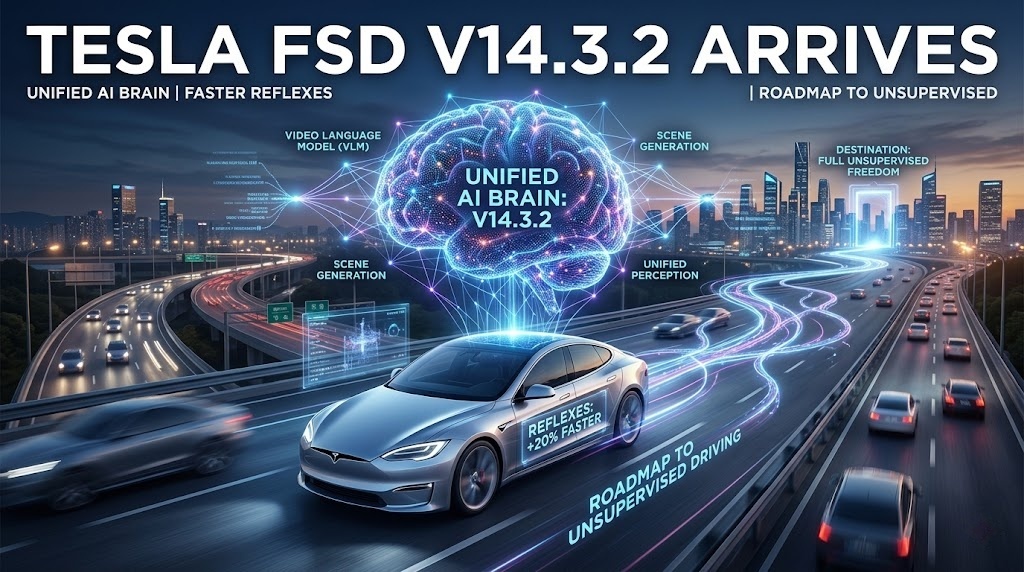
The release notes for V14.3.2 contain a single sentence that represents years of engineering work: “Unified the model between Actually Smart Summon, FSD, and Robotaxi for more capable and reliable behavior.” This unification means that an edge case learned during a parking-lot summon maneuver—say, a shopping cart blowing diagonally across the painted lines—now informs the model‘s behavior when it encounters a similar oblique-moving object at highway speed. The knowledge transfers across contexts because the model is no longer context-specific.
This is a classic example of what machine learning researchers call “multi-task learning with shared representations.” Instead of training three separate policies that each need to encounter every edge case independently, Tesla trains a single policy on a combined dataset that spans all three operational domains. The model develops internal representations that generalize across parking lots, city streets, and highway merges. For the driver behind the wheel, the subjective experience should be one of greater consistency: no more jarring transitions when switching from Summon to FSD, no more feeling that the car behaves differently depending on which software module is active.
1.2 MLIR and the 20% Reaction Time Improvement
The second major architectural change in V14.3.2 is invisible to the driver but measurable in milliseconds. Tesla’s engineering team rewrote the AI compiler and runtime from the ground up using MLIR (Multi-Level Intermediate Representation), an open-source compiler infrastructure originally developed at Google and now part of the LLVM project.
The previous compiler stack translated neural network operations into hardware instructions through a series of intermediate representations, each introducing minor inefficiencies. MLIR allows Tesla‘s engineers to represent computations at multiple levels of abstraction simultaneously—from high-level tensor operations down to register-level hardware instructions—and apply optimizations across those boundaries. The result, per Tesla’s official release notes, is a 20% reduction in end-to-end reaction time.
Twenty percent may sound modest. It is not. In the context of autonomous driving, where a vehicle traveling at 65 miles per hour covers nearly 10 feet in 100 milliseconds, a 20% reduction in processing latency can mean the difference between a near-miss and a collision. Tesla's official position, as stated in the release documentation, is unambiguous: “speed is safety.” The MLIR rewrite means the vehicle processes camera frames, predicts future states, and issues control commands faster than the hydraulic systems in a human driver’s body can transmit a signal from brain to brake pedal.
1.3 Reinforcement Learning at Fleet Scale
The third pillar of the V14.3.2 architecture is a substantially upgraded Reinforcement Learning (RL) training stage. Previous FSD versions relied heavily on imitation learning: the model watched millions of hours of human driving and learned to mimic the most common behavior in each situation. Imitation learning produces smooth, human-like driving in routine conditions but struggles with rare events—precisely the situations where safety matters most.
V14.3.2 introduces a much more aggressive RL component. Instead of simply imitating, the model is now trained to optimize for safety-critical outcomes: avoiding collisions, minimizing harsh braking, maintaining appropriate following distances. The training process sources “hard examples” directly from the Tesla fleet. When a vehicle anywhere in the world encounters an unusual situation—an emergency vehicle approaching from behind, a pedestrian stepping off a curb at the last moment, a traffic cone blown into the travel lane—that data is flagged, anonymized, and fed into the RL training pipeline.
The release notes are unusually detailed about which scenarios received focused RL attention: emergency vehicles and school buses, right-of-way violators, small animals, traffic lights at complex intersections with compound signals and curved approaches, and “rare and unusual objects extending, hanging, or leaning into the vehicle path.” Each of these represents a category of disengagement or near-disengagement that Tesla‘s data engine identified as a priority. By sourcing infrequent events from the global fleet and training on them with RL—where the model receives a reward for safe handling and a penalty for risky behavior—V14.3.2 progressively improves behavior that imitation learning alone could never reliably produce.
Chapter 2: What V14.3.2 Feels Like From the Driver’s Seat
2.1 Low-Visibility and Edge-Case Performance
Early adopter reports from the United States and Europe paint a consistent picture of improvement in precisely the areas that previous versions found most challenging. The upgraded vision encoder in V14.3.2 strengthens 3D geometry understanding—the vehicle‘s internal representation of the three-dimensional structure of the world around it—and expands traffic sign comprehension.
In practical terms, this manifests in several ways. Drivers report that the vehicle now handles heavy rain and fog with notably less hesitation, maintaining appropriate speeds and following distances without the anxious micro-corrections that characterized earlier builds. The synthetic data augmentation that Tesla applies during training—rendering millions of simulated rain-streaked, fog-obscured, and glare-washed driving scenarios—appears to be paying measurable dividends.
Construction zones, historically a major weakness of vision-only systems, have also improved. The expanded 3D geometry understanding allows the vehicle to better interpret temporary lane markings, barrel arrays, and non-standard traffic control devices. Testers in Austin and San Francisco have documented successful navigation through complex work zones that would have triggered disengagements on V13 builds. Crucially, the unified model architecture means that the vehicle maintains situational awareness through construction zones without the abrupt handoff between planning modules that often caused erratic behavior in previous versions.
However, the improvements are not universal. Several experienced FSD testers have noted that pedestrian detection and handling, particularly in crowded urban environments with multiple pedestrians moving in different directions, remains an area of concern. The system occasionally exhibits hesitation or confusion when pedestrians are partially occluded by parked vehicles or street furniture. This may explain why Tesla has kept the wide release paused at less than 1% of the HW4 fleet while it addresses regressions before expanding availability.
2.2 Parking and Summon: The Unified Model in Action
One of the most immediately noticeable improvements in V14.3.2 appears in parking scenarios. The release notes highlight “increased decisiveness of parking spot selection and maneuvering” and a new feature that displays a predicted parking location on the map with a “P” icon before the maneuver begins.
This may seem minor, but it reflects a deeper architectural improvement. Previously, the vehicle‘s parking behavior was governed by a separate planning module that sometimes hesitated, circled unnecessarily, or selected suboptimal spots. The unified model now approaches parking with the same predictive capability it uses for highway driving: it can “see” the parking lot, anticipate the geometry of the maneuver, and execute it with confidence.
Actually Smart Summon benefits directly from this unification. Users report smoother, more decisive behavior when summoning their vehicles across parking lots, with fewer of the stop-and-start hesitation patterns that made earlier versions feel uncertain. Because Summon now runs on the same neural network as the core driving stack, it inherits all of the perception and prediction improvements. A vehicle that can navigate a complex urban intersection can now apply that same spatial reasoning to a crowded Costco parking lot.
2.3 European Observations
Tesla’s European presence provides an important testing ground for FSD, because European roads present challenges that American highways simply do not. Narrower lanes, more complex roundabout designs, tram tracks embedded in road surfaces, and a much higher density of vulnerable road users (cyclists, scooter riders, pedestrians) all stress the system in ways that wide American stroads do not.
In February 2026, Tesla’s European communications team released a video of FSD V14.2.1 navigating Dutch roads, with particular emphasis on its ability to interpret traffic officer hand gestures—a legally required capability for autonomous operation in many EU member states. The video showed a vehicle recognizing a police officer directing traffic and correctly disregarding a red traffic signal in favor of the officer’s gesture, navigating the intersection smoothly.
V14.3.2 builds on this foundation. European owners report improved roundabout handling, better speed adaptation on narrow village streets, and more confident interactions with cyclists—including the ability to anticipate when a cyclist is likely to move laterally to avoid a parked car. The European regulatory environment remains more conservative than the American one, and unsupervised FSD is unlikely to receive EU type-approval before 2028 at the earliest. But the supervised experience is improving at a pace that European owners have long been waiting for.
Chapter 3: The Hardware Divide—AI4, HW3, and the Uncomfortable Truth
3.1 The Confirmation That Changed Everything
On April 22, 2026, during Tesla‘s first-quarter earnings call, Elon Musk stated something that millions of Tesla owners had been dreading: “Hardware 3 simply does not have the capability to achieve unsupervised FSD.” The bottleneck, Musk explained, is memory bandwidth. HW3, the computer installed in approximately 4 million Teslas built between 2019 and 2023, has only one-eighth the memory bandwidth of the newer HW4 platform, now officially branded as AI4.
This was not entirely unexpected. Musk had flagged the issue as early as January 2025, but the Q1 2026 confirmation removed any remaining ambiguity. Vehicles equipped with HW3—including many whose owners paid between 8,000and15,000 for the Full Self-Driving package under the explicit promise that their hardware was “sufficient for full autonomy”—will never achieve unsupervised operation without a hardware retrofit.
The implications are far-reaching. Tesla sold FSD capability to HW3 owners based on the representation that the hardware in their vehicles was adequate. For years, as FSD’s AI models grew larger and more computationally demanding, HW3 vehicles fell progressively behind, eventually stabilizing on FSD V12.6 in early 2025 while AI4 vehicles advanced to V13 and then V14. The gap between the two platforms has become unbridgeable, and Tesla now faces the challenge of making good on promises made to its earliest and most loyal adopters.
3.2 V14-Lite: The Consolation Prize
Tesla‘s response is threefold. First, Ashok Elluswamy, Director of Autopilot Software, confirmed on the earnings call that Tesla will release a “distilled version” of V14 for HW3 vehicles by the end of June 2026. This “V14-lite” will bring park-to-park supervised FSD capabilities to HW3 owners, incorporating many of the V14 feature set currently running on AI4 hardware, but it will not support unsupervised driving.
Second, Tesla is offering a discounted trade-in program for HW3 owners to upgrade to AI4-equipped vehicles. The specific pricing has not yet been disclosed, but Musk framed it as an acknowledgment of the company‘s obligation to early FSD purchasers. How generously Tesla prices this program will largely determine whether HW3 owners view the situation as a reasonable accommodation or a betrayal of trust.
Third, and most ambitiously, Tesla is planning what Musk described as “micro-factories” in major metropolitan areas—small-scale production lines dedicated solely to upgrading HW3 vehicles with new computers and cameras. Unlike the transition from HW2.5 to HW3, which required only a computer swap, the HW3-to-AI4 upgrade also requires camera replacement, significantly increasing the cost and complexity of each retrofit. Musk acknowledged that using standard service centers would be “extremely slow” and “inefficient,” hence the need for dedicated facilities. Whether these micro-factories materialize, and at what scale, remains one of the largest operational questions facing Tesla in the second half of 2026.
3.3 The Timeline for Unsupervised FSD
Unsupervised FSD for consumer vehicles is now targeted for the fourth quarter of 2026 at the earliest, with Musk describing the rollout as “gradual” and “geography-limited.” The initial deployment will almost certainly be confined to Texas and possibly select California markets, where Tesla has already accumulated the most validation miles and where state-level regulatory frameworks are relatively permissive.
The NHTSA’s ongoing engineering analysis—upgraded from a preliminary evaluation in March 2026—adds a significant layer of regulatory uncertainty. If the agency determines that FSD poses a safety risk requiring a recall, the timeline for unsupervised deployment could slip well into 2027 or beyond. Tesla‘s approach of deploying a small Robotaxi fleet in Texas while simultaneously preparing for a wider consumer rollout represents a calculated bet that the safety data from those initial deployments will satisfy regulators.
For HW3 owners, the message is clear: if you want unsupervised FSD, you will need AI4 hardware, whether through a trade-in or a retrofit. For AI4 owners, the promise of unsupervised driving is closer than ever, but it remains contingent on regulatory approval and the accumulation of sufficient validation miles.
Chapter 4: The Competitive and Regulatory Landscape
4.1 How V14.3.2 Compares to the Competition
Tesla‘s approach to autonomous driving—pure vision, end-to-end neural networks, fleet-scale data collection—stands in stark contrast to the strategies of its principal competitors. Waymo, the Alphabet subsidiary widely regarded as the leader in commercial robotaxi operations, relies on a combination of lidar, radar, and high-definition maps that are labor-intensive to create and maintain. Waymo has accumulated more than 15 million driverless miles across four U.S. cities, but each new city requires months of mapping and validation before service can launch.
Tesla‘s vision-only approach, if it works at scale, offers a decisive advantage in geographic scalability. A model that can drive safely without HD maps can, in principle, be deployed anywhere a Tesla vehicle can physically travel—no pre-mapping required. But this advantage exists only on paper until Tesla demonstrates that its system can match or exceed the safety performance of multi-sensor approaches in the diverse conditions that characterize real-world driving.
Chinese competitors, particularly Huawei with its ADS 3.0 system and XPeng with its city navigation assist, have made rapid progress in complex urban environments. Both companies are aggressively expanding in the Chinese domestic market, which now accounts for more than 60% of global EV sales. Tesla‘s ability to compete in China will depend not only on technical performance but also on regulatory compliance and data localization requirements that limit the export of training data.
4.2 The NHTSA and European Regulatory Hurdles
The regulatory environment for autonomous driving is fragmenting along regional lines. In the United States, the NHTSA’s engineering analysis of FSD—upgraded from a preliminary evaluation in March 2026—represents the most serious regulatory scrutiny Tesla’s self-driving program has ever faced. An adverse finding could trigger a recall affecting up to 3.2 million vehicles, with significant financial and reputational consequences.
In Europe, the path is even more complex. The European Union‘s type-approval framework for Level 3 and above automated driving requires compliance with UN Regulation No. 157, which mandates specific data recording, driver monitoring, and system behavior standards. Tesla’s vision-only approach, which dispenses with redundant sensor modalities, faces additional scrutiny under European safety certification protocols that have historically favored multi-sensor architectures.
The divergence between U.S. and European regulatory frameworks creates a strategic challenge for Tesla. A system optimized for U.S. driving conditions and NHTSA requirements may not automatically satisfy EU regulators, and vice versa. Tesla‘s ability to navigate these parallel regulatory tracks will determine whether FSD can achieve anything like the global deployment that its architecture theoretically enables.
Conclusion
FSD V14.3.2 is the closest Tesla has come to delivering on the autonomous driving promise that has been central to the company’s narrative since 2016. The architecture shift to a unified, video-language model trained with reinforcement learning at fleet scale represents a genuine advance over the fragmented, imitation-learning-dominated systems of previous generations. The 20% improvement in reaction time, the smoother cross-domain behavior, and the enhanced low-visibility performance are all real, and early adopter reports confirm measurable progress.
But V14.3.2 also surfaces uncomfortable truths. The Hardware 3 confirmation means that millions of early adopters—the very customers who funded Tesla‘s autonomous driving research through their FSD purchases—have been left with hardware that cannot reach the unsupervised destination. The NHTSA engineering analysis hangs over the entire program. And the gap between supervised and unsupervised operation remains wider than the release notes might suggest.
For Tesla owners in the United States and Europe, V14.3.2 is the best supervised driving experience the company has ever shipped. It handles situations that would have defeated earlier versions, and it does so with a confidence that inspires trust rather than anxiety. But it is still supervised. The driver remains legally and practically responsible for the vehicle‘s behavior. The road to unsupervised FSD—targeting Q4 2026, limited to specific geographies, and contingent on regulatory approval—is shorter than it was, but it has not yet reached its destination.
The most important metric to watch in the coming months is not the version number or the feature list. It is the disengagement rate, the intervention frequency, the safety data that Tesla is accumulating from every mile driven. Those numbers will determine whether V14.3.2 is remembered as another incremental step or as the version that finally made the unsupervised future feel inevitable.
FAQ
Q: Which vehicles are eligible for FSD V14.3.2?
A: V14.3.2 is currently rolling out to vehicles equipped with Hardware 4 (AI4), which includes Model S and Model X produced from 2024 onward, and Model 3, Model Y, and Cybertruck produced from 2023 onward. The rollout remains limited to less than 1% of the AI4 fleet as Tesla addresses regressions before expanding availability.
Q: Will my HW3 Tesla ever get unsupervised FSD?
A: No. Elon Musk confirmed on the Q1 2026 earnings call that Hardware 3 vehicles lack the memory bandwidth required for unsupervised FSD. Tesla will release a “V14-lite” software update for HW3 vehicles by the end of June 2026, bringing many V14 features to HW3 but without unsupervised capability. Tesla is also offering a discounted trade-in program for HW3 owners to upgrade to AI4-equipped vehicles.
Q: When will unsupervised FSD be available?
A: Tesla is targeting Q4 2026 for the initial rollout of unsupervised FSD, but Musk has described it as a gradual, geography-limited deployment. The first markets are expected to be in Texas, where Tesla already operates a small Robotaxi fleet, with possible expansion to select California locations. Regulatory approval from the NHTSA is required, and the outcome of the agency’s ongoing engineering analysis could affect the timeline.
Q: How does V14.3.2 perform in Europe?
A: European owners report improved roundabout handling, better adaptation to narrow streets, and more confident interactions with cyclists compared to previous versions. However, unsupervised FSD is unlikely to receive EU type-approval before 2028, and the European regulatory environment remains more restrictive than the U.S. market.