
Introduction
As Tesla owners in the United States and Europe eagerly track every update from the company, few vehicles generate as much excitement and speculation as the long-awaited second-generation Roadster. On April 1, 2026, Tesla is poised to deliver what CEO Elon Musk has described as one of the most exciting product demonstrations in the company's history — the official unveil of the production-spec Roadster, now targeted for late April 2026 after multiple timeline adjustments.
This isn't just another sports car in Tesla's lineup. The original 2008 Roadster proved that electric vehicles could deliver thrilling performance while challenging the dominance of gasoline-powered icons. Nearly two decades later, the new Roadster aims to redefine what's possible in an all-electric supercar, blending extreme acceleration, extended range, advanced battery technology, and potential aerospace-inspired features from SpaceX collaboration.
For existing Tesla owners — whether driving a Model Y in California, a Model 3 in Germany, or a Cybertruck in Texas — this unveil carries significant implications. It signals Tesla's continued commitment to pushing performance boundaries even as the company scales autonomous driving and energy storage. The Roadster serves as a technological halo that could trickle down innovations in battery efficiency, chassis design, software integration, and even seating ergonomics to more accessible models.
In this comprehensive guide, we explore the historical context of the Roadster, dive deep into expected technical specifications based on Tesla's longstanding claims and recent filings, outline the production and availability timeline with a focus on US and European markets, examine how it integrates into Tesla's broader ecosystem, and provide practical considerations for current owners preparing for its arrival. We'll also address regulatory nuances that differ between the US and Europe, along with strategies to maximize value as an owner.
By the end, you'll have a clear understanding of why the 2026 Roadster matters not just as a collector's item or track toy, but as a catalyst for Tesla's innovation roadmap that benefits the entire owner community.
Section 1: Historical Context and Evolution of the Roadster
The story of the Tesla Roadster begins in 2008 when Tesla Motors launched its first production vehicle — a high-performance electric sports car based on the Lotus Elise chassis. Equipped with a lithium-ion battery pack and an AC induction motor, the original Roadster delivered 0-60 mph in about 3.7 seconds (later improved in Sport versions), a top speed of 125 mph, and a range of roughly 245 miles in later iterations. It wasn't perfect by modern standards, but it accomplished something revolutionary: it proved EVs could be fun, desirable, and capable of outperforming many gasoline sports cars while producing zero tailpipe emissions.
That success laid the foundation for everything that followed — the Model S sedan, Model X SUV, Model 3/Y mass-market vehicles, Semi, and Cybertruck. The Roadster demonstrated that Tesla could engineer sophisticated battery management, power electronics, and vehicle dynamics from scratch.
Fast-forward to November 2017: Tesla unveiled the concept for the second-generation Roadster at a high-profile event. Elon Musk promised game-changing specs: 0-60 mph in 1.9 seconds, a top speed exceeding 250 mph, a quarter-mile time of 8.8 seconds, and an astonishing 620-mile range on a single charge. The concept featured a sleek two-plus-two seating layout (two full front seats plus two smaller rear seats), all-wheel drive, and a dramatically more powerful powertrain than anything Tesla had produced at the time.
Delays soon followed. Initial production targets of 2020 slipped due to the intense focus on scaling Model 3 production, supply chain challenges during the global pandemic, and the company's pivot toward autonomous technology and the Cybertruck. By 2024 and into 2025, Tesla continued refining the design. Recent patent filings and Musk's public comments hint at significant evolutions, including a more squared-off roofline for improved interior space or aerodynamics, and innovative composite seating structures that reduce weight and part count while enhancing comfort and safety.
As of early April 2026, the Roadster has evolved from a 2017 concept into a near-production vehicle. Musk has emphasized that the final version will differ substantially from the original prototype shown nearly a decade ago. It will incorporate lessons learned from millions of miles of real-world data collected from the broader Tesla fleet, advancements in 4680-style battery cells (potentially in high-performance configurations), structural battery integration techniques refined in the Cybertruck, and software optimizations from Full Self-Driving (FSD) development.
For long-time Tesla owners, this evolution represents continuity. The Roadster isn't a detour from the company's mission but a high-end expression of the same engineering principles: maximize efficiency, performance, and sustainability through vertical integration and over-the-air (OTA) upgradability.
In the US, where Tesla enjoys strong brand loyalty among performance enthusiasts in states like California, Florida, and Texas, the Roadster revives the spirit of the original while appealing to owners who have upgraded through multiple models. In Europe, with its rich automotive heritage and stringent emissions regulations, the Roadster positions Tesla as a serious contender against legacy hypercar makers like Ferrari, Lamborghini, and Porsche, especially as the EU phases in stricter CO2 rules and zero-emission mandates.
This section alone underscores why patience has been necessary: each delay allowed Tesla to integrate cutting-edge advancements rather than rush a compromised product.
Section 2: Expected Technical Specifications and Innovations
The 2026 Roadster's performance claims remain among the most ambitious in the automotive world. According to Tesla's longstanding guidance and recent analyst syntheses:
- Acceleration: Base model targeting 0-60 mph in under 2 seconds (1.9 seconds originally promised), with potential for sub-1-second times using an optional SpaceX-derived cold gas thruster package. This would make it one of the quickest production cars ever, outpacing even the Model S Plaid in raw launch capability.
- Top Speed: Over 250 mph (potentially approaching 400 km/h in some configurations), enabled by low drag coefficient (estimated ~0.23), active aerodynamics, and immense power.
- Range: Up to 620 miles (approximately 1,000 km) on a highway cycle, powered by a massive ~200 kWh battery pack — roughly double the capacity of the largest packs in current Model S/X or Cybertruck variants.
- Powertrain: Expected tri-motor all-wheel-drive setup (or quad-motor in top trims) delivering wheel torque figures around 10,000 Nm (7,376 lb-ft). Projected total output could exceed 1,000 horsepower, all delivered instantly from electric motors with near-100% efficiency at the wheels.
- Battery and Charging: A high-energy-density pack, likely incorporating advanced cell chemistries (silicon anodes or refined 4680 formats). DC fast charging capability up to 350 kW or higher, allowing significant range recovery in 15-20 minutes. The pack's size and chemistry aim to balance extreme performance with everyday usability and longevity.
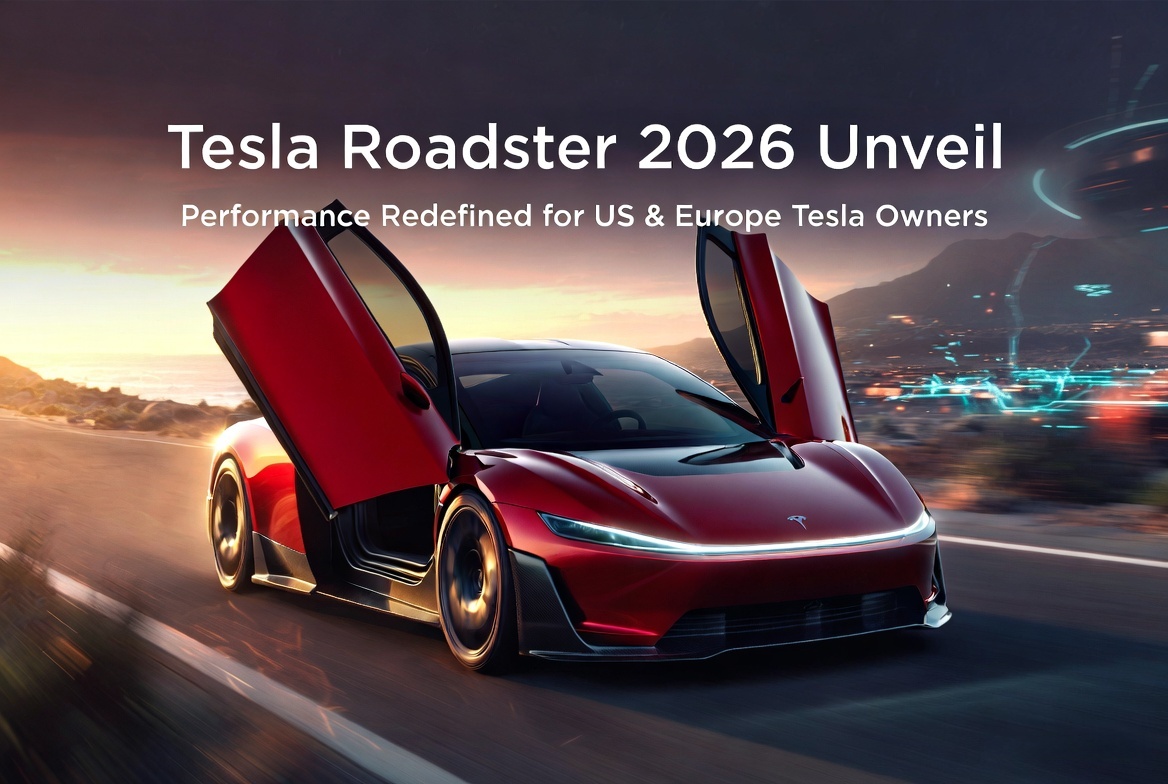
- Chassis and Design: Dedicated EV platform with extensive carbon fiber or composite construction for weight savings. Recent patents describe monolithic composite seating — a single-piece thermoformed structure with zoned stiffness, integrated actuators for six degrees of freedom, built-in ventilation, and programmable ergonomics. This reduces parts count dramatically compared to traditional seats, lowering weight while improving crash safety and comfort. Butterfly doors, a low and wide stance, aggressive LED lighting, and possible retractable rear wing complete the supercar aesthetic.
Innovations extend beyond raw numbers. The optional SpaceX package could include cold air thrusters for enhanced downforce, braking assistance, or even momentary thrust vectoring — turning the car into a bridge between automotive and aerospace engineering. Integration with Tesla's neural net-based autonomy systems means the Roadster could offer advanced driver assistance that evolves via OTA updates, potentially including track-specific modes or future unsupervised capabilities where regulations allow.
Comparisons to competitors highlight the Roadster's uniqueness. While a Porsche Taycan Turbo GT or Ferrari SF90 achieve impressive electric/hybrid performance, none match the claimed combination of sub-2-second acceleration, 600+ mile range, and pure EV architecture without compromise. The Roadster aims to be the ultimate "last great driver's car" before full autonomy potentially shifts the paradigm.
For US owners, these specs translate to thrilling launches on empty highways or track days at Laguna Seca or Circuit of the Americas. European owners will appreciate the high-speed stability on the Autobahn or Nürburgring, combined with compliance for regional noise and emissions standards (as a zero-emission vehicle).
Technical deep dive: Explain torque delivery vs. ICE cars; battery thermal management for sustained performance; how structural integration improves handling; potential for software-defined dynamics.
Section 3: Production and Availability Timeline for US and European Owners
Tesla has indicated the late April 2026 unveil will showcase a production-intent vehicle, with actual production ramp commencing 12-18 months later — pointing to low-volume output potentially starting in late 2027 and scaling into 2028. Initial deliveries will likely prioritize Founders Series or reservation holders.
Pricing expectations start around $200,000 base, climbing to $250,000+ with options, including the SpaceX package. This positions it as an exclusive halo product, with only limited units in early years.
US Market Considerations:
- Federal and state incentives may apply depending on battery sourcing and assembly location (likely Giga Texas or similar). High-income owners in California or other EV-friendly states could benefit from additional rebates or HOV lane access.
- Ordering process will likely mirror current Tesla models: online reservations with potential configuration tools at unveil.
- Delivery logistics favor North American owners initially, with shorter wait times and easier service integration via existing Tesla centers.
European Market Considerations:
- Strict type approval processes under EU regulations, including WLTP range testing, safety standards (Euro NCAP), and noise regulations. As a pure EV, the Roadster avoids many ICE restrictions but must comply with upcoming 2026+ acoustic vehicle alerting systems and battery recycling rules.
- Import duties, VAT variations by country (e.g., lower in some Nordic nations with strong EV incentives), and potential luxury taxes could affect final cost.
- Availability may roll out first in high-demand markets like Germany, Norway, Netherlands, and the UK (post-Brexit alignments). Tesla's European Supercharger network and service centers will support owners, but initial volumes could be constrained.
- Regulatory progress on FSD in Europe (with potential Dutch RDW approvals) could influence software features available at launch.
Owners in both regions should monitor reservation status. Existing Tesla loyalty (e.g., early Model S owners) may receive priority or special editions. Preparation steps include ensuring garage space for a low-slung supercar, evaluating home charging upgrades (for 200 kWh pack), and considering insurance implications for high-value, high-performance vehicles.
Timeline risks exist — Tesla has a history of ambitious targets — but recent focus on Cybercab production starting around the same period suggests parallel engineering efforts that could accelerate Roadster ramp.
Section 4: How It Fits Tesla's Broader Ecosystem
The Roadster isn't an isolated product. It exemplifies Tesla's "master plan" of accelerating sustainable transport through technology leadership. Battery advancements tested in the Roadster's 200 kWh pack could improve energy density and cost in future Model Y or 3 refreshes. Chassis and seating innovations may influence structural designs across the lineup. Autonomy integration reinforces FSD as a core competency, potentially allowing the Roadster to serve as a development platform for Robotaxi tech.
For energy products, synergies exist with Powerwall and Megapack deployments — owners could optimize home charging during off-peak hours or participate in virtual power plants, offsetting the vehicle's energy demands while lowering costs.
Brand perception benefits are substantial. In the US, it reinforces Tesla as a performance leader amid growing competition. In Europe, it counters narratives around Chinese EV imports by showcasing American ingenuity in a segment traditionally dominated by European marques.
Existing owners gain indirect value through brand halo effects that support resale values, software feature parity, and community prestige. Participation in Tesla events or referral programs could offer additional perks.
Section 5: Owner Considerations and Preparation
Practical advice for US and European Tesla owners:
- Budgeting and Financing: Beyond purchase price, factor in insurance (specialty policies for supercars), maintenance (minimal compared to ICE but battery warranties key), and potential track use wear.
- Customization and Options: Prioritize SpaceX package for enthusiasts; evaluate interior materials and tech integrations.
- Daily vs. Occasional Use: Despite supercar status, the range makes grand touring feasible. Compare to daily drivers like Model Y for multi-vehicle households.
- US-Specific: Leverage remaining incentives where available; prepare for potential federal policy shifts.
- Europe-Specific: Navigate WLTP vs. EPA range differences; understand import processes if ordering from US production; monitor EU autonomy regulations.
- Service and Support: Tesla's OTA capabilities mean the car improves post-delivery. Plan for certified service centers capable of high-voltage work.
- Resale and Collectibility: Limited early production could command premiums; track market trends similar to first-gen Roadster appreciation.
Preparation checklist: Home charger assessment, driving skill refresh for high-performance EVs, community engagement via Tesla forums or owner clubs.
Conclusion
The Tesla Roadster 2026 unveil represents more than a new model launch — it's a statement of Tesla's enduring innovation drive. For owners in the US and Europe, it promises extreme performance, technological breakthroughs, and ecosystem reinforcement that enhances the value of every Tesla in the garage. While production timelines extend into 2027-2028, the late April 2026 event offers the first concrete look at a vehicle that could redefine electric supercars.
As Tesla owners, staying informed and prepared positions you to fully appreciate and benefit from this milestone. The Roadster reminds us why many joined the Tesla journey: not just for transportation, but for the future of mobility.
FAQ
- When exactly will the Roadster be unveiled, and is it April 1 or late April 2026? Musk has indicated "probably in late April 2026," building on the earlier April 1 target with some flexibility for the most exciting demo possible.
- What is the expected starting price for the 2026 Tesla Roadster? Approximately $200,000 base, up to $250,000+ with options.
- How does the range compare to current Tesla models? The targeted 620 miles significantly exceeds even the longest-range Model S or Model Y variants, thanks to the large battery pack.
- Will current Tesla owners get priority for reservations or deliveries? Tesla often rewards early adopters and loyal customers; monitor official channels post-unveil for details.
- What regulatory challenges exist in Europe? Type approval, noise standards, and autonomy rules differ from the US; Tesla's experience with other models suggests pathways exist.
- Is the SpaceX package confirmed for production? Musk has repeatedly teased it as an option featuring cold gas thrusters for performance enhancement.
- How will FSD integrate with the Roadster? Expect advanced supervised (and potentially unsupervised where allowed) capabilities, evolving via software updates.
- What impact might this have on resale values of existing Teslas? Positive halo effect often supports brand-wide values, especially for performance-oriented models.
- Can I charge the Roadster at home effectively? Yes, with appropriate high-power wall connectors; the large pack benefits from overnight Level 2 charging.
- When are first customer deliveries expected? Production 12-18 months after unveil suggests 2027-2028 timeframe for initial units.