
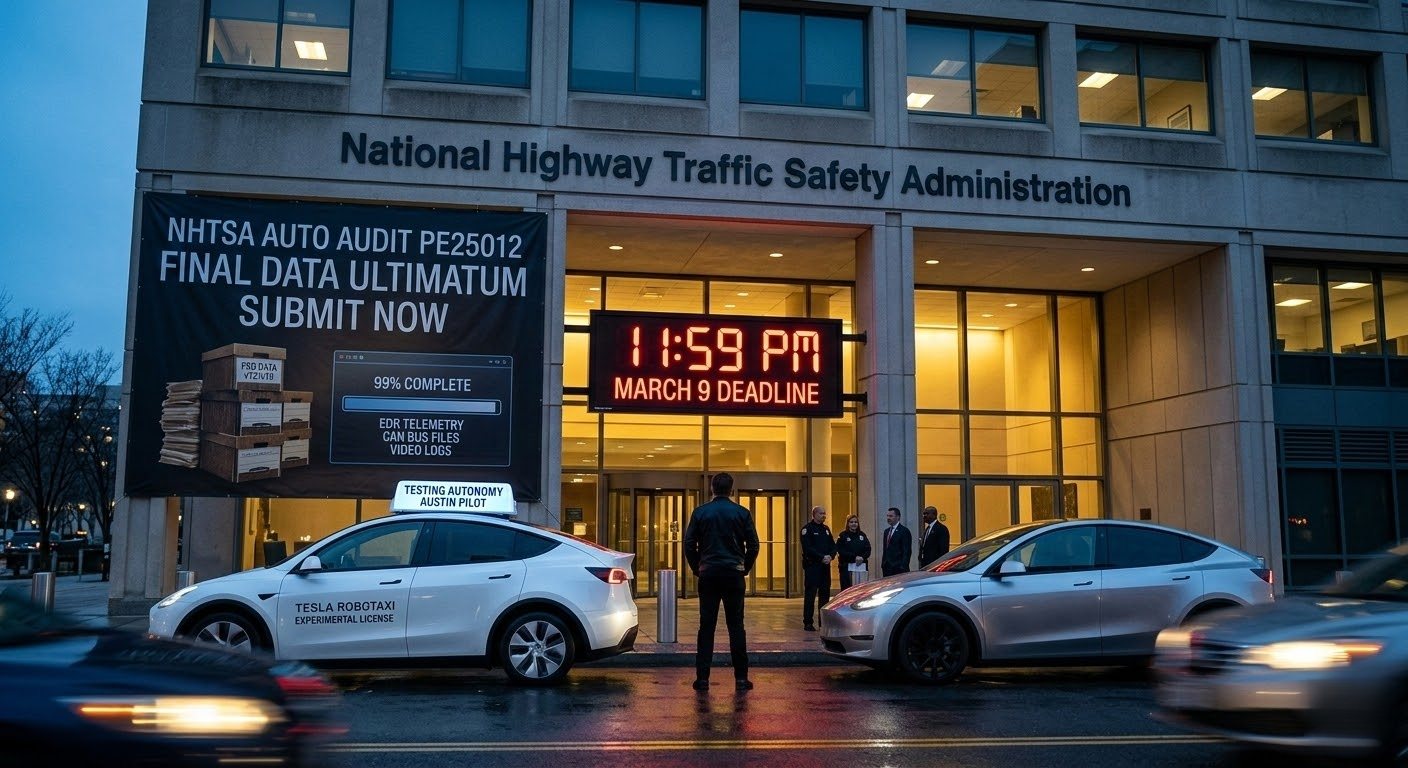
Introduction: The Regulatory "Do-or-Die" Moment
As of today, March 5, 2026, the atmosphere at Tesla’s Austin headquarters is likely one of intense focused activity. While the public and the media are enamored with the technical leaps of FSD v13, a far more bureaucratic—but equally critical—battle is reaching its climax. In exactly four days, on March 9, 2026, Tesla’s second and final extension from the National Highway Traffic Safety Administration (NHTSA) expires.
This is not a routine check-in. This is a comprehensive, deep-dive audit into the safety of Full Self-Driving (FSD) and the emerging unsupervised "Robotaxi" fleet in Texas. The NHTSA is no longer satisfied with high-level safety reports or general statistics; they have demanded the "black box" data—video, Event Data Recorder (EDR) files, and CAN bus telemetry—for dozens of specific incidents where FSD-equipped vehicles allegedly violated traffic laws or were involved in collisions.
For the Tesla community, this deadline represents a pivotal moment for the "Autonomy Narrative." If the data supports Tesla’s claim that FSD is significantly safer than a human driver, it could pave the way for federal approval of widespread unsupervised operations. If, however, the data reveals systemic flaws in how the AI handles "edge cases," the resulting regulatory "recall" could set the autonomy timeline back by years.
Chapter 1: The Anatomy of Investigation PE25012
The current regulatory pressure is centered on Preliminary Evaluation PE25012, an investigation opened in October 2025. This probe was initiated after the NHTSA identified a pattern of "unlawful behavior" in vehicles operating with FSD, specifically focusing on incidents where cars ran red lights, crossed into oncoming traffic, or failed to stop for emergency vehicles.
1.1 The Expanding Scope When the investigation began, it focused on 58 documented incidents. By December 2025, that number had grown to 80. The probe now covers roughly 2.88 million Tesla vehicles—essentially every car in the U.S. fleet equipped with FSD hardware.
The NHTSA’s Information Request is unprecedented in its granularity. They aren't just asking "if" a car crashed. They are demanding:
-
A 30-second pre-crash timeline: What did the car see, and what did it plan to do?
-
Driver Engagement Data: Did the car issue a "strike" or a warning? How many milliseconds before the impact did the driver attempt to intervene?
-
Software Version Tracking: Is there a correlation between specific FSD versions (like v12.3 vs v12.5) and the frequency of violations?
1.2 The Delay and the Deadline Tesla originally faced a January 19 deadline to provide this data. Citing the "undue burden" of processing thousands of gigabytes of video and telemetry, the company secured a five-week extension to February 23. On the eve of that deadline, Tesla requested more time, leading to the current March 9 "Final Accommodation." This pattern of delays has created a "show your work" moment. For investors and owners alike, the silence from Austin regarding the contents of this data has created a "regulatory risk premium" on Tesla’s stock, which currently hovers around $405 as the market weighs the possibility of a federal crackdown.
Chapter 2: The Austin 14—Dissecting the Robotaxi Data
While the broader investigation covers millions of "Supervised" FSD vehicles, the sharpest focus is on Tesla’s fledgling Austin Robotaxi Fleet. Launched in June 2025, this fleet operates with a higher degree of autonomy, although still under remote monitoring.
2.1 The "14 Collisions" Metric Data disclosed to regulators reveals that this fleet has been involved in 14 collisions over approximately 800,000 miles of operation. To the casual observer, this sounds alarming. Critics point out that this equates to one crash every 57,000 miles—a rate that appears much higher than the "major collision" rate of human drivers.
However, a deep dive into these 14 incidents reveals a more nuanced reality:
-
Low Speed/Stationary: Eight of the 14 crashes occurred at speeds below 6 mph. In five cases, the Tesla was moving at less than 2 mph or was completely stationary (e.g., being rear-ended at a stoplight).
-
Non-Fault Incidents: In several reports, the collision was caused by a human driver in another vehicle failing to yield or striking the stationary Robotaxi.
-
Reporting Bias: Unlike human drivers, who may not report a minor "curb-rash" or a low-speed bumper scrape, Tesla’s system automatically flags and reports every sensor-detected impact, no matter how trivial.
2.2 The Downward Trend Perhaps the most optimistic data point for Tesla is the rate of improvement. The first seven incidents occurred in the initial 250,000 miles of the Austin program. It took another 550,000 miles to reach the next seven. This represents a nearly 50% improvement in the incident rate as the neural networks refined their understanding of Austin’s specific urban geography.
Chapter 3: The Safety Dividend—Machine vs. Human
Tesla’s core defense against the NHTSA is built on the "Safety Dividend"—the statistical proof that even a flawed AI is superior to an easily distracted human.
3.1 The 13,300 Trip Benchmark Using conservative estimates for trip length, Tesla’s Austin fleet has completed roughly 186,000 trips. With 14 incidents (mostly minor), that results in one collision per 13,300 trips.
Compare this to the average U.S. driver. While humans go roughly 660,000 miles between major (airbag deployment) crashes, they are involved in millions of minor fender-benders, insurance claims, and "near-misses" that are never captured in federal statistics. Tesla’s argument is that the "unsupervised" fleet is already outperforming the human baseline in preventing life-threatening, high-speed failures, even if it still struggles with the "clumsiness" of low-speed urban maneuvering.
3.2 Supervised FSD: The 5.3 Million Mile Mark For the broader "Supervised" FSD fleet, the numbers are even more lopsided. Tesla’s latest Safety Report indicates that a major collision involving FSD occurs only once every 5.3 million miles. Even when factoring in the most skeptical "apples-to-oranges" comparisons, FSD (Supervised) is consistently shown to be 5x to 8x safer than the average human driver.
The NHTSA’s challenge is to determine if these "safety gains" are real, or if they are simply the result of "human intervention" (i.e., the driver saving the car at the last second). This is why the March 9 EDR and CAN bus data is so vital: it will show exactly how often the human had to "take over" to prevent a disaster.
Chapter 4: Market Implications—The "AI Premium" at Risk
For the Tesla website blogger and the investor community, the March 9 deadline is a valuation event. Tesla is currently valued not as a car company, but as an AI and robotics powerhouse.
4.1 The Autonomy Valuation Wall Street analysts estimate that as much as $1 trillion of Tesla’s $1.5 trillion market cap is tied to the successful deployment of a global Robotaxi network. A negative finding by the NHTSA—such as a determination that FSD possesses a "fundamental defect" in its vision-only architecture—would vaporize this premium.
If the NHTSA forces a "Recall to Update" (as they did with the Autopilot "nag" system in 2024), the impact might be minimal. However, if they demand a "Recall to Stop" (suspending FSD operations until a hardware or massive software change is made), it would trigger a catastrophic re-valuation of the stock.
4.2 The Competitive Landscape Tesla’s regulatory hurdles do not exist in a vacuum. Competitors like Alphabet’s Waymo and GM’s Cruise are also under the microscope, but they have adopted a "slow and steady" geo-fenced approach. Tesla’s "move fast and break things" philosophy with a nationwide fleet of 2.8 million cars puts it in a unique category of regulatory risk. The outcome of the March 9 audit will define the "Gold Standard" for how all autonomous companies are regulated in the U.S. moving forward.
Chapter 5: Looking Ahead—The Post-March 9 Landscape
What happens on March 10? The NHTSA will begin the process of analyzing the terabytes of data Tesla provides. This process could take months, but the "completeness" of Tesla’s filing will provide immediate clues.
5.1 Scenario A: The Clean Bill of Health If Tesla provides a transparent, orderly, and complete data set that proves the system is improving and that humans are not "constantly" saving the car from fatal errors, the regulatory shadow will begin to lift. This would likely catalyze a move to "Unsupervised" status in more cities beyond Austin and Miami.
5.2 Scenario B: The Messy Filing If Tesla again redacts large portions of the data as "Confidential Business Information" or provides incomplete video logs, the NHTSA has the authority to escalate the probe from a "Preliminary Evaluation" to an "Engineering Analysis"—the final step before a mandatory recall.
5.3 Impact on FSD v13 FSD v13 was designed to address many of the "traffic violation" issues the NHTSA is investigating (like red-light running and improper lane changes). If the data shows that v13 has resolved the specific "edge cases" identified in the 80 incidents, the NHTSA may view the software update as a sufficient "remedy," effectively ending the investigation with a win for Tesla.
Conclusion: Trust, but Verify
The March 9 deadline is the ultimate "show your work" moment for Elon Musk’s vision. For years, Tesla has asked for trust based on internal data and curated video clips. Now, the federal government is demanding the raw, unedited reality of the AI’s performance.
For the North American and European Tesla owner, the outcome of this audit will dictate whether their car remains a "supervised assistant" or evolves into a revenue-generating asset. As we count down the final hours to March 9, the world is about to find out if Tesla’s "Safety First" narrative can withstand the most rigorous data audit in automotive history.
FAQ
Q: Is my Tesla going to be "recalled" because of this investigation? A: "Recall" in the Tesla world almost always means an Over-the-Air (OTA) software update. It is highly unlikely that the NHTSA will force a hardware return. However, they could force Tesla to change how FSD operates—such as making the "driver monitor" system more aggressive or restricting FSD in certain high-risk urban areas.
Q: Why does the Austin Robotaxi have a higher crash rate than the standard FSD fleet? A: The Austin fleet operates in a much denser, "unsupervised" (or remotely monitored) urban environment where the AI is making 100% of the decisions. The standard FSD fleet is "supervised" by human owners who intervene before a crash occurs. The Austin data is a "stress test" for the AI without a human safety net in the driver’s seat.
Q: Can the NHTSA stop Tesla from releasing new versions like v13? A: Not directly, but they can issue a "Cease and Desist" if they believe a specific software version is inherently unsafe. Generally, they work with Tesla to ensure new versions address the flaws identified in the investigation.
Q: What is the significance of the "CAN bus" files the NHTSA is asking for? A: The CAN bus is the vehicle’s "nervous system." These files record every signal sent to the motors, brakes, and steering. This data allows investigators to see if the AI "commanded" a dangerous maneuver, or if there was a hardware lag or sensor error that caused the car to ignore a stop sign or red light.