
Introduction
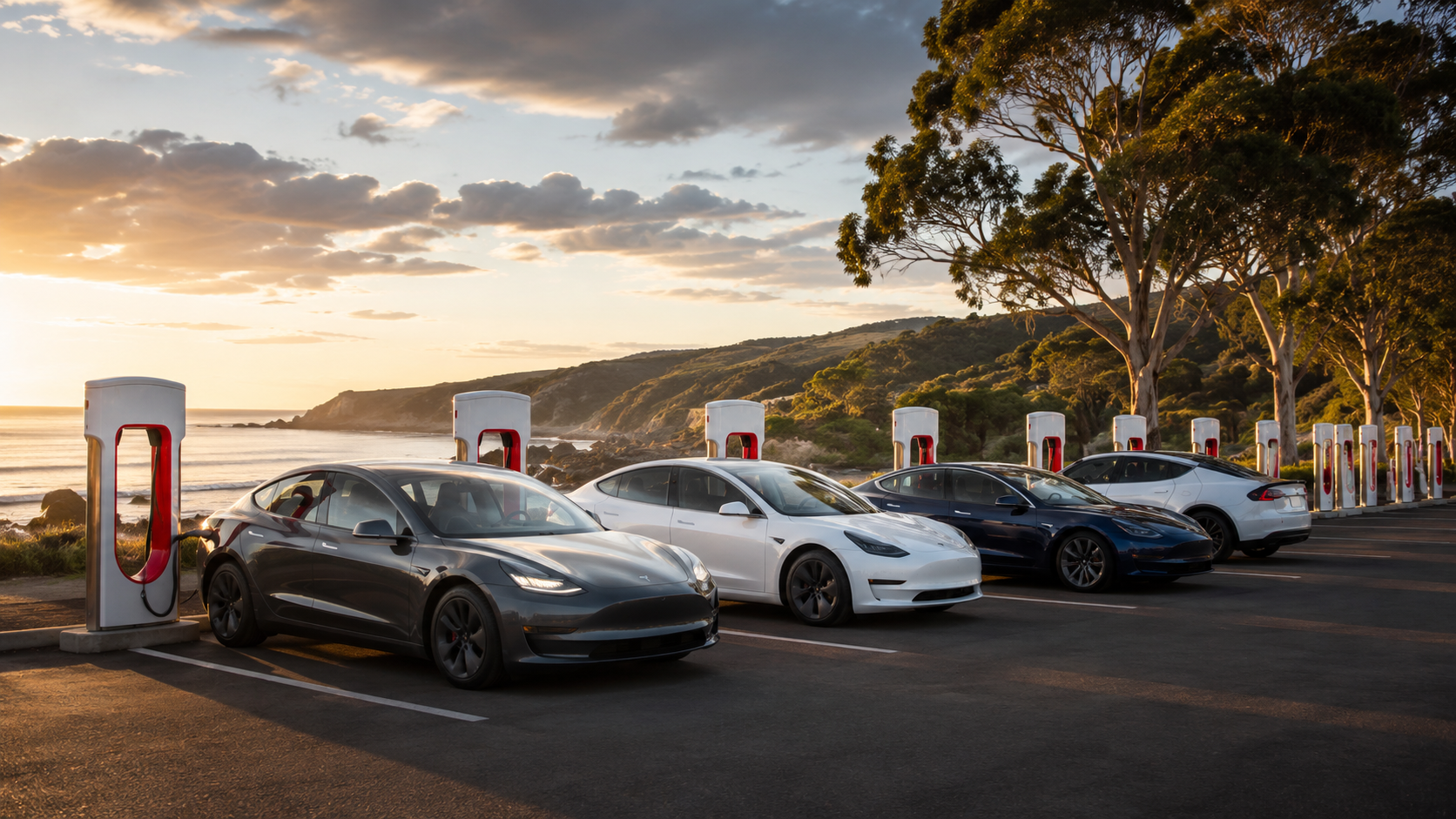
On June 19, 2026, Tesla opened its 1,000th Supercharger post in Australia at a newly completed site in Byron Bay, New South Wales. The Byron Bay site features 10 V4 stalls and a custom design depicting ocean cliffs and surfers on the 1,000th charging stall. A golden plaque at the site reads: "June 2026 – No 1,000 – Supercharger Post in Australia". Tesla announced the achievement on its Australia and New Zealand X account, stating: "Celebrating our 1,000th Supercharger post in Australia with the opening of Byron Bay. This marks 10,000 km of major AU corridors accessible by the Supercharger network".
This milestone is more than a number—it represents the culmination of years of strategic infrastructure investment and signals Tesla's commitment to enabling long-distance electric travel across one of the world's most challenging continents for EV adoption. For Tesla owners in the US and Europe, Australia's supercharger expansion offers valuable insights into the future of charging infrastructure worldwide.
2. The Byron Bay Site: A Custom-Designed Celebration
2.1 The 1,000th Stall
Tesla has a tradition of marking landmark Supercharger installations with special designs. The 1,000th Australian Supercharger continues this tradition. The Byron Bay site features a unique design depicting ocean cliffs and surfers on the 1,000th charging stall. The stall also carries a special-edition wrap and a "No. 1000" plaque. Tesla Australia's 100th Supercharger site received a green-and-gold casing when it opened near Adelaide in 2024, and the company finished the world's 75,000th stall in "glacier blue" when that one landed in Hobart, Tasmania, late last year.
2.2 Strategic Location
Byron Bay is a popular tourist destination on the north coast of New South Wales. The location is strategically important for EV drivers traveling along the eastern seaboard. One Tesla owner commented: "Just 30 minutes away, so we'll never have a reason to use it. But great that the Byron tourist traffic will increasingly be electric". Another said: "Keep them coming! Australia needs as many as they can get!"
The site fills in a key gap for EV drivers, and with it, more than 10,000 kilometers of major Australian highway corridors are now covered by Tesla's fast-charging network.
2.3 V4 Technology
The Byron Bay station houses 10 V4 Supercharger stalls. V4 stalls deliver speeds of up to 300kW and are the latest generation of Tesla's charging hardware. They feature longer cables to accommodate non-Tesla EVs with various charging port locations and are designed to support higher charging speeds for future vehicles.
3. The Growth Story: From 100 to 1,000
3.1 The 100th Site: Glenelg, South Australia
Tesla opened its 100th Supercharger site in Australia at Glenelg, South Australia, in September 2024. The company celebrated the milestone by covering one of the 6 Tesla V3 250 kW Superchargers with a green-and-gold casing.
3.2 The 150th Site: Pokolbin, Hunter Valley
The network reached its 150th site at Pokolbin in the Hunter Valley wine region of NSW in early April 2026, just 18 months after the 100th site milestone. The Pokolbin site features eight V4 stalls delivering up to 300kW and is open to both Tesla and non-Tesla vehicles. By that point, the network had grown to comprise nearly 1,000 individual charging bays nationwide. At Pokolbin, pricing for Tesla vehicles is $0.46 per kWh, while non-Tesla vehicles pay $0.65 if charging without a Tesla Supercharger membership.
3.3 The 1,000th Site: Byron Bay
The Byron Bay site is Tesla's 155th location in the country. It comes in at just under 24 months after the 100th site opened. The acceleration in site deployment is remarkable—from 100 sites to 150 sites in 18 months, and then to 155 sites with a major stall milestone. According to data from carloop, as of March 2026, Tesla was operating 148 active sites in Australia. Over 80 sites—nearly two-thirds of all Tesla sites in Australia—are open to non-Tesla EVs, allowing all drivers with compatible cars to charge at the country's most reliable charging network.
3.4 Western Australia Expansion
The network expanded into states that had previously lagged, such as Western Australia, which expanded from just four stations in early 2024 to 18 by early 2026. This represents a 350% increase in less than two years and demonstrates Tesla's commitment to nationwide coverage.
4. Opening the Network: CCS2 Compatibility
4.1 The CCS2 Standard
A defining feature of Tesla's recent Australian rollout has been the progressive opening of its network to non-Tesla EVs with CCS2-compatible connectors. CCS2 is the most common plug standard for EV fast charging in regions like Europe, Australia, and New Zealand. This is a significant departure from Tesla's historically closed network and represents a strategic shift toward becoming a charging provider for all EVs.
4.2 Over Half the Network Now Open
More than half of all Supercharger sites in Australia now support CCS2, meaning the majority of EVs on Australian roads—not just Teslas—can access the network for long-distance travel. What started as a Tesla-only perk has transformed into something closer to public charging infrastructure.
4.3 Pricing Structure
Tesla has implemented a tiered pricing structure for its Australian Supercharger network. At the Goulburn site, pricing is AU$0.52 (US$0.36) per kilowatt-hour for Tesla drivers and AU$0.73 for non-Tesla EV owners. At Pokolbin, pricing for Tesla vehicles is $0.46 per kWh, while non-Tesla vehicles pay $0.65. Tesla offers membership discounts for non-Tesla drivers who charge frequently.
4.4 The Largest Site in the Southern Hemisphere
Last year, Tesla opened what it described as the "largest EV charging station in the Southern Hemisphere" at Goulburn, New South Wales, featuring 20 V4 Supercharger stalls delivering speeds of up to 300kW and open to all CCS2-compatible vehicles. This site held the title of Australia's largest fast-charging location until a 25-plus-stall site was announced for Mackay, Queensland.
5. Global Context: Tesla's Charging Network Expansion
5.1 The Global Network Crosses 82,000 Stalls
Australia's 1,000th stall is one data point in a global network that crossed 82,000 Supercharger stalls in June 2026. The company now has over 82,000 stalls globally, making it the only global network of its kind. Tesla added around 2,500 Supercharger stalls globally in the first quarter of 2026 alone—a record three months for the company. The network delivered an estimated 1.8 terawatt-hours of energy in the first quarter alone and completed 53 million charging sessions—a 26% increase year-over-year.
5.2 China: 2,600+ Stations
In China, Tesla operates 2,600+ Supercharger stations with 13,000+ posts as of June 2026. This makes China Tesla's largest Supercharger market by far, reflecting the country's rapid EV adoption and Tesla's significant market presence.
5.3 India: Emerging Market
India represents an emerging market for Tesla's charging infrastructure. The company has 5 Supercharger stations operational, with Hyderabad expansion announced. This signals Tesla's long-term commitment to the Indian market, even as vehicle sales remain modest.
5.4 The Folding Supercharger Innovation
In March 2026, Tesla unveiled its new folding supercharger units, with the aim of speeding up the rollout of reliable charging sites globally. Earlier in June 2026, the company revealed its first foldable superchargers making it to Europe, hinting at a future global rollout. This innovation could dramatically accelerate the pace of Supercharger deployment by reducing installation time and complexity.
5.5 Tesla's Commitment: Over $500 Million in 2026
Tesla has committed over $500 million for Supercharger expansion in 2026. This investment reflects the company's recognition that charging infrastructure is a competitive moat—and a growing revenue stream. The Supercharger network is becoming increasingly important to Tesla's business model, both as a customer retention tool and as a source of recurring revenue from non-Tesla EV owners.
6. The Australian EV Market Context
6.1 Rapid EV Adoption
EV charging infrastructure needs to grow as Australians increasingly adopt electric mobility. Retailers sold 515 EVs per day in April 2026, significantly up from 29 per day as recorded in April 2022. This represents a staggering 1,676% increase in daily EV sales over four years.
6.2 Tesla Model Y Dominance
Tesla has been a beneficiary of the electric boom. The company's Model Y SUV has been the best-selling EV for the past three years in Australia. The Model Y set a sales record in May 2026 by selling 5,605 units, boosted by the recently introduced six-seat Model YL. The Model Y was Australia's best-selling new vehicle in May 2026, underscoring the importance of the Australian market.
6.3 The Network Effect
The expansion of Tesla Superchargers is welcome for all EV owners, especially as there are so many automakers that have access to the network. The recent surge in EV adoption and interest provides additional confidence for charge point operators to continue expanding infrastructure in both cities and regional centers. Tesla continues to lead the way in these deployments, now with over 1,000 active fast-charging stalls in Australia, providing confidence to EV buyers across the country.
7. What This Means for Tesla Owners in the US and Europe
7.1 A Preview of Network Evolution
Australia's model of open-access CCS2 charging could preview US and European network evolution. Tesla's move to open its network is reshaping the charging landscape globally. In the US, Tesla has already begun opening some Supercharger sites to non-Tesla EVs using the NACS standard. The Australian experience demonstrates that opening the network can be done successfully without compromising the experience for Tesla owners.
7.2 More Chargers = More Confidence
For Tesla owners everywhere, more chargers mean more confidence for road trips and EV adoption. The Australian milestone demonstrates that Tesla can scale its charging network rapidly when it prioritizes infrastructure investment. The company added around 2,500 Supercharger stalls globally in Q1 2026 alone—a pace that, if sustained, would add 10,000 stalls annually.
7.3 Cross-Compatibility Trends
The Australian network's CCS2 compatibility reflects a broader global trend toward charging standardization. In Europe, CCS2 has long been the standard, and Tesla has adapted its vehicles and Superchargers accordingly. In the US, the industry is moving toward NACS (North American Charging Standard), which Tesla pioneered. The Australian experience shows that Tesla can successfully operate an open network that serves both its own customers and the broader EV community.
7.4 Implications for Road Trips
For US Tesla owners planning international travel, the Australian network demonstrates that Tesla's charging infrastructure is becoming truly global. While adapters may be needed for different plug standards, the underlying network philosophy—reliable, fast, and widespread—is consistent across markets.
Conclusion
1,000 Superchargers in Australia is more than a number—it's proof that Tesla's infrastructure investment is paying off. For owners, it means longer trips, fewer worries, and a charging experience that remains best-in-class.
The Australian milestone reflects several broader trends. First, Tesla is accelerating the pace of Supercharger deployment globally, with a record 2,500 stalls added in Q1 2026 alone. Second, the network is evolving from a closed Tesla-only system to an open charging infrastructure that serves the entire EV community. Third, the integration of V4 technology and innovative solutions like folding Superchargers demonstrates Tesla's commitment to continuous improvement.
For Tesla owners in the US and Europe, Australia's achievement offers a glimpse of what's possible when infrastructure investment matches EV adoption. The 10,000 kilometers of covered corridors in Australia represent a model for how charging networks can enable long-distance electric travel across vast distances. As Tesla continues to invest over $500 million in Supercharger expansion in 2026, the global network will only become more comprehensive, more reliable, and more accessible.
FAQ
Q: Can I use Australian Superchargers with my US Tesla?
A: No. US Teslas use the NACS (North American Charging Standard) plug, while Australian Superchargers use CCS2 connectors. You would need a CCS2 adapter, and your vehicle would need to support the different communication protocols. Tesla does not currently offer cross-compatible charging between these regions.
Q: How does Australia's 1,000 Superchargers compare to the US network?
A: The US Supercharger network is significantly larger, with over 20,000 stalls. However, Australia's 1,000 stalls represent a remarkable achievement given the country's smaller population (approximately 26 million vs. 335 million in the US) and vast distances.
Q: Will Tesla open more Superchargers to non-Tesla EVs in the US?
A: Tesla has already begun opening some Supercharger sites to non-Tesla EVs in the US using the NACS standard. The pace of expansion is expected to accelerate as more automakers adopt NACS for their vehicles.
Q: What's the difference between V3 and V4 Superchargers?
A: V3 Superchargers deliver up to 250 kW of power and use a shorter cable designed primarily for Tesla vehicles. V4 Superchargers deliver up to 300 kW (with future support for 500 kW+), feature longer cables to accommodate non-Tesla vehicles with various charging port locations, and include a payment terminal for credit card payments.
Q: How much does it cost to charge at a Tesla Supercharger in Australia?
A: Pricing varies by site. For Tesla drivers, rates range from AU$0.32 to AU$0.52 per kWh depending on the site and time of day. For non-Tesla EV owners, rates range from AU$0.37 to AU$0.73 per kWh. Tesla offers membership discounts for non-Tesla drivers who charge frequently.
Q: How many Supercharger stalls does Tesla have globally?
A: As of June 2026, Tesla has over 82,000 Supercharger stalls globally. The network crossed 80,000 stalls in April 2026. Tesla added around 2,500 stalls in Q1 2026 alone.
Q: What is the folding Supercharger technology?
A: Tesla unveiled folding Supercharger units in March 2026. These units are designed to speed up the rollout of reliable charging sites globally by reducing installation time and complexity. The first foldable Superchargers made it to Europe in June 2026.