
The future of driving in Europe has just received its most significant software update yet. In a move that has been watched with bated breath by technology enthusiasts, automotive journalists, and, most importantly, Tesla owners, the highly anticipated Full Self-Driving (FSD) Beta V12 has begun its official rollout across several key European markets. This isn't just another incremental update; it represents a fundamental paradigm shift in the quest for autonomous vehicles. At its core, V12 marks Tesla's bold departure from millions of lines of meticulously written code to a revolutionary "end-to-end" neural network-based approach. The car now learns to drive by watching, processing, and imitating, much like a human, rather than by following a rigid set of pre-programmed instructions.
This article serves as a comprehensive guide for the European Tesla owner navigating this new frontier. We will delve into what makes V12 a technological marvel, dissect its performance in the uniquely challenging and diverse driving environments of Europe, and provide a practical manual for what to expect as this software downloads into your vehicle. The central thesis is clear: FSD V12 is a monumental leap towards a future of autonomous driving, but its ultimate success on this continent will be rigorously tested by its ability to master the ancient cobblestone streets, high-speed Autobahns, and complex, roundabout-laden infrastructure that define European motoring. The revolution is here, and it’s time to understand what it means to be behind the wheel.
Chapter 1: The End-to-End AI Revolution: What is FSD V12?
To truly appreciate the significance of V12, one must first understand the profound architectural change that lies beneath the surface. It is a transition from a system governed by explicit logic to one guided by learned intuition, a move from deterministic code to probabilistic artificial intelligence.
From Code to Neurons: A New Mind for Your Tesla
For years, Tesla's Autopilot and FSD Beta systems, up to and including V11, were masterpieces of human programming. Teams of brilliant software engineers wrote millions of lines of C++ code to govern every conceivable driving scenario. If the car needed to navigate a lane change, there was a specific block of code for that. If it encountered a stop sign, another set of instructions would be executed. This approach, while incredibly sophisticated, had its limitations. It was reactive and brittle; engineers couldn't possibly write code for every single "edge case"—a child chasing a ball into the street, a strangely shaped piece of debris, or a confusing, non-standard intersection. The system was only as smart as the situations its programmers had anticipated.
FSD V12 throws that entire playbook out the window. It employs what engineers call an "end-to-end neural network" approach. Instead of programmers telling the car how to drive, they are now showing it what good driving looks like. The system is fed an immense dataset comprising millions of miles of video from Tesla's global fleet. The neural network analyzes this video, correlating the visual data from the car's cameras with the steering, acceleration, and braking inputs made by skilled human drivers.
Think of it like this: V11 was like giving a student a massive, comprehensive textbook on the theory of driving. V12 is like having that student watch thousands of hours of expert driving footage until they develop an intuitive "feel" for the road. The output of the system is no longer a set of decisions based on coded rules, but direct control commands—steering angle, acceleration, braking—generated by the AI itself. This means the car isn't just following instructions; in a sense, it's making its own judgments based on its "experience."
The "Human-Like" Driving Promise
The primary goal of this new architecture is to create a driving experience that feels more fluid, confident, and, for lack of a better word, "human." Owners who have experienced early versions in North America report a noticeable reduction in the hesitant, sometimes jerky movements that characterized previous FSD iterations. The car is said to exhibit a more natural flow, anticipating the need to slow down or reposition within a lane more gracefully. This "human-like" promise is the key to building trust between the driver and the machine, a critical step towards wider acceptance of autonomous technology.
Key Improvements Over V11
The move to an end-to-end neural net brings a host of tangible improvements that owners will notice:
-
Smoother Lane Changes: Lane changes are reported to be less abrupt and more decisive, with the car better judging gaps in traffic.
-
Confident Intersection Handling: This is perhaps the most significant upgrade. The system is far more capable of navigating complex intersections, especially the multi-lane, often chaotic roundabouts that are a staple of European road design. It demonstrates a better understanding of yielding and taking initiative.
-
Enhanced Pedestrian and Cyclist Interaction: By learning from real-world human driver behavior, V12 is better at predicting the movements of vulnerable road users. It gives cyclists a wider berth and shows more caution around pedestrians, especially in dense urban environments.
-
Improved Adverse Weather Performance: The neural network has been trained on vast amounts of data from driving in rain, fog, and light snow, making it more robust and reliable when visibility is compromised. It learns to recognize the subtle cues that human drivers use in such conditions.
Hardware Requirements
The computational demands of running such a sophisticated AI are significant. In Europe, the FSD V12 update is being rolled out to Tesla vehicles equipped with at least Hardware 3 (HW3). Vehicles with the newer Hardware 4 (HW4), which features more powerful processors and higher-resolution cameras, are expected to see even better performance and will likely be the platform for future, more advanced iterations of the software. It's crucial for owners to check their vehicle's configuration in their Tesla account to confirm compatibility.
Chapter 2: The European Proving Ground: How FSD V12 Tackles Unique Challenges
Europe is not a monolith. Its driving environments are a patchwork of ancient history and modern infrastructure, presenting a far more complex challenge for an autonomous system than the relatively uniform grid systems of many North American cities. The success of FSD V12 will be measured by its ability to adapt and perform across this diverse tapestry of roads.
Navigating Historic City Centers
Imagine FSD V12 attempting to navigate the heart of Rome. The streets are narrow, often barely wide enough for one car, and paved with uneven cobblestones that can confuse camera-based systems. Cars are double-parked with impunity, and scooters weave through traffic with breathtaking audacity. Here, V12's learned, human-like behavior is put to the ultimate test. It must understand the unwritten rules of negotiation, inching forward to claim a right of way, and interpreting the subtle hand gestures of other drivers.
Similarly, in Amsterdam, the challenge is not just the narrow streets but the sheer density of cyclists. A coded system might struggle to predict the path of dozens of bicycles in a dedicated lane. V12, having learned from countless hours of video showing drivers safely navigating these exact scenarios, should demonstrate a more innate understanding of the cyclist-car dynamic, creating a safer and more comfortable experience for everyone.
The Autobahn and High-Speed Transitions
At the other end of the spectrum is Germany's legendary Autobahn. On the derestricted sections, V12 must prove its high-speed stability and decision-making. This includes executing lane changes at over 130 km/h, maintaining perfect lane discipline, and smoothly handling "closing speed"—the rapid approach of a vehicle from behind traveling at a much higher velocity. The system needs to understand when to move out of the left lane promptly and how to merge safely from an on-ramp into fast-moving traffic. The smoothness of its acceleration and deceleration profiles is critical here to avoid unsettling the car or alarming other drivers.
Roundabout Roulette
Roundabouts are the bane of many human drivers, let alone autonomous systems. Europe is home to some of the world's most complex examples, from the multi-lane, high-volume madness of the Place de l'Étoile surrounding the Arc de Triomphe in Paris to the "magic roundabouts" in the UK where traffic flows in multiple directions. Previous FSD versions often hesitated, misjudged gaps, or took an incorrect exit. V12's neural network approach is designed to overcome this. By observing how millions of human drivers successfully judge entry speed, select the correct lane, and signal their intentions, V12 aims to navigate these challenging features with a newfound confidence and accuracy that feels intuitive rather than calculated.
Weathering the European Climate
The continent's weather is as varied as its culture. V12 will have to prove its mettle in the persistent drizzle and heavy rain of the British Isles, which can obscure lane markings and challenge camera visibility. It will need to navigate the dense fog that can descend upon the Alpine passes and handle the slick, icy conditions that define a Scandinavian winter. The AI's ability to learn from data captured in these specific conditions is paramount. It's not just about seeing through the rain; it's about understanding that wet roads mean longer stopping distances and that other drivers may behave more erratically.
Country-Specific Road Signs and Markings
While the EU has standardized many road signs, significant variations still exist between countries. From the subtle differences in the design of a "yield" sign to the unique lane markings for bus or tram lanes in cities like Zurich or Vienna, the system must be a quick study. A rules-based system would require constant, country-by-country updates. V12's visual learning approach allows it to adapt more organically. When it "sees" a new type of sign or marking in its vast dataset, correlated with a specific driver action, it learns the meaning in context, much like a human driver would when driving in a foreign country for the first time. This adaptability is key to a seamless pan-European driving experience.
Chapter 3: The Owner's Guide to FSD V12 in Europe
With the update arriving, European Tesla owners are naturally filled with questions. How do I get it? What should I do first? How can I use it safely and effectively? This chapter provides a practical guide.
The Rollout Schedule and How to Get the Update
The V12 rollout is being conducted in a phased approach. Typically, Tesla starts with a small group of long-term FSD Beta testers before expanding to a wider audience. The release is also being staggered by country, likely pending final regulatory reviews and localization checks. The first wave is expected to include countries like Germany, the UK, Norway, and the Netherlands, with others following in the subsequent weeks.
To get the update, ensure your car is connected to a stable Wi-Fi network. You can check for available software updates under the 'Software' tab on your car's main screen. If you are subscribed to FSD, the update will be pushed to your vehicle once it's available in your region. Patience is key, as it can take several weeks for the rollout to reach everyone.
First Drive and Calibration
Once V12 is installed, the car will require a brief period of camera calibration. This usually involves driving for a short distance (typically 20-50 km) on well-marked roads to allow the neural networks to align the cameras and confirm their view of the world. The screen will display a progress indicator for this process.
For your first drive, choose a familiar route with a variety of road types but low traffic. This will allow you to observe the system's new behaviors in a controlled environment. Pay close attention to how it handles turns, stops, and lane changes. Note the differences from V11. The goal of this first drive is not to push the limits, but to establish a baseline understanding of how the new system operates.
Best Practices for Using V12
It is imperative to remember that FSD V12, despite its name and advanced capabilities, is a Level 2 driver-assistance system. It is not fully autonomous. The driver is, at all times, legally and morally responsible for the safe operation of the vehicle.
-
Hands on the Wheel, Eyes on the Road: This is non-negotiable. You must be prepared to take over control instantly at any moment. The car will monitor your attention using the in-cabin camera.
-
Understand the Limitations: The system can still be confused by unusual situations, poor weather, or complex construction zones. Be extra vigilant in these scenarios.
-
Be a Co-Pilot, Not a Passenger: Think of yourself as a supervising pilot. Your job is to monitor the "autopilot," anticipate potential issues, and be ready to intervene. Don't become complacent, especially on long, monotonous drives.
-
Use Turn Signals to Influence: You can still influence the car's decisions. For example, activating your turn signal will prompt the system to look for an opportunity to change lanes.
Interpreting the New Visualizations
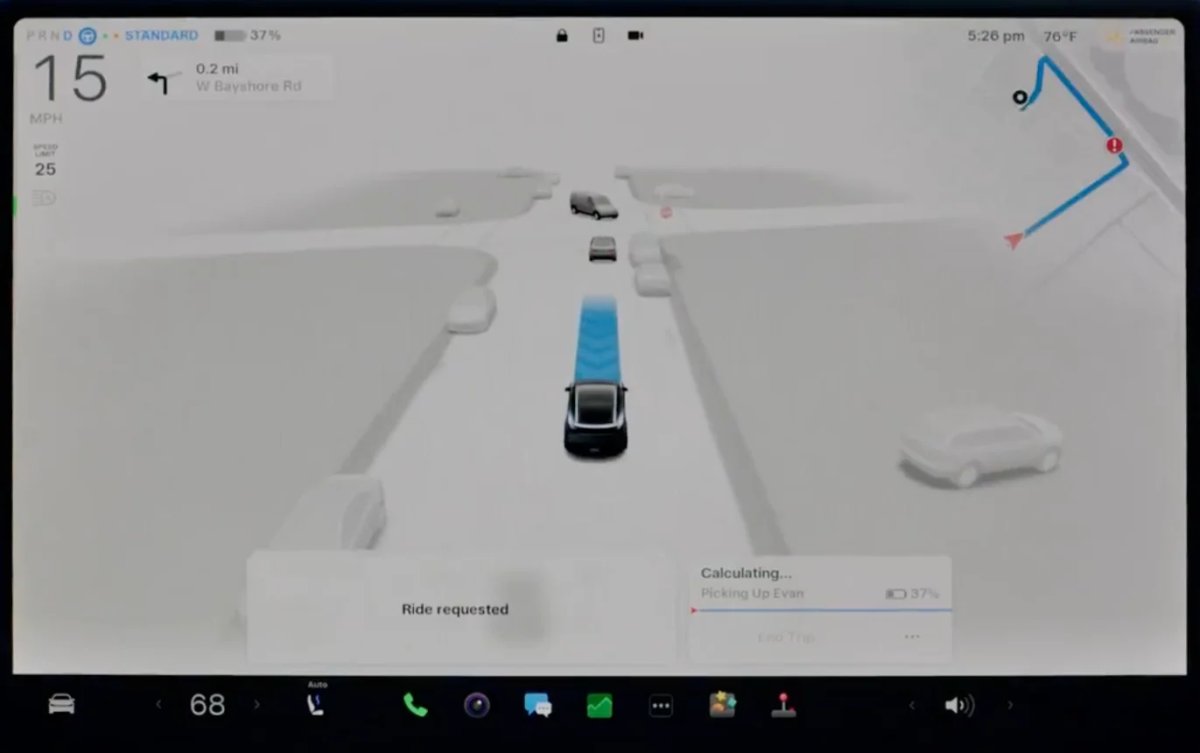
FSD V12 introduces subtle but important changes to the on-screen driving visualizations. The "mind of the car" view now provides a more detailed and confident rendering of the world around you. Pay attention to how it renders other vehicles, pedestrians, and road boundaries. The new system often shows a "path" that it intends to take, which can give you better insight into its decision-making process. Understanding these visualizations helps build trust and allows you to better anticipate the car's next move.
Providing Feedback to Tesla
Every time you disengage the system by turning the wheel or hitting the brakes, you are providing a valuable data point to Tesla. This tells the neural network, "You were about to do something wrong here." After a disengagement, a "Report" button may appear on the screen. Tapping it can flag the last few minutes of video data for review by Tesla's team. This feedback loop is crucial for the continuous improvement of the AI. By being an active and engaged supervisor, you are not just using the technology; you are helping to refine it.
Conclusion
The arrival of FSD V12 in Europe is more than just a software update; it's the beginning of a new chapter in the story of human mobility. The transition to an end-to-end neural network is a breathtakingly ambitious feat of engineering, one that promises a safer, more comfortable, and more efficient driving experience. We have seen how this new architecture is designed to tackle the unique and complex challenges of European roads, from ancient city centers to high-speed highways.
However, the excitement of this technological leap must be tempered with a healthy dose of realism. We are still on the journey towards full autonomy, and V12, for all its brilliance, remains a "Beta" product. It is a Level 2 system that places the ultimate responsibility squarely in the hands of the driver. The owner's role has evolved. You are no longer just a driver, but a supervisor, a teacher, and a critical part of a global data-gathering effort that is pushing the boundaries of what is possible. As you download V12 and take your first drives, you are not just a witness to the AI revolution—you are an active participant in it. The road ahead is long, but with V12, the destination feels closer than ever before.
FAQ Section
-
Is FSD V12 legal to use in all European countries? The legality of Level 2 systems like FSD is generally established across Europe, provided the driver remains fully attentive and in control. However, regulations are constantly evolving, and specific interpretations can vary. Tesla works with regulators in each country before rolling out updates. It is always the driver's responsibility to use the system in accordance with local traffic laws.
-
How does V12 handle trams and other unique European public transport? This is a key area of improvement. Because V12 learns from video of human drivers in cities like Zurich, Berlin, and Lisbon, it has a much larger dataset of how to interact with trams. It learns to recognize tram tracks,専用 signals, and the right-of-way rules associated with them, showing more caution and awareness than previous versions.
-
Will my FSD subscription price increase with the V12 update? Tesla has a history of increasing the price of the FSD package as it adds more capabilities. While no immediate price change has been announced with the V12 rollout, it is reasonable to expect that as the system becomes more capable and approaches regulatory approval for higher levels of autonomy, the price will increase for new buyers. Existing subscribers' rates are typically locked in.
-
What is the data privacy policy for the video clips my car uploads? Tesla's privacy policy states that video clips uploaded for the purpose of FSD development are anonymized and not linked to your personal identity or vehicle. The system is designed to only upload short clips when a critical event or disengagement occurs to help engineers improve the system. Owners can opt-out of data sharing in the car's settings, though this may limit access to certain features.
-
Can I use FSD V12 on roads with no center line markings? Yes. This is a key advantage of the neural network approach. Unlike older systems that relied heavily on clear lane markings, V12 learns to derive the drivable path from the context of the road edges, the texture of the surface, and the behavior of other vehicles. Its performance on unmarked rural roads is significantly improved over V11.
-
How does V12 perform at night on poorly lit rural roads? Performance at night is also enhanced due to the vast amount of training data. The system learns to rely more on the patterns of headlights and taillights of other cars, as well as the subtle cues from road reflectors and edge-of-road objects. However, this remains one of the most challenging environments, and driver vigilance should be at its absolute highest.