
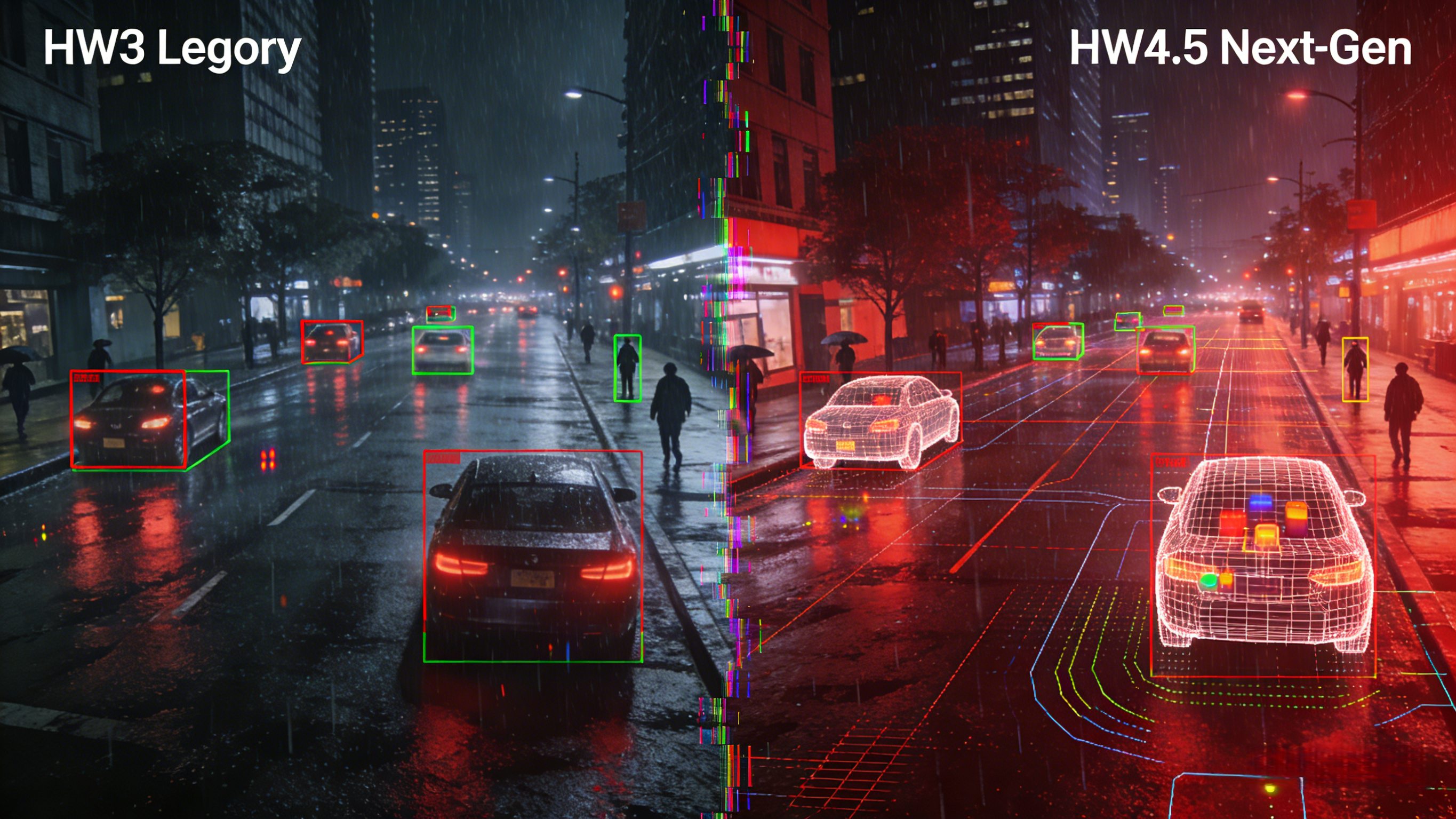
Introduction: The "Hardware-Ready" Myth
For years, Tesla’s marketing mantra was simple: "Every car produced since October 2016 has all the hardware necessary for full self-driving." This promise fueled the sales of millions of vehicles and billions in FSD revenue. However, on February 11, 2026, that narrative has officially collided with the cold reality of silicon limits.
As Tesla rolls out the Hardware 4.5 (HW 4.5) suite—an incremental but vital upgrade to the 2023-era AI4—the performance gap between new vehicles and the "Legacy HW3" fleet has widened into a canyon. This article explores the technical bottlenecks of HW3, the capabilities of the new HW 4.5, and the escalating legal storm as owners realize their "Robotaxi-ready" cars might be capped at "Supervised" assistance forever.
Chapter 1: Hardware 4.5 – The New Gold Standard
While Hardware 4 (AI4) was a massive leap, HW 4.5 (introduced in late 2025/early 2026) is the hardware stack Tesla believes will finally achieve SAE Level 4 autonomy.
1.1 The Return of High-Resolution Radar
Perhaps the most "inconvenient" truth for vision purists is the inclusion of the Phoenix 2.0 HD Radar in HW 4.5. Unlike the low-resolution radars Tesla removed in 2021, this 4D imaging radar provides:
-
Atmospheric Penetration: The ability to "see" through heavy European fog and North American blizzards where cameras fail.
-
Object Velocity Precision: Instantaneous speed detection of cross-traffic, reducing the "perception latency" that causes jerky braking in FSD v13.
1.2 5MP Cameras and the 360° Vision Bubble
HW 4.5 utilizes 5-megapixel sensors with a custom red-tinted lens for superior low-light performance. In contrast, HW3 cars are still navigating the world through 1.2-megapixel "eyes." At 100 meters, a HW 4.5 car can distinguish between a small animal and a road debris; a HW3 car sees a blur of pixels.
1.3 The NPU Power Shift
The compute power of HW 4.5 is estimated to be 8x that of HW3. This allows for "Parallel Hypothesis Testing"—the car doesn't just plan one path; it simulates five potential scenarios simultaneously and chooses the safest one in real-time.
Chapter 2: The HW3 Performance Ceiling – Why v13 is "Lite"
As of today, Tesla has officially bifurcated its software development. FSD v13.x for HW 4.5 is a "Full-Resolution" model, while HW3 owners are receiving "v13 Lite."
2.1 The Memory Bottleneck
The fatal flaw of HW3 is not just the processor speed, but the 8GB of RAM. Modern End-to-End neural networks are massive. To run v13 on HW3, Tesla's engineers have had to "prune" the model—effectively lobotomizing the AI's ability to remember long-term context (like a speed limit sign passed two miles ago) to save memory for immediate obstacle avoidance.
2.2 Latency and the "Micro-Jerk"
Because HW3 has to run the neural net at a lower frame rate to stay within thermal limits, owners are reporting "Micro-Jerks." The car makes a decision, but by the time the motor actuators receive the command, the car's position has shifted by a few inches, leading to constant, minute steering corrections that make the ride feel unpolished compared to the "buttery smooth" HW 4.5.
Chapter 3: The "Unsupervised" Admission
In a rare moment of candor during the late 2025 earnings call, Elon Musk admitted that while HW3 is "capable of being safer than a human," it likely lacks the redundancy required for "Unsupervised" (Eyes-off) driving.
3.1 Lack of Power Redundancy
HW 4.5 vehicles feature dual-redundant power supplies to the FSD computer. If a fuse blows, the car continues to drive. HW3 lacks this architectural redundancy. For a Robotaxi to operate without a human, it cannot have a "single point of failure."
3.2 The Infrastructure of Liability
Regulators in the EU and the US (NHTSA) are signaling that they will only grant Level 3+ permits to vehicles with hardware-level fail-safes. This effectively disqualifies 5 million HW3 Teslas from the upcoming "Tesla Network" Robotaxi fleet.
Chapter 4: The Great Retrofit Debate & Legal Storm
The 2026 "HW3 Revolt" has moved from Reddit threads to the courtroom.
4.1 The Class Action Shift
In California and Germany, class-action lawsuits are gaining traction. The core argument: "Fraudulent Misrepresentation." Plaintiffs argue they paid $12,000–$15,000 for a product (FSD) based on the explicit promise that the hardware was sufficient.
4.2 Is a Retrofit Possible?
Technically, no. Unlike the HW2.5 to HW3 upgrade (which was a simple computer swap), the transition to HW 4.5 requires:
-
A new wiring harness (16V vs 12V).
-
Entirely different camera housing and mounting points.
-
The addition of the Phoenix Radar. Tesla's service centers have stated that a retrofit would cost upwards of $7,000, and the company has shown no intention of subsidizing this for the millions of legacy owners.
Conclusion: Managing Expectations in the AI Era
The hard truth for the 2026 Tesla owner is that hardware matters. While Tesla will continue to provide "Supervised" updates for HW3 to avoid total legal collapse, the "Unsupervised" dream has moved to a new platform.
For current HW3 owners, the car remains an incredible piece of technology, likely the best driver-assist on the road. But as a financial asset, the "Hardware Gap" has permanently altered the resale value trajectory of older Teslas.
FAQ: The Hardware Crisis Explained
Q: Can I pay Tesla to upgrade my HW3 car to HW 4.5? A: As of February 2026, Tesla does not offer an official upgrade path. The structural differences in the wiring and camera placements make it a "total vehicle rebuild" rather than a simple chip swap.
Q: Will FSD v14 and v15 still come to HW3? A: Yes, but expect them to be "Lite" versions. You will get the safety improvements, but you will likely never be allowed to sleep or look away from the road legally.
Q: How do I check if my used Tesla has HW3 or HW4? A: Go to Software > Additional Vehicle Information. If it says "Autopilot Computer: Full Self-Driving Computer," it's HW3. If it says "AI4" or "Hardware 4," you have the newer suite.
Q: Is HW 4.5 the same as AI5? A: No. AI5 (formerly HW5) is the next-generation platform slated for the 2027 Robotaxi. HW 4.5 is the "peak" version of the current 4th-gen hardware.