
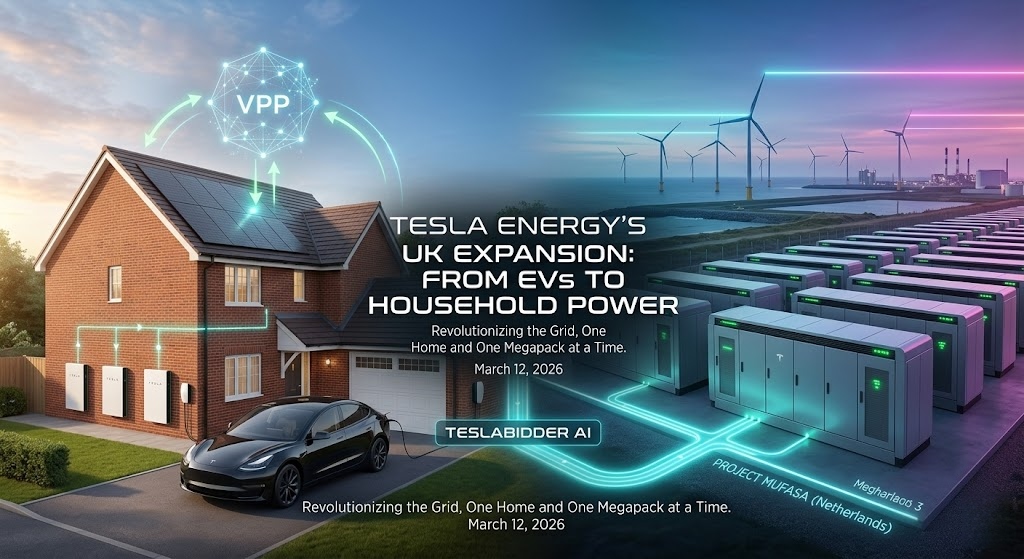
Executive Summary
On March 12, 2026, the energy landscape in Great Britain shifted permanently. Ofgem, the UK's energy regulator, officially granted Tesla Energy Ventures Limited a comprehensive license to supply electricity to domestic and non-domestic customers. This move marks Tesla’s official transition from a premium EV manufacturer to a vertically integrated energy utility. By combining the Powerwall 3, Megapack 3, and the AI-driven Autobidder platform, Tesla is set to disrupt the "Big Six" energy giants in the UK. This article provides an exhaustive analysis of Tesla’s retail energy strategy, the technology behind the Virtual Power Plant (VPP), and the massive Megapack infrastructure currently being deployed across Europe.
Chapter 1: The Ofgem Breakthrough—Tesla as a Retail Utility
The news hitting the wires today is the culmination of a seven-month regulatory journey that began in July 2025.
1.1 The Nature of the License
Unlike Tesla’s previous "Generation License" (held since 2020), this new Supply License allows Tesla to deal directly with the end-consumer. For the first time, a UK household can receive an electricity bill branded not by British Gas or Octopus, but by Tesla.
-
Scope: The license covers England, Scotland, and Wales.
-
Vertical Integration: Tesla now controls the entire energy value chain: from generation (Solar Roof) and storage (Powerwall) to the retail interface and the consumer’s car.
1.2 The "Tesla Electric" Brand in the UK
Following its success in Texas, Tesla is expected to launch Tesla Electric UK by Q3 2026. This service will prioritize "Real-Time Pricing," allowing tech-savvy consumers to avoid the "Standard Variable Tariff" (SVT) traps of traditional providers.
Chapter 2: The Virtual Power Plant (VPP)—The Silent Revolution
The core of Tesla’s UK strategy isn't just selling power; it's orchestrating it.
2.1 How the UK VPP Works
A Virtual Power Plant aggregates thousands of individual Powerwalls into a single, cohesive energy resource.
-
Grid Stabilization: During peak hours (e.g., 5 PM to 7 PM in London), the National Grid often struggles with demand. Instead of firing up carbon-heavy "peaker" plants, Tesla’s software can simultaneously discharge 50,000 Powerwalls across the UK.
-
Dynamic Export Incentives: Current data suggests Tesla will offer a flat export rate of £0.11/kWh, nearly double the standard Solar Export Guarantee (SEG) offered by competitors.
2.2 Powerwall 3: The Hardwired Advantage
The 2026 UK rollout features the Powerwall 3, which boasts an integrated solar inverter with 97.5% efficiency. Its ability to provide 11.04 kW of continuous power means a typical UK home can run entirely "off-grid" during peak price windows, saving up to 75% on annual energy costs.
Chapter 3: Megapack 3 and the European Infrastructure Backbone
While residential energy captures the headlines, Tesla’s utility-scale "Megapack" business is the true profit engine of 2026.
3.1 Project Mufasa (Netherlands)
Located near a critical North Sea wind farm interconnection, Project Mufasa is currently the largest battery storage site in the EU.
-
Capacity: 1.4 GWh (Gigawatt-hours).
-
Technical Detail: It utilizes 372 Megapack units, each featuring the new "Thermal Shield" casing designed for high-humidity coastal environments.
3.2 Cernay-lès-Reims (France)
In partnership with TagEnergy, Tesla has just commissioned a 480 MWh project in France. This site is notable for being the first in Europe to fully implement Autobidder AI for "Frequency Containment Reserve" (FCR). In layman's terms, the site reacts in less than 16 milliseconds to grid fluctuations, preventing blackouts across the Marne department.
Chapter 4: The AI Secret Sauce—Autobidder and Opticaster
Tesla is, at its heart, a software company. The success of its energy division relies on two proprietary algorithms:
-
Autobidder: A real-time trading platform that executes thousands of energy trades per second on wholesale markets. It predicts when energy will be cheapest (excess wind at night) and most expensive (calm, hot afternoons).
-
Opticaster: The consumer-facing sibling that manages individual Powerwalls. It learns a household's consumption habits, ensuring the battery is full before a predicted storm or a price spike.
Chapter 5: Market Implications—The Threat to the "Big Six"
The UK energy market has been notoriously rigid. Tesla’s entry creates a "Tech-First" category that traditional utilities are ill-equipped to fight.
5.1 The Loyalty Loop
For a Tesla car owner, the "Tesla Energy" ecosystem creates an unbreakable loop.
-
Zero-Cost Charging: By syncing car charging with VPP discharge windows, owners can effectively "drive for free" by selling back excess energy when prices are high.
-
App Consolidation: Managing your car, your home battery, and your energy bill in one "Apple-style" app is a massive UX advantage over the fragmented apps of traditional suppliers.
Conclusion: The New Energy Paradigm
Tesla Energy is no longer a "side project" to the automotive business. In 2026, it has become the infrastructure of the future. By securing the UK supply license, Tesla has proven it can navigate the world’s toughest regulatory environments. For the UK consumer, this means lower bills, higher resilience, and a cleaner grid. For the investor, it marks the moment Tesla became an Energy Titan.
FAQ: Essential Guide for UK Homeowners
Q: Do I need a Tesla car to switch my energy provider to Tesla? A: No. While there are "loyalty" perks for car owners, the Tesla Energy supply license allows any household with or without an EV to sign up.
Q: How much can a Powerwall 3 save me on my UK bill? A: On average, a Powerwall 3 combined with a 5kW solar array can reduce grid reliance by 70-90% during the summer and up to 40% in the winter.
Q: Is the UK grid really "unstable"? A: The UK is rapidly de-commissioning gas and coal. This creates "volatility." Tesla’s VPP and Megapacks provide the "buffer" needed to prevent brownouts as we move to 100% renewables.