
Introduction
On July 17, 2026, Tesla quietly did something that may prove to be as consequential as the opening of its first Supercharger station over a decade ago. The company flipped the switch on the world’s first public Megacharger station — a dedicated high-power charging facility for its Tesla Semi electric trucks — in Bloomington, California, about an hour east of Los Angeles.
For years, the Tesla Semi existed in a strange limbo. First teased in 2017, the all-electric Class 8 truck spent nearly a decade as a prototype, a promise, and a punchline for skeptics who doubted whether battery-electric long-haul trucking could ever compete with diesel. That narrative changed in April 2026, when the first Tesla Semi rolled off the high-volume production line at Tesla‘s dedicated Nevada factory. And now, with the Bloomington Megacharger going live, the infrastructure to support those trucks at scale is finally materializing.
This is not merely another charging station opening. It is a fundamental shift in how we think about freight, energy, and the economics of moving goods. The Megacharger represents Tesla’s bet that electric trucks can not only match diesel on range and performance but exceed it on total cost of ownership — provided the charging infrastructure exists to keep them moving.
II. The Bloomington Megacharger: Technical Specifications and First Impressions
Location and Layout
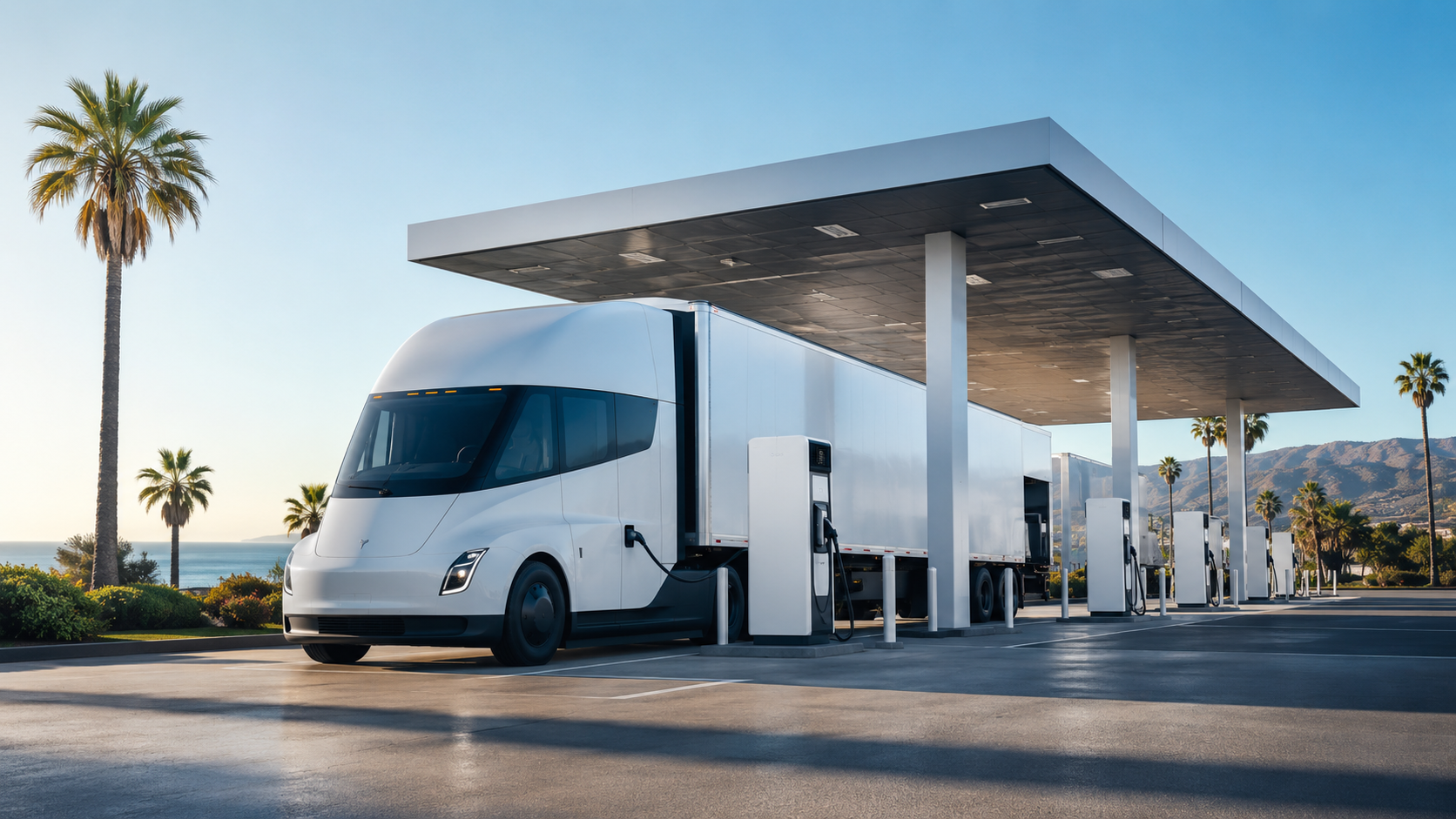
The world’s first public Megacharger is located at 18434 Valley Blvd in Bloomington, California. The site is strategically positioned in San Bernardino County, one of the busiest freight corridors in the United States. It features six individual charging stalls with large drive-through bays designed specifically to accommodate semi-trucks.
Each stall is equipped with Tesla‘s latest Megawatt Charging System (MCS) hardware, which represents a dramatic departure from the Supercharger equipment familiar to Tesla passenger vehicle owners. The physical connector is large and square-shaped — a stark contrast to the sleek NACS plug used for consumer vehicles. This thicker, more robust design is necessary to safely handle the extraordinary power flowing through the cable.
The Power: 1.2 Megawatts Per Stall
The headline specification is staggering: each Megacharger stall is capable of delivering up to 1.2 MW (1,200 kW) of peak charging power. To put that in perspective, a V4 Supercharger — Tesla‘s most advanced passenger vehicle charger — delivers 250 kW. The Megacharger is nearly five times more powerful.
This is not incremental improvement; it is an order-of-magnitude leap. One Megacharger cabinet paired with two posts delivers up to 1.2 MW DC output with a voltage range of 180–1000 VDC and efficiency above 96%. The continuous current rating reaches 1,100 amps.
Within about 30 seconds of plugging in, charging power ramps from zero to roughly 1,206 kW. Tesla pairs the MCS connector with its V4 Supercharger power cabinet, which can output the full 1.2 MW on its own.
Charging Speed and Driver Economics
The practical implication for fleet operators is straightforward: a Tesla Semi Long Range can replenish 60% of its 500-mile range in just 30 minutes. That‘s enough to add approximately 300 miles of range during a driver’s mandatory rest break — the same 30-minute window that federal Hours of Service regulations require truck drivers to take after a certain number of driving hours.
This alignment between charging time and regulatory requirements is not coincidental. Tesla has designed the Megacharger experience to fit seamlessly into existing trucking operations, not disrupt them. A driver pulls in, plugs in, takes their legally mandated break, and returns to a truck with several hundred more miles of range.
Tesla‘s Semi Charging for Business program, launched earlier in 2026, reveals the economics behind this infrastructure. The online configurator shows a starting price of $188,000 for two Megacharger posts, excluding taxes and installation, with Tesla charging an all-inclusive fee of $0.08 per kWh for revenue-generating sites.
Evolution from Earlier Iterations
The Bloomington site is not Tesla‘s first Megacharger, but it is the first truly public one. Tesla had previously opened a Megacharger station in Ontario, California, in March 2026, but that site was limited to 750 kW and used Tesla’s older MC1 connector. Another site in Carson, California, was planned earlier but never materialized as the first public location.
The Bloomington station, by contrast, is a full-scale public Megacharger equipped with Tesla‘s latest 1.2 MW hardware, making it capable of supporting the redesigned Tesla Semi with the newer MC2 connector as high-volume production ramps up. The older Ontario site no longer appears on Tesla‘s Find Us page, suggesting it was a pilot project that has been superseded by the more capable Bloomington facility.
Tesla‘s charging team announced the opening on X (formerly Twitter) with a simple post: “New Tesla Megacharger: Bloomington, CA (6 stalls)”. The Tesla Semi account reshared the announcement, adding: “First Megacharger in SoCal – many more to come”.
Max Zegher, who leads Tesla’s charging deployments in North America, described the opening as the beginning of the Megacharger network, noting that the build-out is focused on the most important Semi routes and depots first. He also emphasized that for Semi customers who can install Megachargers or Basechargers at their depots, Tesla recommends installing their own infrastructure too for the most efficient use of their fleet.
III. The Tesla Semi: A Truck Finally Ready for the Road
High-Volume Production Begins
The Bloomington Megacharger opening is inextricably linked to another milestone that occurred just months earlier: the start of high-volume Tesla Semi production.
In April 2026, the first Tesla Semi rolled off the high-volume production line at Tesla‘s dedicated factory in Sparks, Nevada. The 1.7 million-square-foot facility is built directly adjacent to Gigafactory Nevada and is capable of producing up to 50,000 Semi trucks per year. The ramp-up is targeted for full volume output before the end of June 2026.
Analyst estimates put full-year Semi output at 5,000 to 15,000 units in 2026 — a fraction of the volumes that legacy truck manufacturers like Volvo and Daimler have already placed, but a significant start for a vehicle that was first unveiled nearly a decade ago.
Elon Musk confirmed on X that “Tesla Semi starts high volume production this year,” signaling that the company is finally moving the program from pilot to scale.
Battery and Powertrain Specifications
California Air Resources Board (CARB) regulatory filings have officially confirmed the battery capacities for both Tesla Semi variants:
-
Standard Range: 548 kWh battery pack, delivering over 500 km (approximately 325 miles) of range
-
Long Range: 822 kWh battery pack, delivering up to 500 miles of range at full 82,000-lb gross combination weight
Both variants use Tesla‘s 4680 cells with NCMA (nickel-cobalt-manganese-aluminum) chemistry, which Tesla produces in-house. The Long Range pack is roughly 80 kWh smaller than Musk’s original 2022 estimate of “around 900 kWh” — yet Tesla is still rating the truck at 500 miles of range, suggesting improvements in efficiency and battery technology.
The Long Range variant has a curb weight of 23,000 lbs. Both trims support MCS 3.2 charging and include electric power take-off (ePTO) capability of up to 25 kW.
Fleet Orders and Customer Momentum
Publicly reported orders for the Tesla Semi now exceed 920 units, with a total valuation estimated at well over $230 million. Confirmed buyers and their fleet commitments include:
-
WattEV: 370 units
-
Walmart: Approximately 130 units
-
UPS: 125 units
-
PepsiCo: 100 units
-
Big F Transport: 40 units
-
NA Container Freight: 20 units
WattEV‘s order is particularly notable. The company plans to open additional charging depots later in 2026 in Stockton and Sacramento. Delivery of the first 50 Tesla Semis to WattEV is scheduled to start in 2026, with the full fleet of 370 units operational by the end of 2027. More than 300 of these trucks will support a joint program with the Port of Oakland, helping electrify drayage and regional freight routes.
PepsiCo, one of Tesla‘s earliest pilot partners, is scheduled to receive its first production Semis on December 1, 2026, to support its Sacramento beverage plant and Modesto operations.
IV. Strategic Location: Why Bloomington Matters
The Inland Empire Freight Corridor
Bloomington sits in the heart of the Inland Empire, one of the busiest freight corridors in the world. The region links the Ports of Los Angeles and Long Beach — the two busiest container ports in the United States — with Southern California‘s vast inland warehouse and distribution network.
The location near the junction of the I-10 and I-15 freeways makes it a critical link for electric trucks moving goods between the ports and major distribution centers further inland. This is not a random choice; it is a deliberate placement at the heart of America‘s goods movement infrastructure.
California’s Incentive Ecosystem
California has become the focal point for electric truck adoption, driven by its generous voucher system and local support programs. The state‘s Hybrid and Zero-Emission Truck and Bus Voucher Incentive Project (HVIP) has been a game-changer.
Tesla‘s Semi has already drawn more than 1,200 California HVIP vouchers for buyers of zero-emission heavy-duty vehicles, worth $172 million. In the latest round of vouchers for Class 8 tractors, covering January 2025 to February 2026, the Tesla Semi accounts for an overwhelming majority — 965 of 1,067 vouchers.
These incentives reduce the purchase price of the Semi by up to $120,000 per unit, bringing costs down for vehicles priced between $250,000 and $290,000 depending on range. With stacking of additional programs like the California Clean Fuel Reward (CCFR) — which opened to applications on June 26, 2026, with $250 million allocated for 2026 and more than $1 billion committed through 2030 — a Tesla Semi could cost as little as $50,000 after all incentives.
First of Many
Tesla‘s Semi program lead, Dan Priestley, has said the company aims to deploy 46 Megacharger stations by early 2027, with approximately 37 sites planned for 2026. The Bloomington opening is the first of what Tesla promises will be many more.
V. The Megacharger Network: A 66-Station Blueprint
The Find Us Map Update
In February 2026, Tesla updated its “Find Us” map with 64 new Megacharger locations across 15 states, giving the clearest picture yet of the charging network it is building to support the Tesla Semi. Combined with two sites already operational, the map now shows 66 total locations.
The network is most heavily concentrated in Texas, with 19 planned locations, followed by California with 17. Florida, Georgia, Illinois, and Washington each have four locations. The network targets the busiest freight corridors in North America: I-5 on the West Coast, I-10 as an east-west artery, and I-95 and I-75 along the East Coast.
The Pilot Travel Centers Partnership
Adding significant momentum to the network build-out, Tesla landed a deal with Pilot, the nation‘s largest truck stop operator and a Berkshire Hathaway subsidiary, to install Megacharger stalls at select Pilot travel centers.
Construction of Tesla Semi charging stations at selected Pilot locations in California, Georgia, Nevada, New Mexico, and Texas began in the first half of 2026. Each location will host four to eight charging stalls using Tesla‘s V4 cabinet technology, delivering up to 1.2 MW of power per stall. The first Pilot sites are expected to open by summer 2026.
This partnership is significant for two reasons. First, it gives Tesla access to prime real estate along America‘s busiest freight corridors. Second, it signals that Tesla is serious about building a network that serves not just its own trucks but the broader industry — a strategy that mirrors the Supercharger network’s evolution from Tesla-only to open access.
Factory-Built, Ready-to-Deploy Strategy
Tesla plans to build pre-assembled Megachargers to accelerate network deployment. This factory-built, ready-to-deploy strategy mirrors Tesla‘s consumer Supercharger deployment, which recently hit 80,000 stalls globally.
The approach is designed to reduce construction time and complexity. Rather than building each site from scratch, Tesla can ship pre-assembled units that require minimal on-site work — a proven model from the Supercharger playbook.
VI. Competitive Landscape: Tesla vs. The MCS Ecosystem
The Megawatt Charging System Standard
Tesla‘s Megacharger is built on the Megawatt Charging System (MCS), an open industry standard developed by CharIN that supports charging speeds up to 3.75 MW. MCS represents the next phase in electric truck charging, with power levels that make electric long-haul trucking economically viable.
The first commercial MCS sessions occurred in 2025, and the first US customer-facing Tesla Semi Megacharger site opened in Ontario, California, in early 2026. Europe is ahead of the US on public MCS corridor deployment, led by companies like Milence, Kempower, and ABB, with operational hubs in the Netherlands, Belgium, and Sweden.
Competitors Are Not Standing Still
Tesla is moving fast, but it is not the only player in the megawatt charging space.
Kempower, a Finnish EV charging manufacturer, has deployed MCS charging hubs at three locations in Scandinavia and one in San Bernardino, California — not far from Tesla‘s new Bloomington site. The company‘s Mega Flex Satellite features a megawatt-capable MCS connector and a CCS cable, aimed at busy logistics hubs where a Tesla Semi might need a quick top-up at the same time as a smaller medium-duty truck.
Truck manufacturers Daimler, Volvo, and Scania (part of the Traton Group) are all preparing MCS-compatible electric trucks for commercial deployment in 2026. This means Tesla will face competition not just on charging infrastructure but on the trucks themselves.
Tesla‘s Competitive Advantage
Despite growing competition, Tesla has several advantages. First, its vertical integration — from battery production to vehicle manufacturing to charging infrastructure — allows for a tightly controlled ecosystem that competitors cannot easily replicate. Second, the Semi’s efficiency — averaging 1.7 kWh per mile while hauling a load — gives it a significant operating cost advantage over diesel and competing electric trucks.
Third, Tesla‘s experience with the Supercharger network gives it a playbook for rapid infrastructure deployment that pure-play charging companies and traditional truck manufacturers lack. The company knows how to navigate permitting, utility interconnection, and construction at scale.
VII. The Economics of Electric Trucking
Total Cost of Ownership
The business case for the Tesla Semi rests on total cost of ownership (TCO). Dan Priestley, Tesla’s Semi program lead, has argued that switching from a diesel truck to a Semi makes financial sense, citing the truck‘s efficiency.
At 1.7 kWh per mile, the Semi‘s energy cost is dramatically lower than diesel — even before accounting for maintenance savings. Electric trucks have far fewer moving parts than diesel trucks, meaning lower maintenance costs and less downtime.
Tesla’s Semi Charging for Business program offers fleet operators a turnkey solution for deploying Megachargers at their own facilities. Public sites like Bloomington complement those private installations, providing charging access for a growing number of Semi operators as fleets continue transitioning away from diesel.
The Driver‘s Perspective
The 30-minute charging time aligns with mandatory driver rest breaks, meaning the Semi doesn’t add time to a driver‘s day — it simply uses existing downtime productively. This is a critical selling point for fleet operators concerned about driver utilization.
For a long-haul driver covering 500 miles in a day, a 30-minute charge during a mandatory break provides enough range to complete the route without additional stops. For longer routes, strategic charging along major corridors keeps the truck moving.
The Infrastructure Investment
The economics of Megacharger deployment are significant. At $188,000 for two posts before installation, a full Megacharger site represents a substantial capital investment. However, Tesla‘s $0.08 per kWh fee for revenue-generating sites provides a clear revenue model.
For fleet operators with sufficient volume, installing private Megachargers at their depots may be more cost-effective than relying on public infrastructure. Tesla recommends this approach for customers who can install their own infrastructure.
VIII. Looking Beyond North America: Europe and Global Expansion
Tesla‘s European Ambitions
Tesla has previously indicated that the Semi would eventually expand to Europe, and the company is already laying groundwork for a Megacharger network there. Europe is one of the largest freight markets in the world, with strict emissions regulations pushing fleets toward electrification at an accelerated pace compared to North America.
Elon Musk has indicated that Tesla will bring the Semi to Europe in 2026, with Gigafactory Berlin expected to supply regional markets. Tesla is preparing a major expansion of its network in Europe with the roll-out of Megachargers using the MCS 3.2 standard, delivering up to 1.2 MW of power.
European Competition
Europe is ahead of the US on public MCS corridor deployment. Companies like Milence (a joint venture between Daimler Truck, Volvo Group, and Traton Group) are building heavy-duty charging networks across the continent. Kempower and ABB already have operational MCS hubs in the Netherlands, Belgium, and Sweden.
Tesla‘s entry into the European truck charging market will face stiff competition from established players with deep relationships with European fleet operators. However, Tesla’s brand strength and Supercharger network experience give it a foundation to build upon.
The Global Opportunity
The global market for heavy-duty EV charging is expected to grow rapidly. The above-350 kW (MCS) segment is projected to register the highest compound annual growth rate during the forecast period. Tesla‘s early-mover advantage in the US, combined with its manufacturing scale and vertical integration, positions it well for global expansion.
Conclusion
The opening of the world’s first public Megacharger in Bloomington, California, on July 17, 2026, marks a pivotal moment in the electrification of freight transportation. It is the physical manifestation of a decade of development, the infrastructure backbone for a vehicle that has finally entered high-volume production, and a signal that Tesla is serious about transforming the trucking industry.
The Megacharger‘s 1.2 MW of charging power — enough to add 300 miles of range in 30 minutes — aligns with the operational realities of long-haul trucking. The six-stall Bloomington facility is the first of what Tesla plans to be a 66-station network spanning 15 states, with additional sites coming through partnerships with Pilot Travel Centers.
The Tesla Semi itself is now a reality, with confirmed orders exceeding 920 units from major fleets including WattEV, Walmart, UPS, and PepsiCo. The truck‘s 822 kWh Long Range battery, 4680 cells, and 500-mile range make it a credible competitor to diesel — and California’s generous incentive programs make it an economically attractive one.
The competitive landscape is heating up. Daimler, Volvo, and Scania are all preparing MCS-compatible electric trucks for 2026. Kempower and others are building competing megawatt charging networks. Europe is ahead of the US on public MCS deployment. Tesla‘s early-mover advantage in the US is real, but it will not last forever.
What the Bloomington Megacharger represents, ultimately, is a turning point. The question is no longer whether electric trucks will happen, but how fast they will scale. Tesla has placed its bet on 1.2 MW charging, vertical integration, and a network-first strategy. The next 12 to 24 months will determine whether that bet pays off — and whether the Megacharger becomes as ubiquitous as the Supercharger.
For fleet operators, the message is clear: the infrastructure is coming, the trucks are rolling off the line, and the economics are increasingly compelling. The era of megawatt charging has officially begun.
FAQ
Q: Where is the world‘s first public Megacharger located?
A: The Megacharger is located at 18434 Valley Blvd in Bloomington, California, about an hour east of Los Angeles.
Q: How much power can a Megacharger deliver?
A: Each stall can deliver up to 1.2 MW (1,200 kW) of peak charging power.
Q: How fast does a Tesla Semi charge at a Megacharger?
A: A Tesla Semi Long Range can replenish 60% of its 500-mile range — approximately 300 miles — in just 30 minutes.
Q: How many Megacharger locations does Tesla plan to build?
A: Tesla has identified 66 Megacharger locations across 15 US states, with 37 sites planned for operation by the end of 2026 and 46 by early 2027.
Q: What is the Tesla Semi‘s battery capacity?
A: The Standard Range has a 548 kWh battery, and the Long Range has an 822 kWh battery. Both use Tesla’s 4680 cells with NCMA chemistry.
Q: How much does a Tesla Semi cost?
A: The Semi is priced between $250,000 and $290,000 depending on range, though California incentives can reduce the cost by up to $120,000 per unit.
Q: Who has ordered Tesla Semis?
A: Confirmed buyers include WattEV (370 units), Walmart (~130 units), UPS (125 units), PepsiCo (100 units), and others.
Q: Is Tesla planning Megachargers in Europe?
A: Yes. Tesla is laying groundwork for a Megacharger network in Europe and plans to launch the Semi there, with Gigafactory Berlin expected to supply regional markets.
Q: How does the Megacharger compare to a Supercharger?
A: A Megacharger delivers up to 1.2 MW, nearly five times more powerful than a V4 Supercharger (250 kW).
Q: Can non-Tesla trucks use the Megacharger?
A: The Bloomington Megacharger is open to all Tesla Semi customers. The broader MCS standard is open, but Tesla‘s Megachargers use a proprietary connector.