
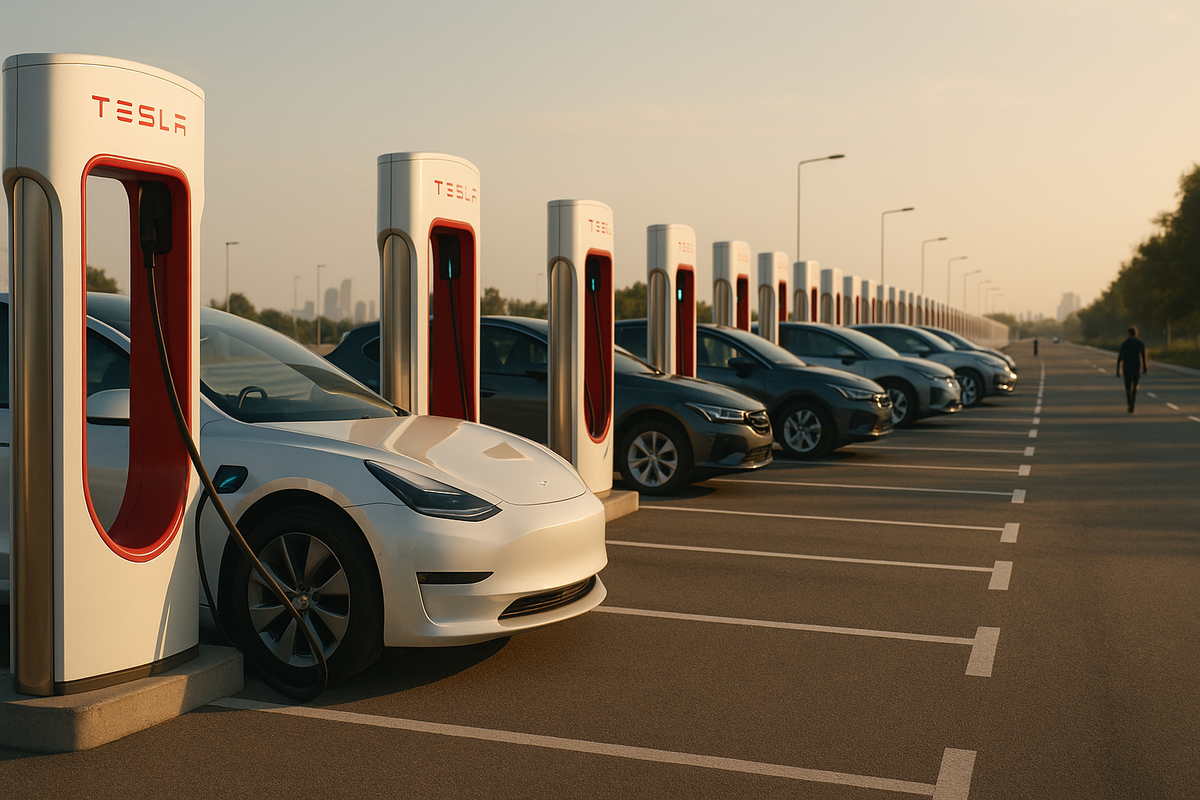
In 2025 Tesla’s Supercharger network is no longer solely a competitive moat for Tesla owners — it is actively reshaping the public charging landscape. Over the past 18 months Tesla has accelerated deployment of next-generation Superchargers (V3/V4), expanded stall counts aggressively, and moved from a largely closed, Tesla-only system toward selective openness: licensing or supporting the North American Charging Standard (NACS), enabling non-Tesla vehicles to use Superchargers through adapters or native ports, and opening some sites to other brands in select markets. These moves materially change travel planning, OEM strategy, and public charging economics in both North America and Europe.
Key facts for 2025: Tesla reports tens of thousands of Supercharger connectors worldwide (70k+ as of mid-2025), a growth trajectory that continues this year; V4 hardware is rolling out and Tesla has publicized higher per-stall peak power in countries including China and North America (325 kW and rising), with plans/announcements about even higher-power cabinets. Meanwhile many major automakers (BMW, Porsche/Audi, Ford/GM among others) are committing to adopt NACS or are distributing adapters, creating meaningful interoperability. Regulators — especially in the EU — remain focused on standardization, open access, and consumer protection, which will shape how Tesla’s strategy plays out regionally.
This article explains the technical and commercial implications of Tesla’s Supercharger expansion, decodes the NACS migration, walks through how interoperability actually works for owners today (adapters, software authentication, Plug & Charge), analyzes competitive and regulatory impacts in the U.S. and Europe, and offers practical recommendations for Tesla owners, non-Tesla EV drivers, fleet managers, and policymakers.
1. Why the Supercharger network matters (again)
Charging networks are the connective tissue of EV adoption. For a long time Tesla’s market advantage came from three interrelated assets: high-range vehicles, integrated vehicle-to-software UX, and a widely available, fast Supercharger network that enabled reliable long-distance travel. That advantage shaped consumer perceptions: early adopters bought Teslas because long road trips “just worked.”
In 2025, the Supercharger network remains strategically important, but its role is evolving. The network is now a platform business — not just a customer benefit — with Tesla monetizing access, licensing connector standards (NACS), and integrating non-Tesla cars. That evolution accelerates EV usability for many drivers, but it also turns the network into a battleground among automakers, charging operators, and regulators. The end result will affect trip planning, second-hand values, fleet operating costs, and where private investment flows for public charging.
2. The network today — scale, pace of expansion, and hardware generations
Current scale (Q2–mid-2025 snapshot)
Tesla’s own and third-party reporting indicate Tesla operates thousands of Supercharger stations and over 70,000 charging connectors globally as of mid-2025. Independent trackers and Tesla’s Q2 2025 reporting cited figures in that neighborhood (roughly 7,300+ stations and ~70,000+ connectors). That size makes Tesla by far the largest fast-charging operator by installed DC fast stalls in many markets.
Pace of expansion
Tesla has continued to add sites at a brisk clip in 2024–2025: adding thousands of stalls year-over-year and opening markets such as expanded deployments in China, Europe, and key U.S. corridors. Market commentary in late 2025 highlights plans to continue significant expansion through the rest of the decade. Analysts also point out Tesla’s capacity to install stations faster than many competitors because of integrated site selection, procurement scale, and in-house software.
Hardware evolution: V2 → V3 → V4 (and beyond)
-
V2 (earlier): modest power suitable for overnight/top-up charging.
-
V3: introduced higher sustained power (up to ~250 kW in many installations) and enabled simultaneous high-speed charging without splitting power across pairs in many layouts.
-
V4 & V3.5 incremental updates (2024–2025): V4 introduces an upgraded cabinet that supports higher per-stall peak rates (Tesla announced some V4 posts capable of up to 325 kW in practice, and industry reporting cites development plans for even higher peak power in future cabinets). China and North America are among early deployment zones for V4. Tesla has also discussed 500 kW+ capability in the roadmap (often described as “future V4+”), although attainable peak power to any given vehicle depends on the vehicle’s battery architecture and onboard thermal management.
What operators and drivers see on the ground: not every car can accept the highest possible peak rate; Cybertruck and some next-generation platforms show higher acceptance rates where Tesla tuned the battery management. Other EVs (with older battery chemistries or lower max charge acceptance) will see lower power even on V4 hardware. Still, V4 rollout improves throughput, reduces queuing at many busier sites, and provides headroom for non-Tesla cars as they begin to access the network.
3. NACS: from Tesla proprietary plug to de-facto industry standard
What is NACS?
NACS (North American Charging Standard) is Tesla’s connector form factor and associated authentication/communications approach originally used on Tesla vehicles and Superchargers in North America. It bundles a compact connector design with Tesla’s vehicle-to-charger communications and the platform features Tesla built (app integration, billing, Plug & Charge in some cases). Historically, the EV industry in the U.S. and Europe used CCS (Combined Charging System); Tesla’s NACS competed with that ecosystem.
Why NACS adoption matters
When major OEMs decide to adopt NACS ports or distribute adapters, several effects follow:
-
Direct access to Tesla’s physical network — vehicles with NACS ports can plug directly into many Superchargers without an adapter.
-
Improved UX — native port plus software integration can enable features like plug-and-charge (automatic authentication and billing), in-car navigation to Superchargers with reservation logic, and simpler cross-brand charging.
-
Network externalities — as more brands adopt NACS, the value of each Supercharger stall increases because it serves more vehicles, which can attract more public and private site hosts.
In 2025 multiple OEMs publicly committed to NACS adoption or to bridging strategies (adapters or in-car payment integration). BMW, Porsche (and Audi), Ford/GM moves and many others were widely reported in 2024–2025, changing the calculus for both network operators and regulators.
4. Real interoperability: how non-Tesla cars actually charge at Superchargers today
There are three pragmatic paths to cross-brand charging at a Supercharger in 2025:
1) Native NACS port on the vehicle
Some OEMs announced that future vehicles will ship with NACS built in (BMW’s announcements, for example). Vehicles with NACS ports simply plug and, where supported, can use Plug & Charge or app-based authentication. This is the smoothest UX.
2) CCS-to-NACS adapter (physical adapter)
Many legacy EVs built for CCS can use a physical adapter (a CCS1 ↔ NACS adapter) to plug into a Tesla stall. Some OEMs (Hyundai, Volkswagen group brands, others) indicated they would distribute or subsidize adapters for existing customers, while others planned to include adapters with certain new models. Adapters work but add friction: owners must carry the adapter, there may be supply constraints early on, and some adapters may limit maximum achievable charge rates depending on engineering.
3) Software authorization and payment integration
Even with the right physical connection, the charging session needs authorization and billing. Tesla has enabled workflows where non-Tesla vehicles can begin charging using the Tesla app; in some partner programs automakers integrate Supercharger access into their own brand apps (e.g., My Porsche). Where Plug & Charge is enabled across brands, the move from physical access to smooth authentication is significantly improved. Initial “soft launches” have used the Tesla app as the gateway — later integration reduces the friction.
Practical realities and limits today
-
Not all sites are open immediately. Tesla has prioritized opening specific stations or regions for guest access or partner programs rather than flipping every Supercharger worldwide overnight. Early openings have focused on high-traffic corridors and regions with partner automakers.
-
Adapters have logistics issues. Demand surged when adapter availability was announced; manufacturers and third parties scrambled to scale production. Some early owners reported supply bottlenecks and inconsistent documentation on charge speeds with adapters.
-
Billing UX differs by market. Where automakers integrated billing in their apps, users saw better experience; where they have to use the Tesla app, the flow is clunkier (and may require account creation). Plug & Charge rollout across brands is an ongoing engineering and billing reconciliation challenge.
5. Market and competitive implications
Tesla’s decisions ripple through multiple participant groups: independent charging networks, automakers, site hosts (malls, restaurants), and utilities.
A. For independent charging networks (ChargePoint, Blink, Ionity, Electrify America)
-
Pressure on wholesale economics: Tesla’s scale and faster per-stall throughput can make it harder for smaller networks to compete on price and convenience on intercity corridors. Analysts in 2025 highlighted that Tesla could become the dominant fast charging operator in many corridors, pressing incumbents to consolidate or specialize (e.g., urban Level 2 vs. highway fast charging).
-
Opportunity for specialization: Some networks will double down on partner relationships with automakers or offer value-added services (reservation, booking, fleet management) that complement or target segments Tesla doesn’t serve.
B. For automakers
-
Strategy split: Some manufacturers accelerated NACS adoption (or planned to) to give customers access to Superchargers; others pursued multi-connector strategies (support both CCS and NACS, or rely on roaming agreements). OEMs must weigh the cost and strategic implications of standardizing on NACS versus continuing with CCS. Automakers that adopt NACS reduce range anxiety for their customers and can market easier long-distance use.
-
Brand UX and control: By integrating charging into their own navigation and payment systems, automakers can control UX and data flows rather than sending users to the Tesla app. However, this requires engineering and billing integration.
C. For site hosts and governments
-
Site economics improve: Higher throughput V4 hardware and interoperability make Superchargers more attractive to shopping centers, malls, and hospitality sites. This increases the pool of potential hosts and private capital willing to install chargers under Tesla’s ownership model or via Tesla’s “Supercharger for Business” style programs.
6. Regulation, standards, and the EU context
EU regulatory posture and standards friction
Europe historically standardized on Type 2 (AC) and CCS for DC fast charging. The EU and UNECE regimes emphasize interoperability, safety, and open access. NACS’s entry into Europe complicates standards governance: regulators are not fond of fragmentation, but they also want to ensure consumer choice and efficient use of infrastructure.
The European Commission and national authorities have launched consultations and calls for evidence about charging infrastructure, grid impacts, and interoperability policy. Expect regulators to require:
-
Open access / nondiscrimination: policies that prevent gatekeeping of public chargers.
-
Transparent pricing and roaming rules: so drivers can see real-time prices and avoid opaque billing.
-
Data sharing / cybersecurity requirements: for safe operation and to prevent lock-in.
Policy levers that matter
-
Mandating standard connectors or requiring adapters at publicly funded sites could be used to ensure consumer access.
-
Roaming and billing standards (similar to how mobile telephony roaming is regulated) may be proposed to standardize authorization and billing across networks.
-
Safety & cybersecurity rules (charging protocol security) will shape how operators implement plug-and-charge and remote update systems. Recent research on attack surfaces for CCS underscores the importance of security standards.
Regional nuance: Europe vs. North America
-
Europe: strong emphasis on standardized open access, anti-lock-in rules, and ensuring compatibility across cross-border travel. Regulatory momentum could push for guaranteed CCS presence at publicly supported sites or minimum interoperability requirements, which may slow pure NACS-only rollouts. Mobility stakeholders in Europe debate whether to accept NACS as a de-facto additional standard or to reinforce CCS as the single mandated standard.
-
North America: market-driven adoption of NACS has already moved faster due to OEM decisions and Tesla’s market share. U.S. regulators are more likely to oversee safety and transparency rather than dictate connector standards in the near term.
7. Charging economics and pricing models
How Tesla prices Supercharging (and changes in 2025)
Tesla uses location-based, time-of-day, and membership pricing in some countries. In some markets Tesla introduced subscription or membership tiers (e.g., UK membership reductions reported), station-level pricing displays on V4 units, and dynamic pricing measures to manage congestion. Some sites now offer discounted membership options, while non-member per-kWh or per-minute pricing persists. Local electricity costs and taxes lead to big regional variations.
Network economics
-
Throughput (stalls per hour) increases with higher peak power and better queuing management; this improves revenue per site.
-
Roaming and partnerships (where non-Tesla drivers pay via automaker or Tesla app) introduce revenue splits and additional billing reconciliation complexity.
-
Ownership models: Tesla’s model of owning and operating most sites yields control of UX and data but requires capital. Alternatives (hosted models, public-private partnerships) distribute capital but create interoperability coordination work.
8. Owner experience: what to expect when you charge (Tesla and non-Tesla)
Charging as a Tesla owner
-
Smoother UX where Tesla integrates route planning with Supercharger stops, typical estimated time to charge, and on-screen visuals. V4 sites increasingly show real-time pricing and free contactless payment pads for guest use. Higher peak power reduces stop times for cars that can accept it.
Charging as a non-Tesla owner
-
If you have an adapter or NACS-equipped car: access may be straightforward, but you may need the Tesla app or the automaker’s integration to start a session. Some early adopters reported successful charging via adapter, while others faced supply or authorization friction. Expect improved UX as OEM apps are updated to support plug-and-charge and in-car billing.
Edge cases and friction points
-
Queuing and etiquette: adapters and different charge acceptance rates can cause slower fill times and frustration if drivers don’t coordinate.
-
Billing confusion: varying per-kWh or per-minute rules and the need to manage multiple apps can be annoying for occasional users.
-
Adapter compatibility & warranty questions: Using third-party adapters may raise warranty or safety questions; owners should follow OEM guidance.
9. Fleet & commercial operator considerations
Fleet managers (delivery, rental, ride-hail) evaluate charging networks on availability, throughput, billing, and data APIs.
Why Supercharger access matters for fleets:
-
Predictable high-power charging shortens downtime for high-utilization vehicles.
-
Nationwide coverage reduces range anxiety for intercity routing.
-
Plug & Charge / billing APIs enable automated reconciliation for commercial operations.
Practical advice for fleets:
-
Assess coverage along route legs and peak utilization times; peak travel days can create queuing even at large sites.
-
For mixed fleets, ensure vehicles are NACS-equipped or that robust adapter and operational protocols exist.
-
Negotiate enterprise relationships where possible — automakers and Tesla may offer enterprise agreements or reserved access for high-volume customers.
10. Future scenarios: three trajectories for 2026–2030
Below are three plausible scenarios that illustrate the strategic options and potential industry outcomes.
Scenario A — “Fast convergence” (NACS + open market): interoperability wins
-
Majority of OEMs adopt NACS or provide adapters; Tesla opens more sites and integrates Plug & Charge across brands.
-
Public charging becomes more seamless; competition shifts to site density and price. Independent networks consolidate around complementary roles (urban charging, depot solutions).
-
Result: improved consumer experience, faster long-distance EV adoption. Regulatory friction is moderate; EU accepts multi-connector reality with roaming rules.
Scenario B — “Regulatory lockdown” (standards pushback)
-
EU and some governments mandate CCS or specific open-access rules; certain publicly funded sites must support CCS. Tesla continues to roll out NACS in markets where permissive.
-
Result: more adapter logistics, some duplication of infrastructure, slower universal roaming. Competitive tension increases among operators.
Scenario C — “Fragmented specialization” (networks segment)
-
Tesla dominates highway fast charging via Superchargers; third-party networks focus on urban and depot charging, specialized fleet offers, and lower-cost coverage. OEMs choose mixed strategies (some NACS, some CCS).
-
Result: Consumers use multiple apps and networks; telematics and navigation play larger role in seamless routing. Market consolidation occurs but fragmentation in UX remains.
Implications: Owners should plan for at least temporary fragmentation: carry adapter options if you drive multiple brands, keep multiple apps updated, and expect billing consolidation efforts over the next 12–24 months.
11. Practical recommendations (for drivers, fleet managers, and policymakers)
For Tesla owners
-
Benefit: you’ll continue to enjoy the superior in-car route planning and priority access at many sites. V4 hardware reduces peak charging times for newer Tesla platforms.
-
Tip: keep Tesla app updated, monitor firmware notes, and consider membership programs where available to reduce session costs.
For non-Tesla EV drivers
-
Short term: request or buy a certified CCS→NACS adapter if your OEM supports it. Follow OEM guidance on where adapters are safe/guaranteed.
-
Medium term: prefer new models shipping with native NACS if you frequently travel on highways served by Superchargers.
For fleet operators
-
Evaluate station throughput, queuing risk, and enterprise APIs. Negotiate reserved or priority access where possible; plan routes to use a mix of network providers to avoid single-network risk.
For policymakers
-
Require transparency in public funding: require any publicly funded station to support at least one widely adopted standard and implement open roaming or nondiscriminatory access.
-
Mandate data reporting on usage and availability (anonymized) so planners can optimize grid and site investments.
12. Risks and unanswered questions
-
Adapter supply & safety: can production and distribution keep pace with demand, and are third-party adapters always safe at high charge rates? OEM and regulator guidance will be critical.
-
Billing & UX fragmentation: multiple apps, varying price models, and slow Plug & Charge standardization will degrade UX until integrations are mature.
-
Grid capacity & site electrification: higher-power V4 stations require heavy grid upgrades or buffering (on-site batteries/solar). Local grid constraints could bottleneck buildout.
-
Regulatory action: EU decisions on mandated standards or open-access rules could materially change network economics and technical requirements.
13. Conclusion
Tesla’s Supercharger strategy in 2025 has shifted from a Tesla-only convenience to a public infrastructure pivot point. The combination of rapid hardware rollout (V4), broad stall count growth, and the industry’s adoption of NACS is changing what it means to “have access” to a high-power charging network. For drivers, the near future will be more convenient for long trips, though temporary friction (adapters, apps, billing) will persist. For automakers and network operators, the shift forces strategic re-evaluation: adopt NACS to reach a great network quickly, or double down on CCS and differentiate via site density, price, or services.
From a policy perspective, regulators should prioritize user protection, interoperability rules, and transparent pricing to ensure that the benefits of faster, more ubiquitous charging are fairly distributed. For Tesla, enabling non-Tesla access is a smart platform play — it turns the network into a revenue center and an industry standard setter. For everyone else, the next 12–36 months will determine whether charging becomes truly seamless or remains a patchwork of competing solutions.
FAQ — Practical owner & fleet questions
Q1 — How many Superchargers are there now (mid-2025)?
A: As of mid-2025, reporting places the count at roughly 7,300+ stations and over 70,000 connectors worldwide; Tesla and third-party trackers published numbers in that range. These numbers change quickly as Tesla continues to add sites.
Q2 — Can non-Tesla cars charge at Superchargers today?
A: Yes, in many markets non-Tesla cars can charge via one of three methods: if the vehicle has a native NACS port, via a CCS→NACS adapter, or through app-based authorization where Tesla or partner automaker enables access. Availability varies by country and by specific Supercharger site.
Q3 — Will my Toyota/Ford/BMW get access to Superchargers automatically?
A: It depends. Some automakers have announced NACS adoption or adapter plans (BMW, Porsche/Audi, Ford/GM moves were reported). Check your OEM’s communication for exact timelines and whether they will supply adapters.
Q4 — Are V4 Superchargers 500 kW already?
A: Some reporting and Tesla communications reference V4’s ability to reach higher peaks (325 kW is commonly reported in early production), and Tesla has spoken about future cabinets that could support even higher peaks (some industry pieces mentioned up to 500 kW). Realized charge rate will depend on both charger and vehicle charge acceptance.
Q5 — Will the EU force Tesla to add CCS to Superchargers?
A: The EU is focused on interoperability and transparency. While regulators could mandate certain capabilities in publicly funded infrastructure, forcing Tesla to physically change its ports across private sites is unlikely in the immediate term. Instead regulators will push for roaming, adapter availability, nondiscrimination, and clear pricing. The debate remains active.
Q6 — What should I carry on a long trip in 2025?
A: If you drive a non-Tesla, consider carrying a certified CCS→NACS adapter if your OEM supports it, keep the Tesla app and your OEM charging apps installed, and plan alternate charging stops (Electrify America, Ionity, or local third-party networks) in case of site constraints.