
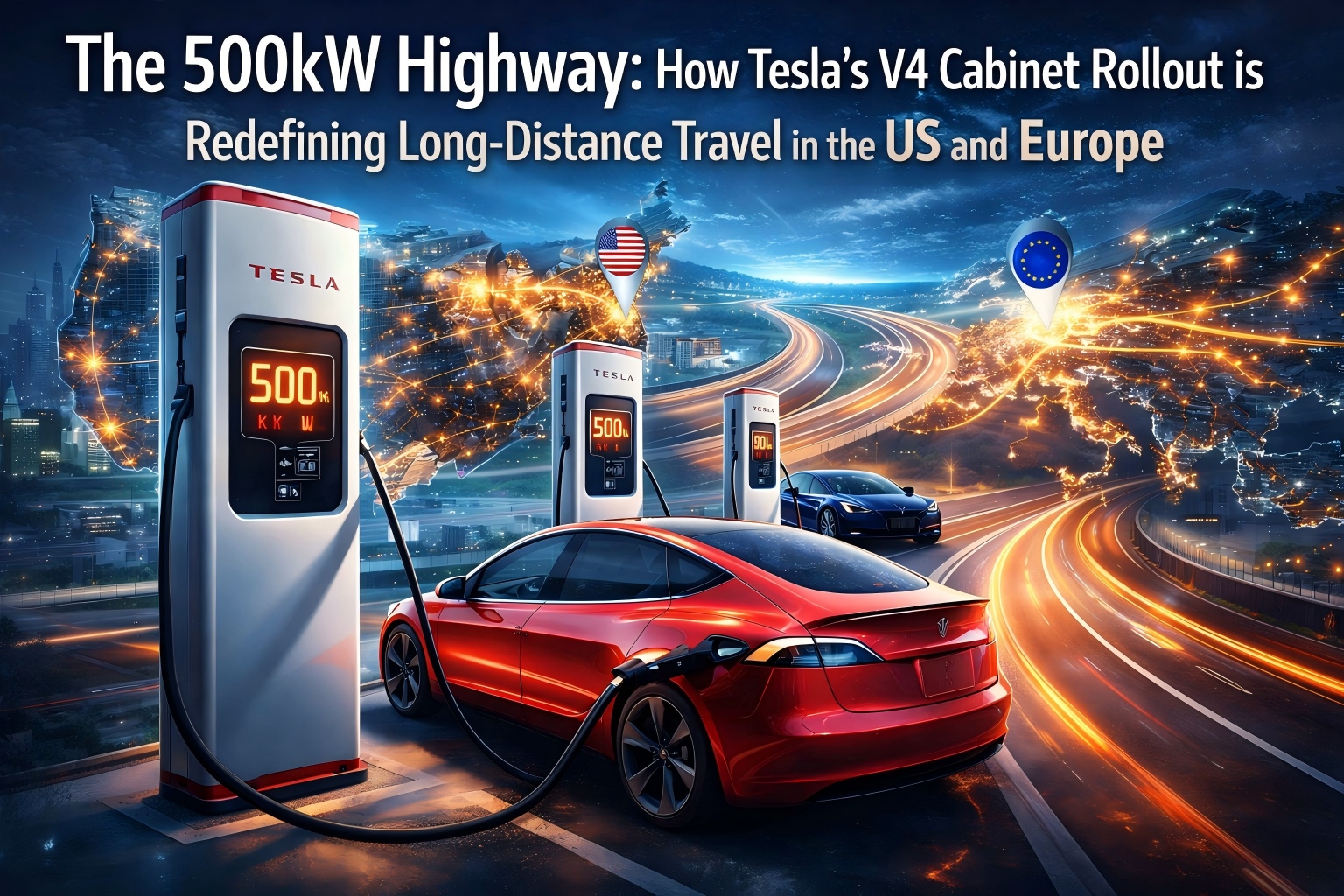
Part I: The V4 Cabinet—Anatomy of a 500kW System
1.1 Beyond the Stall: The Cabinet is the Key
A common misconception among owners is that the tall, sleek V4 stall is the source of the new speed. In reality, the stall is merely the "dispenser"—the user interface. The heart of the system is the V4 Power Cabinet. Throughout 2024 and most of 2025, many "V4" sites were actually hybrid deployments: V4 stalls connected to legacy V3 cabinets, limiting them to 250kW .
That changed in February 2026, when Tesla achieved scale production of the true V4 cabinet. According to engineering analysis from TESMAG, the V4 cabinet boasts three times the power density of its predecessor . It achieves this through a radical expansion of its voltage range. While V3 cabinets were capped at 500V DC, the V4 cabinet supports an input/output range of 180V to 1000V DC .
This 1000V ceiling is the technical breakthrough. It allows the cabinet to natively support the 800V architecture of the Cybertruck without the need for heavy, inefficient onboard converters. It also future-proofs the network for the next generation of Model S and X, which are widely expected to adopt higher voltage systems to reduce copper weight and improve thermal efficiency.
1.2 The 500kW Experience: What It Actually Feels Like
Reaching 500kW is not automatic. It requires a perfect storm of conditions: a vehicle capable of accepting that power (currently, the Cybertruck is the primary beneficiary), a low state of charge (typically below 10%), optimal battery temperature (managed by the vehicle's preconditioning system), and a V4 cabinet with sufficient spare capacity.
When these stars align, the result is transformative. On a true V4 cabinet, a Cybertruck can recover over 150 miles of range in approximately 10 minutes . This fundamentally alters the calculus of long-distance towing or heavy hauling. The stop becomes a "bathroom break" rather than a "meal break."
The magic behind this speed is the liquid-cooled cable. To push 615A of continuous current without melting the cable or making it too heavy to lift, Tesla uses an advanced immersive coolant that circulates through the cord, keeping it pliable and safe for users of all ages .
1.3 The 400V Fleet: Do Legacy Cars Benefit?
A crucial question for the vast majority of owners who do not own a Cybertruck is: "What's in it for me?" The answer is a resounding "yes," albeit indirectly.
If you own a 400V Model 3 or Model Y, your car will still peak at around 250kW. You will not charge faster at a V4 cabinet than you did at a V3 cabinet . However, you will experience a more reliable charge. The V4 cabinet's "Global Bus" logic dynamically allocates its massive 1.2MW total power across up to eight stalls . In a V3 setup, if you were paired with another car on the same cabinet, your speeds would be cut in half. With the V4's higher total throughput, the impact of sharing is significantly reduced. You are far less likely to experience "power sharing slowdowns," especially during peak travel hours .
Part II: North America—The NACS (J3400) Victory Lap
2.1 The End of the Adapter Era
In North America, the story of 2026 is the final consolidation of the charging standard. The "charging wars" are effectively over. As of the first quarter of 2026, every major automaker—from Ford and General Motors to Hyundai and Mercedes-Benz—has released at least one model with a native NACS (J3400) port .
This is a monumental shift. The V4 rollout coincides with the disappearance of the bulky CCS-to-NACS adapters that cluttered frunks in 2024 and 2025. Native integration means "Plug & Charge" works seamlessly for all brands. A Rivian R1T or Ford F-150 Lightning pulling up to a V4 stall now has the same one-click experience as a Tesla.
2.2 The "Wrong Side" Problem Solved
One of the most significant physical upgrades of the V4 stall is its 3-meter (10-foot) cable . For years, non-Tesla EVs struggled with Supercharger stalls designed for Teslas, where the charge port is typically on the driver's side rear. Many CCS cars have their ports on the front passenger side. The short V3 cables often forced drivers to park awkwardly, taking up two spots.
The V4's extended, more flexible cable, combined with its longer reach, finally allows any vehicle to park and charge normally. This is critical for maintaining order and throughput at busy travel plazas from California to New York.
2.3 Reliability as the Killer App
While competitors like Electrify America have struggled with uptime (often hovering in the low 90% range), Tesla maintains a 99.9% uptime across its network. Under the SAE J3400 standard, this reliability is now available to all EV owners. The simplicity of the NACS connector, which shares pins for AC and DC charging, results in a more robust handle less prone to mechanical failure . For the US market, the V4 cabinet is not just the fastest option; it is the most dependable.
Part III: Europe—The "Trojan Horse" Strategy
3.1 Supercharger for Business (SfB)
Tesla's strategy in Europe differs markedly from its approach in North America. While the US network is largely owned and operated by Tesla, Europe is seeing the rise of the "Supercharger for Business" (SfB) program .
Under SfB, Tesla acts as a hardware supplier and software provider. The company sells V4 cabinets and stalls to third-party hosts—shopping malls in France, hotel chains in Spain, logistics hubs in Italy. The business owner provides the land and the electrical connection, while Tesla provides the technology and the "Plug & Charge" ecosystem.
This is an "asset-light" expansion model. It allows Tesla to grow its footprint exponentially without bearing the full capital expenditure of land acquisition and grid connection. For European owners, this means more charging options in more convenient locations, accelerating the transition to electric mobility in dense urban environments.
3.2 The Megapack-Backed Supercharger
Grid capacity remains a significant hurdle in Europe, where aging infrastructure struggles to keep pace with the EV boom. Tesla has cleverly deployed its Energy division to solve this problem. In early 2026, Tesla began rolling out Megapack-backed Supercharger sites, most notably in Sweden and Germany.
These sites function as giant batteries. During off-peak hours (at night, when demand is low and energy is cheap), the Megapacks charge up from the grid. During peak travel times (Saturday afternoons), the Megapacks discharge at 500kW directly into the vehicles, bypassing the grid's limitations. This prevents the "brown-outs" and throttling that have plagued rival networks and ensures that V4 speeds are available on demand.
3.3 Preparing for the Semi: The Megacharger Network
The 1.2MW capacity of the V4 cabinet hints at a larger ambition: the Tesla Semi. While the Semi currently operates primarily in the US, Tesla is laying the groundwork for its European debut. In February 2026, the company posted a job opening for a Business Development lead for Commercial Charging in Munich, specifically mentioning "Megacharging" .
Megachargers are the Semi's equivalent of the Supercharger, delivering up to 1.2 megawatts of power . By deploying V4 cabinets with Megacharger capabilities now, Tesla is effectively building the backbone for a future where freight transport across the Autobahn and the UK's M25 is fully electric. The installation of these cabinets in logistics hubs near major ports like Rotterdam or Hamburg is the first step toward that reality .
Part IV: The User Experience—Planning the 2026 Road Trip
4.1 How to Find a "True" V4 Site
As of March 2026, not all V4 stalls are created equal. Many sites are still running on V3 cabinets. How do you find a "True V4" (500kW capable) site?
-
In-Car Navigation: The most reliable method is the Tesla navigation system. When you route to a Supercharger, the car predicts your charging curve. If it estimates a peak above 250kW, you are likely heading to a V4 cabinet site.
-
The Tesla App: In the coming weeks, Tesla is expected to update the "Find Us" map to differentiate between "V4 (250kW)" and "V4 (500kW)" sites, with the latter often being newer stations in Germany, Norway, and select US corridors like the I-10 in Texas and I-5 in California .
-
Physical Cues: Look for the new, taller V4 stalls with the integrated credit card reader on the side. If the station has large, Megapack-sized cabinets nearby, it is almost certainly a true V4 site.
4.2 The 15-Minute Rule and Trip Planning
With true V4 speeds, the optimal charging strategy shifts. The old adage of "charging to 80%" remains true, but the time to reach 80% has collapsed. For Cybertruck owners, a stop of 15-18 minutes is now sufficient to add the energy needed for 2-3 hours of highway driving. This "15-Minute Rule" aligns perfectly with human physiology—the time it takes to use a restroom, grab a coffee, and stretch your legs.
For owners of 400V cars, the strategy remains the same, but the peace of mind is higher. Knowing that the site has ample power reserves means you can arrive with a lower state of charge, confident that the V4 cabinet's power-sharing algorithm will get you back on the road quickly, even if the site is busy.
Part V: The Competitive Landscape—Tesla's Moat
5.1 The Profit Center
Tesla's charging network has evolved from a cost center (a necessity to sell cars) to a potential profit center. By opening the network to all EVs and monetizing the hardware through the SfB program, Tesla is turning its infrastructure into a revenue-generating asset. The 500kW speed is a premium product. In Europe, where charging is often priced per kWh, faster turnover means more revenue per stall per day.
5.2 The Standard is the Moat
The adoption of NACS as the SAE J3400 standard is perhaps the most enduring moat Tesla has built. Every new EV from a legacy automaker that rolls off the line with a NACS port is a validation of Tesla's engineering and a commitment to using its network. The V4 cabinet ensures that when those millions of new EVs hit the road over the next five years, the network they plug into will have the capacity and speed to handle them.
Conclusion
As of March 20, 2026, the age of 500kW charging is officially here. Tesla's V4 cabinet rollout is a masterstroke of engineering and strategic planning. In North America, it solidifies Tesla's dominance through the NACS standard and finally unlocks the true potential of the Cybertruck. In Europe, it demonstrates a flexible, intelligent approach to grid challenges through Megapack integration and a savvy "asset-light" expansion model.
For the Tesla owner, the future of road tripping has never looked brighter. The anxiety of waiting for a charge is rapidly being replaced by the simple logistics of a brief pause. The "Supercharger" is no longer just a charger; it is the gold standard of the electric highway, and with V4, it just raised the bar.
FAQ: V4 Charging and 500kW Speeds
Q: I have a 2025 Model Y Performance in the UK. Will I ever see 500kW?
A: No. Your Model Y operates on a 400V architecture and is limited by its internal electronics to approximately 250kW. However, you will benefit from faster site throughput and less charge sharing at busy V4 stations .
Q: I'm driving from Paris to Marseille. How do I ensure I only stop at V4 500kW sites?
A: Use the Tesla navigation system. Input your destination and look at the predicted charge times for each stop. If the nav predicts a very short stop (under 15 minutes for a Cybertruck, or a very flat curve for a Model 3), it is routing you to a V4. As of late March, Tesla is updating the mobile app to visually distinguish these sites.
Q: Is 500kW charging more expensive than 250kW charging?
A: Pricing is typically set by location and time of day, not by the speed of the cabinet. However, because you spend less time occupying the stall, your total cost for the session may be similar or slightly lower, as you pay for energy (kWh), not time (minutes) in most EU and US states.
Q: My local V4 station doesn't have credit card readers. Is it a fake V4?
A: To comply with EU regulations (AFIR), all new V4 stalls in Europe must have integrated credit card terminals. If your local station lacks them, it is likely an older V3.5 site (V3 cabinet, V4 stall). True V4 cabinets come with the reader built-in.
Q: Will the Semi charge at my local V4 station?
A: Probably not. While the V4 cabinet supports 1.2MW, the Semi requires a dedicated pull-through lane and even higher amperage connectors. The V4 stalls you use are for passenger vehicles. Megachargers for the Semi are being built at separate, dedicated truck stops and logistics hubs.