
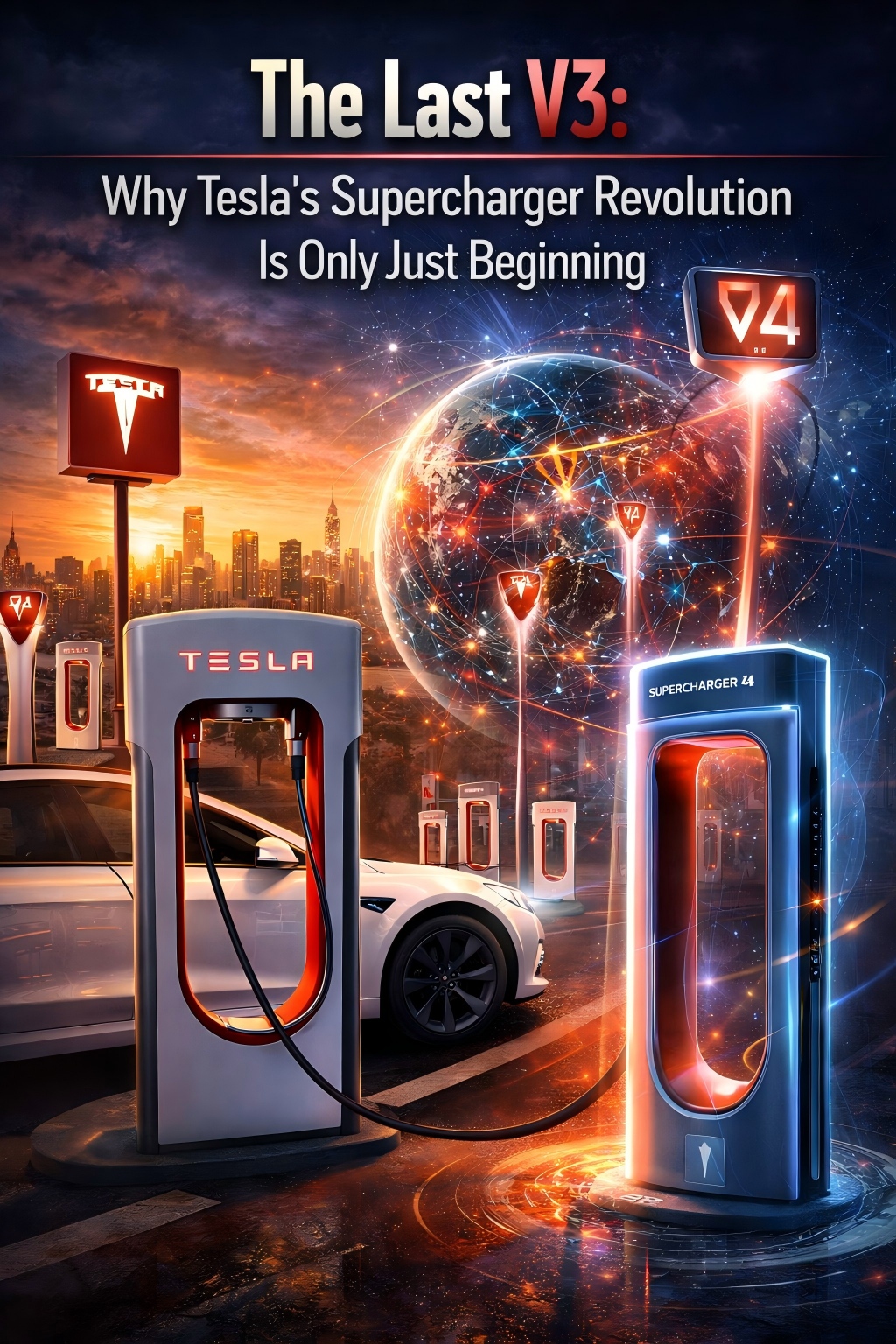
Introduction: A Milestone in New York
On March 16, 2026, a seemingly ordinary event occurred at Tesla's Gigafactory in Buffalo, New York. A production line, after seven years of continuous operation, assembled its last unit and fell silent. Workers gathered, perhaps for photos, perhaps for a quiet acknowledgment of the moment. Then, as planned, the line began retooling for what comes next .
The product that rolled off that line for the final time was the V3 Supercharger cabinet—the unsung hero of Tesla's charging revolution. Over seven years, Gigafactory New York produced more than 15,000 of these cabinets, each capable of powering multiple charging stalls . Together, they formed the backbone of the Supercharger network that made Tesla ownership viable for millions of drivers across North America, Europe, and beyond.
The V3 cabinet's retirement marks more than just a production milestone. It signals a fundamental shift in Tesla's charging strategy—a shift toward higher speeds, universal compatibility, and the kind of infrastructure that can support not just millions of passenger vehicles but also the Tesla Semi, the Cybertruck, and eventually the robotaxi fleets that Musk envisions.
For Tesla owners in the United States and Europe, the transition from V3 to V4 matters in ways that will become increasingly apparent over the coming months and years. Faster charging, better reliability, easier access for non-Tesla vehicles, and ultimately a more robust, more profitable network that can continue expanding indefinitely.
This is the story of that transition—of what V3 accomplished, what V4 makes possible, and what it means for the future of electric vehicle charging on both sides of the Atlantic.
Part 1: The V3 Legacy-Building the World's Best Network
The 250kW Revolution
When Tesla introduced the V3 Supercharger in 2019, it fundamentally changed expectations for electric vehicle charging. Prior to V3, Superchargers operated at 120kW or 150kW, requiring 30-40 minutes for a meaningful charge. V3's 250kW capability cut that time dramatically, enabling most Tesla vehicles to add approximately 200 miles of range in 15 minutes .
The engineering behind this achievement was substantial. V3 cabinets employed a new architecture that shared power more efficiently across stalls, reducing the impact of adjacent vehicles charging simultaneously. They introduced liquid-cooled cables that could handle higher currents without overheating. And they laid the groundwork for the "battery preconditioning" feature that allowed vehicles to arrive at Superchargers with batteries already warmed to optimal charging temperature .
Over seven years, the V3 network grew to encompass thousands of stations and tens of thousands of individual stalls. By early 2026, Tesla had deployed over 75,000 Supercharger connectors globally . The network became Tesla's single greatest competitive advantage—an asset so valuable that other automakers, including Ford, General Motors, Rivian, Polestar, and Lucid, lined up to secure access for their vehicles .
The 15,000-Cabinet Milestone
Each V3 cabinet produced at Gigafactory New York represented years of engineering refinement and manufacturing optimization. The 15,000-cabinet milestone means that Tesla deployed enough V3 hardware to support tens of thousands of individual charging stalls across dozens of countries .
The Buffalo factory's role in this achievement is often overlooked. Originally conceived as a solar panel manufacturing facility, Giga New York pivoted to Supercharger production as Tesla's priorities shifted. The factory became the exclusive source of V3 cabinets for global deployment, demonstrating the flexibility of Tesla's manufacturing approach and the company's willingness to repurpose assets as circumstances change.
What V3 Made Possible
Beyond the raw numbers, V3 enabled behaviors that Tesla owners now take for granted. Long-distance road trips became practical, with charging stops shorter than typical meal breaks. The network effect—more stations attracting more owners, more owners justifying more stations—accelerated deployment. And the reliability of V3 hardware established Superchargers as the gold standard against which all other charging networks are measured.
Tesla's decision to open the network to other automakers, beginning with Ford in early 2024, represented a strategic pivot that V3 infrastructure made possible . With 15,000 cabinets already deployed, Tesla had sufficient capacity to absorb additional demand without compromising the experience for its own customers. The longer cables of V4, which we'll discuss shortly, will make this integration even smoother .
Part 2: The V4 Architecture-A Complete Overhaul
Beyond Incremental Improvement
The transition from V3 to V4 isn't merely an incremental upgrade. It's a complete rethinking of Supercharger architecture, addressing limitations that became apparent as the network grew and vehicle technology evolved.
At its core, V4 represents a shift from a 400V-centric design to a system capable of supporting 800V and even 1000V vehicle architectures . This matters because Tesla's newest vehicles—the Cybertruck, the Semi, and eventually the next-generation Roadster—operate at higher voltages that enable faster charging and improved efficiency. Even the S3XY lineup, while remaining at 400V, benefits from V4's improved power electronics and higher peak capabilities.
The specifications tell the story. Where V3 cabinets delivered up to 250kW shared across four stalls, V4 cabinets can deliver up to 500kW for passenger vehicles and an astonishing 1.2 megawatts (1,200kW) for the Tesla Semi . Each V4 cabinet can power up to eight stalls—double the capacity of V3—while maintaining higher per-still performance .
The 1,000-Volt Future
The voltage leap from 400V to 1000V represents one of the most significant technical transitions in electric vehicle history. Higher voltages reduce current for the same power, which means thinner cables, lower resistive losses, and faster charging without excessive heat generation.
For Tesla owners, the practical implication is straightforward: V4-enabled vehicles will charge faster than ever before. The Cybertruck, with its 800V architecture, can already achieve charging speeds that approach the limits of V3 hardware. With V4, it will be able to charge at its maximum capability, potentially adding hundreds of miles of range in the time it takes to use the restroom and grab a coffee .
Future vehicles, including the next-generation Roadster and possibly the Model S and X successors, will likely adopt 800V or higher architectures. V4 ensures that the Supercharger network will be ready for them.
Power Density and Cost Efficiency
One of the most impressive aspects of V4 is its power density. Tesla claims the new power electronics deliver three times the power density of previous hardware . This means more charging capability in a smaller footprint, which translates directly to lower installation costs and faster network expansion.
The cost numbers are striking. Tesla states that V4 installations come in at under $40,000 per stall . That's remarkably cheap for high-speed DC fast charging infrastructure, which typically costs $100,000 or more per stall when deployed by other networks. Tesla achieves this cost advantage through vertical integration, high-volume manufacturing, and the simplified architecture of the V4 system.
Lower costs mean faster expansion. Every dollar saved on hardware and installation can be reinvested in additional stations. With V4's improved economics, Tesla can accelerate the already rapid growth of the Supercharger network, bringing convenient high-speed charging to even more locations.
Part 3: The Cable That Changes Everything
The Three-Foot Difference
Among the most visible changes in V4 installations is the charging cable itself. Where V3 cables were designed specifically for Tesla vehicles—with charge ports located in consistent positions on the driver's side rear—V4 cables are approximately three feet longer .
This seemingly minor change has profound implications. The longer cable reaches charging ports in different locations—front corners, passenger sides, rear bumpers—accommodating the wide variety of EV designs now entering the market. A Ford Mustang Mach-E with its front fender port can charge without awkward maneuvering. A Rivian R1T with its front bumper port can pull in normally rather than blocking multiple stalls. A Lucid Air with its front fender port can reach without stretching the cable to its limits .
For Tesla owners, the longer cable offers unexpected benefits. Vehicles towing trailers, which previously required blocking multiple stalls to accommodate the trailer length, can now maneuver more easily and connect without obstruction. Drivers who prefer to back in at an angle—common in Europe where parking configurations vary—have more flexibility. And as stations become busier with mixed fleets of vehicles, the ability to accommodate different parking preferences reduces congestion and conflict.
The V3.5 Interlude
Tesla's transition to V4 hasn't been instantaneous. Over the past year, many new Supercharger installations have featured a hybrid configuration that Tesla refers to internally as "V3.5" . These sites pair the newer V4 stalls (with their longer cables) with older V3 cabinets (still limited to 325kW peak output) .
The V3.5 approach allowed Tesla to begin deploying the more accessible V4 stalls before the V4 cabinets were ready for volume production. It's a pragmatic compromise that improves the user experience for non-Tesla EVs while maintaining compatibility with the existing cabinet infrastructure.
With V3 production now ended and V4 cabinet production ramping, the V3.5 era will gradually give way to full V4 installations. These true V4 sites, with both the cabinets and stalls upgraded, will unlock the full 500kW potential of the new architecture .
Universal Design Philosophy
The longer cable reflects a broader philosophical shift at Tesla. The Supercharger network was once a Tesla-exclusive advantage, designed specifically for Tesla vehicles. Today, it's becoming a public utility—open to all compatible EVs and designed with their needs in mind.
This shift is evident in other V4 features as well. Some V4 locations now include centralized payment kiosks, allowing non-Tesla drivers to pay without using the Tesla app . The stalls themselves feature ergonomic, easy-grip handles that accommodate gloved hands in cold weather. And the cabling is designed to remain flexible even at low temperatures, reducing the wrestling match that sometimes accompanies cold-weather charging .
For Tesla owners, this universal design doesn't diminish the experience—it enhances it. A network that works well for everyone works well for Tesla owners too. And by attracting more users, the network generates more revenue, funding faster expansion and better maintenance.
Part 4: The Network Effect 2.0
75,000 Connectors and Counting
As of March 2026, Tesla has deployed over 75,000 Supercharger connectors globally . That's more than any other fast-charging network by a substantial margin, and the gap is growing as Tesla accelerates its deployment pace.
The V4 transition will only accelerate this growth. With lower per-stall costs and simplified installation, Tesla can deploy more stalls for the same capital investment. The eight-stall-per-cabinet architecture doubles the density of previous installations, meaning new sites can serve more vehicles without requiring additional cabinet infrastructure .
For owners, this means shorter waits, more convenient locations, and greater confidence in long-distance travel. The Supercharger network already covers most major travel corridors in North America and Europe. With V4-enabled expansion, it will fill in the gaps, reaching secondary routes and less-traveled destinations.
The Partner Onboarding
Tesla's decision to open the Supercharger network to other automakers has transformed the competitive landscape of EV charging. Ford was first, gaining access in early 2024. General Motors, Rivian, Polestar, and Lucid have since followed, with more automakers expected to join .
For these partners, Supercharger access solves the single biggest obstacle to EV adoption: charging anxiety. Their customers can now use the network that Tesla owners have enjoyed for years, with the same reliability, convenience, and coverage.
For Tesla, the benefits are equally substantial. Each non-Tesla vehicle charging at a Supercharger generates revenue that helps fund network expansion. The increased utilization improves the economics of each station, making it viable to build in locations that might not justify a Tesla-only site. And the growing ecosystem of compatible vehicles creates lock-in—once a non-Tesla owner gets used to Supercharger convenience, they're less likely to switch to a brand that can't offer the same experience.
The European Dimension
For European Tesla owners, the network story is particularly encouraging. Europe's charging landscape has historically been fragmented, with multiple networks using different connectors, payment systems, and reliability standards. Superchargers have always been the exception—a unified network with consistent performance and seamless user experience.
The V4 transition will enhance this advantage. European Supercharger sites will feature the same longer cables, higher speeds, and improved reliability as their American counterparts. And as more non-Tesla EVs gain access, the network will become even more valuable, creating a virtuous cycle of utilization and expansion .
Recent developments in European regulation also favor Tesla's approach. The EU's mutual recognition mechanism means that FSD approval in the Netherlands, potentially coming as soon as March 20, 2026, could accelerate the deployment of advanced driver assistance features across the continent . While not directly related to charging, this regulatory progress reflects a broader European openness to Tesla's technology—an openness that extends to Supercharger deployment.
Part 5: The Technology Deep Dive
Cabinet Architecture
The V4 cabinet represents a complete redesign of Supercharger power electronics. Where V3 cabinets used discrete components optimized for 400V operation, V4 employs an integrated architecture designed from the ground up for voltage flexibility .
At the heart of the V4 cabinet are advanced power modules that can handle up to 1,000V while maintaining high efficiency. These modules incorporate silicon carbide (SiC) semiconductors, which offer lower switching losses and higher temperature tolerance than traditional silicon devices. The result is a cabinet that can deliver more power in a smaller footprint, with less energy lost as heat .
The cabinet's control system is equally advanced. Embedded processors monitor each stall's power demand in real time, dynamically allocating capacity based on vehicle needs, battery state of charge, and thermal conditions. This intelligence enables the cabinet to maximize throughput while protecting both the infrastructure and the vehicles being charged.
Stall Design and User Experience
The V4 stalls themselves incorporate lessons learned from millions of charging sessions. The cable management system reduces strain on both the cable and the user, with a lighter, more flexible cable that remains manageable even in cold weather .
The user interface has been streamlined, with a larger display, simplified payment options, and improved visibility in bright sunlight. For non-Tesla vehicles, the longer cable and intuitive handle design reduce the learning curve, making the charging experience as seamless as possible .
Thermal management has also been improved. The liquid-cooled cables can handle sustained high-power charging without overheating, while the stall's internal cooling system ensures reliable operation in extreme temperatures. This matters for European owners who charge in varied climates, from Scandinavian winters to Mediterranean summers.
Semi and Megacharger Compatibility
Perhaps the most forward-looking aspect of V4 is its compatibility with the Tesla Semi. The 1.2MW capability of V4 cabinets—achieved by pairing multiple cabinets—enables charging at the speeds required for commercial trucking .
The Semi's 1,000V architecture and massive battery pack require charging power far beyond what passenger vehicles need. With V4, Tesla can deploy the same cabinet infrastructure for both passenger and commercial charging, simplifying logistics and reducing costs. A station serving passenger vehicles can add capacity for Semi charging as demand warrants, without requiring entirely new infrastructure.
This dual-use capability positions Tesla to dominate commercial charging as the electric truck market develops. European freight corridors, with their dense traffic and strict emissions regulations, represent a particularly attractive opportunity. If Tesla can deploy V4-based charging along major European routes, the Semi could gain the same network advantage that the Model S enjoyed a decade ago.
Part 6: What V4 Means for European Owners
The Approval Timeline
For European Tesla owners, the V4 transition coincides with another significant development: the potential approval of FSD (Supervised) in the Netherlands on March 20, 2026 . While seemingly unrelated, these developments share a common thread: Tesla's commitment to the European market and its confidence in the region's regulatory evolution.
The Dutch approval, if granted, would mark the first time Tesla's latest FSD software has been certified for use in Europe. Leveraging EU mutual recognition, this approval could quickly extend to other member states, opening the continent to Tesla's most advanced driver assistance features .
V4 Superchargers will serve the vehicles that benefit from these approvals. As European owners gain access to more capable FSD, they'll likely drive more—taking longer trips, exploring new destinations, and relying more heavily on the Supercharger network. V4's faster speeds and improved reliability will make those trips more enjoyable and less stressful.
Giga Berlin's Role
Tesla's European manufacturing hub at Giga Berlin will play an increasingly important role in the V4 story. While the cabinets themselves are produced at Giga New York, the stalls deployed in Europe are assembled and distributed locally. Berlin's growing capabilities—including potential future production of Optimus robots and Tesla Semis—will create additional demand for Supercharger infrastructure .
Musk has suggested that Giga Berlin could become "the largest factory complex in Europe" . If that vision materializes, the surrounding region will need extensive charging infrastructure to serve employees, visitors, and the vehicles produced on-site. V4 Superchargers, with their lower cost and higher capacity, will be essential to meeting that demand.
The Cross-Border Experience
European travel presents unique charging challenges. Borders, varying regulations, and different utility grids all complicate the charging experience. V4's universal design—the same hardware, same user interface, same reliability regardless of location—simplifies cross-border travel.
A Tesla owner driving from Paris to Berlin can expect the same charging experience in France, Germany, and anywhere in between. The longer cables accommodate whatever vehicle they're driving. The payment system works seamlessly across borders. The reliability that characterizes the Supercharger network extends to every V4 installation, regardless of country.
This consistency matters enormously for European owners. In a region where national boundaries are easily crossed but infrastructure often varies dramatically, Superchargers provide a reliable constant. V4 enhances that constant, making it even more valuable.
Conclusion: The Network That Keeps Getting Better
The retirement of the V3 Supercharger cabinet marks the end of an era—but more importantly, it marks the beginning of a new one. V4 represents not just incremental improvement but a fundamental reimagining of what Supercharger infrastructure can be: faster, more efficient, more universal, and more economical.
For Tesla owners, the benefits will accumulate over time. Initially, the transition will be gradual—V4 sites appearing alongside V3 and V3.5 installations, with the full capabilities unlocking as the new cabinets become standard. Over months and years, the network will evolve, with older hardware gradually replaced and new sites built to V4 specifications.
The result will be a Supercharger network that remains Tesla's greatest competitive advantage—even as it becomes more open, more universal, and more accessible to non-Tesla vehicles. The network that helped make Tesla the dominant force in electric vehicles will continue to evolve, ensuring that Tesla owners always have access to the best charging experience available.
The last V3 cabinet has been built. The first V4 cabinets are already rolling off the line . The future of charging is here, and it's faster, more capable, and more universal than anything that came before.
Frequently Asked Questions
Q: When will I start seeing true V4 Superchargers (with both the new cabinet and new stalls)?
A: Fully deployed V4 installations are already appearing, and the pace will accelerate now that V3 production has ended. Most new sites opened in late 2026 and beyond will be true V4 installations, though some may still use V3.5 configurations as inventory is depleted .
Q: Can my current Tesla charge faster at a V4 cabinet?
A: It depends on your vehicle's maximum charge rate. The Cybertruck, with its 800V architecture, can take advantage of V4's higher speeds. Other Tesla models will charge at their existing maximum rates, though they'll benefit from V4's improved reliability and the longer cable's flexibility .
Q: Will V4 Superchargers work with non-Tesla vehicles?
A: Yes, that's a primary design goal. The longer cable and universal payment options are specifically designed to accommodate vehicles from Ford, GM, Rivian, and other automakers who have joined the NACS alliance .
Q: What happened to the old V3 cabinets?
A: Existing V3 cabinets will continue operating for years. Tesla maintains its network rigorously, and V3 hardware has proven reliable. The end of production applies only to new cabinets, not to existing installations .
Q: How much does a V4 Supercharger cost to build?
A: Tesla claims V4 installations cost under $40,000 per stall, making them the most cost-effective Superchargers yet. This low cost enables faster network expansion and more sites in marginal locations .
Q: Will European Superchargers get the same V4 treatment as American ones?
A: Yes. The V4 transition is global. European sites will feature the same hardware, same longer cables, and same improved capabilities as their American counterparts .
Q: What about the Tesla Semi? Can it charge at V4 stations?
A: V4 cabinets can support Semi charging at up to 1.2MW when multiple cabinets are paired. Dedicated Semi charging locations will use V4 technology scaled appropriately .
Q: How does V4 affect the "open network" strategy with other automakers?
A: V4's longer cables and universal design make it easier for non-Tesla vehicles to use Superchargers, accelerating the transition to an open network. This benefits Tesla through increased utilization and revenue, which funds further expansion.