
Introduction
Tesla’s Supercharging network has transitioned from a proprietary customer perk into the recognized standard for DC fast charging across North America and Europe. As major legacy automakers adopt the North American Charging Standard (NACS) and global regulatory bodies enact stringent infrastructure guidelines, the deployment of Tesla's next-generation V4 Supercharging hardware marks a pivotal evolution in charging speed, grid integration, and payment accessibility.
Engineering Capabilities of V4 Superchargers
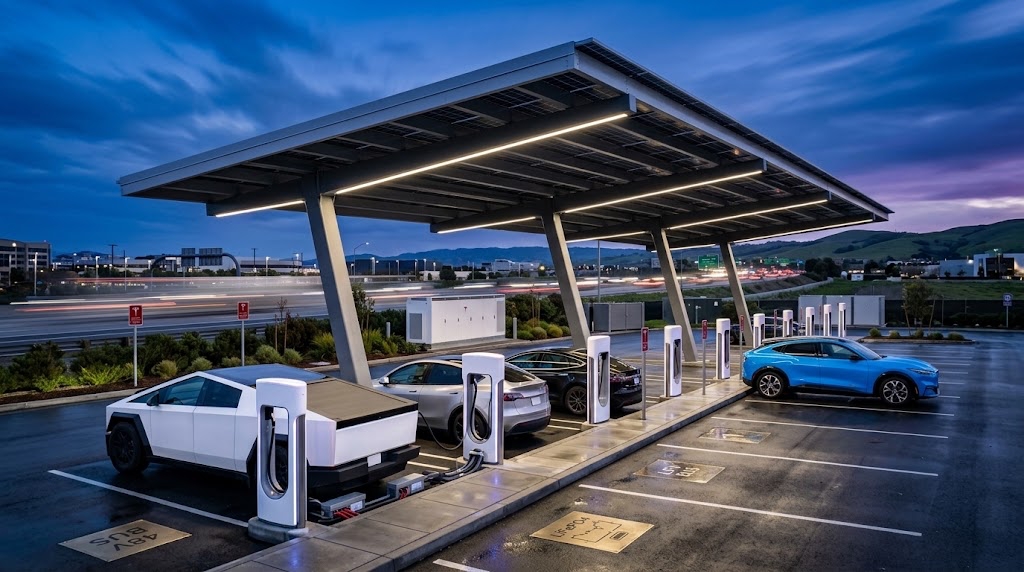
The complete V4 Supercharger system pairs all-new dispensers with 1.2 MW utility power cabinets capable of delivering up to 500 kW peak output per stall.
-
Native 800V Support: While legacy Model 3 and Model Y vehicles utilize a 400V architecture, modern platforms like the Cybertruck and diverse third-party EVs operate on high-voltage 800V to 1000V packs. V4 cabinets supply high-voltage charging natively, eliminating thermal throttling and drastically reducing charging times for high-voltage vehicles.
-
Physical Ergonomics & Extended Cables: V4 dispensers feature significantly longer, liquid-cooled charging cables mounted on elevated booms. This design resolves port-reach issues for third-party vehicles with charging doors located on front fenders or opposite corners, eliminating the need to take up multiple parking spaces.
-
On-Site Energy Storage Integration: V4 hubs are increasingly co-located with utility-scale Tesla Megapacks. These stationary battery systems buffer the local electrical grid during high-demand travel periods, stabilizing grid load and protecting operators from peak utility demand charges.
Policy Frameworks: US NEVI Reboot vs. European AFIR Mandates
Federal and supranational regulations are transforming how public charging stations operate across both continents:
-
United States (NEVI Reboot): The updated National Electric Vehicle Infrastructure (NEVI) guidelines have streamlined permitting and relaxed the rigid 50-mile spacing mandate in favor of state-directed corridor optimization. This acceleration ensures broader availability of NACS-native high-power charging corridors across secondary highways and rural routes.
-
European Union (AFIR Compliance): The Alternative Fuels Infrastructure Regulation (AFIR) mandates full pricing transparency and ad-hoc accessibility. Every newly installed V4 stall in the EU includes physical contactless EMV credit card terminals and explicit per-kWh pricing displays, removing the obligation for non-Tesla drivers to install the mobile app or register an account prior to initiating a session.
Best Practices for Road Tripping in 2026
With non-Tesla EV volume expanding across the Supercharging network, owners should refine their road-trip strategies:
-
Preconditioning Optimization: Always use the in-car navigation to route to Superchargers. This initiates automatic thermal conditioning of the battery pack, ensuring maximum charge acceptance upon arrival.
-
Observe 80% Taper Curves: Fast-charging speeds taper sharply above 80% state-of-charge (SOC). To minimize travel times, depart once the vehicle has sufficient range to reach the next station with a 10–15% buffer.
-
Leverage Aggregation Apps: In addition to the native Tesla trip planner, third-party apps provide real-time visibility into NEVI-funded corridor stations and dynamic pricing schedules.
Conclusion
The rapid rollout of V4 Supercharging hardware, combined with regulatory maturation in the US and Europe, cements Tesla’s position as the gold standard in electric transit. For owners, these developments guarantee higher station reliability, expanded high-voltage charging speeds, and a frictionless cross-country travel experience.
Frequently Asked Questions (FAQ)
Q: Does charging a non-Tesla EV at a Supercharger slow down adjacent stalls?
A: On legacy V2 Superchargers (150 kW), power was shared in pairs (1A/1B). On V3 and V4 Superchargers, power is dynamically distributed from a centralized DC bus, meaning adjacent vehicles do not cut each other's charge speeds in half.
Q: Are 400V Teslas (Model 3, Model Y) able to charge at 500 kW on V4 stalls?
A: No. The peak charging rate of 400V vehicles is limited by their battery pack voltage and thermal dissipation limits (typically capping at 250 kW). 500 kW speeds are utilized by vehicles with 800V architectures, such as the Cybertruck.
Q: What happens if a V4 card reader is damaged in Europe?
A: Under AFIR requirements, stations maintain redundant payment methods. If an integrated credit card reader fails, users can initiate and pay for charging sessions via the Tesla mobile app or authorized roaming RFID networks.