
Introduction
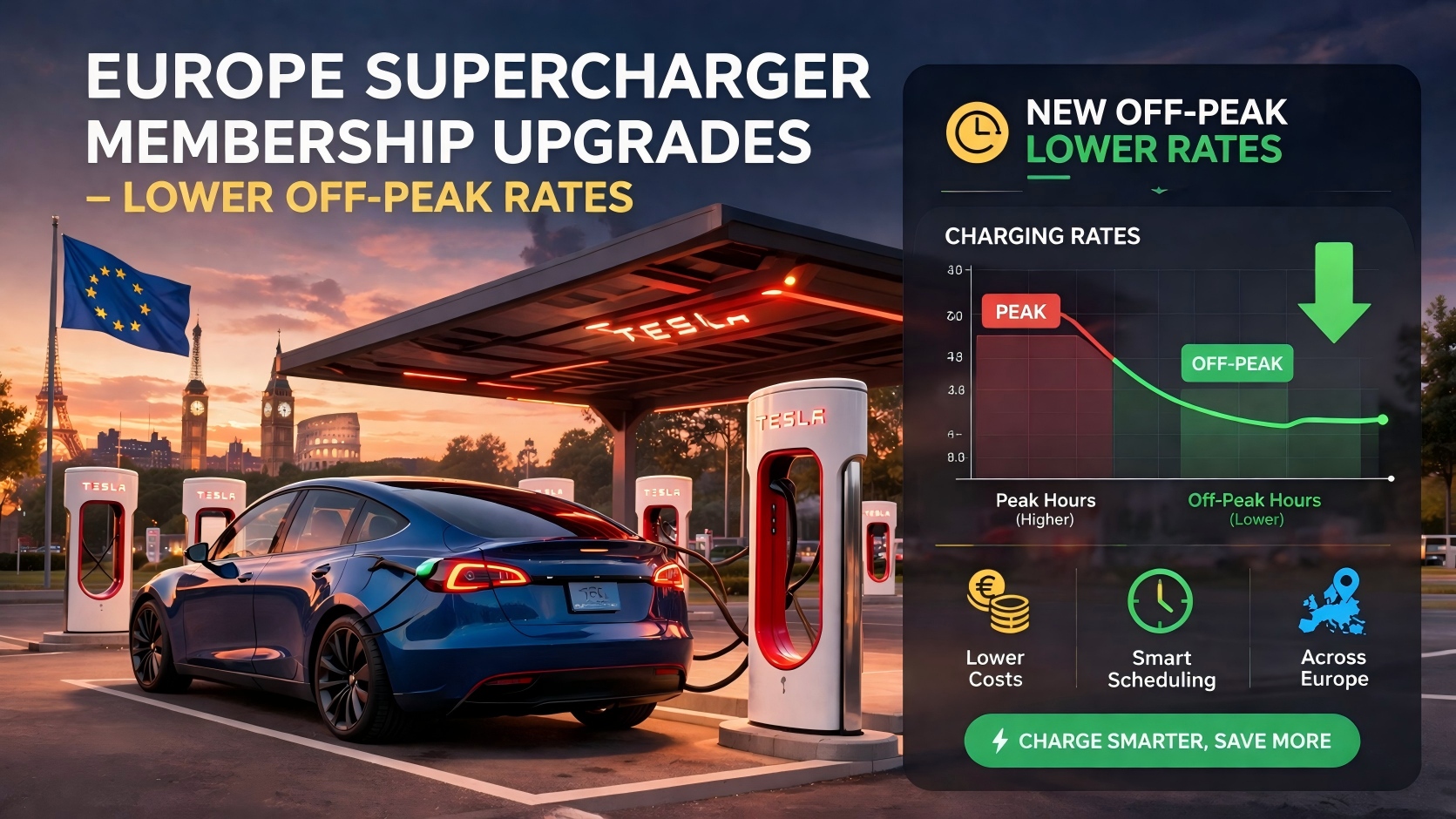
In April 2026, Tesla quietly rolled out one of the most significant updates to its European Supercharger pricing structure in years. For owners across Germany, France, the Netherlands, Sweden, Norway, and Denmark, the changes are immediately visible at the pump: off-peak rates have dropped by as much as 40%, while a revamped membership program offers even deeper discounts for frequent travelers.
But these changes come with a catch. Peak-hour rates have increased slightly, non-Tesla access has expanded (creating more competition for stalls), and the pricing structure has become more complex than the simple “plug and pay” model that early adopters enjoyed.
Chapter 1: What Changed in April 2026
1.1 The New Pricing Tiers
As of April 2026, Tesla has implemented a three-tier pricing structure across its European Supercharger network in Germany, France, the Netherlands, Sweden, Norway, and Denmark. Other European markets are expected to follow in May and June 2026.
Tier 1: Non-Tesla / Guest Users
-
Peak hours: €0.55–0.75/kWh (up from previous averages)
-
Off-peak hours: €0.40–0.50/kWh
-
No membership options available
-
Priority access: Lowest
Tier 2: Free Tesla Account Holders (Default for all Tesla owners)
-
Peak hours: €0.45–0.60/kWh
-
Off-peak hours: €0.30–0.40/kWh
-
No monthly fee — simply having a Tesla account qualifies you
-
This is the baseline for all Tesla owners who do not subscribe to the paid membership
Tier 3: Paid Membership (€9.99/month)
-
Peak hours: €0.35–0.45/kWh
-
Off-peak hours: €0.20–0.28/kWh
-
Includes priority access during congestion
-
Available to both Tesla and non-Tesla EV owners
1.2 Off-Peak Hours Defined
The off-peak definition varies by country and sometimes by specific station, but the general framework is:
-
Weekdays: 22:00 (10 PM) to 06:00 (6 AM)
-
Weekends: All day Saturday and Sunday (from 00:00 Saturday to 06:00 Monday)
-
Public holidays: Treated as weekends
The weekend provision is particularly significant for road trippers. If you‘re driving from Berlin to Paris on a Saturday, you’ll pay off-peak rates regardless of the time of day — potentially saving 30-40% on charging costs for the entire journey.
1.3 Geographic Rollout
The new pricing structure is currently active in:
-
Germany (all Supercharger locations)
-
France (all Supercharger locations)
-
Netherlands (all Supercharger locations)
-
Sweden (all Supercharger locations)
-
Norway (all Supercharger locations)
-
Denmark (all Supercharger locations)
Other European countries — including Switzerland, Austria, Belgium, Italy, and Spain — are expected to transition to the new pricing model in May and June 2026. The UK rollout timeline has not been announced but is expected later in 2026.
Chapter 2: Cost Analysis — How Much Can You Actually Save?
2.1 Per-Session Savings: Real Numbers
To understand the financial impact, let‘s look at a typical charging session for a Model Y Long Range, which has an 82 kWh battery. Charging from 10% to 80% requires approximately 57 kWh of energy.
Scenario A: Non-Tesla driver (guest access)
-
Peak rate (€0.65/kWh average): €37.05 per session
-
Off-peak rate (€0.45/kWh average): €25.65 per session
-
Savings: €11.40 when charging off-peak
Scenario B: Free Tesla account holder (default for owners)
-
Peak rate (€0.52/kWh average): €29.64 per session
-
Off-peak rate (€0.35/kWh average): €19.95 per session
-
Savings: €9.69 when charging off-peak
Scenario C: Paid member (€9.99/month)
-
Peak rate (€0.40/kWh average): €22.80 per session
-
Off-peak rate (€0.24/kWh average): €13.68 per session
-
Savings vs. free account off-peak: €6.27 per session
The numbers tell a clear story: a paid member charging off-peak pays approximately €13.68 for a session that would cost a non-Tesla driver €37.05 — a saving of over 60%.
2.2 Break-Even Analysis for the €9.99 Monthly Membership
The paid membership costs €9.99 per month. When does it pay for itself?
Compare free account (baseline) vs. paid membership:
| Monthly charging volume (kWh) | Savings per kWh (peak) | Savings per kWh (off-peak) | Monthly saving | Net after €9.99 |
|---|---|---|---|---|
| 100 kWh (mostly off-peak) | N/A | €0.11 | €11.00 | +€1.01 |
| 150 kWh (mixed) | ~€0.10 | ~€0.11 | €15.50 | +€5.51 |
| 200 kWh (mostly peak) | ~€0.15 | N/A | €30.00 | +€20.01 |
| 300 kWh (road trip month) | ~€0.15 | ~€0.11 | €38.00 | +€28.01 |
The break-even point is approximately 100 kWh per month, which translates to roughly two full charging sessions (10% to 80%) per month. If you Supercharge twice a month or more, the membership pays for itself.
Practical examples:
-
Daily commuter who charges at home: The membership is probably not worth it. You may only Supercharge once a month on long trips.
-
Weekly road tripper: The membership will almost certainly save you money.
-
Apartment dweller without home charging: If you rely entirely on Supercharging for all your energy needs, the membership is essential.
2.3 Comparison with European Competitors
To evaluate whether Tesla’s new pricing is competitive, we must compare it with the major European fast-charging networks.
Ionity (Europe’s largest open HPC network):
-
Ionity Go (pay-as-you-go): from 77p/kWh (approximately €0.90/kWh)
-
Ionity Motion 365 (£45.99/year): 58p/kWh (approximately €0.68/kWh)
-
Ionity Power 365 (£86.99/year): 46p/kWh (approximately €0.54/kWh)
Fastned:
-
Standard rate: approximately €0.59-0.69/kWh
-
Gold membership (€12/month): €0.35/kWh
Other networks (EnBW, Allego, Shell Recharge):
-
Rates typically range from €0.39-0.79/kWh depending on membership status
Tesla paid member off-peak: €0.20-0.28/kWh
The comparison is stark. Tesla’s paid member off-peak rate is roughly half the price of Fastned’s gold membership and less than a third of Ionity’s pay-as-you-go rate. Even Tesla’s free account off-peak rate (€0.30-0.40/kWh) is competitive with or cheaper than most competitor membership rates.
2.4 Country-by-Country Variation
It is important to note that pricing varies significantly by country. According to recent data, Supercharger rates in Europe range from approximately €0.23/kWh in Turkey to €0.80/kWh during peak hours in Switzerland.
The new pricing tiers are averages. In high-cost countries (Switzerland, Germany, UK), rates will trend toward the higher end of each tier. In lower-cost countries (Norway, Sweden, parts of Eastern Europe), rates will trend lower.
Always check the Tesla app for the exact rate at your intended charging location before plugging in.
Chapter 3: Non-Tesla Access Expansion — Friend or Foe?
3.1 The New Reality: Sharing the Network
Tesla has been progressively opening its Supercharger network to non-Tesla EVs across Europe since 2022. As of April 2026, the majority of Supercharger locations in Europe are now “open to all,” with only the busiest urban sites remaining Tesla-only.
For Tesla owners, this expansion cuts both ways.
Pros of non-Tesla access:
-
Increased utilization leads to more investment in network expansion
-
Tesla earns revenue from non-Tesla drivers, subsidizing network maintenance
-
Government incentives and regulatory goodwill (important for European market access)
Cons of non-Tesla access:
-
More competition for stalls during peak hours
-
Non-Tesla drivers often park inefficiently (different charge port locations)
-
Potential for longer wait times at popular locations
3.2 How Tesla Prioritizes Its Own Owners
Tesla has implemented several mechanisms to protect its own owners from excessive congestion:
Priority access: During busy periods, Tesla vehicles receive priority in queue management. The software automatically prioritizes Tesla vehicles over non-Tesla EVs when stalls are limited.
Congestion fees: When sites are busy, Tesla applies congestion fees (approximately €0.50 per minute in most European countries) that accrue when charging is complete or at a high state of charge, encouraging drivers to move on quickly.
Higher non-Tesla pricing: As shown above, non-Tesla drivers pay significantly more per kWh — typically €0.55-0.75/kWh compared to €0.30-0.45/kWh for Tesla account holders. This pricing differential naturally discourages non-Tesla use unless necessary.
3.3 The European Regulatory Context
The expansion of non-Tesla access is not purely voluntary. The European Union’s Alternative Fuels Infrastructure Regulation (AFIR), which entered full force in 2026, requires that all publicly funded charging infrastructure be open and interoperable. While Tesla’s network was largely privately funded, the regulatory pressure to open access has been significant.
For Tesla owners, AFIR also brings benefits: improved pricing transparency, standardized payment methods (including Plug & Charge), and more reliable uptime requirements across all public charging networks.
Chapter 4: Smart Charging Strategies for European Owners
4.1 Should You Subscribe to the Paid Membership?
The decision depends entirely on your charging habits. Use this decision matrix:
Subscribe if:
-
You Supercharge more than twice per month (approximately 100+ kWh monthly)
-
You frequently take long road trips on weekends (weekend off-peak all day)
-
You have no home charging and rely on Supercharging as your primary energy source
-
You live in a high-cost country (Switzerland, Germany, UK) where savings are larger in absolute terms
Do NOT subscribe if:
-
You charge at home 90%+ of the time and only Supercharge once a month or less
-
Your annual road trip mileage is under 5,000 km
-
You live near low-cost Superchargers where the differential is smaller
-
You can reliably charge only during off-peak hours using the free account
Consider subscribing on a monthly basis: The membership has no long-term commitment. If you‘re planning a month with heavy travel (summer vacation, holiday season), subscribe for that month only and cancel afterward.
4.2 Maximizing Savings Without the Membership
Even without the paid membership, the free Tesla account offers substantial savings over non-Tesla rates. To maximize those savings:
Charge on weekends whenever possible. Weekend off-peak rates apply all day Saturday and Sunday, making weekend travel significantly cheaper than weekday travel.
Night-charge on road trips. If you’re staying overnight at a hotel, check if there‘s a Supercharger nearby. Charging at 11 PM on a weeknight could save you 30-40% compared to charging at 3 PM.
Plan your charging stops using the in-car navigation. Tesla’s navigation system shows real-time pricing at Supercharger locations. Urban stations are often priced lower than high-traffic interstate stops.
Combine with home charging. The cheapest way to charge remains at home. European residential electricity rates typically range from €0.15-0.30/kWh — cheaper than any Supercharger tier. If you have home charging, use Superchargers only for the portion of your journey that exceeds your home range.
4.3 The Home Charging Advantage
No discussion of Supercharger economics is complete without acknowledging that home charging is always cheaper. In most European countries, residential electricity rates for overnight charging (using time-of-use tariffs) can be as low as €0.12-0.20/kWh — less than half the cost of even the cheapest Supercharger off-peak member rate.
The Tesla Wall Connector delivers up to 44 miles of range per hour at home, meaning a full overnight charge costs approximately €10-15 for a Model Y Long Range — compared to €25-35 for a Supercharger session.
If you own your home and can install a Level 2 charger, that remains the most cost-effective charging strategy by a significant margin. Supercharging is for road trips — not daily commuting.
Chapter 5: The Future of Supercharging in Europe
5.1 Tesla’s Network Expansion in 2026
Tesla’s Supercharger network continues to expand at a remarkable pace. By the end of 2025, Tesla operated approximately 8,182 DC fast-charging stations and over 77,682 charging connectors worldwide, up roughly 17-19% in a single year.
In Europe specifically, the network has grown to cover virtually every major highway corridor. The focus for 2026 is on:
-
Urban densification: More chargers in city centers and apartment-heavy areas
-
Inter-corridor connections: Eliminating remaining gaps in Eastern and Southern Europe
-
V4 Supercharger rollout: Next-generation chargers capable of up to 350 kW (though most European sites already feature V3 chargers at 250 kW)
5.2 Potential Pricing Trends
Will Supercharger prices go up or down in the coming years?
In the short term, the new off-peak discounts are likely here to stay — Tesla is using pricing to manage demand and shift charging behavior to off-peak hours. Peak-hour rates may continue to rise modestly as congestion increases.
In the long term, as competition from Ionity, Fastned, and other networks intensifies, and as government regulations push for pricing transparency and fairness, Tesla will need to maintain competitive rates to retain owner loyalty.
For now, European Tesla owners have access to the cheapest fast-charging network on the continent — and with the new membership and off-peak rates, it just got significantly cheaper.
Conclusion
Tesla‘s April 2026 Supercharger pricing overhaul in Europe represents a genuine win for owners. Off-peak rates as low as €0.20/kWh for members make Supercharging more affordable than ever, while weekend all-day off-peak pricing is a game-changer for road trippers.
The €9.99 monthly membership pays for itself after approximately 100 kWh of charging — roughly two full sessions per month. For frequent travelers and those without home charging, it’s a no-brainer. For occasional users, the free Tesla account still offers competitive rates that undercut almost every competitor.
The expansion of non-Tesla access is a double-edged sword — more competition for stalls, but also more revenue for network expansion and regulatory compliance. Tesla‘s priority access and congestion fee systems help protect owner experience.
For European Tesla owners, the message is clear: understand the new pricing tiers, do the math on your charging habits, and consider subscribing if you Supercharge regularly. And always, always charge at home when you can — it’s still the cheapest option by far.
FAQ
Q1: Is the paid membership available in all European countries?
A: Currently available in Germany, France, Netherlands, Sweden, Norway, and Denmark. Other European markets will follow in May-June 2026.
Q2: Can I subscribe for just one month?
A: Yes. The €9.99/month membership has no long-term commitment. Subscribe before a road trip month, cancel when you‘re back to home charging.
Q3: Do weekends count as off-peak all day?
A: Yes. From 00:00 Saturday to 06:00 Monday, all charging is at off-peak rates regardless of time of day.
Q4: What about public holidays?
A: Public holidays are treated as weekends — off-peak rates all day.
Q5: Does the membership give me priority access at busy stations?
A: Yes. During congestion, Tesla vehicles with active memberships receive priority in queue management over non-members and non-Tesla vehicles.
Q6: How do I know if a specific Supercharger location has off-peak pricing?
A: Check the Tesla app or your vehicle’s navigation. Real-time pricing is displayed before you navigate to or plug in at any location.
Q7: Will off-peak pricing come to North America?
A: Tesla has already introduced time-of-day pricing at many US Supercharger locations, though the specific tiers and discounts differ. European pricing is generally lower than US pricing.
Q8: Can non-Tesla owners subscribe to the paid membership?
A: Yes, the €9.99/month membership is available to both Tesla and non-Tesla EV owners. However, non-Tesla owners still pay higher rates than Tesla account holders, even with membership.
Q9: Is there a limit to how many times I can Supercharge per month with the membership?
A: No. The membership provides discounted rates for all Supercharging sessions — no session limits or caps.
Q10: What happens if I cancel my membership mid-month?
A: You retain member pricing for the remainder of the billing period. Cancellation takes effect at the start of the next billing cycle.