
Introduction
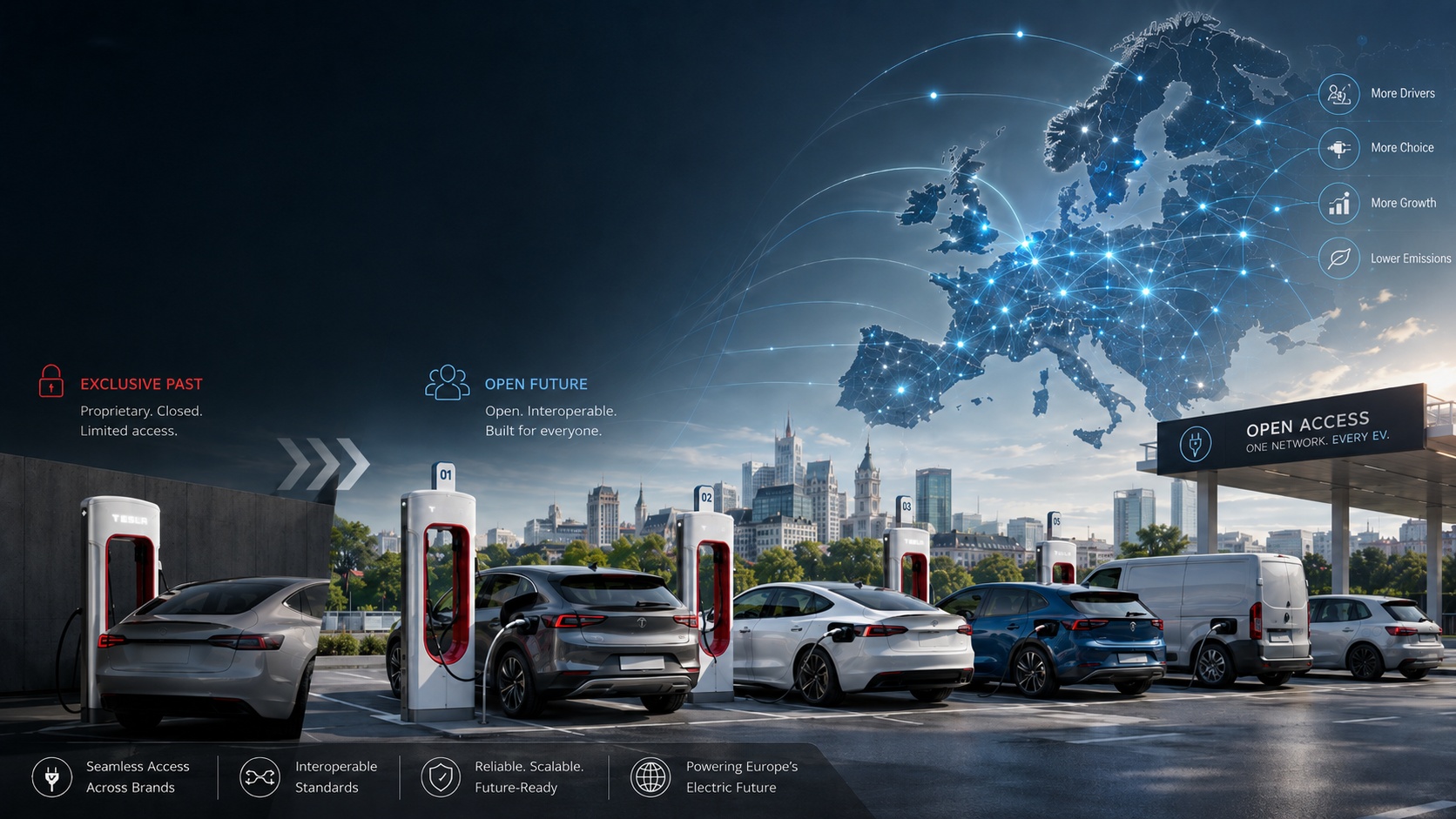
On June 4, 2026, Tesla announced a fundamental transformation of its charging business in Europe. The company is now offering complete white-label Supercharger solutions to any third-party business — supermarkets, hotels, parking operators, gas stations, and energy companies can purchase Tesla’s V4 charging equipment, operate it under their own brand, set their own electricity prices, and keep most of the revenue while Tesla handles the backend software, maintenance, and service. This shift from exclusive access to open infrastructure represents the most significant evolution of the Supercharger network since its inception in 2012. For European Tesla owners, the implications are profound: more charging locations, more competition on pricing, and ultimately, a more mature and accessible charging ecosystem.
Chapter 1: The Third Wave — Understanding the Evolution of Tesla’s Supercharger Business Model
Tesla‘s charging strategy has evolved through three distinct waves, each progressively opening the network to a broader audience. Understanding this evolution is essential to appreciating the magnitude of the June 2026 white-label launch.
Wave One: The Walled Garden (2012–2022)
From the very first Supercharger station, Tesla built its charging network as a competitive moat. These stations were designed exclusively for Tesla owners, using proprietary connectors, Tesla-specific authentication protocols, and providing free or low-cost charging as a customer acquisition tool. The message was clear: buy a Tesla, and you gain access to the world’s most reliable, fastest-growing charging network. This approach worked brilliantly. By the end of 2021, Tesla had built over 30,000 Supercharger stalls globally, and for millions of Tesla owners, the network was a primary reason for choosing the brand over competitors.
Wave Two: Opening the Gates (2022–2025)
Beginning in late 2022, Tesla began selectively opening its network to non-Tesla EVs in Europe. Norway led the way, followed by France, Germany, the Netherlands, and the UK. The company deployed CCS adapter-equipped stalls, allowed non-Tesla drivers to charge via the Tesla app at higher rates, and began experimenting with different pricing tiers. By mid-2025, more than half of all European Supercharger stations were accessible to non-Tesla vehicles. This wave signaled that Tesla recognized the growing EV market — more EVs on the road meant more demand for charging, and Tesla could capture that demand by becoming a charging provider rather than just a vehicle manufacturer.
Wave Three: The White-Label Revolution (June 2026 — Present)
What Tesla announced in early June 2026 represents a radical departure from both prior waves. Rather than simply allowing non-Tesla vehicles to use Tesla-branded stations, Tesla is now selling the entire Supercharger stack to third-party businesses. Any company can buy V4 charging cabinets, install them on their property, put their own logo on the pedestals, and operate the station as their own business. Tesla continues to provide backend software, warranty coverage, uptime guarantees, and maintenance services, while the customer sets the retail electricity price and collects the revenue. In Tesla’s own words: any business can “directly purchase Tesla Supercharger posts, affix their own brand logo, and independently determine electricity prices and operating models”.
This evolution is not merely incremental — it is transformative. Tesla is transitioning from a vertically integrated hardware maker to an infrastructure provider that monetizes its technological lead across every layer of the charging value chain. For the European EV ecosystem, it means that the world’s best charging hardware and software will soon appear under countless local brands.
Chapter 2: Technical Specifications — What White-Label Buyers Actually Get
At the heart of Tesla’s white-label offering is the V4 Supercharger system, identical to the equipment Tesla deploys at its own stations. This is not a cut-down or lower-quality version — it is the full, production-ready V4 stack.
Power and Compatibility
The V4 system supports up to 500 kW charging power for passenger vehicles, a figure that significantly exceeds current European public charging standards. For context, most 350 kW chargers offered by Ionity and Fastned are already considered ultra-rapid; Tesla’s 500 kW capability pushes the boundary even further. The system is compatible with vehicles using 400V to 1000V electrical architectures, meaning it can charge current Tesla vehicles, next-generation EVs with 800V systems (like the Porsche Taycan, Hyundai Ioniq 5, and Lucid Air), and future vehicles expected to adopt even higher-voltage configurations.
Each V4 charging cabinet can serve up to eight charging stalls simultaneously, sharing a total of 1,200 kW of power across the entire group. This dynamic power-sharing capability means that if only one vehicle is plugged in, it can receive the full 500 kW of power. If multiple vehicles are connected, the system intelligently distributes power based on each vehicle’s state of charge and requested charging rate, optimizing throughput and minimizing wait times for all users.
Charging Connectors and Global Standards
One of the most technically sophisticated aspects of the V4 system is its multi-standard compatibility. On the white-label information page for Germany, Tesla explicitly lists support for NACS (North American Charging Standard), CCS1, CCS2, GB/T, and MCS (Megawatt Charging System for heavy-duty trucks). For European operators, CCS2 is the dominant standard, and Tesla’s guarantee of CCS2 compatibility means white-label stations will seamlessly connect with virtually all EVs sold in Europe.
The MCS support is particularly noteworthy. It suggests Tesla is positioning the V4 platform not only for passenger vehicles but also for electric trucks and commercial fleets — a market segment that is expected to explode in the coming years as Europe tightens emissions regulations on commercial transport.
Hardware Reliability and Uptime Guarantees
Tesla claims a 97 percent uptime guarantee for white-label stations — a figure that, if delivered consistently, would exceed the reliability of most existing European public charging networks. The company also provides credit card reader support for contactless payments, positioning in Tesla’s own route planner (which remains one of the most accurate EV navigation tools available), and connectivity infrastructure for remote monitoring and troubleshooting.
For third-party operators, the most valuable asset may be Tesla’s operations team. Managing a fast-charging station requires constant attention — software updates, hardware repairs, payment system integrity, and compliance with local grid regulations. Tesla handles all of that, allowing white-label customers to focus on their core business (retail, hospitality, logistics) rather than becoming charging experts.
Chapter 3: The Financial Breakdown — From Purchase Price to 15-Year Revenue
Tesla has made its white-label economics transparent, offering a public ROI calculator and detailed pricing breakdowns across multiple European markets. The numbers reveal a compelling case for businesses willing to make the upfront investment — but also highlight the risks inherent in any infrastructure business.
Hardware and Installation Costs
For a standard eight-stall V4 station, the hardware-only price is approximately €264,000. This includes the main charging cabinet, eight Supercharger pedestals, DC cabling, credit card readers (if required), site controllers, and connectivity infrastructure. An additional €15,000 covers “other hardware” such as DC cables, credit card readers, site controller hardware, and connectivity equipment. Service costs for project planning and commissioning add another €15,000, while shipping and logistics add approximately €6,000.
When installation, grid connection, civil works, permitting, and other site-specific costs are factored in, Tesla estimates the total project investment for an eight-stall station at roughly €658,000. This figure can vary significantly based on the location — a station in a dense urban area with existing high-capacity grid access will cost less than one in a rural area requiring new transformer installations.
Tesla also offers smaller configurations to lower the entry barrier. A minimum configuration with four V4 stalls is priced at approximately €150,000 for hardware, while a 16-stall configuration doubles the cost to €600,000.
In the Netherlands, the starting price for a four-stall V4 Supercharger station is €234,000, according to Dutch auto publication Autovisie. This suggests that Tesla is tailoring its pricing to local market conditions, electricity costs, and competitive dynamics.
Revenue Projections and ROI
Tesla‘s ROI calculator provides simulation data based on assumed utilization, electricity purchase prices, and retail markups. The company’s base-case assumptions include an annual utilization growth rate of 7 percent, an energy loss of approximately 15 percent during charging, and a Tesla service fee of €0.09 per kWh for ongoing operations and the guarantee of a place in Tesla‘s route planner.
For an eight-stall station in the Netherlands, assuming 314 kWh of daily consumption, a retail price of €0.69 per kWh, and a purchase price of €0.197 per kWh, Tesla projects cumulative profit of approximately €3.1 million over 15 years after accounting for the company’s service fee. A larger 24-stall station — representing a €1.4 million investment — could generate €18.7 million in profit over the same period.
Across Europe, Tesla’s broader simulation suggests that a standard eight-stall station can achieve cumulative revenue of €6.2 million over 15 years under high-utilization scenarios, with average annual revenue of €414,000.
Critical Caveats: Theory vs. Reality
It is essential to emphasize that these projections are highly theoretical. Actual profitability depends on three uncontrollable variables: the wholesale price of electricity, the actual utilization rate of the station, and the retail price per kWh that the market will bear.
Electricity prices fluctuate based on regional grid conditions, time-of-day demand, and geopolitical factors. If wholesale prices rise sharply, the gap between purchase price and retail price compresses. Conversely, if competitors undercut the station‘s retail price, customers will choose cheaper options, driving down utilization.
The assumption of 314 kWh of daily consumption — equivalent to about 30 to 40 charging sessions per day at an average of 8–10 kWh per session — may be reasonable for high-traffic locations near highways or major commercial centers. But for a station in a suburban shopping center, daily consumption could be a fraction of that, dramatically extending the payback period.
Furthermore, Tesla’s 0.09 euro per kWh service fee applies only to “profitable stations,” suggesting that if a white-label station struggles to break even, Tesla may waive or reduce this fee. The exact terms are negotiated on a case-by-case basis.
Chapter 4: Target Market — Who Is Tesla Selling To?
Tesla has cast a wide net in its search for white-label customers, targeting any business that owns or leases physical real estate with vehicle access.
Supermarkets and Retailers
Supermarket chains like Lidl, Aldi, Carrefour, and Tesco already offer EV charging at many locations. With Tesla‘s white-label solution, these retailers can upgrade their existing charging offerings from relatively slow 50 kW units to 500 kW ultra-rapid V4 stations. For a supermarket, the value proposition is straightforward: chargers bring customers to the parking lot, and while they wait 20–30 minutes to charge, they walk into the store and make purchases.
Hotels and Hospitality
Hotels have become a battleground in the EV charging market. Business travelers and vacationing families increasingly choose hotels based on charging availability. A white-label Tesla V4 station at a hotel parking lot could be a significant competitive advantage — guests can arrive with a low battery, charge to 80 percent overnight, and start the next day fully energized.
Gas Stations
Traditional fuel retailers are facing an existential crisis. As European governments phase out internal combustion engine vehicles, gas stations must transition to electric charging or go out of business. Tesla‘s white-label solution offers these businesses a path forward: they can retain their existing real estate, customer relationships, and convenience store operations, simply replacing fuel pumps with V4 chargers.
Parking Operators
Parking garages in city centers and near airports are ideal locations for charging stations. Customers typically park for hours, not minutes, so even slower charging speeds would suffice. However, ultra-rapid V4 chargers offer flexibility for drivers who need a quick top-up before continuing their journey.
Energy Companies and Utilities
For energy companies already producing or trading electricity, charging stations represent a way to vertically integrate — selling their own electricity directly to end customers rather than through intermediaries. BP, a notable example, ordered Supercharger hardware for its own charging network several years ago, suggesting that large energy companies were early adopters of Tesla‘s infrastructure.
Chapter 5: Strategic Significance — Why White-Label Changes Everything for Tesla
For Tesla, the white-label launch is not a side business or an experimental project — it is a strategic pivot that redefines the company‘s relationship with the entire EV industry.
From Cost Center to Profit Center
The Supercharger network has historically been a cost center for Tesla — a massive capital investment that improved customer satisfaction but did not directly generate profit. The white-label model changes that calculation. Every station sold generates hardware revenue up front, followed by recurring software and service revenue over the station’s operational life. According to financial analysts, this shift could transform the Supercharger network from a drag on earnings into a meaningful contributor to Tesla‘s gross margin.
Accelerated Network Expansion Without Capital Expenditure
The most capital-intensive part of building a charging network is purchasing real estate, securing permits, installing equipment, and maintaining operations. Under the white-label model, third-party businesses bear these costs. Tesla provides the technology, collects a fee, and watches its network footprint grow without spending a euro on new stations. In effect, Tesla is turning thousands of potential business partners into franchisees who pay for the privilege of operating Tesla-powered stations.
Data Feedback Loops
Every white-label station that Tesla powers is a source of data: charging patterns, peak demand times, vehicle types, payment methods, and customer behavior. This data is invaluable for optimizing Tesla‘s own station placements, improving V4 hardware, refining software algorithms, and predicting future grid demands. Competitors like Ionity, Fastned, and Allego do not have access to this level of operational intelligence.
Strengthening the Supercharger Standard
By putting its V4 hardware into thousands of third-party stations, Tesla is effectively making its technology the de facto standard for European ultra-rapid charging. Just as Android handsets run on Qualcomm processors and Google’s software, white-label stations run on Tesla hardware and Tesla software — even if the customer never knows it. This creates a powerful ecosystem effect: as more drivers use white-label stations, they become accustomed to the Tesla charging experience, and when they eventually buy an EV, the Tesla brand is top of mind.
Chapter 6: Challenges — The Risks That Could Undermine White-Label Success
Despite the compelling vision, the white-label model faces significant hurdles that could limit its adoption or reduce its effectiveness.
High Upfront Investment
A €658,000 minimum investment is beyond the reach of many small businesses. A family-owned hotel or a small-town grocery store cannot easily raise that kind of capital. Even if they can, the payback period may be five to ten years — a timeline that requires patience and financial stability that not all businesses possess. Tesla could address this by offering financing, leasing, or power-purchase agreement models, but those options have not yet been announced.
Operational and Regulatory Complexity
Different European countries have different grid connection rules, permitting processes, utility regulations, and consumer protection laws. A business in Germany will face a completely different regulatory environment than a business in France, Spain, or Poland. Navigating this complexity is not Tesla’s responsibility under the white-label model — it falls on the local business, which may lack the expertise to handle it efficiently.
Price Competition Among White-Label Stations
One of the stated benefits of the white-label model is increased competition, which should drive down electricity prices for consumers. But for the operators themselves, price competition is a threat. If every gas station and hotel along a highway installs white-label V4 chargers, they will compete aggressively on price, squeezing margins for everyone. The high fixed costs of V4 hardware mean that stations need consistent utilization to break even — price wars could make that impossible.
Consumer Confusion
From a driver’s perspective, walking up to a white-label station with an unfamiliar brand name could be disorienting. Not all drivers will know that “Joe‘s Grocery Charging” is actually a Tesla V4 station underneath. Tesla mitigates this by including white-label stations in its route planner, so drivers using navigation will see them as compatible options regardless of the brand name. But for drivers who are not using Tesla navigation — a significant percentage of European EV owners — discovering and trusting an unknown charging brand remains a barrier.
Chapter 7: Impact on European Tesla Owners — What Changes, What Stays the Same
For readers who are European Tesla owners, the white-label launch has tangible implications for daily driving.
More Charging Locations
The most immediate benefit is simple: there will be more places to charge. As supermarkets, hotels, parking lots, and gas stations install white-label V4 chargers, the density of ultra-rapid charging in Europe will increase dramatically. For Tesla owners, every white-label station is accessible via the same Tesla app or in-car navigation used for Tesla’s own Superchargers. The experience of plugging in, authenticating, and paying will be identical.
Potential Pricing Volatility
One downside of white-label competition is price volatility. Under Tesla’s owned-and-operated model, Supercharger pricing has been relatively stable and predictable. Under the white-label model, each operator sets its own price based on local electricity costs, competitive pressures, and desired profit margins. This means that prices could vary significantly from one station to another, even on the same highway. Savvy drivers will need to compare prices in the Tesla app before choosing a station.
No Change to Tesla’s Own Supercharger Network
It is important to emphasize that Tesla‘s own Supercharger network remains fully operational and is not being replaced or reduced by the white-label program. If you prefer the familiarity and consistency of Tesla-branded stations, they will continue to exist and expand. The white-label program is additive, not substitutionary.
Impact on Resale Value
A stronger charging ecosystem benefits all EV owners, regardless of brand. If white-label adoption accelerates, range anxiety will continue to decline, making EVs more attractive to mainstream consumers. This should support the residual values of all EVs, including Teslas, by reinforcing the perception that charging is abundant, reliable, and convenient.
Chapter 8: Looking Ahead — The Future of White-Label Charging
Tesla‘s white-label launch is still in its early days. The program went live on June 4, 2026, and no third-party stations have yet been deployed — businesses are currently evaluating the offering, running the ROI calculator, and deciding whether to commit. The first white-label stations are expected to come online in late 2026 or early 2027.
Potential Expansion Beyond Europe
Europe is the first region for the white-label program, but it will almost certainly expand. The United States is the obvious next target, where Tesla‘s Supercharger network is even larger and the shift to NACS as a national standard has already begun. If the European rollout is successful, expect announcements for North America by late 2026 or early 2027.
Lower-Cost Options for Small Businesses
The current white-label offering is high-end: V4 hardware, 500 kW speeds, eight-stall minimums. This serves large businesses with deep pockets. But there is a market for smaller, cheaper configurations — perhaps four-stall V3 stations, or even AC destination chargers. If Tesla wants to capture the hotel and small retail market, it will need to expand its white-label catalog to include more affordable options.
Integration with Tesla Energy
White-label charging is part of a broader Tesla Energy strategy. Powerpacks, Megapacks, solar panels, and virtual power plant software can all be bundled with white-label charging stations, allowing businesses to store solar energy during the day and sell it for EV charging at night. This vertically integrated energy solution — generation, storage, and consumption — is something no other charging company can offer.
Conclusion
Tesla’s white-label Supercharger launch on June 4, 2026, marks the beginning of a new era for EV charging in Europe. After 14 years of operating a closed, Tesla-only network, the company has opened its entire charging stack to any business willing to invest.
The technical specifications are class-leading: 500 kW, 1,200 kW shared power, CCS2 and MCS compatibility, and Tesla‘s proven reliability. The financial economics, while theoretical today, suggest that a well-placed station in a high-traffic area could generate millions of euros in profit over 15 years — a compelling return on a €658,000 investment. The strategic implications for Tesla are equally profound: the Supercharger network transitions from a cost center to a profit center, expands without Tesla’s capital, and reinforces the company‘s position as the dominant technology provider in the EV ecosystem.
For European Tesla owners, the white-label program is unambiguously positive news. More charging stations mean less range anxiety. More competition means pressure on pricing. And more third-party operators entering the market means a healthier, more resilient charging infrastructure for everyone.
As with any ambitious business transformation, the risks are real: high upfront costs, regulatory complexity, price competition, and the challenge of educating consumers about white-label stations. But if Tesla executes successfully, the white-label model could become the template for EV charging infrastructure globally — turning every supermarket parking lot, hotel garage, and gas station forecourt into a node in the world‘s most advanced charging network.
FAQ
Q: Will Tesla’s own Supercharger network continue to operate and expand?
A: Yes. The white-label program is an additional initiative, not a replacement for Tesla‘s first-party Supercharger network. Tesla continues to build and operate its own branded stations across Europe.
Q: Can I use a white-label station if I don’t have the Tesla app?
A: Yes. All white-label stations are required to support credit card payments via integrated card readers. However, using the Tesla app provides a smoother experience with automatic authentication and in-car route planning.
Q: Will white-label stations charge at the same speed as Tesla‘s own V4 stations?
A: Yes. The hardware is identical — 500 kW peak power, compatible with 400V to 1000V vehicle architectures. The only difference is the branding on the pedestal and the retail price per kWh.
Q: How will I find white-label stations on the road?
A: White-label stations that purchase Tesla’s service package are included in Tesla‘s in-car route planner and the Tesla app, just like Tesla’s own stations. They will appear alongside first-party Superchargers.
Q: Is Tesla making money from white-label stations?
A: Tesla generates revenue from hardware sales at the time of purchase, ongoing software fees, and a per-kWh service fee (€0.09) for profitable stations. The model turns the Supercharger network from a cost center into a revenue generator.
Q: When will the first white-label stations open in Europe?
A: The program launched on June 4, 2026. Given the typical timeline for permitting, grid connection, and installation, the first stations are expected to come online in late 2026 or early 2027.