
Introduction
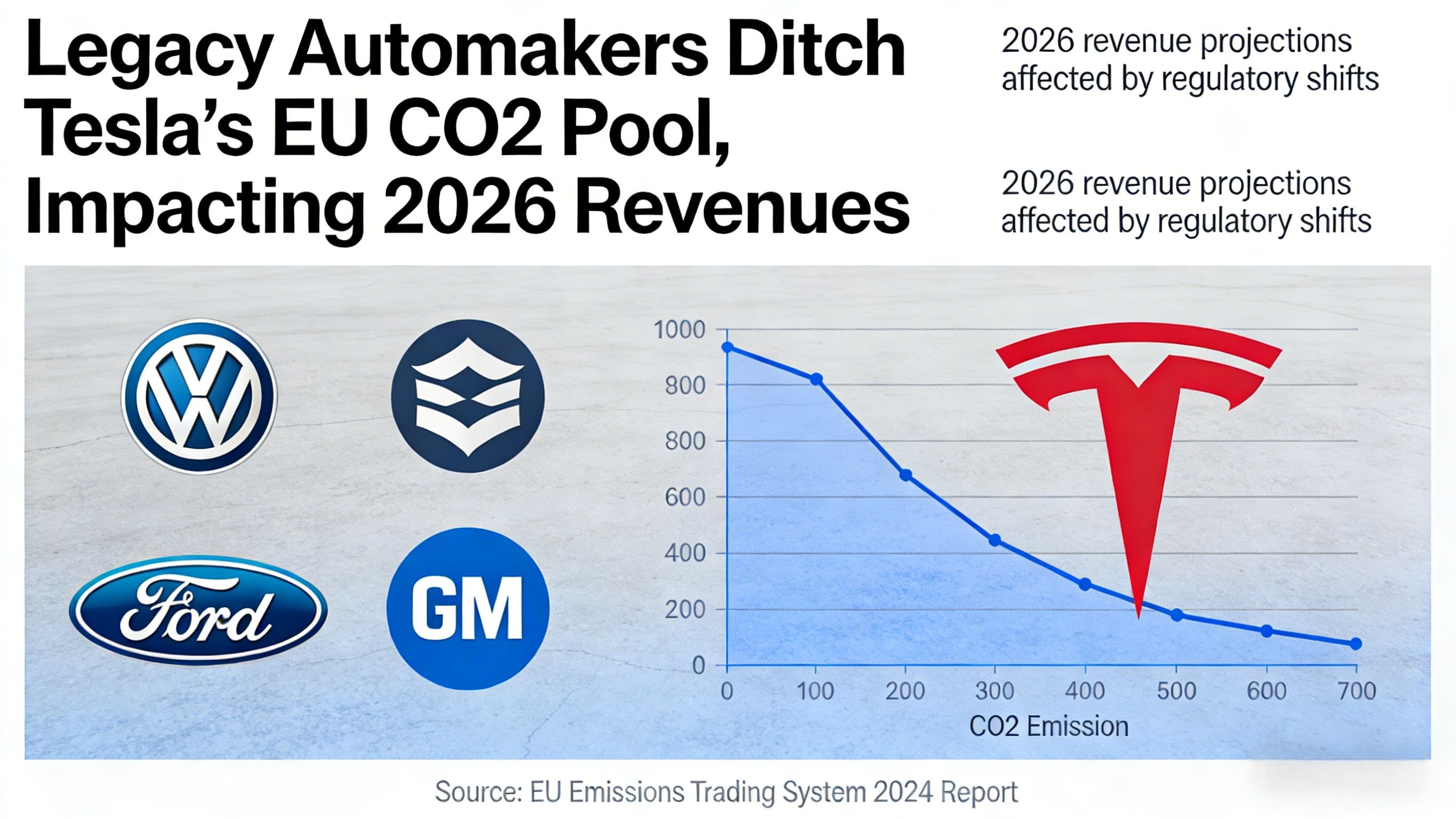
In the ever-evolving landscape of the electric vehicle (EV) market, Tesla has long positioned itself not just as a manufacturer of cutting-edge automobiles but as a pivotal player in the global push toward sustainability. One of the lesser-known but highly lucrative aspects of Tesla's business model has been its role in the European Union's (EU) CO2 emissions pooling system. This regulatory framework allows automakers to collaborate in meeting stringent emissions targets, effectively turning excess compliance credits from low-emission producers like Tesla into a revenue stream. However, as of early March 2026, this dynamic is undergoing a significant shift. Recent EU filings reveal that Toyota Motor Corporation and Stellantis NV—two of the world's largest legacy automakers—have opted out of Tesla's CO2 pool for the 2026 compliance year. This development, confirmed in a February 27, 2026, EU document, marks a potential multibillion-dollar blow to Tesla's non-vehicle revenue and underscores the maturing nature of the EV sector in Europe.
The EU's CO2 pooling mechanism is a cornerstone of its environmental policy, designed to accelerate the transition away from internal combustion engines (ICE) by incentivizing electrification. Under this system, manufacturers with fleets exceeding average CO2 emission limits can "pool" with those under the threshold, averaging out emissions across the group to avoid hefty fines. Tesla, with its all-electric lineup, has been the anchor of one of the largest such pools since the program's inception. In 2025 alone, Tesla generated approximately $1.99 billion globally from regulatory credits, a substantial portion of which came from European partners. The pool has historically included heavyweights like Ford, Honda, Mazda, Suzuki, Toyota, and Stellantis (which encompasses brands such as Fiat, Peugeot, Opel, and Jeep). For Tesla owners in Europe, this arrangement has indirectly supported the company's aggressive pricing strategies and rapid innovation cycles, as credit sales have funded everything from R&D to infrastructure expansion.
The exit of Toyota and Stellantis is not merely a contractual adjustment; it reflects broader market dynamics. As legacy automakers ramp up their EV production, they are increasingly able to meet EU targets independently. Toyota, for instance, has expanded its hybrid and EV portfolio, including models like the bZ4X and Prius Plug-in, reducing its reliance on external credits. Stellantis, meanwhile, has invested heavily in electrification through its Dare Forward 2030 plan, aiming for 100% EV sales in Europe by the end of the decade. This self-sufficiency comes at a time when EU regulations are tightening further, with the 2025-2029 phase requiring a 15% reduction in fleet emissions from 2021 levels, escalating to 37.5% by 2030. The departure also includes Subaru, a Toyota affiliate, further shrinking the pool to just Tesla, Ford, Honda, Mazda, and Suzuki.
Financially, this is a watershed moment for Tesla. Analysts estimate that the full pool contributed over €1 billion to Tesla's coffers in 2025, with Toyota and Stellantis being the primary payers due to their large, still partially ICE-dependent fleets. Losing these partners could slash Tesla's European credit revenue by hundreds of millions, if not more, in 2026. This comes amid Tesla's broader challenges, including slowing global EV demand, increased competition from Chinese rivals like BYD, and economic headwinds such as higher interest rates affecting consumer financing. For Tesla's stock, traded as TSLA on NASDAQ, this news has contributed to volatility; shares dipped 2.5% in after-hours trading following the initial reports on March 3, 2026.
From the perspective of European Tesla owners—primarily in markets like Germany, France, the UK, Norway, and the Netherlands—this shift could have ripple effects. Tesla's ability to subsidize vehicle prices through credit sales has kept models like the Model Y and Model 3 competitive against emerging European EVs from Volkswagen and Renault. If revenue dips, Tesla might adjust pricing, incentives, or even delay regional-specific features. However, it's not all doom; this exodus signals a healthier, more competitive EV ecosystem, where Tesla's technological edge—such as its Full Self-Driving (FSD) software and Supercharger network—becomes even more critical for differentiation.
Moreover, this development highlights the EU's success in driving electrification. In February 2026, EV registrations across Europe surged, with Tesla reclaiming some market share after a dip in late 2025. Data from the European Automobile Manufacturers' Association (ACEA) shows Tesla delivering 17,425 units in key markets, a 10% year-over-year increase, driven by strong performances in France (up 55%) and Spain (up 74%). Yet, overall market share for Tesla hovered at 6.1%, trailing Volkswagen Group's 12.3%. This recovery is partly fueled by government incentives, such as Germany's extended EV subsidies and France's "social leasing" program for low-income buyers.
The broader implications extend to sustainability goals. The EU's Green Deal aims for carbon neutrality by 2050, with transport accounting for 25% of emissions. By forcing automakers to internalize compliance costs, the pooling system's evolution pushes faster innovation. For Tesla, founded on Elon Musk's vision of accelerating the world's transition to sustainable energy, this is a double-edged sword: less easy money, but validation of its mission as competitors catch up.
In summary, the withdrawal of Toyota and Stellantis from Tesla's CO2 pool is a symptom of a maturing industry. It challenges Tesla to rely more on core operations—vehicle sales, energy storage, and autonomy—while benefiting European consumers with more choices. As we delve deeper, we'll explore the mechanics of the system, competitive shifts, owner strategies, and future outlooks.
Section 1: Mechanics of EU CO2 Credits
To fully grasp the significance of Toyota and Stellantis' exit, it's essential to unpack the intricacies of the EU's CO2 emissions trading and pooling system. Established under the EU's Effort Sharing Regulation and the Cars and Vans CO2 Regulation (Regulation (EU) 2019/631), this framework sets binding annual emission reduction targets for passenger cars and light commercial vehicles. The core principle is simple: each manufacturer's fleet must not exceed a specific grams of CO2 per kilometer (g/km) average, calculated based on vehicle registrations. For 2025-2029, the target is a phased reduction from the 2021 baseline of 95 g/km, with penalties of €95 per excess gram per vehicle for non-compliance.
Pooling allows manufacturers to form alliances, combining their fleets for compliance purposes. A low-emission leader like Tesla, whose vehicles emit zero tailpipe CO2, generates "super-credits" that can offset partners' overages. In exchange, partners pay Tesla for the privilege, creating a market-driven incentive for electrification. This isn't charity; it's a calculated business move. Tesla's pool, formally registered annually with the European Commission, has been one of the most expansive. In 2025, it encompassed Tesla, Ford, Honda, Mazda, Suzuki, Toyota, Stellantis, and even Leapmotor (a Stellantis affiliate). Payments are negotiated privately but are substantial; UBS analysts pegged Toyota and Stellantis' contributions at over €500 million each annually, based on their fleet sizes and emission profiles.
Tesla's earnings from these credits have been a financial lifeline. In 2025, regulatory credits accounted for $1.99 billion in revenue, representing about 2% of total sales but a higher margin contributor since they involve minimal costs. Historically, this revenue stream helped Tesla weather early losses and invest in Gigafactories, including Giga Berlin, which produces the Model Y for European markets. The system's evolution traces back to 2010, when the EU first introduced fleet-wide targets, but it gained traction post-2015 Paris Agreement, with pools becoming common by 2020.
Why are partners leaving now? The answer lies in regulatory changes and internal progress. The EU's 2023 amendments to the CO2 Regulation tightened targets and phased out super-credits for plug-in hybrids (PHEVs) by 2025, forcing a true shift to battery electric vehicles (BEVs). Toyota, a hybrid pioneer, has accelerated its BEV rollout, with models like the Urban SUV Concept entering production in 2026. Its global EV sales hit 104,000 in 2025, up 38% year-over-year, allowing it to meet targets solo or form smaller pools. Stellantis, facing a €20 billion loss in H2 2025 from overambitious EV plans, is recalibrating by writing down €22 billion in EV investments and refocusing on profitable hybrids and ICE vehicles while maintaining EV commitments. A spokesperson for Stellantis noted on March 4, 2026, that while not currently in the pool, rejoining remains possible until December 1, 2026. Toyota echoed this, stating "nothing has been decided" definitively.
Subaru's exit, as a Toyota subsidiary, is linked, reducing the pool's diversity. Remaining members like Ford (with its Mustang Mach-E) and Honda (e:Ny1) still benefit from Tesla's credits, but the pool's value diminishes. Analysts from Matthias Schmidt Automotive Research predict this could halve Tesla's EU credit income, from €1 billion to €500 million. Broader regulatory changes, including the EU's Carbon Border Adjustment Mechanism (CBAM) starting in 2026, add pressure by taxing imported high-carbon goods, favoring local EV production.
Comparatively, other pools exist: Volkswagen leads one with its brands, while BMW and Mercedes operate independently. Tesla's model has been unique in scale, but as EV penetration reaches 22% in Europe (per ACEA 2025 data), pools may become obsolete by 2035, when the EU bans new ICE sales. For now, this mechanic underscores Tesla's strategic pivot needed in 2026.
Section 2: Competitive Shifts in European EV Market
The departure of Toyota and Stellantis from Tesla's CO2 pool coincides with a period of intense competition in Europe's EV market, where Tesla is staging a recovery but facing formidable challengers. In February 2026, Tesla's registrations across 15 key European markets totaled 17,425 units, marking a 10% increase from February 2025. This uptick reversed a late-2025 slump, where Tesla's share fell to 6.1% amid supply chain issues and economic slowdowns. Country-specific gains were notable: France saw a 55% surge to 3,200 units, fueled by government leasing incentives; Spain jumped 74% to 1,800; and Norway, Tesla's stronghold, held steady at 2,500 with the Model Y topping charts.
This recovery is contextualized by broader trends. Europe's EV market grew 12% year-over-year in February 2026, with total BEV registrations hitting 285,000, per preliminary ACEA figures. However, growth has slowed from 2024's 37% pace due to subsidy cuts in Germany and inflation. Tesla's rebound is attributed to price cuts— the Model 3 now starts at €38,990—and enhanced production from Giga Berlin, which output 50,000 vehicles monthly by Q1 2026.
Competition is fierce from Chinese entrants like BYD, which overtook Tesla globally in Q4 2025 with 526,000 deliveries. In Europe, BYD's Atto 3 and Seal models captured 4.2% share in February, benefiting from 27.5% tariffs but lower production costs. Volkswagen Group, with 12.3% share, leverages its ID. series; the ID.3 sold 15,000 units, emphasizing affordability. Stellantis, post-exit, focuses on its own EVs like the Peugeot e-208, which led February sales at 4,500 units.
Toyota's independent stance bolsters its hybrid dominance, with the Yaris Cross PHEV selling 6,000 units. This shift reduces Tesla's indirect subsidies to competitors, potentially leveling the field. X posts from industry watchers, like those from @NotATeslaApp on March 4, highlight how this shrinks Tesla's revenue but accelerates true competition.
Economic factors play in: High energy prices post-Ukraine conflict favor efficient EVs, but charging infrastructure lags, with only 500,000 public points versus a 2030 target of 1 million. Tesla's Supercharger network, with 12,000 stalls in Europe, remains a moat.
Section 3: Strategies for Tesla Owners in Europe
For European Tesla owners, the pool exits could manifest in higher costs or altered incentives. Vehicle pricing might rise 5-10% if Tesla offsets lost revenue, per analyst estimates. Owners should monitor resale values, as credit dependency questions arise.
Strategies include leveraging incentives: France's €5,000 bonus for Model 3 buyers. Optimize ownership with Tesla's app for energy savings. Community forums on X suggest group buys for accessories.
Conclusion
Tesla's adaptation through Giga Berlin expansions and new models like the refreshed Model Y will be key. Outlook remains positive with AI integrations.
FAQ
-
Why did Toyota and Stellantis exit Tesla's EU CO2 pool for 2026? Toyota and Stellantis' decision to withdraw from Tesla's CO2 emissions pooling arrangement stems from their growing self-sufficiency in meeting the European Union's stringent fleet-wide emissions targets. Under EU Regulation (EU) 2019/631, automakers must achieve an average of less than 95 g/km of CO2 emissions across their sold vehicles, with penalties for exceedances. Tesla's all-electric lineup generates excess credits that partners like Toyota and Stellantis have historically purchased to offset their higher-emission fleets, which still include many internal combustion engine (ICE) and hybrid models. However, by 2026, Toyota has significantly expanded its electrified portfolio, including battery electric vehicles (BEVs) like the bZ4X and Urban SUV, alongside its dominant hybrids such as the Prius Plug-in. Toyota's global EV sales reached over 104,000 units in 2025, a 38% increase year-over-year, allowing it to comply independently or form smaller, more cost-effective pools. Similarly, Stellantis—encompassing brands like Peugeot, Fiat, Opel, and Jeep—has accelerated its electrification under the Dare Forward 2030 strategy, aiming for 100% EV sales in Europe by 2030. Despite a €22 billion writedown on EV investments in late 2025 due to slower-than-expected demand, Stellantis has rolled out affordable models like the Citroën ë-C3 and Peugeot e-208, reducing its reliance on external credits. This exit, including Subaru (a Toyota affiliate), reflects a maturing EV market where legacy automakers no longer need Tesla's "lifeline" to avoid fines, which can reach €95 per excess gram per vehicle. For Tesla owners, this signals a competitive shift where rivals are catching up, potentially leading to more diverse EV options in Europe.
-
Will this exit raise prices for Tesla vehicles in Europe? It's possible that Tesla could adjust pricing to offset the revenue loss from CO2 credits, but several factors may limit significant hikes. In 2025, Tesla earned approximately €1 billion from its EU pooling partners, with Toyota and Stellantis contributing a substantial portion—estimates suggest up to €500-700 million combined. Losing this high-margin income (which involves minimal operational costs) might pressure Tesla to recoup through vehicle sales, potentially increasing base prices by 5-10% on models like the Model Y (currently starting at €42,990 in Germany) or Model 3 (€38,990). However, intense competition in Europe could cap such increases: Chinese rivals like BYD offer models like the Atto 3 at under €35,000, while Volkswagen's ID.3 competes at similar price points with local incentives. Tesla's strategy has historically involved price cuts to boost volume, as seen in early 2026 reductions that drove a 10% registration surge in February. Additionally, EU incentives—such as France's €5,000-7,000 bonuses for EVs under €47,000 or Germany's extended Umweltbonus—could absorb any adjustments for buyers. For US owners indirectly affected (via global revenue impacts), prices might remain stable due to stronger domestic demand, but monitor Tesla's Q1 2026 earnings call for signals. Owners should consider locking in current prices or exploring leasing options, which often include fixed rates and incentives.
-
What is the impact on current and prospective Tesla owners in Europe? For existing Tesla owners, the primary impact is indirect: reduced credit revenue might slow Tesla's investments in regional features, such as enhanced Supercharger expansions or localized software updates for EU road regulations. Resale values could dip slightly if market perception views Tesla as less financially insulated, though the Model Y's strong February 2026 sales (up 10% YoY to 17,425 units) suggest resilience. Prospective buyers might face adjusted incentives; Tesla could reduce discounts or bundle deals to maintain margins, but this is offset by government subsidies like the UK's Plug-in Car Grant (up to £2,500) or Norway's VAT exemptions, where EVs dominate 80% of new sales. Broader effects include a more competitive market, benefiting owners with faster innovation across brands—e.g., Stellantis' over-the-air updates mirroring Tesla's. Insurance and maintenance costs remain unchanged directly, but Tesla's focus on autonomy (like FSD subscriptions at €99/month) could accelerate as a new revenue stream. US owners might see minimal ripple effects, but global supply chain tweaks could influence delivery times. Advice: Join Tesla owner communities on platforms like Reddit's r/TeslaMotors or X for real-time updates, and use tools like Tesla's configurator to compare costs pre- and post any announcements.
-
Can Toyota and Stellantis rejoin Tesla's pool later? Yes, rejoining is possible until December 1, 2026, as per EU pooling rules, which allow amendments to registered pools throughout the compliance year. The initial filings on February 27, 2026, show them opting out, but spokespeople from both companies have left the door open. A Stellantis representative stated on March 4 that "nothing is finalized," indicating flexibility if their EV rollout falls short—e.g., if economic slowdowns reduce BEV demand or supply chain issues delay models like the Jeep Avenger EV. Toyota echoed this ambiguity, noting ongoing assessments. Rejoining would require renegotiating payment terms with Tesla, potentially at higher rates given the shrinking pool (now limited to Tesla, Ford, Honda, Mazda, and Suzuki). Historical precedents exist: Honda briefly exited in 2023 but rejoined in 2024 amid hybrid sales slumps. For Tesla owners, a reentry could stabilize revenue and prevent price pressures, but it's unlikely given the EU's tightening targets (15% reduction by 2025, escalating to 37.5% by 2030). Monitor EU Commission updates or Tesla's investor relations site for changes, as this could influence stock volatility (TSLA down 2.5% post-news).
-
How much revenue could Tesla lose from this exit? Estimates peg the loss at €500 million to €1 billion for 2026, depending on final pool dynamics and payment structures. In 2025, Tesla's global regulatory credits totaled $1.99 billion, with Europe contributing about half—primarily from Toyota (€300-400 million) and Stellantis (€200-300 million), based on UBS and Barclays analyst models. This high-margin revenue (nearly 100% profit) has funded R&D, including AI-driven features like Full Self-Driving. With the pool shrinking, remaining partners like Ford (with its Mustang Mach-E) may pay more per credit, but overall income could halve. Broader context: Tesla's Q4 2025 earnings showed credits as 2% of revenue but crucial for margins amid slowing EV growth (global deliveries up only 3% YoY). If reentries occur, losses mitigate; otherwise, Tesla might offset via cost cuts or new ventures like energy storage (Powerwall sales up 20% in Europe). For owners, this underscores diversifying investments if holding TSLA stock—analysts like those at Morgan Stanley predict a shift to software revenue by 2027. Track Tesla's March 2026 SEC filings for precise figures.
-
What is the broader market effect of this development? This exit accelerates Europe's EV transition by forcing legacy automakers to internalize compliance costs, spurring faster innovation and investment in electrification. The EU's Green Deal goals—carbon neutrality by 2050, with transport emissions down 90%—benefit as pools evolve from crutches to incentives for true BEV adoption. Market-wide, it levels the playing field: Tesla loses a subsidy edge, while competitors like Volkswagen (12.3% share in February 2026) and BYD (4.2%) gain traction. EV penetration hit 22% in 2025, up from 14% in 2023, but growth slowed due to subsidy cuts; this could reinvigorate it by reducing "greenwashing" via hybrids. Challenges include infrastructure gaps—only 500,000 public chargers vs. a 1 million target by 2030—and economic headwinds like inflation. Positively, it validates Tesla's mission, as Elon Musk noted on X: "Competition is good; it pushes us all forward." For US markets, parallels exist with California's ZEV credits, where Tesla earns $300-500 million annually; similar shifts could occur if Ford and GM go independent. Overall, expect more affordable EVs, but short-term volatility in stocks and supply chains.
-
What is Tesla's likely response to this revenue shift? Tesla is expected to pivot toward core strengths: boosting vehicle volumes, expanding software/services, and leveraging global production. With Giga Berlin ramping to 1 million units annually by mid-2026, Tesla can offset losses through economies of scale—February registrations rose 10% via price tweaks and refreshed models. Autonomy remains key: FSD subscriptions and Robotaxi plans could generate $10 billion by 2030, per Ark Invest. Energy division growth (Megapack deployments up 50% in 2025) provides diversification. Cost controls, like workforce optimizations post-2025 layoffs, and new markets (e.g., right-hand-drive Model Y for UK expansion) are likely. Elon Musk's X posts hint at "aggressive innovation," including Cybercab unveilings. For owners, this means more OTA updates and features—e.g., enhanced navigation for EU charging. Long-term, Tesla's vertical integration (batteries, software) insulates it better than peers. Investors should watch the April 2026 earnings for strategies; analysts rate TSLA a "buy" at $390/share, citing resilience.