
As Tesla owners across the United States and Europe, we live and breathe the brand every day—whether it’s the effortless acceleration on a California freeway, the silent glide through Berlin traffic, or the satisfaction of plugging into a Supercharger after a long road trip. Today, fresh registration data from key European markets delivers a powerful message: Tesla is not just holding its ground in one of the world’s most competitive EV landscapes—it is surging back with undeniable momentum. Released on April 1, 2026, the March figures show new Tesla registrations tripling in France, more than doubling across the Nordic countries, and posting strong double-digit gains in multiple other nations. This isn’t a fleeting blip; it’s a clear signal of renewed consumer confidence, strategic product moves, and the enduring appeal of Tesla vehicles to drivers who prioritize innovation, efficiency, and long-term value.
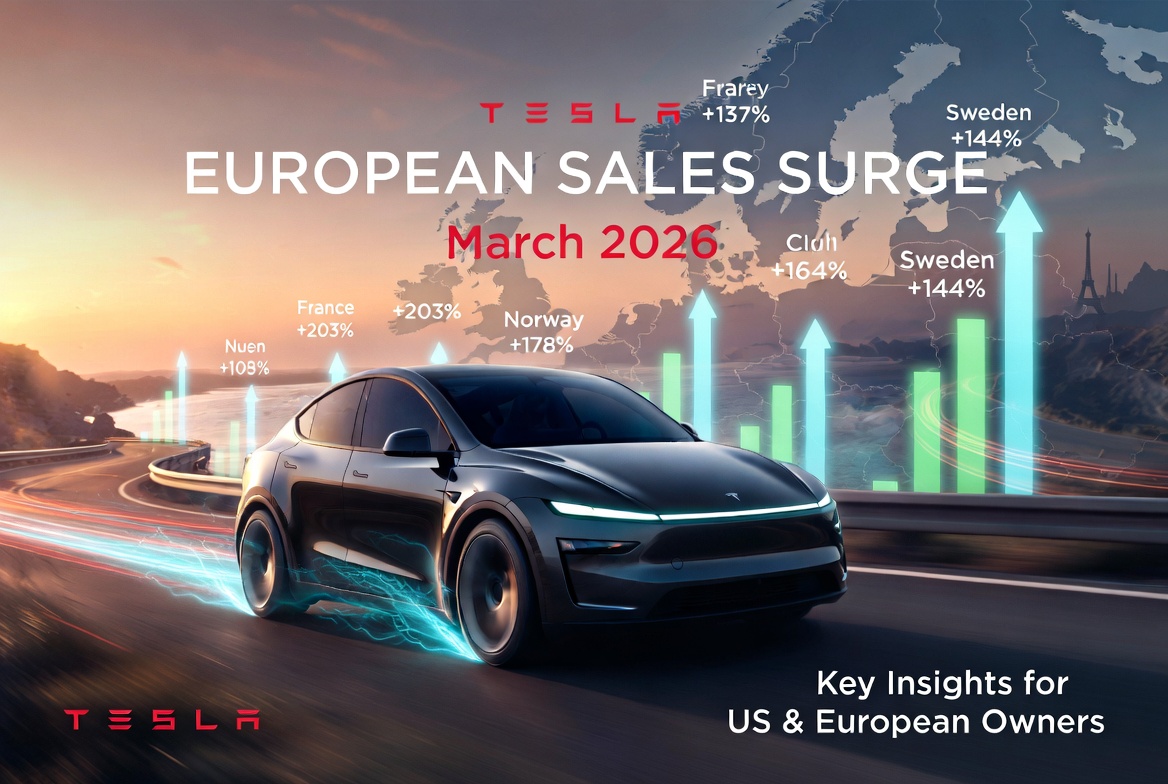
Let’s put the numbers in perspective. In France alone, 9,569 new Teslas were registered in March 2026—a staggering 203% increase year-over-year and just three units shy of the all-time record set in December 2023. Norway saw registrations climb 178% to 6,150 vehicles, while Sweden posted a 144% jump to 1,447 units and Denmark recorded a 96% rise to 1,784 vehicles. Momentum extended further: Belgium grew 89% to 1,806 registrations, the Netherlands rose 72% to 1,819, Italy increased 32% to 2,920, and Spain gained 25% to 2,477. Even in more modest markets like Switzerland and Portugal, the trend was positive or stable. For context, these gains come after a challenging 2025 in which Tesla lost nearly half its European market share amid heightened competition from Chinese brands, slower new-model rollouts, and external factors. Yet the turnaround began in late 2025 with the introduction of more affordable variants of the Model Y and Model 3, and March 2026 has accelerated that recovery dramatically.
Why does this matter to you as a Tesla owner in Los Angeles, Munich, or anywhere in between? First, stronger European demand directly supports global resale values. A Model Y or Model 3 that holds its value better in Europe translates to higher trade-in offers and private-sale prices in the US market as well. Second, robust sales fuel continued investment in Tesla’s ecosystem—more service centers, faster parts availability, and expanded Supercharger networks that benefit both continents. Third, these figures reinforce brand confidence at a time when EV adoption faces headwinds like policy shifts and economic pressures. For US owners still navigating the post-tax-credit landscape and European owners enjoying generous incentives, this surge validates the decision to go Tesla. It also highlights how our cars are part of a larger story of sustainable mobility that transcends borders.
This article dives deep into the data, country by country, to help you understand exactly what drove the surge and how it connects to your ownership experience. We’ll explore the implications for current Model Y and Model 3 owners, then zoom out to broader market trends and what lies ahead in 2026 and beyond. Whether you’re a daily commuter optimizing for efficiency or a weekend adventurer planning epic road trips, these insights will equip you with the knowledge to make the most of your Tesla today and tomorrow.
Section 1: Country-by-Country Breakdown
Europe is far from a monolithic market, and the March 2026 registration data reveals fascinating regional nuances that explain Tesla’s resurgence. Starting with France—the standout performer—9,569 registrations represent more than just volume; they reflect a perfect storm of policy support, product timing, and consumer sentiment. The French government’s bonus écologique, which can reach up to €7,000 for qualifying EVs, combined with rising fuel prices and urban low-emission zones (ZFE), has made the switch to Tesla even more attractive. Data from the French car body PFA shows that the refreshed, lower-priced Model Y variants launched in late 2025 dominated the mix, appealing to families and fleet operators alike. Compared to March 2025, when registrations were roughly one-third of this level, the 203% growth signals that Tesla has clawed back significant ground from competitors like Renault, Peugeot, and incoming Chinese models.
In Norway, long the poster child for EV adoption, Tesla’s 6,150 registrations and 178% year-over-year increase translated into a commanding 34.8% market share for the entire month. According to the Norwegian Road Traffic Information Council (OFV), Tesla even outsold every other brand combined during the first week of March—an extraordinary feat in a country where EVs already account for over 90% of new car sales. The Model Y claimed the top spot on the national bestseller list, followed closely by the Model 3. Norway’s zero-tax policy on EVs, combined with generous toll exemptions and access to bus lanes, continues to amplify Tesla’s appeal. Owners here benefit from one of the densest Supercharger networks in the world, and the March surge will likely accelerate further infrastructure upgrades, including V4 stations with higher power output.
Sweden’s 144% growth to 1,447 registrations and Denmark’s 96% rise to 1,784 units follow a similar Nordic pattern but with distinct local flavors. In Sweden, Mobility Sweden data highlights strong uptake in urban areas like Stockholm and Gothenburg, where environmental bonuses and company-car tax advantages favor premium EVs. Danish figures from bilstatistik.dk show particular strength in Copenhagen and surrounding regions, driven by the country’s aggressive 2030 carbon-neutral targets. Across these Nordic markets, the Model Y’s versatility—spacious enough for families yet efficient for daily commutes—has been the primary driver, with owners reporting real-world ranges that exceed expectations even in cold Scandinavian winters.
Moving south and west, Belgium’s 89% increase to 1,806 units and the Netherlands’ 72% rise to 1,819 registrations underscore Tesla’s strength in densely populated, infrastructure-rich countries. Belgian data from Febiac and Dutch figures from RAI indicate that corporate fleets are playing a larger role here, with leasing companies favoring Tesla for its low total cost of ownership and over-the-air update capabilities. In Italy, a more modest but still impressive 32% growth to 2,920 units reflects gradual EV infrastructure build-out in cities like Milan and Rome, where the Model 3’s sporty dynamics appeal to enthusiasts. Spain’s 25% uptick to 2,477 registrations, per ANFAC data, shows progress in a market historically slower to adopt EVs, aided by national subsidies and Tesla’s expanding presence in Madrid and Barcelona.
Even in smaller markets like Switzerland (stable at 674 units) and Portugal (slight 1.7% dip to 1,189 but still positive in context), the overall European picture is one of broad-based recovery. What ties these countries together? The strategic rollout of more accessible pricing for the Model Y and Model 3, which lowered the entry barrier without compromising the premium experience that Tesla owners expect. Local incentives vary—France’s purchase bonuses, Norway’s tax exemptions, Sweden’s green car rebates—but the common thread is Tesla’s ability to deliver vehicles that outperform expectations in range, performance, and technology.
For you as an owner, these country-specific surges mean tangible benefits. In high-adoption markets like Norway or France, increased volume supports faster service appointments and more localized parts inventory. In the US, where federal tax credits have phased out for many buyers, the European momentum helps stabilize global production schedules at factories in Fremont, Austin, and Shanghai, indirectly improving availability and pricing for American owners. Moreover, the data debunks any narrative of declining interest in Tesla; instead, it shows a brand that adapts, competes, and wins where it matters most—on the roads of Europe.
To visualize the scale, consider this simplified March 2026 registration snapshot across major markets:
- France: 9,569 (+203%)
- Norway: 6,150 (+178%)
- Sweden: 1,447 (+144%)
- Denmark: 1,784 (+96%)
- Belgium: 1,806 (+89%)
- Netherlands: 1,819 (+72%)
- Italy: 2,920 (+32%)
- Spain: 2,477 (+25%)
These figures, sourced from official national registries and aggregated by Reuters, represent the strongest monthly performance Tesla has posted in Europe in well over a year. The first-quarter totals further reinforce the trend, with France up 108%, Norway 95%, Sweden 48%, and Denmark 50% compared to Q1 2025. This isn’t random growth—it’s the result of deliberate product strategy meeting receptive markets.
Section 2: What This Means for Model Y and Model 3 Owners
The March 2026 surge is overwhelmingly powered by the Model Y and Model 3, and this has direct, immediate relevance for the hundreds of thousands of owners already behind the wheel of these vehicles. In Norway, for example, the Model Y and refreshed Model 3 occupied the top two spots on the bestseller list, underscoring their dominance in a mature EV market. The late-2025 introduction of more affordable trims—featuring optimized battery packs, streamlined interiors, and targeted range improvements—has broadened the appeal without diluting the core Tesla DNA of performance and software sophistication.
For existing Model Y owners in Europe, the sales boom translates to stronger resale values. Industry analysts project that a 2024 or 2025 Model Y in strong condition could see its residual value improve by 5-8% over the next 12 months in key markets like Germany, France, and the UK, as heightened demand reduces supply pressure on the used market. US owners benefit similarly through global pricing stability; higher European uptake helps Tesla maintain efficient production runs, which in turn keeps new-vehicle pricing competitive and parts costs lower. Imagine trading in your Model Y in California—the European surge means dealers have more confidence in wholesale values, potentially adding hundreds or even thousands of dollars to your offer.
Model 3 owners, particularly those with the Highland refresh or earlier variants, gain from the halo effect. The March data shows the Model 3 contributing significantly to volume in urban-centric markets like the Netherlands and Belgium, where its compact size, agile handling, and Autopilot capabilities shine in stop-start traffic. Owners report that the surge validates software investment: features like Enhanced Autopilot and Full Self-Driving (FSD) subscriptions become even more valuable as Tesla’s user base grows, accelerating data collection for neural network improvements that benefit everyone.
Cross-continent ownership insights are particularly valuable here. European owners often receive software updates slightly ahead of US counterparts due to regulatory pathways, meaning March’s sales strength could expedite FSD approvals in the EU (with a key Dutch decision anticipated by April 10, 2026). US owners, in turn, enjoy the fruits of scaled manufacturing—Shanghai and Berlin Gigafactories ramping to meet European demand free up capacity for North American deliveries, reducing wait times for Cybertruck or new Model Y orders. Practical daily benefits include faster Supercharger expansion; with more vehicles on European roads, Tesla is incentivized to add V4 stalls with up to 500 kW capability, which will eventually roll out stateside as well.
Consider a real-world owner scenario. A family in Munich with a 2025 Model Y Long Range now sees their vehicle’s market value holding firmer amid the surge, while a tech professional in Austin, Texas, benefits from quicker access to service appointments because global parts logistics are optimized for higher volume. Both owners gain from the collective data pool: more Teslas on the road means richer telemetry for refining energy efficiency, suspension tuning, and safety systems via over-the-air updates. The Model Y’s versatility—cargo space for weekend getaways, efficiency for commuting—has never been more evident, and the European numbers prove it resonates across cultures and climates.
Furthermore, the surge highlights Tesla’s ecosystem advantage. Owners of Model Y or Model 3 paired with Powerwall or Solar Roof installations see indirect benefits as energy storage demand grows alongside vehicle sales. In Europe, where electricity prices remain elevated in many regions, the ability to charge at home during off-peak hours becomes an even smarter financial move, amplified by the brand’s strengthened market position.
In short, whether your Tesla is parked in a Los Angeles garage or a Paris apartment building, March 2026’s registrations affirm that your vehicle is part of a thriving, forward-moving community. The Model Y and Model 3 aren’t just cars—they’re platforms for continuous improvement, and this sales momentum ensures Tesla will keep investing in the features and infrastructure that enhance your daily drive.
Section 3: Broader Market Trends and Future Outlook
Zooming out from specific countries and models, the March 2026 data reveals several macro trends that will shape the EV industry and Tesla’s role within it for the remainder of 2026 and beyond. After losing nearly half its European market share in 2025, Tesla has stabilized and begun reclaiming territory. Q1 2026 registrations in key markets show triple-digit growth in several nations, reversing a year-long skid and signaling that affordable pricing, product refreshes, and improved supply chains are working.
Competition remains intense—Chinese brands like BYD continue to pressure pricing—but Tesla’s vertical integration, over-the-air capabilities, and Supercharger network provide a moat that pure-play manufacturers struggle to match. The data also underscores the importance of policy: Europe’s Fit for 55 package and national incentives continue to drive EV adoption, even as some US states adjust their own programs post-federal tax credit changes. For owners, this means Tesla’s European success helps buffer against US-specific headwinds, maintaining global scale that keeps costs down.
Looking ahead, Q2 2026 is poised for further acceleration. With FSD regulatory progress expected in the Netherlands by mid-April and potential wider EU rollout, software revenue could become a larger profit driver. Tesla’s energy business—Megapacks and Powerwalls—synergizes with vehicle growth; higher car sales in Europe drive demand for home and grid storage solutions, creating a virtuous cycle. Analysts project Tesla could capture 12-15% of the European BEV market by year-end, up from the lows of 2025, assuming sustained momentum.
Challenges persist: supply chain volatility, raw material costs, and geopolitical factors could temper growth. Yet the March figures demonstrate resilience. For US and European owners, the outlook is optimistic—stronger sales support stock performance (indirectly benefiting employee owners or those with stock options), faster innovation cycles, and an expanding charging network that makes long-distance travel seamless.
Broader industry trends favor Tesla as well. As legacy automakers grapple with legacy platforms and slower software iteration, Tesla’s first-mover advantage in autonomy and energy becomes more pronounced. Owners who invested early are now positioned to benefit from Robotaxi potential and next-generation vehicle platforms rumored for 2027-2028.
In essence, March 2026 marks a turning point—not the end of competition, but the reaffirmation of Tesla’s leadership in a maturing EV market. For owners, it’s a reminder that your choice was forward-thinking and that the ecosystem you’re part of is only getting stronger.
Conclusion
The European sales surge in March 2026 is more than statistics—it’s validation for every Tesla owner who believed in the mission of sustainable, exhilarating transportation. From the triple-digit gains in France and Norway to the steady progress across the continent, these registrations reflect a brand that listens, adapts, and delivers. For US owners, the ripple effects mean better global supply chains and sustained innovation. For European owners, they mean stronger local support and community pride. Together, we’re driving the future.
As we head into Q2 and the rest of 2026, keep an eye on FSD developments, new Supercharger openings, and potential model updates. Your Tesla isn’t just a car—it’s an investment in progress. Share your experiences in the comments, connect with fellow owners via the Tesla app, and continue enjoying the ride. The road ahead looks brighter than ever.
FAQ
Q1: Will this European surge improve my Tesla’s resale value in the US or specific European countries? A: Absolutely. Higher demand in Europe typically lifts residual values across global markets by 5-10% over the next year for well-maintained Model Y and Model 3 vehicles, according to industry valuation models. In the US, this helps offset the end of federal incentives, while in countries like Germany or the UK, local used-market liquidity improves significantly. Factors like mileage, software version, and battery health still matter most, but the brand momentum is a clear positive tailwind.
Q2: How will these sales affect service and parts availability for my car? A: Expect faster turnaround times. Increased volume justifies Tesla expanding service centers and inventory in high-growth markets, with spillover benefits to the US through centralized logistics. Owners in Europe may see shorter wait times for appointments, and US owners could notice quicker shipping for common components like wiper blades or brake pads.
Q3: Does the surge mean faster rollout of new features like FSD in Europe? A: It strengthens the case. More vehicles on the road provide richer training data, and regulatory bodies are more likely to approve expansions when adoption is rising. The anticipated Dutch decision by April 10, 2026, could unlock broader EU access, with US owners potentially seeing aligned updates shortly after.
Q4: Should I consider upgrading my current Model Y or Model 3 now? A: It depends on your needs. If you want the latest affordable trims or refreshed interiors, the current market strength makes trading in favorable. However, existing vehicles receive the same software updates and will continue to benefit from network improvements, so holding can make financial sense for many owners.
Q5: How does this impact Tesla’s competition with brands like BYD or traditional automakers? A: Tesla maintains its edge through software, charging infrastructure, and brand loyalty. While competitors offer lower prices, Tesla’s ecosystem—Superchargers, Autopilot, energy integration—delivers superior long-term value, as evidenced by the market share gains in March.
Q6: Will Supercharger expansion accelerate in Europe and the US? A: Yes. Higher vehicle density drives investment in V4 stations and non-Tesla compatibility. Expect more 500 kW stalls in key corridors, benefiting road trips for all owners.
Q7: What does this mean for energy product owners (Powerwall, Solar)? A: Synergies grow. More EVs on the road increase demand for home storage to manage charging costs, potentially leading to bundled incentives and faster installation times.
Q8: How can I track similar data for my local market? A: Follow national registration bodies (PFA in France, OFV in Norway, etc.) or sites like Not a Tesla App and Electrek for monthly updates. Tesla’s quarterly reports also provide global context.
Q9: Is this surge sustainable through 2026? A: Indicators point to yes, assuming continued product execution and regulatory support. Q1 trends already show broad Q1 growth, setting a strong foundation.
Q10: As a US owner, how can I personally benefit from European success? A: Through global scale efficiencies—lower costs, faster innovation, and a stronger brand that enhances your ownership pride and resale prospects.