
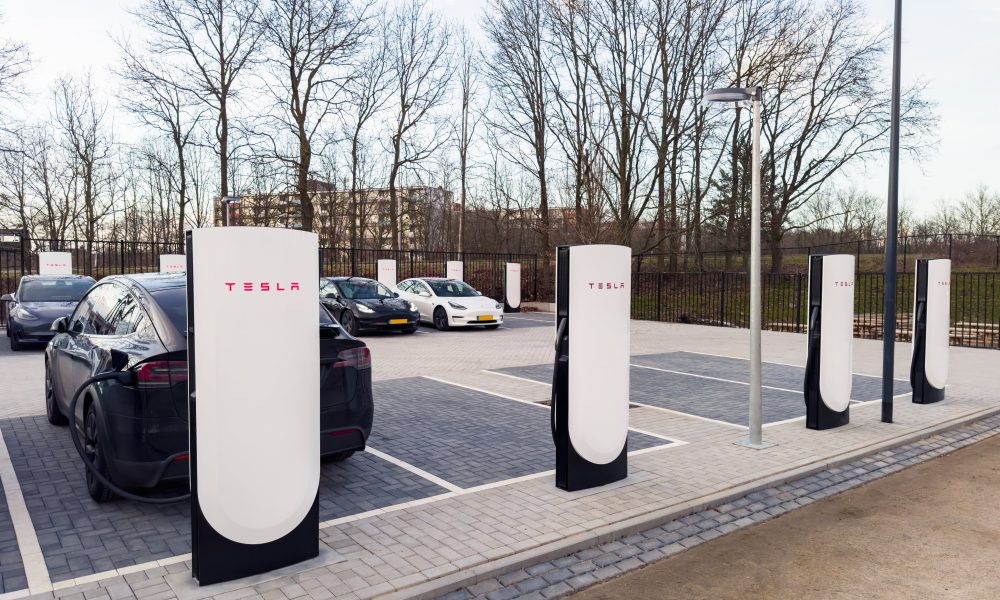
Tesla’s Supercharger strategy has shifted from a closed, Tesla-only fast-charging network to a more modular, higher-power and commercially flexible platform. Three linked developments define today’s change:
-
the rollout of next-generation V4 Supercharger hardware (higher power per cabinet, more stalls, improved cable/connector ergonomics);
-
a formal Supercharger for Business program that allows businesses to buy or host Tesla-managed Superchargers (including white-label options and managed services); and
-
expanded interoperability — Tesla now supports certain non-Tesla vehicles at selected Superchargers via native NACS ports or NACS adapters, and OEMs are beginning to adopt NACS.
Together these moves make it easier and faster to add high-power charging in urban centers and travel corridors, open revenue opportunities for property owners, and change the ownership experience for Tesla and non-Tesla EV drivers alike. Below I explain exactly what’s changing, how the hardware and commercial models work, what owners should expect day-to-day, and the strategic and regulatory implications for Europe and the U.S.
1. What’s new — a quick snapshot of the three big changes
-
V4 hardware rollouts: Next-gen V4 Superchargers are being deployed in multiple markets; V4 supports higher peak power per cabinet, denser station layouts, and station controls (payments, on-post terminals). Early V4 deployments have gone live in China and Europe, and Tesla is scaling installations across major corridors.
-
Supercharger for Business (sell/host model): Tesla now offers a program for businesses and property owners to purchase and host Superchargers. The company provides hardware, software, and managed-support options — effectively letting third parties own sites while Tesla handles operations and integration. This program includes white-label possibilities so a site can carry a business brand while using Tesla equipment and software.
-
Interoperability & NACS adoption: Tesla continues to open selected Superchargers to non-Tesla cars that use the NACS connector or a certified NACS adapter. Major OEMs and adapter programs are accelerating access for non-Tesla drivers (and some manufacturers like Porsche have announced deeper access plans).
These are not isolated product upgrades — they are a coordinated strategic push to scale charging faster, monetize idle assets, and make the Supercharger platform a broader infrastructure play instead of a closed in-house amenity.
2. V4 technical changes: what’s different and why it matters
V4 hardware highlights
-
Higher peak power per cabinet: V4 cabinets are engineered to deliver significantly higher peak power per cabinet than earlier versions (public reporting and vendor teardowns indicate per-stall peaks far above V3’s ~250 kW design), enabling much faster charging for capable EVs. Early deployments show Tesla targeting very high peak outputs per cabinet while managing load dynamically across stalls.
-
More stalls per site and denser layouts: V4 designs allow more stalls per cabinet and more cabinets per site within a smaller footprint. This increases throughput and reduces queue risk at busy hubs.
-
Improved cables & ergonomics: Longer, more flexible cables and improved connectors reduce hassles for larger vehicles and make public charging easier for drivers of different car geometries.
-
Integrated payment and management hardware: V4 sites roll in payment terminals and on-post electronics that let customers pay directly at the stall if needed, a change from older models where the Tesla app was the only standard payment method.
Why V4 matters practically
-
Shorter charge times for capable cars: For cars that can accept higher kW rates, V4 reduces highway dwell times. That makes long-distance EV travel faster and more convenient.
-
Higher site throughput: More power and more stalls reduce congestion at peak times, improving the everyday experience.
-
Lower total site cost per stall (in some cases): Denser layouts and integrated switchgear can improve land-use efficiency and reduce per-stall civil costs.
Caveat: peak power depends on both the EV’s charging curve and local grid availability. Not every car will see the absolute maximum kW at all times; V4’s practical benefit is biggest for vehicles with aggressive charging curves and for corridors with robust grid capacity.
3. Supercharger for Business: a new commercial model
What Tesla is offering
Tesla’s “Supercharger for Business” (public-facing pages and recent press) proposes a full-service offering: businesses purchase or allocate space, Tesla supplies the charging cabinets (V4 or otherwise), provides the backend software and monitoring, and offers ongoing maintenance, uptime guarantees and driver support. The program includes branding options (white-label cabinets with the business logo) and operational SLAs so owners can market fast charging as an amenity or a direct revenue stream.
Key features typically described in program summaries:
-
Hardware & software bundle: Tesla supplies chargers, networking, station controls, and integration with the Tesla fleet management platform.
-
Managed services: Preventive maintenance, remote monitoring, and software updates handled by Tesla or a certified partner.
-
Branding / white-label options: Businesses can brand the cabinets while charging sessions and back-end billing can still flow through the Tesla system.
-
Minimum scale & site requirements: Early program briefs suggest minimum ordering quantities (e.g., several stalls) and site readiness checks (power access, civil work).
-
Uptime targets: Tesla advertises high availability and service SLAs (some reporting cites a 97% uptime guarantee for managed sites).
Why Tesla is doing this
-
Rapid footprint expansion: Selling managed sites to businesses shifts the capex burden for land/site provision to private capital while leveraging Tesla’s operational platform to scale quickly.
-
Local partners accelerate permits & site procurement: Local businesses can negotiate faster with municipalities and provide convenient locations (retailers, parking operators, truck stops).
-
Monetize the network: Even if businesses buy hardware, Tesla can retain software revenue, payment processing fees, and service contracts — recurring revenue streams beyond car sales.
-
Reduce installation bottlenecks: Tesla can standardize site packages (V4 + medium-voltage package) that reduce custom engineering and shorten build times.
Business models & revenue flows
There are multiple settlement patterns possible:
-
Full purchase + managed services: Business pays for the equipment & installation and signs a contract for Tesla’s operations and software. The business keeps charging revenue but pays fees to Tesla.
-
Lease or revenue-share model: Tesla or a financier may subsidize hardware in exchange for a revenue share, useful for businesses lacking upfront capex.
-
White-label with Tesla billing: Business hosts the site and displays its brand, while Tesla handles customer billing and keeps a percentage of fees.
Each model has tradeoffs for risk, cashflow and customer experience — more on that below when we cover impacts for owners and operators.
4. Interoperability, NACS and the adapter story
The NACS pivot
Tesla designed the NACS (North American Charging Standard) port early and used it widely in North America. In 2024 and 2025 several OEMs signalled support for NACS (either by adopting the port natively or by offering adapters), and Tesla has progressively opened Superchargers to NACS-equipped non-Tesla cars at selected sites. Tesla’s support page now lists Superchargers open to non-Tesla vehicles that are NACS-equipped or using certified NACS adapters.
Adapters, native ports and OEM moves
-
OEMs are pursuing different approaches: some will include native NACS ports on future models; others will supply a government-approved adapter (or free adapter programs) to enable charging at Superchargers. Porsche and some other premium OEMs have announced paths to Tesla network access for their owners. This adoption accelerates cross-brand network effects and reduces range-anxiety friction.
Payment & app integration (plug-and-charge vs app)
-
Historically, the Tesla app (or Tesla account payment) was required. V4 sites are increasingly adding on-post payment hardware and enabling “plug-and-charge” or tokenized payment flows where an OEM account or a car’s credential triggers billing automatically. Tesla has also rolled out features that let users with Tesla accounts pay at third-party chargers via consolidated accounts (emerging as “Multipass” or similar product updates).
Practical implications
-
Non-Tesla EV owners gain meaningful access: Vehicles that are NACS-equipped or adapter-capable can now use many Superchargers, which increases effective charging coverage across brands.
-
One-stop billing: Tesla’s payment and account services allow drivers to charge at multiple sites and pay through a single account — a usability improvement that reduces friction for long trips.
-
Plug-and-charge adoption depends on OEM support: For true seamless plug-and-charge, carmakers must support the underlying authentication protocols. Until then, some owners still rely on apps or adapters.
5. How the new model changes charging availability and pricing for owners
Availability — more sites, faster deployment
-
By enabling businesses to buy or host sites, Tesla lowers the transaction friction of finding and funding new Supercharger locations. Expect more chargers at retail centers, hotels, restaurant hubs and parking operators. This should reduce charging deserts along major routes and in suburban areas over the medium term. The practical effect: shorter detours and fewer queues on primary corridors.
Pricing models & dynamic pricing
-
Dynamic idle fees & congestion pricing: Tesla has long used idle fees to discourage post-charge occupation. The new program allows owners/operators and Tesla to experiment more broadly with dynamic pricing and reservation models (for example, time-slot pricing at peak travel times). Expect pilot programs with surge pricing, subscription passes, or business-host promotions.
-
Business-host incentives & cross-subsidies: Property owners may use chargers as loss leaders (free or subsidized charging to attract customers) or monetize them directly. Hospitality operators may bundle charging with stays or loyalty programs.
-
Transaction fees & app convenience: Tesla’s managed billing simplifies payments but adds processing fees. Whether end users see lower per-kWh prices depends on operator choices and local electricity/demand charges.
What owners should watch for
-
Peak-time price signals: Charging during peak travel windows may be costlier; planning off-peak charging when possible reduces cost.
-
Reservation & membership products: Some sites will test booking windows for high-demand corridors; owners who need guarantees on long trips may find membership/reservation useful.
-
Roaming & payment consolidation: Tesla’s Multipass-style features aim to let drivers pay for multiple networks through one account — a convenience improvement, especially for European cross-border travel.
6. Impact for non-Tesla EV drivers and OEM relationships
Network access for non-Tesla cars
-
With NACS adoption and adapter programs, non-Tesla cars increasingly gain access to Superchargers at selected sites — improving cross-brand network coverage. OEMs with active adapter programs (or native NACS ports) will see a step-change in public charging convenience for customers.
OEM partnerships and strategic alignment
-
Tesla’s move to offer Superchargers to third parties and allow OEM access is a strategic pivot from closed-garden to platform provider. This both reduces Tesla’s competitive advantage as a closed ecosystem and creates new industry standards (NACS). OEMs that adopt NACS accelerate interoperability; those who resist must rely on other charging networks or adapters. The commercial relationships vary: some OEMs will pay Tesla for access; others will integrate billing for plug-and-charge experience.
For drivers of other brands: things to verify
-
Adapter availability: Does your car support a certified adapter, or will your model include a native NACS port in upcoming years?
-
Plug-and-charge support: For a frictionless experience, confirm whether your OEM supports credential-based plug-and-charge at Tesla sites or whether the Tesla app (or manual payment) is required.
-
Charger eligibility: Not all Superchargers are open to non-Tesla vehicles — check Tesla’s support pages for individual station eligibility.
7. Case studies & strategic deals: EG Group, BP, Porsche and early adopters
EG Group & BP deals (examples of early commercial routes)
-
Tesla has previously struck deals to sell chargers to major fuel-retail operators and convenience store chains (e.g., deals with EG Group and large energy retailers), and those partnerships illustrate the white-label/host model’s potential to rapidly infill highway and urban sites. These agreements leverage well-placed retail footprints and tap existing fuel-retailer logistics for maintenance and forecourt services.
Porsche & OEM access
-
Premium OEMs (e.g., Porsche) have publicly signalled pathways for their customers to access Tesla’s network via NACS or adapters; Porsche’s move to integrate access shows how OEMs consider the Supercharger network a competitive advantage to offer owners, not just a Tesla-only asset. Such moves encourage broader acceptance of Tesla’s connector standard and create a more uniform charging experience across brands in Europe. Early site example: Gigafactory & urban V4 pilots
-
V4 stations at major Tesla facilities and urban test sites demonstrate higher throughput and serve as real-world testbeds for congestion management, payment flows and mixed-brand access policies. These pilots provide the early data Tesla and partners need to fine-tune pricing, reservations and grease the interconnection processes with DSOs.
8. Grid, interconnection and technical deployment realities
Grid constraints remain the ultimate limiter
-
Adding V4 cabinets requires robust medium-voltage connections and sometimes substation upgrades. Prefab station designs help, but distribution upgrades and local grid agreements remain major lead-time items for new high-power sites. Tesla’s managed program helps standardize technical packages, which can reduce engineering review time, but it cannot eliminate DSO/TSO-driven interconnection queues.
Energy storage pairing
-
Many high-power Supercharger hubs pair with on-site battery storage (or battery-as-a-service) to smooth peak loads and reduce demand charges. The combination of Megablock/Megapack deployments and V4 chargers is an operational pattern that reduces the need for costly grid reinforcement at every site, but it adds capex and complexity. Owners should watch whether hosted sites include storage — that will affect reliability and peak pricing.
Permitting & local approvals
-
Urban and historic areas still face long permitting windows. Partnering with local businesses via the Supercharger for Business program helps speed approvals because local hosts can navigate municipal channels and use established relationships.
9. Operational & UX changes owners will notice
App experience & payment improvements
-
Expect more charging sessions to support direct on-post payments and consolidated Tesla account billing (one wallet across networks). This makes cross-network trips simpler and reduces the need for multiple apps or RFID cards. Tesla’s Multipass-style products aim to aggregate purchases across networks into a single Tesla account.
Reservations, idle fees & congestion controls
-
Busy hubs will increasingly experiment with reservation windows, time-based bookings for long trips, and stepped idle/overstay fees. If you’re planning a long trip, check for reservation options or membership products; for everyday charging, avoiding peak periods will yield better prices and availability.
Station signage & branding
-
White-labelled cabinets may carry host branding but will still connect to Tesla’s management platform. Drivers should confirm that payment and compatibility info is clearly posted at sites (especially for non-Tesla vehicles).
10. Regulatory, competitive and privacy considerations
Competition & fair access
-
European regulators are watching interoperability closely. The move toward NACS is largely market-driven, but regulators may push for minimum open-access requirements or standard roaming agreements to ensure fair competition among CPOs (charge point operators). Interoperability frameworks (OCPI/OSCP/ISO 15118) remain important for cross-network credentials.
Data & privacy
-
Centralized billing and telemetry mean Tesla (or its partners) will collect session-level data (timestamps, energy, car ID). European data protection rules (GDPR) impose obligations on how that data is stored, shared and used; hosts and Tesla must provide compliant privacy terms.
Local energy policy alignment
-
National charging strategies, subsidies and grid upgrade programs influence which sites receive public funding. Businesses and municipalities will look for co-funding models that align public grants with private Supercharger deployments.
11. Strategic implications for Tesla and the wider charging ecosystem
For Tesla
-
From product moat to platform play: Tesla is shifting some advantage from proprietary charging to platform services — hardware sales, software services and managed operations generate new revenues and reduce the burden on Tesla to own all sites.
-
Recurring revenue & software monetization: Even if third parties buy hardware, Tesla’s software and operations remain a revenue stream. That recurring income can be more stable than one-time charger sales.
-
Brand tradeoff: Opening the network reduces the exclusivity Tesla owners enjoyed, but a broadly accessible, reliable network improves EV adoption and benefits Tesla vehicle sales in the long run.
For the charging industry
-
Faster network densification: Retailers and fuel operators will accelerate site rollouts, increasing competition with incumbent CPOs but also stitching a denser national backbone.
-
Standard consolidation: If NACS continues to gain OEM support in Europe, it pressures other networks to provide adapters or adopt plug standards for cross-network convenience.
12. Practical recommendations for owners
If you own a Tesla:
-
Expect more convenient fast-charging options in the next 12–36 months as businesses adopt Tesla’s managed program. Check site eligibility for your route before long trips.
-
Enable plug-and-charge when available to reduce friction; ensure your Tesla app is updated and payment methods are current.
-
Watch for reservation & membership features on key corridors — they’ll be useful for peak travel or guaranteed charging windows.
If you own a non-Tesla EV:
-
Check adapter availability or native NACS plans from your OEM. If your model supports an adapter or native NACS, your long-distance charging options improve quickly.
-
Confirm plug-and-charge capability with your manufacturer to get the most seamless experience at Tesla sites.
-
Plan ahead: Not all Superchargers are open to non-Tesla cars yet; always verify station eligibility before relying on a given hub.
If you’re a business/property owner:
-
Evaluate the Supercharger for Business proposition against alternative CPOs — weigh capex, expected foot traffic, service levels, branding, and revenue share.
-
Consider storage pairing if local demand charges are high or grid constraints exist. Tesla’s integrated offerings may accelerate commissioning.
13. Risks & what could slow this momentum
-
Grid interconnection bottlenecks: High-power installs still require medium-voltage connections and substation upgrades; local grid capacity is a practical limiter.
-
Adapter fragmentation & slow OEM rollout: If OEMs are slow to adopt native NACS or universal authentication protocols, interoperability frictions remain.
-
Regulatory intervention: Regulators could require more open-access rules or standardized roaming, which could slow revenue models that depend on proprietary control.
-
Public perception & maintenance quality: Rapid scale without quality control risks reliability degradation; partner SLAs and maintenance programs will determine real reliability outcomes.
14. Conclusion — what this all means for owners now
Tesla’s Supercharger evolution to V4 hardware, open interoperability and a business-host model is a game-changer for charging infrastructure density and usability. For owners in Europe and the U.S., the near-term benefits are practical: faster potential charging speeds, a larger set of convenient locations (especially on busy routes), and smoother payments if plug-and-charge and account consolidation roll out as advertised. Non-Tesla owners are starting to see better access, and property owners can monetize valuable parking with managed Supercharger sites.
The change is not friction-free — grid upgrades, permitting, and OEM integration timelines will shape how fast the benefits arrive. But the strategic shift is clear: Tesla is moving from a protective ecosystem to a broader platform player, and that will materially improve charging convenience for EV drivers as long as the rollout stays reliable.
FAQ
Q: Can any business buy a Supercharger today?
A: Tesla launched a Supercharger for Business program that lets property owners purchase and host chargers; details and minimum site requirements are provided on Tesla’s business pages and via local Tesla sales channels.
Q: Are Superchargers in Europe open to non-Tesla cars?
A: Some Superchargers are now open to non-Tesla vehicles that are NACS-equipped or use certified NACS adapters. Not all sites are open yet; check Tesla’s “Supercharging Other EVs” support page for station-level status.
Q: Will my non-Tesla car charge as fast as a Tesla at V4?
A: Charging speed depends on your car’s maximum DC charging rate and battery charging curve. V4 increases station capacity, but your car’s electronics determine the peak kW it will accept.
Q: Will I have to use the Tesla app to pay?
A: V4 and the business program are introducing on-post payment terminals and consolidated account billing, but the precise payment flow depends on the operator and whether your car supports plug-and-charge with your OEM credentials. Tesla has also been rolling out Multipass-style features to let users pay across networks with a Tesla account.
Q: Will this make Superchargers more expensive?
A: Pricing will vary by operator and region. Some hosts may subsidize charging as an amenity; others may adopt dynamic pricing to manage congestion. Higher peak-cost sites may use demand pricing