
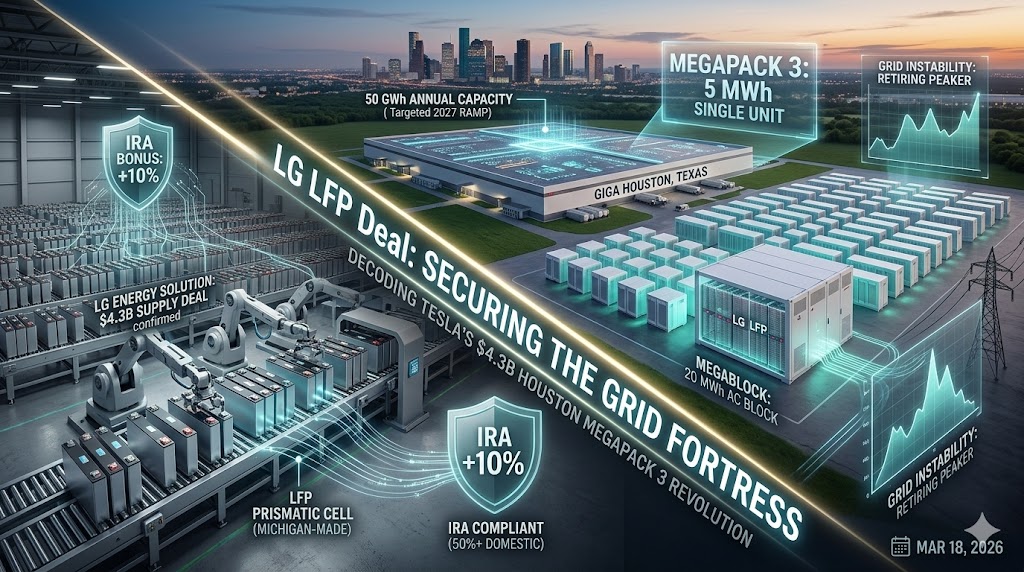
1. Introduction: The Strategic Pivot of 2026
While the world’s media was focused on the latest FSD v13 update and the upcoming Roadster reveal, the most significant shift in Tesla’s financial future was confirmed by the U.S. Department of the Interior on March 16-17, 2026. Tesla has officially been named as the buyer behind a monumental $4.3 billion battery supply agreement with South Korean giant LG Energy Solution (LGES).
This deal isn't just about buying batteries; it’s about onshoring the revolution. The agreement secures a massive supply of Michigan-made Lithium Iron Phosphate (LFP) cells destined for a specific purpose: powering the Megapack 3 at Tesla's new $200 million "Megafactory" near Houston, Texas. As of March 2026, Tesla’s energy division is growing faster than its automotive segment, and this deal is the fuel that ensures that trajectory continues.
2. The Infrastructure: Giga Houston and Megapack 3
To understand the scale of this investment, we must look at the destination of these cells: Giga Houston (located in Brookshire, Texas).
2.1 A Replication of Lathrop
Modeled after the highly successful Lathrop, California facility, the Houston Megafactory is a 1-million-square-foot marvel of automation.
-
Annual Capacity: Targeted at 50 GWh per year—enough to retire hundreds of fossil-fuel "peaker" plants annually.
-
Economic Impact: The facility is expected to create 1,500 high-tech jobs by 2028, with many roles paying upwards of $100,000, signaling Tesla’s commitment to the American "Energy Belt."
2.2 What makes Megapack 3 Different?
The Megapack 3 is a leap forward in utility-scale density.
-
Storage Capacity: Each unit now delivers approximately 5 MWh of storage, a significant increase over the 3.9 MWh of the Megapack 2XL.
-
The Megablock: Tesla has also introduced the "Megablock"—a pre-engineered solution that combines four Megapack 3 units into a single 20 MWh AC block, allowing utilities to deploy 1 GWh of storage in just 20 business days.
3. The Geopolitical Masterstroke: LG and the IRA
Why spend $4.3 billion with LG instead of continuing to rely solely on Chinese giants like CATL? The answer lies in the Inflation Reduction Act (IRA) and shifting trade dynamics.
3.2 The Lansing Rebirth
The cells for this deal will be produced in Lansing, Michigan. This facility was originally a joint venture with GM (Ultium Cells 3), but after GM’s departure from the project, LG retooled the site specifically for LFP prismatic cells.
-
IRA Compliance: By 2026, domestic content requirements for federal tax credits hit a 50% threshold. Sourcing cells from Michigan allows Tesla’s utility customers to claim the 10% "Domestic Content" bonus, making Tesla the most cost-competitive option in the U.S. market.
-
Tariff Mitigation: With the U.S. government aggressively increasing tariffs on Chinese-made battery imports in early 2026, the LG deal shields Tesla from supply chain volatility and ensures price stability for its 90 GWh order backlog.
4. Business Impact: Energy Outpacing Auto
The financial data from Q4 2025 and Q1 2026 tells a clear story: Tesla Energy is the new growth engine.
-
Revenue Scale: In 2025, Tesla’s energy segment generated $12.8 billion, representing 13% of total revenue.
-
Profitability: While automotive margins faced pressure from price cuts, energy storage margins hit record highs of 30%, contributing nearly $3.8 billion in gross profit for the year.
-
Backlog Visibility: Tesla enters mid-2026 with a backlog of over 90 GWh in grid-scale orders. The LG deal ensures that the "iron" (LFP) is available to turn that backlog into recognized revenue.
5. Conclusion: Tesla as a Global Utility Titan
The $4.3 billion LG deal marks the end of Tesla's reliance on foreign-made stationary storage batteries for the North American market. By linking Michigan cell production to Houston-based assembly, Tesla has created a closed-loop domestic supply chain that is immune to geopolitical tremors.
For the Tesla owner, this matters because the "Energy Empire" provides the financial floor that allows the company to continue innovating in FSD, Robotics, and next-gen vehicles. Tesla is no longer just a car company—it is the backbone of the 21st-century electric grid.
FAQ: The Houston Megafactory & LG Deal
Q: Will this deal affect the price of the Powerwall 3 for my home?
-
A: Indirectly, yes. Scaling LFP production in the U.S. with LG lowers the overall cost-per-kWh for Tesla, which helps keep the Powerwall 3 at its competitive $8,500 (pre-install) price point.
Q: Why is LFP used for Megapacks instead of the 4680 cells used in the Cybertruck?
-
A: LFP (Lithium Iron Phosphate) is ideal for stationary storage because it has a significantly longer cycle life (10,000+ cycles) and a superior safety profile, which are more critical for grid use than the extreme energy density required for high-performance trucks.
Q: When will the Houston Megafactory reach full capacity?
-
A: Production begins in late 2026, with a targeted ramp-up to its full 50 GWh capacity by the end of 2027.