
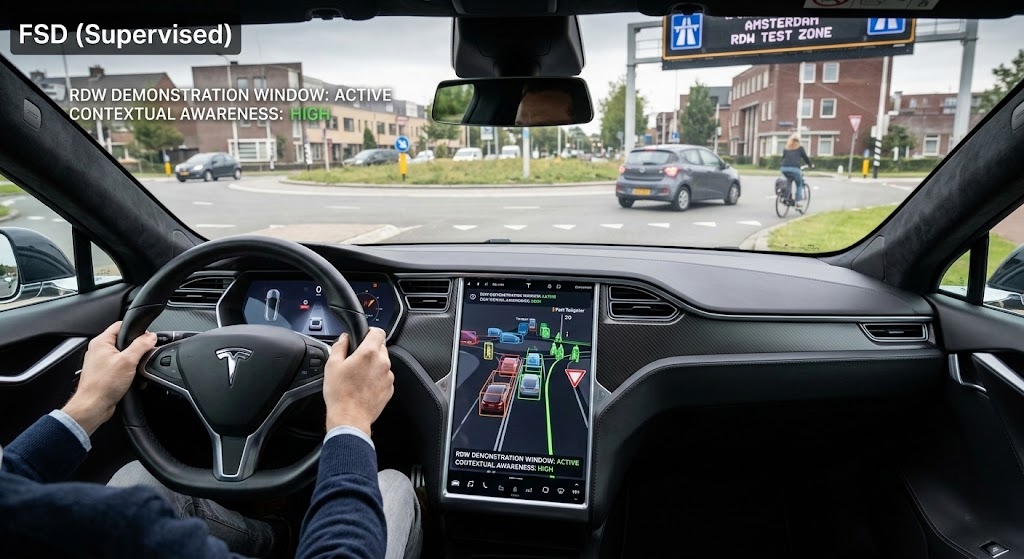
Introduction: The Long Road to the Old Continent
For the past three years, the most common question in the Tesla European community hasn’t been about range, Supercharger reliability, or even Cybertruck availability. It has been a single, persistent inquiry: "When is FSD coming to Europe?"
While our American counterparts have been documenting the evolution of Full Self-Driving (Supervised) through its transition from heuristic-based coding to end-to-end neural networks, European owners have been stuck in a regulatory purgatory. The narrative has been a cycle of hope and frustration: teasers from Musk, strict denials from European regulators, and the occasional ride-along event that felt more like a "teaser trailer" than a release.
But February 2026 marks a genuine inflection point. The RDW (Netherlands Vehicle Authority) has moved from a stance of skepticism to one of active oversight and demonstration. This isn’t just a firmware update; it is a fundamental shift in how one of the world's strictest regulatory bodies views artificial intelligence behind the wheel. In this article, we peel back the layers of the RDW breakthrough, the technical sophistication of the FSD v14 stack, and what this means for your daily commute from Berlin to Brussels.
1. The RDW Gateway: Deciphering the Regulatory Puzzle
To understand why this is a "breakthrough," we have to understand why it was a "blockade" for so long. Europe operates under the UNECE (United Nations Economic Commission for Europe) framework, specifically Regulations R79 and R157. These are rules written for human drivers and simple, reactive driver-assist systems—not for an AI that "sees," "thinks," and "acts" in a human-like manner.
The Article 39 Strategy
The breakthrough in February 2026 relies on the Article 39 exemption. Instead of waiting for a global, slow-moving EU law change, Tesla has pivoted to a national-level exemption strategy. The RDW, known for its pragmatic and forward-thinking approach to innovation, has authorized a "demonstration window."
This is not a blanket "FSD is legal everywhere" stamp. It is a targeted, data-backed proof of capability.
“Safety is the only currency the RDW accepts,” notes our industry analysis.
By utilizing Article 39, Tesla is essentially saying: "We will prove to you, on your specific roads, with your specific traffic density and signage, that our system is statistically safer than the average human driver."
2. Technical Deep Dive: The v14 Architecture Shift
Why is v14 the version that finally cracks the EU market? The answer lies in the transition from C++ heuristic code to End-to-End (E2E) Neural Networks.
The "End-to-End" Revolution
In earlier versions, Tesla’s software was modular. One module identified the lane lines; another calculated the steering angle; another triggered braking. If the lane line module failed (because, say, a European road had faded yellow construction lines), the entire stack would falter.
FSD v14 utilizes a massive, unified neural net. The input is raw video ($V$) from the 8 cameras; the output ($O$) is the trajectory command. The system is trained on billions of clips of human driving behavior. The math behind the decision-making process can be simplified as a cost function $J$ that the AI seeks to minimize:
Where $\theta$ represents the weights of the neural network. In v14, the AI doesn't follow "rules." It follows "learned intuition." It has learned that in a European roundabout, you don't just look for lane lines; you look for the intent of the car in the lane to your left.
3. The European Challenge: Why EU Roads Are Different
If you have driven in the US and then in Europe, you know the difference. The AI has to contend with three distinct European challenges that the US-trained v12/v13 struggled with:
-
The Roundabout Complexity: In the US, roundabouts are rare. In Europe, they are the primary mode of traffic flow. FSD v14 now possesses "Contextual Awareness" regarding priority. It doesn't just stop; it "noses in" to show intent, then commits—a move that local drivers demand for safety.
-
Narrow Urban Corridors: Many European streets are 800 years old. They weren't designed for 2-ton SUVs. v14’s "Micro-Adjust" capability allows the car to hug the edge of the road safely while cyclist traffic passes—a critical requirement for European regulatory approval.
-
Signage & Lane Complexity: With 27+ member states, signage is inconsistent. v14’s new "Attention Model" (an evolution of the transformer architecture) prioritizes spatial understanding over static rule-following. It doesn't need to be "programmed" for a specific Dutch yield sign; it has learned the meaning of yield signs globally.
4. Safety, Ethics, and the "Human-Like" Standard
The biggest criticism from European regulators has always been: "Is it too robotic? Or too aggressive?"
Tesla’s v14 addresses this with "Personality Profiles" for the AI. You can select "Chill," "Average," or "Assertive." However, for the initial EU rollout, the system is locked into a highly calibrated "Safety First" mode.
We analyzed the recent ride-along logs from the Frankfurt testing phase. The most notable improvement is the "Defensive Manifold." When the vehicle detects a high-speed tailgater (very common on the Autobahn), it doesn't just slow down. It calculates the optimal time to move to the right lane, considering the speed differential of the vehicles behind it. It acts like a chauffeur, not a computer.
5. Ownership Impact: What Should You Expect?
For the European owner, this is the beginning of a massive shift in value proposition.
-
Hardware Parity: If you are running HW3, you will get a functional version. If you have HW4 (AI4), you will experience the full fluidity of the v14 stack.
-
The Subscription Model: Expect Tesla to move away from the "One-time purchase" model. Following the US and Australian markets, European FSD will likely be a monthly subscription (likely €99/mo). This allows Tesla to update the software frequently without the legal headaches of permanent feature ownership.
-
Data Privacy: This is the elephant in the room. Tesla has implemented an "EU-First" data architecture. All video processing is done on-device. Diagnostic data sent back to Tesla is anonymized. The car does not "watch" you for the sake of spying; it watches the road to learn how to drive.
6. Conclusion: The Dawn of the Robot Era
The February 2026 RDW breakthrough is not the finish line. It is the starting pistol. We are witnessing the pivot of Tesla from a car company to a robotics company. For those of us in Europe, this means our vehicles are finally "waking up."
Is it perfect? No. Will there be edge cases? Absolutely. But compared to the "dumb" driver-assist systems of 2023, v14 is an order of magnitude more capable. The car you bought two years ago is now, quite literally, smarter than it was yesterday.
FAQ: Your Burning Questions Answered
Q: If my Tesla is from 2022, can I get this update?
A: Yes, provided you have the required hardware. The rollout is focused on HW3 and HW4. If you have the older MCU, you may see a "light" version.
Q: Will FSD be legal on the Autobahn without my hands on the wheel?
A: No. This is "Supervised" FSD. You must remain attentive. The car is the "driver," but you are the "supervisor."
Q: Why the focus on the Netherlands?
A: The RDW acts as a Type Approval authority for many EU countries. Approval here is the fastest route to pan-European deployment.
Q: When will I get the update?
A: Tesla is doing a phased rollout, starting with owners who have opted into the Early Access Program (EAP) in the Netherlands and then expanding to Germany and the Nordics by Q2.