
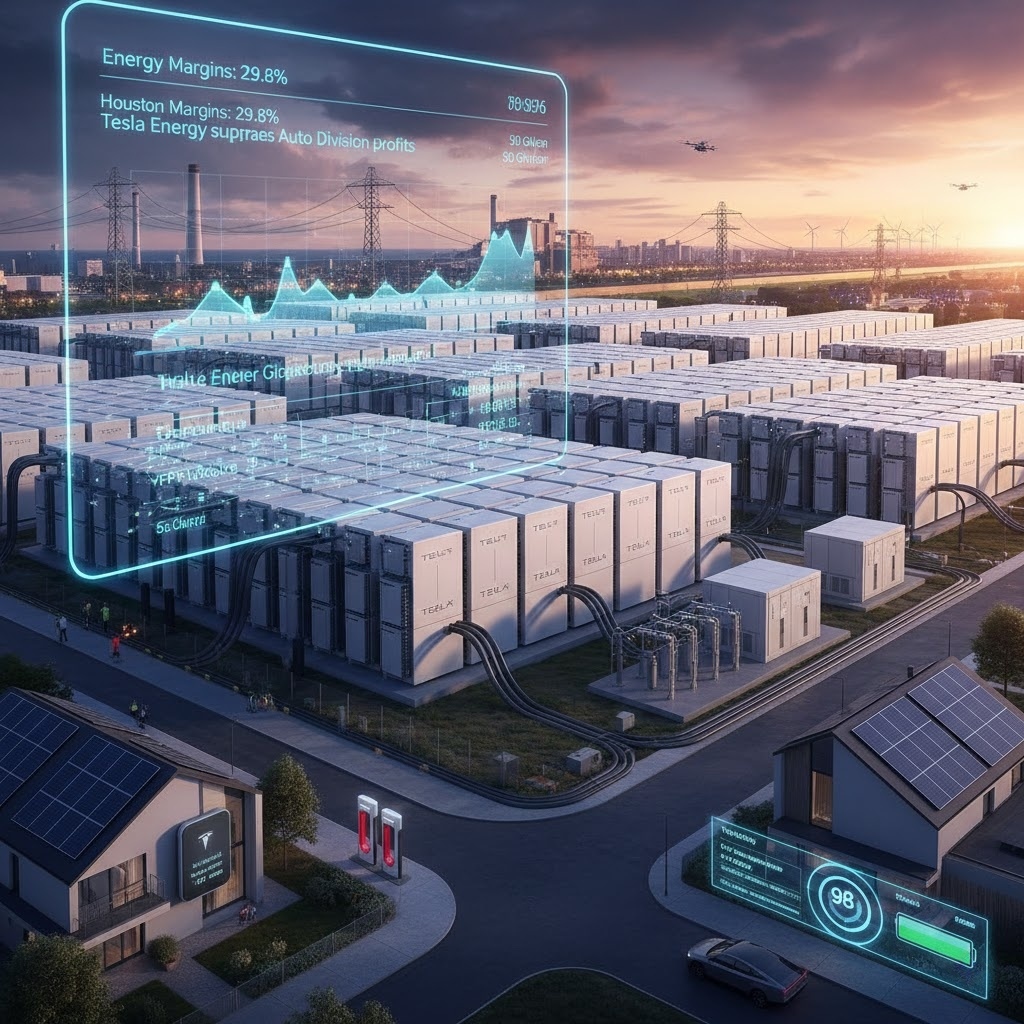
Introduction: The "Sleeping Giant" Awakes
For over a decade, the global narrative surrounding Tesla has been dominated by its role as an automaker. From the sleek Model S to the ubiquitous Model Y, the "metal and rubber" of the automotive industry was the primary engine of the company's valuation. However, as of February 2, 2026, a fundamental structural shift has reached critical mass.
While the automotive sector faces cooling global demand and increased competition from European and Chinese incumbents, Tesla Energy has quietly emerged as the company's new growth locomotive. Today, Tesla is no longer a car company with a battery side-project; it is a global energy utility and storage provider that just happens to make electric vehicles. With record-shattering deployments of 46.7 GWh in 2025 and the announcement of massive new industrial-scale facilities, 2026 is the year where energy margins may finally solidify Tesla’s "AI and Power" valuation.
Chapter 1: The Numbers Behind the Surge
1.1 Record-Breaking Deployments
Tesla’s Q4 2025 financial results, released just days ago on January 28, 2026, tell a tale of two companies. While automotive revenue saw a 10-11% year-over-year decline, the energy division hit a quarterly record of 14.2 GWh in deployments. For the full year of 2025, Tesla deployed a staggering 46.7 GWh of energy storage—nearly a 50% increase over 2024.
1.2 The Margin Flip
Perhaps the most significant revelation for Wall Street today is the profitability divergence. Tesla Energy reported gross margins of 29.8% in the most recent quarter, nearly double the 15.4% (excluding credits) earned by the automotive division. This margin expansion is driven by the decreasing cost of Lithium Iron Phosphate (LFP) cells and the massive economies of scale achieved at the Lathrop and Shanghai Megafactories.
Chapter 2: The "Megablock" and the Houston Factory
2.1 Project Megablock: Scaling the Grid
In early 2026, Tesla officially introduced the "Megablock." While the individual Megapack was designed for decentralized storage, the Megablock is a factory-integrated, massive-scale system designed for gigawatt-level utility deployments. Each Megablock unit comes pre-wired with integrated power electronics, allowing utilities to deploy thousands of MWh in a fraction of the time required for traditional battery farms.
2.2 The Houston Powerhouse
To support this new product, Tesla has broken ground on its most ambitious energy facility yet: the Houston Megablock Factory.
-
Planned Capacity: 50 GWh annually.
-
Total Capacity Projection: Once Houston joins the Lathrop (40 GWh) and Shanghai (40 GWh) facilities, Tesla’s total grid-storage manufacturing capacity will exceed 130 GWh per year.
-
Strategic Location: By placing this plant in Texas, Tesla is positioned at the heart of the U.S. energy transition, leveraging the state’s massive wind and solar surplus.
Chapter 3: Project Mufasa – The European Energy Backbone
3.1 Stabilizing the Dutch Grid
In Europe, the standout project of 2026 is Project Mufasa in Vlissingen, Netherlands. Developed in partnership with Lion Storage and Return, this site utilizes 372 Tesla Megapack 2 XL units to create a 1.4 GWh storage reservoir.
3.2 Repurposing the Past
What makes Project Mufasa a blueprint for the future is its location: it occupies the site of a former coal-fired power plant. By utilizing the existing high-voltage grid connections of the fossil-fuel era, Tesla is literally replacing the "old guard" with sustainable AI-managed energy. The site can power over 200,000 households and provides the rapid-response frequency regulation needed to stabilize a European grid that is increasingly dependent on intermittent renewables.
Chapter 4: Consumer Synergy – The Powerwall 4 and Tesla Electric
4.1 Powerwall 4: The Home Micro-Grid
While Megapacks dominate the utility space, the Powerwall 4 (launched in late 2025) has revolutionized the residential market. With a higher peak output and integrated EV charging logic, it allows homeowners to disconnect from the grid during peak pricing hours.
4.2 Tesla Electric Expansion
Tesla is no longer just selling the battery; it is selling the electrons. The "Tesla Electric" utility service is now expanding across the UK and Germany in 2026. By aggregating thousands of Powerwalls and Megapacks into a Virtual Power Plant (VPP), Tesla can outbid traditional gas-peaker plants on the open market, sharing the profits with its customers.
Conclusion: The Utility of the Future
As we look at the remainder of 2026, the trajectory is clear. Tesla’s expertise in battery chemistry and high-volume manufacturing has successfully bridged the gap between transportation and the electric grid. With energy storage backlogs stretching into 2027 and margins far exceeding its core car business, Tesla Energy is no longer a side project—it is the foundation upon which the company’s future "amazing abundance" will be built.
FAQ
-
Q: Why are energy margins higher than car margins?
-
A: Energy storage products like the Megapack have fewer components (no seats, steering wheels, or complex safety sensors) and use cheaper, longer-lasting LFP chemistries, allowing for higher manufacturing efficiency.
-
-
Q: Can I use my Tesla car as a Powerwall?
-
A: In 2026, Tesla has expanded Vehicle-to-Home (V2H) capabilities for the Cybertruck and the new "Redwood" platform, allowing the vehicle to act as a backup power source during outages.
-
-
Q: Where is the energy division most profitable?
-
A: Currently, the U.S. and Australia lead in profitability due to high demand for grid stabilization, but Europe is the fastest-growing region following the launch of Project Mufasa.
-