
Introduction: The "Model T" Moment of the 21st Century
For nearly a decade, the "$25,000 Tesla"—often dubbed by the community as the "Model 2"—has been the automotive industry’s equivalent of a ghost story. It was frequently discussed, occasionally glimpsed in patent filings, but never quite tangible. As of February 27, 2026, the specter has taken a solid, metallic form.
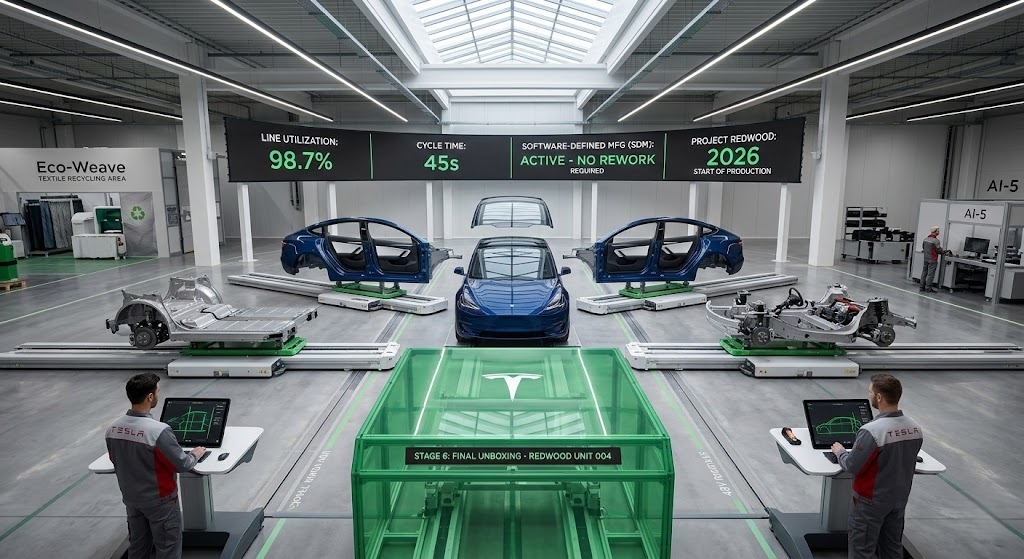
With the first "Project Redwood" pilot units now rolling off the lines at Giga Texas and Giga Berlin, we are witnessing more than just the launch of a budget car. We are witnessing a total reinvention of how a vehicle is conceived, built, and sold. To hit a $25,000 price point while maintaining a 20%+ gross margin, Tesla couldn't just "shrink" a Model 3. They had to rewrite the rules of the factory floor.
1. The "Unboxed" Assembly Process: Breaking the 100-Year-Old Line
The traditional automotive assembly line, pioneered by Henry Ford and perfected by Toyota, moves a stamped metal shell through a long linear path. Workers and robots reach inside the cramped body to install seats, dashboards, and wiring. This is inefficient; it wastes space and limits how many people can work on a car at once.
Parallel Manufacturing
Tesla’s "Unboxed Process," debuting fully with the Model 2, breaks the car into six distinct modules (sub-assemblies).
-
Front Underbody (Giga Casting)
-
Rear Underbody (Giga Casting)
-
Left/Right Side Panels
-
Interior Floor/Battery Pack
-
Roof Structure
Each of these is fully outfitted separately. For example, the seats are bolted onto the battery pack/floor module while it is still open and accessible—not threaded through a door opening later. At the very end of the line, these modules are "snapped" together in a single high-precision joining station.
The Math of Efficiency:
By building the car in parallel, Tesla has reduced the factory footprint by 40%. In the expensive industrial zones of Germany (Brandenburg), this footprint reduction is the difference between a profitable product and a loss-leader.
2. Software-Defined Manufacturing: The $800 Advantage
Tesla has begun utilizing "Software-Defined Manufacturing" (SDM) to eliminate the "invisible costs" of car building. Historically, if a robot misaligns a screw or a weld, the line stops, or the car is sent to "rework."
In 2026, the Model 2 production line uses a proprietary vision-based AI (derived from the FSD stack) to monitor the assembly in real-time. If a component is $0.5\text{ mm}$ out of tolerance, the software compensates the next robot in the sequence to adjust its path automatically.
Internal Benchmark: Industry data from February 2026 suggests this "Self-Correcting Line" saves Tesla approximately $400 to $800 per vehicle in inspection and correction costs compared to legacy OEMs.
3. The $25k Specs: Range, Power, and the LFP Strategy
To reach the price target, the Model 2 (Project Redwood) utilizes a 53kWh Lithium Iron Phosphate (LFP) battery pack. While LFP is heavier than the Nickel-based cells in a Model S, the Model 2's radical light-weighting compensates for it.
Technical Specifications (2026 Model 2 RWD):
-
Range: 250 miles (EPA) / 410 km (WLTP).
-
0-60 mph: 5.9 seconds.
-
Architecture: 48-Volt Low Voltage System (allowing for thinner, lighter wiring).
-
Drag Coefficient ($C_d$): 0.21 (Expected to be the most aerodynamic hatchback in its class).
The 48V architecture is a "silent hero" here. By moving away from the industry-standard 12V system, Tesla has reduced the amount of copper in the car by nearly 15kg. In a world of rising commodity prices, this is a massive hedge against inflation.
4. Interior Revolution: The "Mini-Y" Aesthetic
Early leaks from Giga Berlin confirm that the Model 2 is a "compact crossover"—think of a shrunk-down Model Y with a more aggressive "Kamm-back" rear for aerodynamic efficiency.
Inside, Tesla has doubled down on minimalism. There is no traditional instrument cluster and, controversially, no physical stalks. Everything is controlled via the 15-inch central display or the steering wheel scrolls.
-
Recycled Textiles: The 2026 interior features a new "Eco-Weave" fabric made from recycled ocean plastics, replacing the expensive "Vegan Leather" used in the Model 3/Y.
-
Ambient Lighting: A full-width LED light bar provides the primary cabin illumination, doubling as a visual alert for FSD notifications.
5. The "FSD Lite" and High-Margin Software
The Model 2 is "Autonomy First." Every unit comes standard with the AI 5 computer (Hardware 5). Tesla is expected to offer a specific "FSD Lite" for this model—a $99/month subscription that provides urban navigation and auto-parking, tailored for city dwellers.
By making the car "FSD-ready" from day one, Tesla turns a $25,000 hardware sale into a potential $10,000/year software revenue stream. This is why Tesla can afford to sell the hardware at such a low price: they aren't just selling a car; they are selling a portal to a service.
Conclusion: Ending the "EV for the 1%" Era
The 2026 Model 2 is the "Model T" moment for the electric era. It represents the point where an EV is no longer a luxury statement or a tech-enthusiast's toy, but a pragmatic tool for the masses. By leveraging "Unboxed" manufacturing and a software-first approach to the factory itself, Tesla has built a moat that will be incredibly difficult for legacy automakers to cross.
FAQ: Your Redwood Questions Answered
Q: Can I actually buy one for $25,000?
A: Yes, the base RWD model is targeting a $24,990 USD / €26,000 price point. However, with the US Federal Tax Credit or European local incentives, the "effective" price for many owners will be under $18,000.
Q: Is it a hatchback or an SUV?
A: It is technically a "Compact Crossover." It has a higher seating position than a Model 3 but a shorter footprint, making it ideal for European city parking.
Q: Does it have a steering wheel?
A: Yes. While the "Cybercab" is wheel-less, the Model 2/Redwood is designed for human drivers, though it is optimized for high-utilization FSD.
Q: Where is it built?
A: Initial production is at Giga Texas. Giga Berlin is currently installing the second "Unboxed" line, with European deliveries expected to ramp in Q3 2026.