
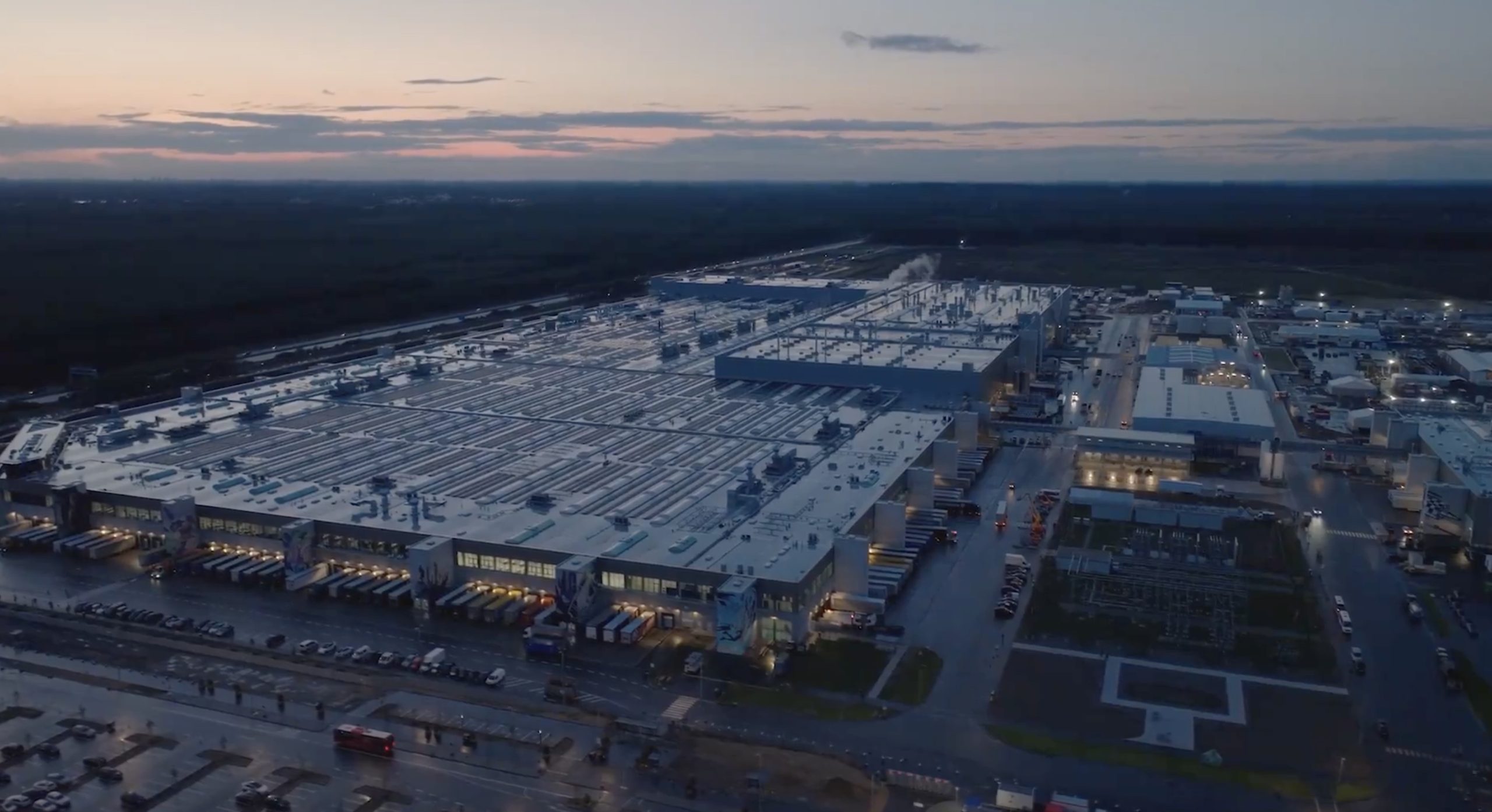
In July 2025, Tesla confirmed a major expansion at Giga Berlin while actively scouting locations for a new Gigafactory in Southern Europe. These developments signal Tesla’s commitment to reinforcing its manufacturing presence within Europe, optimizing logistics, reducing costs, and meeting the growing demand for electric vehicles (EVs) and energy products in the region. This report covers Giga Berlin’s production ramp, the scope of its expansion, and the rationale behind Tesla’s Southern European factory exploration.
I. Giga Berlin Expansion: Scope and Timeline
-
Factory Footprint and Capacity Goals
-
Expansion adds 2 million square feet of factory space, increasing total capacity from 500,000 to 800,000 vehicles per year.
-
Additional space dedicated to in-house battery cell production and energy storage assembly.
-
Projected project completion timeline: Q4 2027.
-
-
Product Line Expansion
-
Current production includes Model Y Highland and European-specific Model 3 Highland.
-
Expansion enables localized production of Cybertruck European variant (from 2027).
-
Launch of entry-level compact Tesla model for Europe projected to begin in early 2028.
-
-
Workforce and Employment Growth
-
Current workforce: ~11,500 employees.
-
Projected workforce post-expansion: 17,000 employees.
-
Focus on upskilling programs and apprenticeship pipelines in partnership with German technical universities.
-
II. Supply Chain and Energy Integration at Giga Berlin
-
Localized Component Sourcing
-
Expansion of local Tier 1 supplier base within Germany and neighboring EU countries.
-
Targeting 65% European-sourced components by 2027 to reduce logistics costs and carbon footprint.
-
-
Renewable Energy Commitments
-
Onsite 300 MW solar farm expansion, aiming for 100% daytime renewable operation.
-
Additional battery storage installations to reduce grid dependency during peak hours.
-
Participation in Germany’s energy grid balancing markets through stationary storage products.
-
III. New Southern European Gigafactory Plans
-
Candidate Countries and Site Considerations
-
Shortlisted countries: Spain, Italy, Portugal.
-
Site criteria: access to seaports, renewable energy infrastructure, workforce availability, and government incentives.
-
Expected factory capacity: 500,000 vehicles annually with 50 GWh battery cell production capability.
-
-
Product Strategy for Southern Europe
-
Focus on compact and affordable EVs tailored to Southern European markets.
-
Potential addition of Tesla Energy products, including Megapack assembly lines.
-
Support for regional energy projects, particularly in solar-dense areas.
-
-
Timelines and Decision Roadmap
-
Final site decision expected by Q1 2026.
-
Groundbreaking projected for late 2026, with start of production by 2029.
-
Early government discussions indicate favorable subsidies and green energy project collaborations.
-
IV. Strategic Impact on European Market
-
Scaling Access to Affordable EVs
-
Southern European factory lowers barriers to EV adoption by reducing price sensitivity.
-
Reduced shipping distances cut delivery times and improve after-sales support.
-
-
Enhancing Tesla’s Competitive Edge
-
Diminishes European automakers’ cost advantage in local production.
-
Accelerates rollout of new models and updates through localized manufacturing.
-
Reinforces Tesla’s software deployment advantage with faster over-the-air (OTA) update responsiveness.
-
-
Contribution to European Climate Goals
-
Supports EU Fit for 55 targets by localizing sustainable transport and energy solutions.
-
Promotes renewable energy integration within Tesla’s industrial footprint.
-
Enables expanded participation in grid services, supporting European energy stability.
-
Conclusion
Tesla’s Giga Berlin expansion and plans for a Southern European factory demonstrate a clear strategy to bolster its European manufacturing and energy presence. By localizing production, expanding renewable integration, and targeting affordable EV segments, Tesla aligns itself with regional market needs and climate objectives. These moves solidify Tesla’s position as a long-term industrial force in Europe.
FAQ
Q1: When will the Giga Berlin expansion be completed?
A1: Construction is scheduled to finish by Q4 2027, with full ramp-up expected in 2028.
Q2: Will the new Southern European factory produce batteries?
A2: Yes, the proposed site is expected to include battery cell production capacity of 50 GWh annually.
Q3: Which vehicles will be made in Giga Berlin after the expansion?
A3: Model Y, Model 3 Highland, Cybertruck European variant, and a new entry-level compact EV are planned.
Q4: What is the advantage of a Southern European factory for Tesla owners?
A4: Lower vehicle prices, quicker delivery times, and improved regional service infrastructure.
Q5: How is Tesla contributing to renewable energy at Giga Berlin?
A5: Tesla is expanding its onsite solar farm to 300 MW, installing battery storage, and contributing to Germany’s grid stabilization programs.