
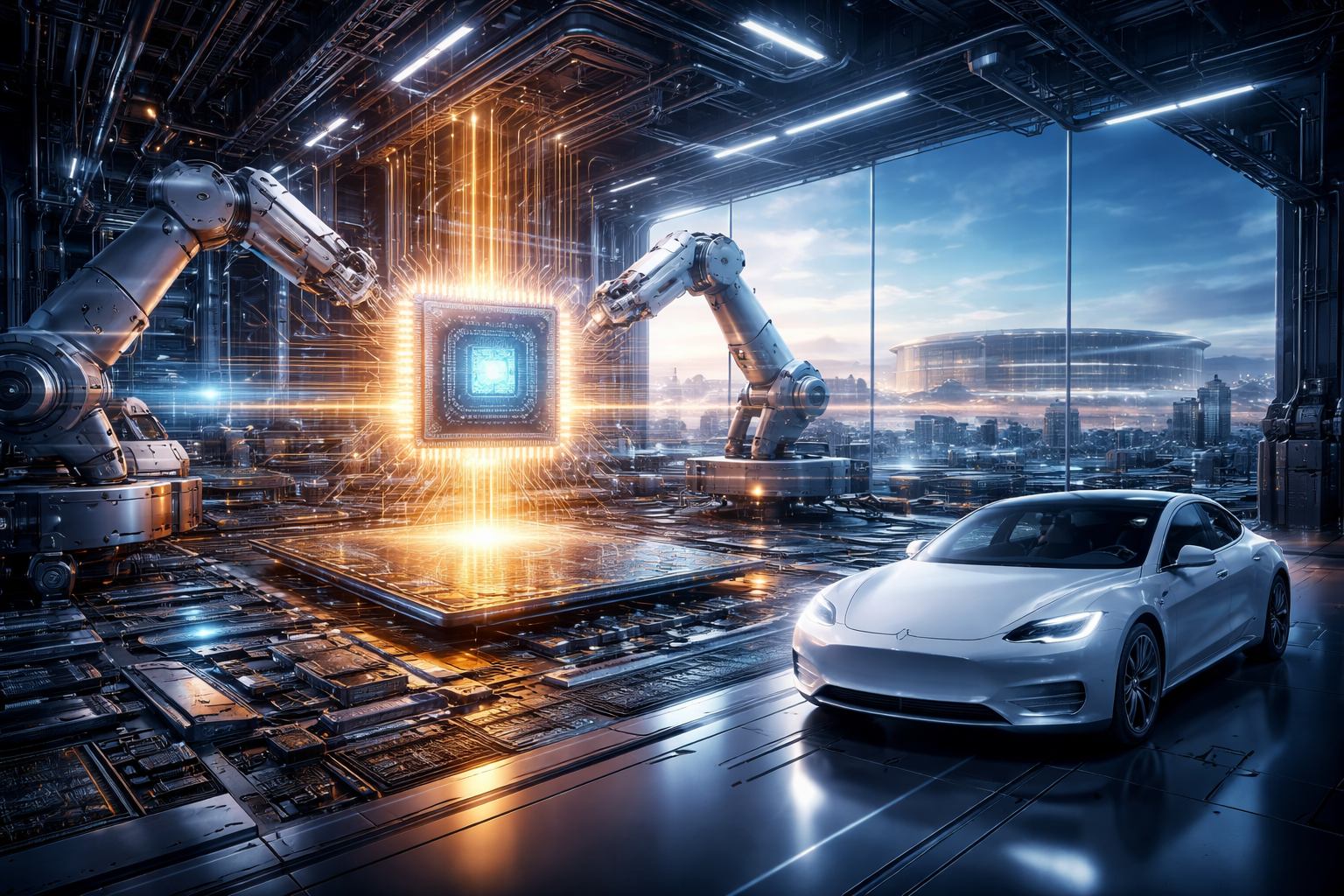
I. Introduction — A New Frontier in Tech & Automotive Integration
On March 21–22, 2026, Elon Musk announced something extraordinary: Tesla, in partnership with SpaceX and Musk’s AI venture xAI, is launching Terafab — a massive semiconductor fabrication project in Austin, Texas.
Terafab isn’t just another chip factory. It is designed to produce one terawatt (1 trillion watts) of AI compute capacity annually, far exceeding the output of any current U.S. fab facility.
In plain terms:
- It seeks to produce custom chips for Tesla vehicles, Optimus robots, and AI workloads.
- It represents an effort to internalize semiconductor production that many automakers depend on outside vendors for.
- It embodies Musk’s vision of vertical integration across automotive, AI, robotics, and space tech.
This project is arguably as significant as Tesla’s early Gigafactory announcements — potentially defining Tesla’s trajectory over the next decade.
But what exactly Terafab is, and why it matters not just to Tesla owners, but also to the broader EV and AI industry? Let’s unpack the full story.
II. Global Semiconductor Landscape: Why Chips Matter More Than Cars
A. The Importance of Semiconductors in Modern Technology
Semiconductors are the brains of modern machines — from mobile phones to cars, to data centers and space infrastructure. The global chip shortage that began mid‑decade exposed how vulnerable industries are when they rely on a handful of suppliers.
Tesla — like almost every automaker — currently depends on suppliers such as TSMC, Samsung, and Micron for its chips.
However:
- Automotive AI needs are increasing exponentially.
- Traditional fabs focus heavily on consumer devices and data center chips.
- Very few fabs specialize in the specific edge compute chips Tesla needs.
This rising demand set the stage for Tesla’s bold move.
B. The U.S. Chip Industry & Strategic Challenges
Despite recent government incentives, the U.S. produces a fraction of global semiconductor output. This led Tesla to conclude that its future growth — especially in autonomous driving and AI — could be constrained without its own manufacturing capabilities.
III. What Terafab Is — Ambition, Strategy, and Scope
A. The Terafab Announcement Explained
Terafab is a joint manufacturing initiative led by:
- Tesla
- SpaceX
- xAI (acquired by SpaceX earlier in 2026)
The facility is being planned near Austin, Texas, where Tesla’s Giga Texas and several related operations are located.
According to reports:
- Two advanced chip factories are planned — one for Tesla/Optimus-focused chips, one for space AI compute chips.
- The goal is to achieve one terawatt of compute annually.
This level of output is far beyond what current chip fabs produce — and positions Terafab as a potential global powerhouse.
B. Fully Integrated Vertical Manufacturing
Terafab isn’t just about wafer fabrication. It aims to house:
- Chip design
- Lithography
- Memory production
- Advanced packaging
- Testing
All under one roof — something no existing fab worldwide currently does at scale.
C. Chip Types and Target Uses
Terafab is targeting multiple chip families:
- AI inference chips (for vehicles and Optimus robots)
- AI training chips (potentially for xAI and SpaceX applications)
- Memory and custom processors for high‑performance needs
This breadth illustrates Tesla’s strategy to cover both edge computation (vehicles, robots) and heavy AI workloads.
IV. Strategic Importance to Tesla
A. Vertical Integration — From Cars to Chips
Tesla has a long history of pushing vertical integration:
- Designing its own motors and batteries
- Building proprietary software
- Owning manufacturing end‑to‑end
Terafab extends that integration into hardware that previously came from external suppliers.
This means greater control over:
- Supply chains
- Cost structures
- Innovation pace
B. Reducing External Dependencies
Today, Tesla still depends heavily on companies like TSMC and Samsung for key semiconductor components.
Terafab aims to significantly reduce that reliance, giving Tesla a more stable supply and fewer external constraints.
C. Supporting Future Technologies
Terafab’s output is expected to align with Tesla’s ambitions in:
- Full self‑driving AI
- Optimus humanoid robots
- AI infrastructure
- Space AI operations through SpaceX
This isn’t a one‑off factory — it’s meant to be foundational for Tesla’s future ecosystem.
V. The Competitive Landscape: Automakers vs. Chipmakers
A. Established Fab Giants
Companies like TSMC, Samsung, and Intel have decades of experience in semiconductor manufacturing. They dominate fabs at advanced process nodes.
Terafab is entering a highly specialized, capital‑intensive space where experience matters.
B. Other Automaker Initiatives
Some automakers have begun designing custom chips, but:
- Few have moved to manufacturing scale
- Most still rely on external fabs
Tesla’s move, if successful, could set a new precedent.
VI. Economic & Industry Impacts
A. Costs and Investment Size
Industry estimates place Terafab’s potential build cost in the $20–25 billion range — a massive investment.
B. Job Creation and Local Economy
Building such a facility near Austin, Texas could create:
- Thousands of construction jobs
- Long‑term semiconductor manufacturing positions
It could further solidify Texas as a major U.S. technology hub.
C. Broader Semiconductor Ecosystem Effects
Terafab’s entry might stimulate:
- Increased competition among fabs
- More local semiconductor suppliers
- Innovation in advanced chip manufacturing
VII. Technical Challenges & Roadblocks
Building a fab of this scale is incredibly difficult — both technically and operationally.
A. Capital Intensity & Yield Complexity
Even with massive investment, achieving high yields at advanced nodes is one of the toughest barriers in semiconductor manufacturing.
B. Talent & Expertise Gap
Advanced chip manufacturing requires a highly specialized workforce — engineers with deep experience in lithography, process control, and yield optimization.
Recruiting and retaining such talent could be a challenge.
C. Timeline Uncertainties
So far, Tesla executives have not provided a precise timeline for full production operations.
Even for experienced fabs, deployment can take years from groundbreaking to full production.
VIII. Regulatory & Geopolitical Considerations
A. U.S. Policy Support for Chip Manufacturing
U.S. government incentives for domestic semiconductor production have increased recently.
Terafab may benefit — but also compete — with other subsidized fab projects.
B. Global Chip Competition & Supply Chains
With most advanced semiconductor capabilities centered in East Asia, Terafab could shift the global balance if it becomes operational at scale.
IX. Long‑Term Scenarios — What’s Next for Tesla and Terafab?
A. Best‑Case Scenario
- Terafab reaches full capacity
- Tesla secures self‑reliant supply
- Costs decrease
- Market advantage accelerates
B. Most Likely Scenario
- Initial production focuses on vehicle and robot chips
- Hybrid reliance on external fabs continues
- Capacity scales over years
C. Worst‑Case Scenario
- Delays and technical bottlenecks
- Cost overruns
- Production timelines significantly slip
X. Conclusion — A Strategic Bet with Massive Upside and Risk
Terafab is more than a chip factory. It symbolizes Tesla’s broader ambition to integrate vertically, secure vital technology, and potentially redefine how AI and automation hardware is produced.
Whether Terafab becomes a global powerhouse or a long‑term investment with incremental progress, it will shape Tesla’s future — and potentially the semiconductor industry at large.
FAQs
Q1: What exactly is Terafab?
A1: Terafab is a planned semiconductor fabrication initiative led by Tesla, SpaceX, and xAI in Austin, Texas, aimed at producing advanced AI and custom chips — targeting one terawatt of annual compute capacity.
Q2: When will Terafab start production?
A2: No official production start date has been announced yet; construction and full deployment timelines remain uncertain.
Q3: Will Terafab replace Tesla’s existing chip suppliers?
A3: Terafab is expected to reduce dependence on external suppliers over time but won’t completely eliminate all external procurement immediately.
Q4: Why does Tesla need its own semiconductor factory?
A4: To secure stable supply, reduce dependency on third parties, lower costs, and accelerate innovation in AI and autonomous technologies.
Q5: How does Terafab relate to SpaceX?
A5: SpaceX is a partner in the project, and one of Terafab’s fabs will produce chips for space AI and related applications.