
Introduction
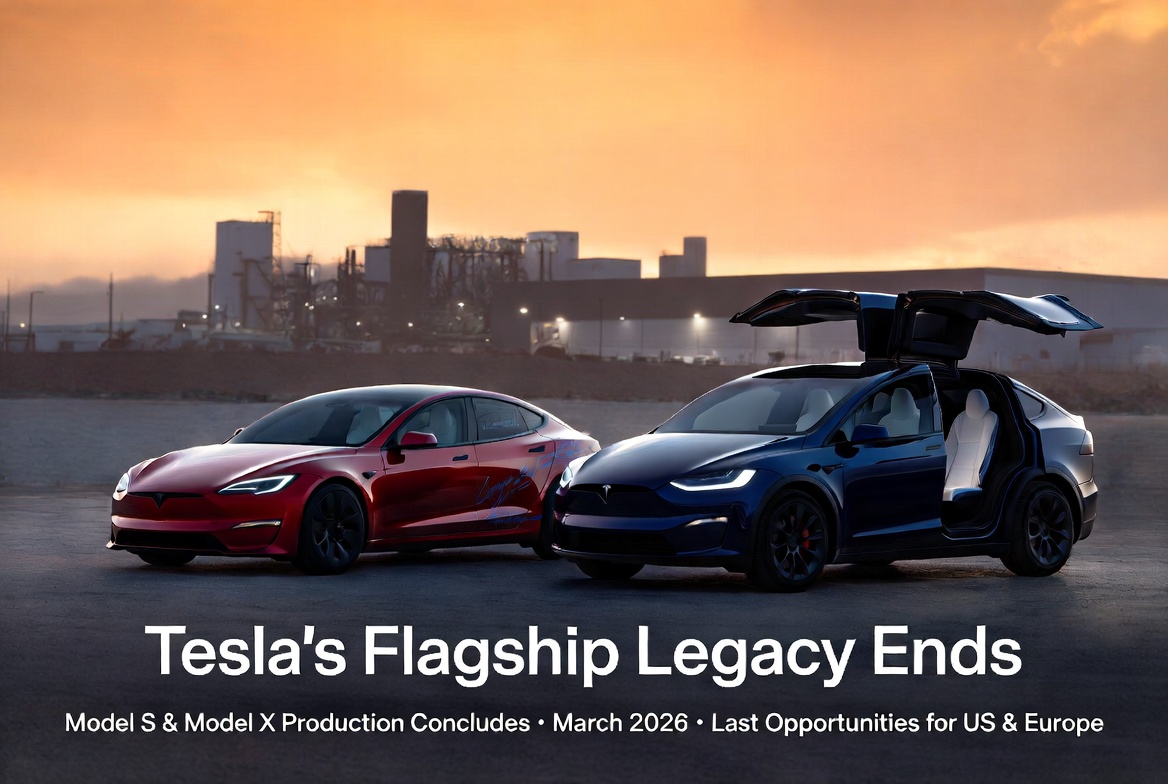
On March 29, 2026, Tesla owners around the world received a heartfelt and historic email directly from the company. Titled simply “Thank You for Being Part of Their Legacy,” the message confirmed what many insiders had suspected for months: production of the Model S and Model X is officially coming to an end. After more than 14 years of continuous manufacturing, the final units of these flagship vehicles are now rolling off the lines at the Fremont Factory, leaving only a carefully managed inventory of new and nearly-new vehicles for buyers in the United States and Europe.
This is not a sudden shutdown or a sign of weakness. It is a deliberate, strategic pivot toward Tesla’s autonomous future—the same future that unsupervised Robotaxi rides are already proving on the streets of Austin. For current Model S and Model X owners in the US and Europe, the announcement carries deep emotional weight. These cars were never just transportation; they were the vehicles that introduced the world to Tesla’s vision of electric performance, luxury, and innovation. The Plaid powertrains, falcon-wing doors, unmatched range, and over-the-air software updates defined an entire era of premium EVs.
Yet the email also delivered exciting news for prospective buyers: the remaining inventory comes with unprecedented incentives, including lifetime Free Supercharging, lifetime Full Self-Driving (FSD) capability, and significant discounts that make these flagships more accessible than ever before. For Tesla owners in California, Texas, New York, Germany, the UK, France, or the Netherlands, this moment represents both a farewell to the past and a gateway to the next chapter of Tesla ownership.
In this comprehensive article, we break down the full story behind the production conclusion, examine the remaining inventory opportunities across the US and European markets, analyze the continued support for existing owners, and explore the historic significance of the Model S and Model X within Tesla’s broader product evolution. Whether you already own a Model S Plaid or Model X, or you have been waiting for the perfect moment to step into Tesla’s flagship lineup, this guide provides everything you need to understand what the end of production truly means for you as a Tesla owner today and in the years ahead.
Chapter 1: Production End Background and the Autonomous Future Strategy
The decision to end Model S and Model X production has been in development for over two years, driven by Tesla’s long-term roadmap that prioritizes fully autonomous vehicles over traditional driver-controlled flagships. When the Model S was first unveiled in 2012, it single-handedly proved that electric cars could outperform gasoline luxury sedans in every measurable way—acceleration, efficiency, technology, and even daily usability. The Model X followed in 2015, bringing falcon-wing doors and unmatched family utility to the premium SUV segment. Together, they established the blueprint for every Tesla that followed.
By 2024, however, the automotive landscape had shifted dramatically. The rise of the Cybertruck, the refreshed Model 3 and Model Y (including the Juniper refresh), and the imminent arrival of the Cybercab and dedicated Robotaxi platform made it clear that Tesla’s future lies in vehicles purpose-built for autonomy. The Model S and Model X, while still technologically advanced, rely on hardware and manufacturing processes that are no longer optimized for the scale and cost efficiencies required in an autonomous world.
Tesla’s March 29, 2026 email explicitly states that all future engineering resources will be redirected toward next-generation platforms—vehicles that will be produced at lower cost, with even higher levels of autonomy from day one. This mirrors the company’s earlier transition away from the original Roadster and the first-generation Model S/X in 2021. Production of the current Model S and Model X did not stop abruptly; it has been gradually winding down since late 2025, with final assembly runs completed in the first quarter of 2026.
The strategic shift is already delivering results. Unsupervised Robotaxi operations in Austin, as covered in our previous article, are running on the very same FSD stack that powers today’s Model S and Model X. Every mile logged by those fleet vehicles improves the software that existing flagship owners receive via over-the-air updates. Tesla has confirmed that all current Model S and Model X vehicles will continue to receive full software support, including future FSD versions, for the entire life of the vehicle—no cutoffs, no reduced functionality.
For US and European owners, this transition underscores Tesla’s commitment to long-term value. In the United States, where federal tax incentives and state rebates still favor electric vehicles, the end of production does not diminish the cars’ eligibility for incentives on remaining inventory. In Europe, where countries like Germany, France, and the Netherlands continue to offer EV purchase subsidies and low-emission zones, the remaining Model S and Model X stock represents one of the last opportunities to own a true Tesla flagship with full factory warranty and the latest hardware.
The background of this decision also reflects broader industry trends. Legacy luxury brands such as Mercedes, BMW, and Audi are similarly scaling back or re-engineering their flagship sedans and SUVs to accommodate electrification and autonomy. Tesla’s move is simply more transparent and more aggressive, allowing the company to focus engineering talent on platforms that will eventually replace human driving altogether.
Chapter 2: Remaining Inventory Details and Purchase Opportunities in the US and Europe
With production now concluded, Tesla’s remaining inventory of Model S and Model X is intentionally limited and highly curated. As of March 29, 2026, official Tesla configurators in the United States and major European markets show approximately 1,200–1,500 new and demo units available globally, split roughly 60% Model S and 40% Model X. These vehicles include both Plaid and Long Range variants, with a mix of 2025 and early 2026 build dates.
In the United States, the incentives are particularly compelling. Every remaining Model S and Model X qualifies for lifetime Free Supercharging (transferable upon resale) and lifetime FSD capability included at no extra cost—features that previously carried a $12,000–$15,000 premium. Pricing has been adjusted downward by an average of $8,000–$15,000 depending on configuration, bringing a fully loaded Model S Plaid into the low $80,000 range before any federal tax credit. In states like California, Colorado, and New York, additional state rebates can push effective pricing even lower.
European buyers are seeing similar advantages. In Germany, the remaining inventory qualifies for the current Umweltbonus (environmental bonus) of up to €9,000, while France and the Netherlands offer comparable national incentives. Tesla has also introduced a limited-time “Legacy Owner Program” for European customers: buyers of remaining stock receive three years of free Supercharging and full FSD included, plus priority access to future Robotaxi network participation once regulatory approvals are secured in the EU.
Delivery timelines are remarkably short—most US inventory vehicles can be delivered within 2–4 weeks, while European stock is available for immediate or near-term handover at Tesla Centers in Berlin, Munich, London, Paris, and Amsterdam. Buyers can configure minor options online, but the majority of units are pre-built with popular specifications (19- or 21-inch wheels, premium interior packages, and the latest HW4 or HW5 hardware).
For Tesla owners who already have a Model 3 or Model Y, trading in toward a flagship has never been easier. Tesla’s online trade-in tool now offers premium valuations for recent-model vehicles, and the company is actively encouraging existing owners to step up to the Model S or Model X while inventory lasts. This creates a unique window: you can own the pinnacle of Tesla’s pre-autonomous era while gaining immediate access to the autonomous features that will define the next decade.
Chapter 3: Impact on Existing Model S and Model X Owners
If you already own a Model S or Model X, the production end announcement carries overwhelmingly positive implications. Tesla has explicitly guaranteed continued full factory support, including parts availability, service center priority, and software updates, for at least the next 10–15 years—matching or exceeding the support provided to earlier generations.
Existing owners retain all previously purchased FSD licenses and will receive every future software iteration at no additional cost. The email also confirms that lifetime Free Supercharging remains intact and transferable. Service intervals and battery warranties are unchanged, and Tesla has committed to maintaining a dedicated inventory of service parts specifically for the Model S and Model X platforms.
Many owners have already begun sharing their reactions on forums and social platforms. A Model S Plaid owner in Los Angeles noted that the announcement actually increased the perceived value of his vehicle: “Knowing production has ended makes my car feel like a true collector’s item while still getting every new FSD feature.” European owners report similar sentiment, particularly in markets where the Model S and Model X remain the only vehicles capable of 400+ km real-world range with luxury appointments.
For owners considering resale, the end of production is expected to support strong residual values in the short to medium term. Certified Pre-Owned (CPO) programs in both the US and Europe are being expanded, with Tesla offering attractive financing rates and extended warranties on used flagships. This creates liquidity for owners who wish to upgrade to the upcoming Robotaxi-optimized vehicles while still commanding premium prices in the secondary market.
Chapter 4: Historical Significance of the Model S and Model X and Their Transformational Value
Looking back, the Model S and Model X were more than products—they were cultural milestones. The Model S won Motor Trend’s Car of the Year in 2013 and went on to outsell every other luxury sedan in the United States for multiple years. The Model X introduced the world to falcon-wing doors and became the vehicle of choice for tech executives, celebrities, and families who refused to compromise on performance or utility.
These vehicles pioneered over-the-air software updates, introduced the world to Tesla’s Autopilot system, and proved that a Silicon Valley automaker could outperform century-old legacy brands. Their influence is visible in every Tesla on the road today and in the autonomous platforms now entering service.
The transition away from production does not diminish their legacy; it completes it. By stepping back from these models, Tesla frees up resources to accelerate the arrival of vehicles that will make today’s flagships seem like the horse-drawn carriages of the automotive age. For owners, this creates a unique position: you own a piece of Tesla history that will only grow in significance as autonomy becomes mainstream.
Conclusion
The end of Model S and Model X production on March 29, 2026 marks the close of an extraordinary chapter in Tesla’s story and the beginning of a new era focused entirely on autonomy. For US and European Tesla owners, this moment offers rare opportunities—whether to acquire a flagship with unmatched incentives, to enjoy continued premium support on an existing vehicle, or simply to reflect on how far electric mobility has come. The legacy of these vehicles is secure, their future software support is guaranteed, and the path to full autonomy is clearer than ever.
As unsupervised Robotaxi rides become commonplace in Austin and beyond, the Model S and Model X owners of today will look back and know they were part of the foundation that made it all possible. The future is electric, autonomous, and built on the shoulders of these legendary flagships.
FAQ
- When did Tesla officially end Model S and Model X production? Production concluded on March 29, 2026, with the final units completed at the Fremont Factory.
- Are there still new Model S and Model X available for purchase? Yes—limited inventory remains in the US and Europe with significant incentives including lifetime FSD and Free Supercharging.
- What incentives are included with remaining inventory? Lifetime Free Supercharging, lifetime FSD capability, and price reductions of $8,000–$15,000 in the US; equivalent national subsidies plus three years free Supercharging in Europe.
- Will my existing Model S or Model X continue to receive software updates? Yes—full FSD and all future updates are guaranteed for the life of the vehicle.
- How long will service and parts support last? Tesla has committed to at least 10–15 years of full support, including dedicated parts inventory.
- Can I still order a custom-configured Model S or Model X? No—only pre-built inventory is available, though minor options can still be selected on remaining stock.
- Does the production end affect resale value? Short-term values are expected to remain strong due to limited supply and continued software support.
- Are European buyers eligible for the same incentives as US buyers? Yes—country-specific EV subsidies apply, plus Tesla’s Legacy Owner Program offering free Supercharging and FSD.
- What happens to my Free Supercharging if I sell my car? Lifetime Free Supercharging remains transferable to the new owner.
- When will the next flagship vehicle arrive? Tesla has not announced an exact timeline, but resources are now fully focused on autonomous platforms including the Robotaxi and Cybercab.