
Introduction: The Gold Fleet Arrives
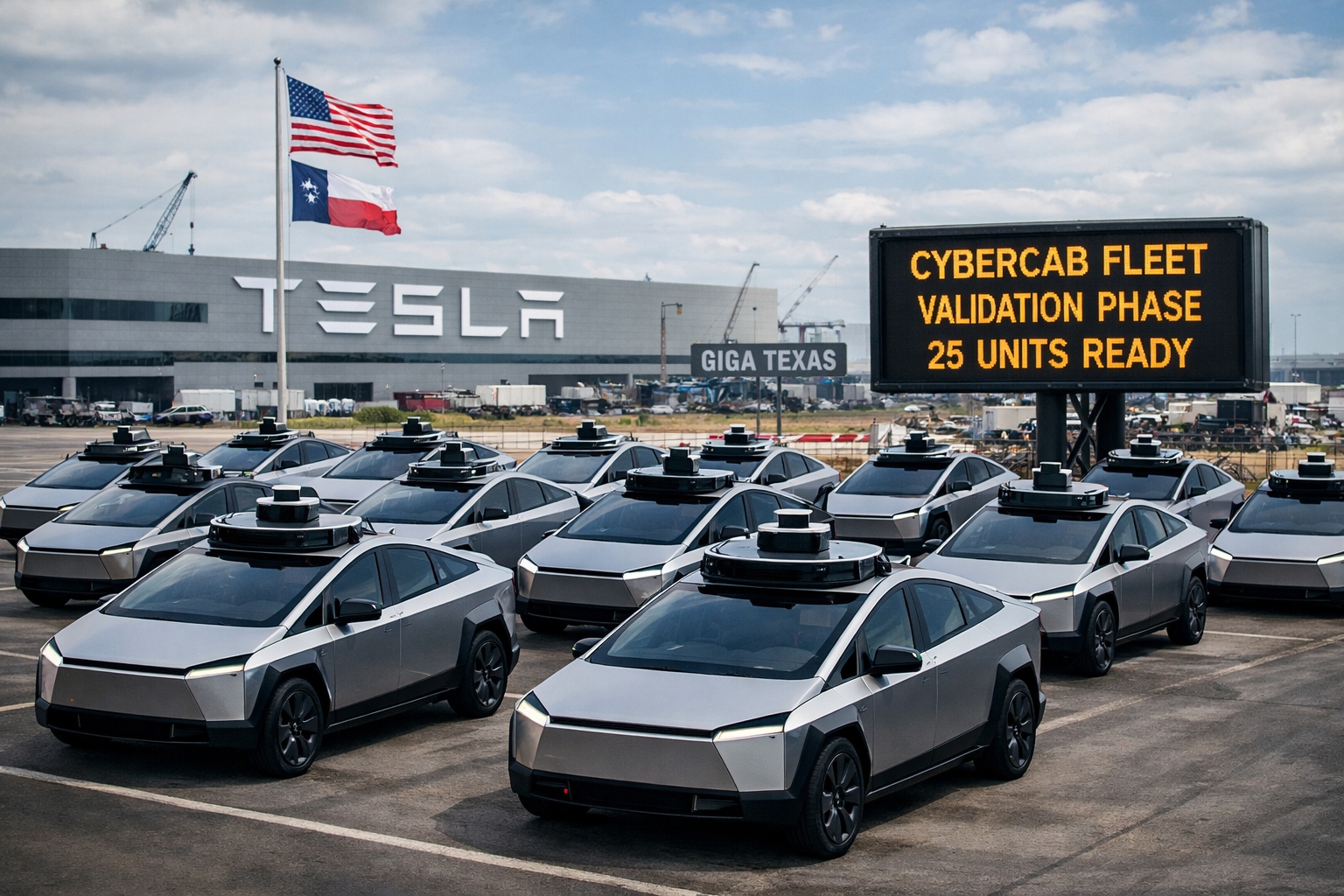
On the expansive grounds of Gigafactory Texas, something remarkable is taking shape. Drone observers and industry watchers have documented the largest single-day grouping of Tesla Cybercabs ever assembled—25 metallic gold units distributed across three critical locations within the factory complex . Fourteen vehicles parked in tight formation outside the factory exit, nine more undergoing structural validation at the crash testing facility, and two additional units receiving final checks at the west end-of-line area .
This is not merely a production milestone. It is the physical manifestation of Tesla's bet that the future of transportation belongs not to personally owned vehicles but to a fleet of autonomous robotaxis. The Cybercab, first unveiled in October 2024 to a mix of excitement and skepticism, is now moving through the final validation gates before mass production begins.
The timing could not be more significant. Tesla faces mounting pressure on its core automotive business, with analysts projecting a potential third consecutive year of delivery declines in 2026 . The company's valuation, hovering near $1.5 trillion, increasingly rests on promises of autonomy and robotics rather than vehicle sales . The Cybercab, therefore, carries an immense burden: it must demonstrate that Tesla can transition from the world's most valuable automaker to the world's most ambitious mobility service provider.
Section 1: The Validation Fleet — What 25 Units Reveal About Production Readiness
The observation of 25 Cybercab units at Giga Texas, documented by drone operator Joe Tegtmeyer, offers an unprecedented window into Tesla's manufacturing ramp strategy . Each grouping serves a distinct purpose in the validation process.
1.1 The Factory Exit Formation
The 14 vehicles parked outside the factory exit represent the most visible sign of production momentum. These are not show cars or hand-built prototypes—they are vehicles that have completed initial assembly and are awaiting distribution to various validation programs. The metallic gold finish, first seen on Cybercab prototypes, appears to be the standard production color for initial units, possibly chosen for its distinctive appearance during public testing or its thermal properties in Texas heat.
The density of this grouping—described by observers as the largest single-day Cybercab collection to date—suggests that Tesla's production line is moving beyond pilot phase . Early March 2026 marked a significant increase in output, with line rates sufficient to generate batches of vehicles rather than isolated units .
1.2 Crash Testing Validation
Perhaps more significant than the factory exit grouping are the nine units observed at the crash testing facility . Crash testing is the most rigorous validation any vehicle undergoes before reaching customers. For the Cybercab, this phase carries unique challenges.
Unlike conventional vehicles, the Cybercab has no steering wheel, no pedals, and no traditional driver's seat. The occupant compartment must protect passengers in ways that differ fundamentally from driver-centric designs. Frontal crash scenarios, for example, must account for passengers who may be seated in unconventional positions, possibly facing each other or reclined.
The presence of nine units at crash testing indicates that Tesla is running multiple test configurations—varying impact angles, speeds, and occupant positions to validate the full spectrum of safety scenarios. This is not a cursory compliance exercise; it is the kind of exhaustive testing required for a vehicle architecture that regulators will scrutinize more heavily than any previous Tesla model.
1.3 End-of-Line Final Checks
The two units at the west end-of-line area represent the final quality gate before vehicles exit the factory . These are likely the first production-representative units, built with the same tooling and processes that will generate customer vehicles. End-of-line checks typically include:
Software validation: Flashing final firmware and verifying all electronic control units communicate properly.
Fit and finish inspection: Ensuring panel gaps, paint quality, and interior assembly meet specifications.
Dynamic testing: Short test drives (where possible) to verify basic functionality.
Sensor calibration: Confirming cameras and sensors are properly aligned and functioning.
That two units have reached this stage suggests that Tesla has resolved the major manufacturing challenges and is now refining quality and throughput.
Section 2: Public Road Testing — From Silicon Valley to Suburban Streets
While factory activity provides evidence of production capability, public road testing demonstrates real-world readiness. Since October 2025, when the first Cybercab was spotted near Tesla's Engineering Headquarters in Los Altos, California, the frequency of sightings has accelerated dramatically .
2.1 The Silicon Valley Testing Corridor
Recent weeks have brought a steady stream of Cybercab sightings on public roads throughout Silicon Valley. Community observers on X have posted fresh footage of Cybercabs navigating the complex urban and suburban environments that characterize the region .
These test routes are carefully chosen. Silicon Valley offers:
Dense urban streets: Los Altos, Mountain View, and Palo Alto present narrow roads, frequent intersections, and heavy pedestrian traffic
High-speed arterials: El Camino Real and other major thoroughfares test high-speed merging and lane changes.
Suburban neighborhoods: Quiet residential streets validate low-speed navigation and interaction with parked cars, children, and pets.
Complex intersections: The region's irregular grid, combined with California's unique turn patterns, challenges the autonomy stack
Each public road mile logged by the Cybercab feeds data back to Tesla's training infrastructure, refining the neural networks that will eventually enable unsupervised operation.
2.2 Safety Driver Protocols
All current public road testing is conducted with safety drivers on board—a requirement for any autonomous vehicle testing in California . However, the role of these safety drivers is evolving.
Early Cybercab testing in October 2025 featured safety drivers positioned in the driver's seat, ready to take immediate control . Recent sightings suggest a shift: safety drivers are now positioned in passenger seats, with the vehicle operating autonomously under close supervision. This configuration more closely resembles the eventual robotaxi experience, where passengers will occupy the vehicle without any ability to manually control it.
The transition to passenger-seat monitoring indicates growing confidence in the autonomy system's reliability. Safety drivers remain ready to intervene via emergency stop buttons or remote commands, but the system is increasingly trusted to handle routine driving without constant readiness for takeover.
2.3 Key Engineering Validations
Public road testing serves multiple engineering objectives beyond simply accumulating miles. Recent Cybercab sightings have revealed several specific validation priorities:
Sensor Suite Performance: The Cybercab's camera array, including a distinctive C-pillar camera position for expanded rear and side field of view, is being validated across varied lighting and weather conditions. Early morning and evening testing sessions, documented by observers, suggest particular attention to low-light performance .
Thermal Management: California's microclimates, ranging from cool coastal fog to inland valley heat, provide opportunities to validate the Cybercab's battery and electronics thermal systems. The metallic gold exterior, which reflects more solar radiation than darker colors, may offer thermal advantages in warm climates.
Ride Comfort: As a robotaxi, the Cybercab must prioritize passenger comfort over the performance driving characteristics that enthusiast owners appreciate. Testing likely includes validation of acceleration, braking, and cornering profiles optimized for comfort rather than speed.
Interaction with Other Road Users: Autonomous vehicles must communicate intent to pedestrians, cyclists, and human drivers. The Cybercab's external displays and lighting signatures are being validated for clarity and predictability in real-world traffic.
Section 3: The Production Ramp — From Agonizingly Slow to Insanely Fast
Elon Musk has never been shy about setting expectations for production ramps, and the Cybercab is no exception. In a recent post on X, Musk offered characteristically candid guidance: "For Cybercab and Optimus, almost everything is new, so the early production rate will be agonizingly slow, but eventually end up being insanely fast".
3.1 Understanding the S-Curve
Musk's description reflects the fundamental reality of manufacturing innovation. When a product incorporates "almost everything new"—as the Cybercab does with its dedicated robotaxi architecture, camera array, interior configuration, and manufacturing processes—the production learning curve starts at zero.
The "agonizingly slow" phase typically involves:
Tooling validation: Proving that automated equipment can consistently produce components to specification.
Process refinement: Identifying bottlenecks and optimizing workflow
Quality stabilization: Achieving acceptable first-pass yield rates.
Supplier coordination: Ensuring component deliveries align with production needs.
Tesla has navigated these challenges before. The Model 3 production ramp in 2017-2018 was famously described as "production hell," with the company struggling to achieve volume while maintaining quality. Yet by 2019, Tesla had mastered Model 3 production and was generating substantial profits.
The Cybercab ramp benefits from lessons learned across two decades of manufacturing experience. Tesla's factories at Fremont, Shanghai, Berlin, and Texas have each contributed knowledge that applies to Cybercab production. The "agonizingly slow" phase for Cybercab may therefore be shorter and less painful than previous ramps.
3.2 Volume Targets: 2 Million Units Annually
Despite the expected slow start, Tesla's long-term targets for Cybercab production are staggering. Musk has stated that the company is aiming for at least 2 million Cybercab units per year across more than one factory, with a potential ceiling of 4 million annually .
To appreciate the scale of this ambition, consider:
Global auto sales across all manufacturers total roughly 70 million units annually
Toyota, the world's largest automaker, sells approximately 10 million vehicles per year
Tesla's total vehicle production in 2025 was approximately 2.5 million units across all models
Achieving 2 million Cybercabs annually would nearly double Tesla's total production volume, requiring:
Dedicated production lines at multiple factories
Significant expansion of Gigafactory Texas capacity
Potential construction of new factories specifically optimized for Cybercab manufacturing
Massive battery supply chain expansion.The 4 million annual ceiling would make Cybercab production alone larger than most major automakers' entire vehicle output.
3.3 Multi-Factory Strategy
The reference to "more than one factory" for Cybercab production is significant . While initial production is centered at Giga Texas, Tesla's global manufacturing footprint offers multiple expansion paths:
Giga Shanghai has become Tesla's most efficient factory, capable of rapid production ramps and high volume. Chinese regulators have shown increasing openness to autonomous vehicle testing, making Shanghai a logical second Cybercab production site.
Giga Berlin could serve European demand, though regulatory approval for unsupervised autonomous vehicles in the EU remains a hurdle. The recent RDW approval for FSD Supervised in the Netherlands suggests progress, but full autonomy will require additional regulatory steps .
Giga Mexico, announced but not yet operational, could be designed from the ground up for Cybercab production. A purpose-built factory optimized for robotaxi manufacturing might achieve even higher efficiency than retrofitted existing facilities.
Giga Nevada expansion plans, focused on Semi and battery production, might also accommodate Cybercab lines if demand justifies additional capacity.
The multi-factory approach distributes production risk, reduces logistics costs for serving regional markets, and enables faster scaling than any single facility could achieve.
Section 4: Design and Engineering Deep Dive
Beyond production metrics, the Cybercab itself represents a fundamental rethinking of vehicle design. Recent disclosures, including a display at the U.S. Department of Transportation and ongoing testing, have revealed details of the engineering choices that define this unique vehicle.
4.1 Interior Architecture Without a Driver
The most radical aspect of the Cybercab is what it lacks: any provision for a human driver. There is no steering wheel, no pedal assembly, no rearview mirror, and no traditional instrument panel. This absence is not merely a styling choice—it enables fundamental changes to the interior packaging.
Without a steering column and pedal box, the entire front of the cabin becomes available for passenger accommodation. The Cybercab's interior, glimpsed during the DoT display and in testing videos, features:
Massive legroom: Front passengers enjoy space equivalent to first-class airline seating, with no obstruction between them and the vehicle's front structure
Configurable seating: The 2-2-2 layout provides individual seats with armrests and personal space
Large displays: Passengers can access entertainment, information, and vehicle controls through centrally mounted screens
Storage integration: Without a traditional trunk separated by a bulkhead, the Cybercab offers flexible cargo space that can accommodate golf bags, luggage, or shopping
4.2 The Braille Innovation: Accessibility by Design
Among the small but significant features revealed during the Cybercab's Washington, D.C., appearance is the integration of Braille on interior controls . Both the hazard lights button (which serves as an emergency stop) and the door releases feature raised Braille characters, enabling blind passengers to navigate the vehicle independently .
This design choice carries profound implications. For millions of people with visual impairments, traditional driving has been inaccessible. Ride-sharing services have provided mobility, but they depend on sighted drivers and the ability to communicate with those drivers. The Cybercab, with Braille controls and fully autonomous operation, offers genuine transportation independence.
The Braille integration reflects a broader philosophy: autonomous vehicles should serve everyone, not merely those who previously drove themselves. Tesla has positioned Full Self-Driving technology as a solution for those who cannot drive due to disability, age, or other factors . The Cybercab makes this promise tangible.
Other accessibility features likely include:
Audio navigation cues: Providing spoken directions and information
Visual contrast: High-contrast interior elements for passengers with low vision
Wide door openings: Accommodating mobility devices and easier entry/exit
Adjustable seat heights: Enabling transfers from wheelchairs
4.3 Sensor Architecture and Computing
The Cybercab's autonomy capabilities depend on a sensor and computing architecture evolved from Tesla's current Full Self-Driving hardware. While Tesla has not disclosed the specific hardware version in Cybercab, several elements are apparent from testing vehicles:
Camera Array: The Cybercab features an expanded camera suite compared to production Model 3 and Y vehicles. The most distinctive addition is the C-pillar camera, positioned to provide rear and side visibility that complements the existing fender and B-pillar cameras. This configuration eliminates blind spots and provides redundancy for critical viewing angles.
Computing Redundancy: For a vehicle operating without a human backup, computing reliability is paramount. The Cybercab likely features redundant FSD computers, capable of seamless failover if the primary unit encounters an error. This architecture, previewed in Tesla's discussions of future hardware, ensures that a single component failure does not strand passengers.
Cleanliness Systems: Cameras must remain clear in rain, snow, mud, and other obscuring conditions. The Cybercab incorporates heating elements and possibly washer systems to maintain sensor visibility, learning from challenges encountered during early Semi and Cybertruck development.
Emergency Stop Mechanisms: While passengers cannot drive, they can stop. The hazard lights button, marked with Braille, serves as an emergency stop that brings the vehicle safely to a halt . Additional emergency communication methods, likely including voice commands and mobile app controls, provide multiple paths to safety.
Section 5: Strategic Implications for Tesla's Valuation
The Cybercab is not merely a new product—it is central to the investment thesis that supports Tesla's $1.5 trillion market capitalization. Understanding this context is essential for evaluating the significance of the current validation phase.
5.1 The Core Automotive Pressure
Tesla's traditional automotive business faces mounting headwinds. Analysts from Morgan Stanley and Morningstar now project a potential third consecutive year of delivery declines in 2026 . Factors include:
Loss of U.S. EV tax credits: Reducing affordability for price-sensitive buyers
Tougher European competition: Legacy manufacturers and new entrants capturing market share
Aging Model 3/Y lineup: Despite recent refreshes, the core products face intensifying competition
Political factors: Musk's political engagements affecting brand perception in some markets
Morningstar analyst Seth Goldstein estimates a nearly 5% drop in vehicle deliveries for 2026, citing weakness in the U.S. and Europe . This pressure comes as Tesla plans to double capital expenditures to over $20 billion, with Wall Street now expecting negative free cash flow after seven years of positive cash generation .
5.2 The Autonomy Bet
Against this challenging automotive backdrop, Tesla's valuation depends on successful execution in autonomy and robotics. As one investor noted, "Zero growth is a 'win' and a decline smaller than last year is 'neutral'" . Only accelerating declines would trigger serious concern.
The Cybercab enables multiple revenue streams beyond vehicle sales:
Robotaxi Service Revenue: Tesla plans to operate its own ride-hailing fleet, capturing the full economics of each ride rather than merely selling vehicles to fleet operators. Margins on mobility services, once scaled, could significantly exceed automotive margins.
Fleet Sales: Third-party operators, from traditional rental companies to new mobility startups, may purchase Cybercabs for their own fleets. This replicates the traditional automotive model but with higher average selling prices.
Software and Services: Robotaxi operations generate data that improves autonomy, creating a virtuous cycle. Premium services—faster pickups, vehicle preferences, entertainment packages—could generate recurring revenue.
Regulatory Credits: Autonomous vehicles may qualify for regulatory credits under various programs, providing additional income.
5.3 The Cash Flow Calculus
Tesla's projected negative free cash flow of $5.19 billion in 2026 reflects massive investment in future capabilities . The Cybercab program consumes a substantial portion of this spending, funding:
Production line tooling and automation
Validation testing across multiple regions
Regulatory approval processes
Initial fleet deployment costs
Investors appear willing to tolerate near-term cash burn as long as progress toward autonomy remains visible. The current validation phase, with 25 units testing and public road mileage accumulating, provides exactly the tangible evidence investors seek.
Section 6: The Path to Commercial Service
With production validation underway and public testing accelerating, when will actual passengers experience their first Cybercab ride? The timeline depends on several parallel tracks.
6.1 Production Timeline
Tesla is targeting an April 2026 start for mass production . The initial months will produce relatively low volumes as the "agonizingly slow" early ramp plays out. By late 2026, assuming typical learning curve improvements, production should reach sustainable volumes sufficient for pilot fleet deployments.
6.2 Regulatory Approvals
Production is necessary but not sufficient for commercial service. Each jurisdiction where Cybercab operates must authorize driverless operations. The regulatory landscape varies significantly:
Texas: As Tesla's home state, Texas offers the most permissive environment. State legislation explicitly authorizes autonomous vehicle operations without human drivers, and local authorities in Austin have worked cooperatively with Tesla on testing.
California: The California Public Utilities Commission and DMV have established frameworks for autonomous ride-hailing, though requirements are more stringent than Texas. Waymo and Cruise have operated in San Francisco, establishing precedent that Tesla can follow.
European Union: The recent RDW approval for FSD Supervised in the Netherlands marks progress, but unsupervised autonomous vehicles require additional approvals under UNECE regulations . Tesla's timeline for European Cybercab service likely extends into 2027 or later.
Other Markets: China, the Middle East, and select Asian markets may offer faster approval pathways, potentially enabling Cybercab service before Europe achieves regulatory clarity.
6.3 Phased Deployment Strategy
Based on Tesla's historical approach and industry precedent, Cybercab service will likely roll out in phases:
Phase 1 (Late 2026) : Limited deployment in Austin, Texas, serving a defined geofenced area. Initial fleet size measured in dozens rather than hundreds. Free or promotional pricing to build ridership and demonstrate capability.
Phase 2 (2027) : Expansion to additional Texas cities, possibly including Houston, Dallas, and San Antonio. Fleet scaling to hundreds of vehicles. Introduction of paid service with competitive pricing.
Phase 3 (2027-2028) : California launch, pending regulatory approvals. Expansion to additional U.S. markets. Pilot programs in select international markets.
Phase 4 (2028+) : Broad international rollout as regulatory approvals and production capacity allow.
6.4 Owner Implications
For current Tesla owners, the Cybercab rollout carries several
implications
Fleet Participation: Tesla has discussed allowing owners to add their vehicles to the robotaxi network when not in use, sharing revenue with the company. This program would require vehicles capable of unsupervised autonomy—likely those with Hardware 4 or later.
Trade-In Values: As robotaxi fleets scale, demand for used Tesla vehicles may increase, potentially supporting residual values. Fleet operators seeking to expand capacity could purchase used vehicles, creating a secondary market.
FSD Transfer: The development of robotaxi technology benefits all Tesla vehicles through over-the-air updates. Features validated on Cybercab will migrate to consumer vehicles, improving their autonomous capabilities.
Conclusion: The Validation Phase as Inflection Point
The appearance of 25 Cybercab units across Gigafactory Texas marks an inflection point in Tesla's journey from automaker to mobility provider. For years, the promise of autonomous vehicles has remained just beyond reach—demonstrated in controlled conditions but not delivered at scale. The Cybercab program, now moving through crash testing, public road validation, and production ramp, represents the most serious attempt yet to make driverless transportation a commercial reality.
The challenges ahead remain substantial. Production must scale from the current trickle to millions annually. Regulatory approvals must be secured across dozens of jurisdictions. Public acceptance of driverless vehicles must grow. Competition from Waymo, Cruise, and emerging Chinese players will intensify.
Yet the evidence accumulating in Texas and California suggests Tesla is making genuine progress. The 14 vehicles outside the factory, the 9 in crash testing, the 2 at end-of-line—these are not concepts or promises. They are physical products, rolling off production lines and onto public roads.
For Tesla owners, the Cybercab represents both a threat and an opportunity. The personal vehicle ownership model that Tesla has championed may gradually give way to mobility services. But the technology enabling robotaxis will also make personally owned vehicles more capable, more valuable, and more useful. FSD Supervised, now rolling out in Europe, demonstrates this progression: features developed for autonomy benefit drivers today, even as they pave the way for driverless tomorrow .
The gold fleet at Giga Texas will soon give way to a rainbow of Cybercabs serving passengers across Austin and beyond. When that day comes, transportation will have changed forever—and Tesla will have delivered on a promise made years ago.
Frequently Asked Questions
When will the Cybercab be available for passengers?
Tesla targets late 2026 for initial commercial service in Austin, Texas, with expansion to other markets following regulatory approvals .
Can I buy a Cybercab for personal use?
Tesla's primary focus is operating its own robotaxi fleet, but the company has not ruled out private sales. If offered, personal Cybercabs would likely arrive after fleet deployment .
How does the Cybercab ensure passenger safety?
The Cybercab features redundant computing, comprehensive camera coverage, emergency stop controls (including Braille-marked buttons), and validation through extensive crash testing .
Will my current Tesla benefit from Cybercab technology?
Yes. Features validated on Cybercab, including improvements to the FSD neural network, reach existing Teslas through over-the-air updates .
What happens if the Cybercab encounters something it cannot handle?
The vehicle is designed to recognize its limitations and perform a minimum risk maneuver—typically pulling over and stopping safely—while contacting remote assistance.
How much will Cybercab rides cost?
Tesla has not announced pricing, but the company aims to offer rides at costs below current ride-hailing services. Recent pricing adjustments for the existing robotaxi service in Texas suggest Tesla is finding optimal economics .