
Introduction: The Update Hidden in Plain Sight
In the spring of 2026, Tesla began pushing software update 2026.14 to its global fleet — a package that, on its surface, seemed to offer the expected seasonal refresh of features that Tesla owners have grown accustomed to. A redesigned Self-Driving App interface. Enhanced weather maps. Immersive sound upgrades. Sharper vehicle renderings on the center display. Supercharger pricing filters. Extended dashcam downloads. These were the features that dominated owner forum discussions and YouTube review videos in the days following the rollout.
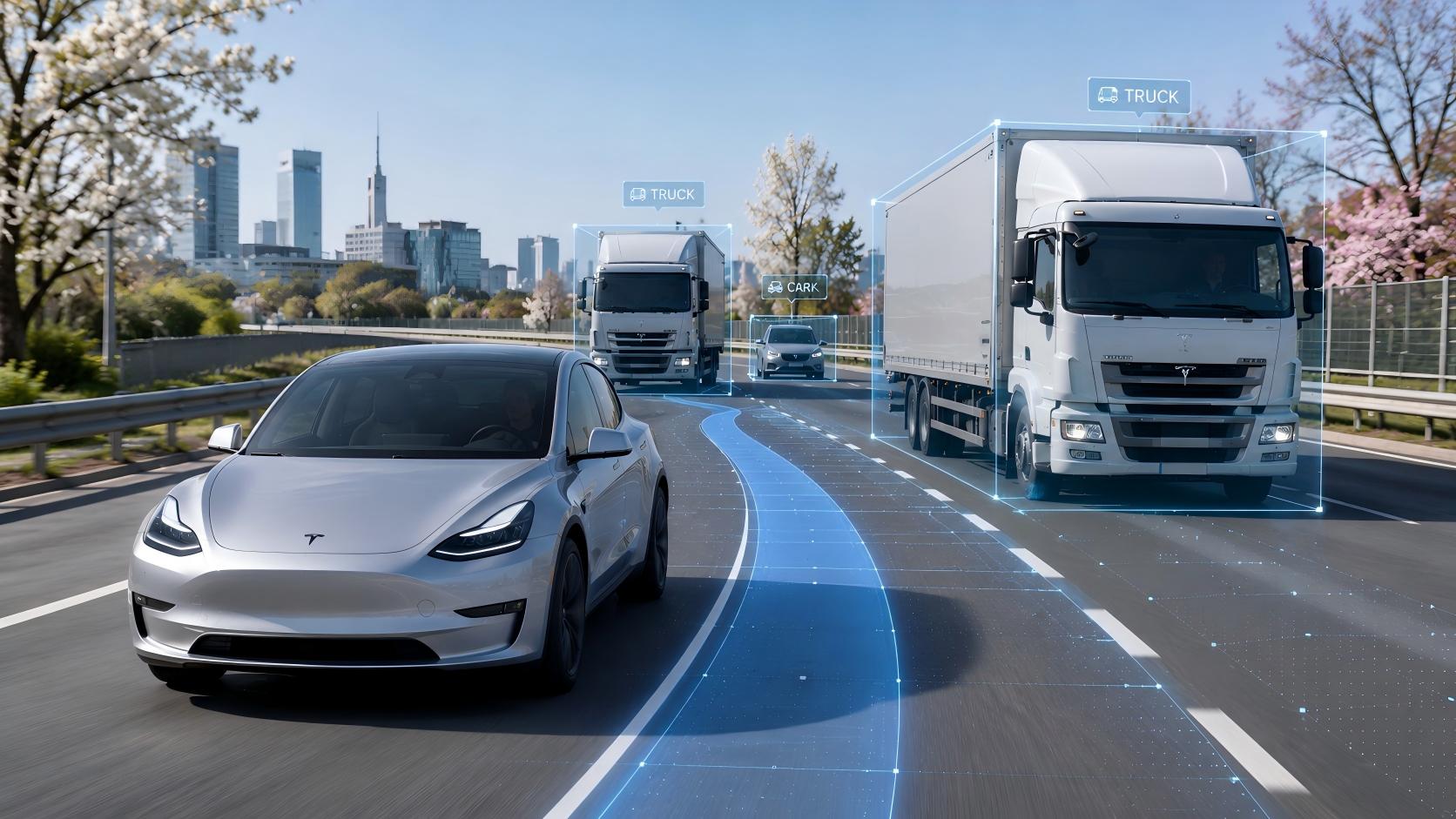
But buried among these flashy user-facing additions was a change so subtle that many owners might have missed it entirely — a change that says more about Tesla’s global autonomous driving ambitions than any splashy headline feature could. For the first time in the company’s history, Tesla had begun incorporating region-specific vehicle designs into its Full Self-Driving (FSD) visualization system. European Tesla owners who updated to 2026.14 found themselves looking at something new on their center displays: flat-fronted, cab-over European-style semi-trucks, rendered in crisp 3D alongside the familiar long-nose North American tractor-trailers that had been the standard visualization since the system’s inception.
This seemingly minor graphical update — a single 3D model of a European truck — represents one of the most strategically significant software changes Tesla has made in its pursuit of global FSD deployment. It signals a fundamental shift in how the company approaches international markets: not as afterthoughts to a North American-centric development roadmap, but as distinct environments requiring their own deeply localized perception and visualization capabilities. The European cab-over truck is the first tangible evidence of a localization strategy that will eventually extend to every region where Tesla aims to deploy autonomous driving technology.
Chapter 1: The Anatomy of the Update: What Changed and How It Works
The Spring 2026 update — released in waves as software versions 2026.14.1, 2026.14.2, and 2026.14.3 — contained a package of features that collectively represent one of Tesla’s most substantial seasonal updates. But the regional visualization change stands apart from the rest in terms of its long-term strategic weight.
The specific change is this: European Tesla vehicles running 2026.14 now display two distinct 3D semi-truck models on the center screen’s driving visualization. The first is the traditional North American long-nose tractor-trailer — the same model that Tesla owners worldwide have seen for years. The second is an all-new cab-over, flat-fronted European-style semi-truck that accurately reflects the design language of heavy transport vehicles common on European roads. The vehicle’s onboard AI selects which model to display based on what it actually detects in the environment ahead, meaning the visualization dynamically adapts to match the real-world road scene.
Several technical details are worth highlighting. First, this feature does not require an FSD subscription. Every Tesla owner in Europe — regardless of whether they have purchased FSD (Supervised) or use only the standard Autopilot package — sees the European truck visualizations. Tesla has democratized this feature, making it available across the entire European fleet.
Second, the system intelligently switches between the two truck models based on real-time detection. If a Tesla in Europe encounters a North American-style long-nose truck — perhaps an imported vehicle or one operating near a port — it will display that model. If it detects the more common cab-over European truck, it will render the European model. The system is not simply defaulting to European trucks for all European-registered vehicles; it is actually perceiving and classifying different vehicle types in real time.
Third, the European truck model was not created in response to the Spring Update cycle. According to detailed reporting on the change, the visual asset for the European cab-over semi was actually added to Tesla’s vehicle software back in October 2025, alongside approximately fifteen other new visual assets. Tesla deliberately held it in reserve — integrated into the software but not activated — for more than six months. The company activated the feature only once fleet data confirmed that its AI systems could recognize these trucks with high confidence in real-world European driving conditions.
This “integrate early, activate later” approach is not unique to the European truck visualization. Tesla employed the same methodology for recent rollouts of visualizations for horses and golf carts — less critical object classes that nonetheless expand the AI’s understanding of the diverse objects that can appear on roads. In each case, Tesla waited for reliable detection performance before enabling the graphics, ensuring that what drivers see on the screen accurately reflects what the AI actually perceives.
Chapter 2: Why Accurate Visualizations Matter-Trust, Safety, and Regulation
To a casual observer, updating a 3D truck model might seem like a cosmetic exercise — the automotive equivalent of a video game character skin. This view fundamentally misunderstands the role that visualization plays in Tesla’s autonomous driving ecosystem.
Visualization serves three critical functions, each of which becomes more important as Tesla pushes toward unsupervised FSD operation:
Trust Building. When a driver activates FSD (Supervised) and watches the center display render the road environment — other vehicles, lane markings, traffic signals, pedestrians, and now region-specific truck designs — they are receiving a real-time window into what the car’s AI “sees.” The more accurately this visualization matches the actual road environment, the more confidence the driver develops in the system’s perceptual capabilities. A European driver who sees a flat-fronted cab-over truck on the display that matches the truck visible through the windshield experiences a moment of cognitive alignment: the car sees what I see. This alignment builds the psychological trust that is essential for autonomous driving adoption.
Conversely, inaccuracies in visualization erode trust. If a European driver consistently sees North American-style trucks rendered for European vehicles, the mismatch creates a subtle but persistent sense that the system does not truly understand the local driving environment. Over time, this undermines the driver’s willingness to rely on the system, slowing adoption even if the underlying perception and planning algorithms are technically sound.
Safety Assurance. Accurate vehicle classification is not merely about visual fidelity — it has direct safety implications. Different vehicle types have different physical characteristics that affect how an autonomous system should interact with them. A cab-over European truck has a shorter overall length relative to its trailer, different turning dynamics, and a different blind spot profile compared to a North American long-nose truck. When the AI correctly classifies a vehicle as a European cab-over, it can draw on training data specific to that vehicle type when making planning decisions about following distance, passing maneuvers, and intersection behavior. The visualization that the driver sees is a reflection of this underlying classification accuracy.
Regulatory Communication. European Union regulators have repeatedly emphasized the importance of human-machine interface (HMI) transparency in their assessments of automated driving systems. The EU’s regulatory framework for automated vehicles places significant weight on how well the vehicle communicates its perception and intentions to the human driver. By localizing visualizations to match regional road environments, Tesla strengthens its case for regulatory approval in multiple European jurisdictions — demonstrating that FSD does not treat European roads as a mere variant of North American roads but as a distinct operating domain requiring dedicated adaptation.
These three functions — trust, safety communication, and regulatory positioning — explain why Tesla invested engineering resources in what might superficially appear to be a minor graphical change. The European truck visualization is not cosmetic; it is infrastructural. It lays the groundwork for everything from driver confidence in FSD to regulatory approval in Brussels.
Chapter 3: Tesla’s Data-Driven Philosophy-Wait for Confidence, Then Activate
The six-month gap between when the European truck asset was added to Tesla’s software (October 2025) and when it was activated for public display (April-May 2026) reveals a great deal about Tesla’s approach to autonomous driving development.
Tesla’s competitive advantage in autonomy is fundamentally data-driven. With millions of vehicles on roads worldwide — each equipped with a suite of cameras and sensors — Tesla collects real-world driving data at a scale that no other automaker or autonomous driving company can match. This fleet data is the raw material for training and validating the neural networks that power FSD’s perception, prediction, and planning capabilities.
The European truck visualization followed a specific data-driven workflow. First, Tesla’s engineering team created the 3D visual asset for the cab-over truck design — a relatively straightforward graphics task. Second, they integrated this asset into the vehicle software in a dormant state, where it could not be seen by drivers but could be accessed by the vehicle’s internal systems. Third, they allowed the fleet to continue operating in Europe, with vehicles encountering actual European cab-over trucks on real roads every day. Fourth, the vehicles’ perception systems — even without displaying the visual asset — were classifying these trucks, building a dataset of millions of real-world encounters. Fifth, Tesla’s engineering team analyzed this fleet data to measure detection confidence: how accurately and consistently were European cab-over trucks being identified across different lighting conditions, weather scenarios, road types, and traffic densities?
Only when the confidence metrics crossed a predetermined threshold did Tesla flip the switch, making the visualization visible to drivers. This approach ensures that what drivers see is not aspirational — a representation of what the AI hopes to recognize — but verified, reflecting what the AI actually recognizes with high reliability in the messy, unpredictable conditions of real roads.
This methodology stands in contrast to approaches that some other companies have taken, where visualizations are deployed based on engineering confidence rather than empirically validated fleet data. Tesla’s approach is more conservative on the front end — delaying feature activation — but more robust on the back end, as the features that do activate have been validated against real-world data at massive scale.
The broader implication is that Tesla is building a systematic framework for regional adaptation. European cab-over trucks are just the first example. As Tesla expands FSD to markets in Asia, the Middle East, South America, and beyond, the same methodology can be applied to region-specific vehicle types — the tuk-tuks of Southeast Asia, the compact delivery vans of Tokyo, the distinct truck designs found in different global markets. Each region presents unique perception challenges, and Tesla’s “integrate, learn, validate, then activate” framework provides a scalable approach to addressing them.
Chapter 4: The EU Regulatory Landscape-FSD’s Path Through European Approval
The Spring Update’s European localization arrives at a pivotal moment in Tesla’s multi-year effort to gain regulatory approval for FSD across the European Union. Understanding this context is essential to appreciating why the visualization update matters beyond owner enthusiasm.
In April 2026, the Dutch vehicle authority RDW (Rijksdienst voor het Wegverkeer) granted provisional approval for Tesla’s FSD (Supervised) system, allowing its use on all Dutch public roads. This approval followed 18 months of testing and more than 1.6 million kilometers (approximately 1 million miles) driven on EU roads during the evaluation period. The Dutch approval was strategically significant because EU regulations require at least one member state to approve a new vehicle technology before it can be considered for EU-wide authorization. The Netherlands served as Tesla’s entry point into the European regulatory system.
However, the path from Dutch approval to EU-wide authorization has proven considerably more complex than Tesla had hoped. According to email correspondence obtained by Reuters, regulators in several northern European member states — Sweden, Finland, Denmark, and Norway — have raised substantive safety objections to FSD following the Dutch approval.
Swedish Transport Agency investigator Hans Nordin wrote on April 15, 2026, just five days after the Dutch approval, that he was “quite surprised” to learn Tesla permitted FSD to exceed posted speed limits, and stated that such behavior should not be permitted. Finnish transport agency official Jukka Juhola questioned directly whether Tesla was “really introducing a system that allows hands-free driving also on icy 80 km/h roads” — a pointed reference to the fact that FSD’s training data is overwhelmingly weighted toward California’s sunny, ice-free driving conditions rather than Nordic winter environments.
Beyond the specific safety concerns, regulators have also questioned whether the very name “Full Self-Driving (Supervised)” misleads drivers about the system’s actual capabilities. Tesla has already been compelled to change its branding in multiple regions — most notably rebranding to “Intelligent Assisted Driving” in China — reflecting the sensitivity of the naming issue across different regulatory cultures. The addition of “Supervised” to the FSD name itself appears to be a concession regarding the system’s limitations, replacing the earlier “Beta” designation that the system carried for years.
The EU approval process requires a vote by the European Commission’s Technical Committee on Motor Vehicles, with approval needing representatives of at least 55% of member states representing 65% of the EU’s population. Dutch officials began presenting their case for FSD approval to this committee in early May 2026, but an EU-wide vote is not scheduled before July 2026 at the earliest, with October 2026 emerging as a potentially more realistic timeline.
It is within this complex and contested regulatory environment that the Spring Update’s European truck visualization takes on heightened significance. By demonstrating that Tesla is actively localizing FSD for European road conditions — rather than simply exporting a North American system — the company strengthens its regulatory argument that FSD is being developed with genuine attention to regional safety conditions. The visualization update is one piece of a larger effort to convince skeptical European regulators that Tesla takes the continent’s distinct driving environment seriously.
Chapter 5: The Dutch Experience-10 Million Kilometers and Counting
While regulatory debates continue at the EU level, Tesla owners in the Netherlands have been accumulating real-world FSD experience at a remarkable pace. Less than one month after the RDW’s April 2026 approval, Tesla owners in the Netherlands had already surpassed 10 million kilometers (6.2 million miles) driven using FSD (Supervised).
This rapid adoption provides Tesla with an invaluable data stream. Every kilometer driven with FSD active in the Netherlands generates perception data, planning data, and intervention data that feeds back into the neural network training pipeline. The Dutch experience effectively serves as a large-scale, real-world validation of FSD’s performance on European roads — roads that differ from North American roads in lane width, signage conventions, roundabout prevalence, cyclist density, and traffic culture.
It is important to note that the European version of FSD is not identical to the version that U.S. drivers use. The RDW’s approval statement explicitly notes that the software versions and functionalities in the U.S. and Europe “are therefore not comparable one-to-one.” The European version features stricter hands-on steering-wheel requirements, more limited driving mode profiles, and stricter eye-tracking requirements compared to the U.S. version — concessions to the European regulatory preference for more conservative human-machine interaction protocols.
These differences between the U.S. and European FSD implementations illustrate a broader challenge Tesla faces as it expands globally: the system cannot simply be copy-pasted from one region to another. Each jurisdiction has its own regulatory expectations, its own driving culture, its own physical road infrastructure, and its own vehicle fleet composition. The European truck visualization is one manifestation of Tesla’s growing recognition that global FSD deployment requires genuine regional adaptation, not just software translation.
The 10-million-kilometer milestone also provides Tesla with a powerful data point in its regulatory advocacy. When Dutch officials present their case to the EU Technical Committee, they can point to a substantial body of real-world driving data — not just controlled test-track results — demonstrating FSD’s operational safety profile on European roads. This data-driven argument is consistent with the engineering philosophy underlying the European truck visualization: let the fleet data speak before making claims.
Chapter 6: The Bigger Picture-Tesla’s FSD Global Timeline
The Spring Update’s visualization changes must be understood within Tesla’s broader timeline for global FSD deployment — a timeline that has evolved significantly over the past several years.
Tesla’s current publicly stated targets include a first unsupervised FSD release in Q4 2026, with Robotaxi operations expanding across approximately one dozen U.S. cities by the end of the year. According to the internal performance benchmarks tied to Elon Musk’s compensation package, the company is targeting 10 million active FSD subscriptions and 1 million Robotaxis in commercial operation as medium-term goals.
For the European market specifically, Tesla’s internal target has been EU-wide FSD approval in the second or third quarter of 2026. However, the skepticism expressed by Nordic regulators, combined with the EU’s deliberate committee voting process, makes it increasingly likely that meaningful EU-wide approval will not arrive before late 2026 or early 2027.
The Spring Update’s European localization features should be seen as preparatory infrastructure for this timeline. Tesla is building the perceptual and visualization capabilities that FSD will need when it eventually receives European regulatory approval, rather than waiting for approval and then scrambling to adapt. This “build first, deploy when approved” strategy allows Tesla to accumulate validation data and refine regional performance while the regulatory process plays out.
It is also worth noting what the Spring Update does not include. FSD (Supervised) remains limited in availability outside North America. The European truck visualization prepares the perception and display systems for European FSD operation, but does not in itself enable full FSD functionality in the region. European Tesla owners who see the cab-over trucks on their displays are looking at a preview of the system’s future capabilities — a promise embedded in pixels — rather than experiencing full autonomous driving today.
Chapter 7: What This Means for Tesla Owners-Practical Takeaways
For different categories of Tesla owners and prospective buyers, the Spring Update carries different practical implications:
European Tesla Owners. The most immediate impact is a more accurate and confidence-building visualization experience. When you drive on European highways and see cab-over trucks accurately rendered on your center display, you are experiencing a system that demonstrably understands your local road environment. This does not yet translate to full FSD availability, but it signals that Tesla is actively preparing European-specific capabilities. The visualization is available to all European Tesla owners without requiring an FSD purchase or subscription, meaning every owner can see this evidence of regional development progress.
North American Tesla Owners. The Spring Update demonstrates that FSD’s underlying architecture is being built for global deployment, not just North American operation. For owners who travel internationally or who are interested in Tesla’s long-term autonomous driving trajectory, the appearance of European-specific features in production software indicates that Tesla’s development roadmap has genuinely global ambitions. The same visualization framework that supports European trucks today will eventually support region-specific vehicle types across Asia, South America, and other markets.
Prospective Tesla Buyers. The Spring Update provides a concrete example of Tesla’s over-the-air update capability delivering meaningful new functionality. Traditional automakers cannot add region-specific vehicle recognition to vehicles already in customer hands. Tesla can — and did. This OTA capability is one of Tesla’s most durable competitive advantages, and the European truck visualization is a case study in how it creates ongoing value for vehicle owners long after the initial purchase.
Technology Enthusiasts and Industry Observers. The localization strategy revealed by the Spring Update has implications for understanding Tesla’s autonomous driving competitive position. Many autonomous driving companies — Waymo, Cruise, Zoox — have developed their systems for specific geographic areas and then expanded city by city. Tesla’s approach, by contrast, leverages its global fleet to learn regional characteristics simultaneously, potentially enabling faster geographic scaling once the core FSD architecture is mature. The European truck visualization is a small but telling piece of evidence supporting this global scaling thesis.
Chapter 8: The Road Ahead-Localization as Competitive Advantage
Looking forward, the Spring Update’s European localization features suggest a roadmap that extends well beyond truck visualizations. If Tesla follows the same “integrate, learn, validate, then activate” methodology for other regional vehicle types, European Tesla owners can expect to see progressively more region-specific visual elements appearing in future software updates.
Possible near-term additions might include: European-style emergency vehicles with distinct light bar configurations and color schemes; region-specific road signs that differ from North American standards; European cyclist and pedestrian models that reflect typical European clothing, bicycle types, and behavior patterns; and urban infrastructure elements like the distinctive roundabout designs, narrow medieval street patterns, and tram systems found in European cities.
Each of these additions would serve the same three functions as the truck visualization: building driver trust through accurate environmental representation, enhancing safety through improved perception accuracy, and strengthening Tesla’s regulatory case by demonstrating genuine regional adaptation.
For the broader autonomous driving industry, Tesla’s approach to localization raises the competitive bar. Companies that treat autonomous driving as a universal technology to be deployed identically worldwide will increasingly find themselves at a disadvantage compared to companies that invest in deep regional adaptation. The future of autonomous driving is not one-size-fits-all; it is precisely tailored to the specific roads, vehicles, signs, and behaviors of each region where the system operates.
The European cab-over truck, in this light, is not just a new 3D model. It is Tesla’s opening statement in a global localization strategy that will define the next phase of autonomous driving competition.
Conclusion: Seeing the World, One Truck at a Time
The Spring 2026 update’s European cab-over truck visualization is the kind of feature that is easy to overlook and dangerous to underestimate. It represents a fundamental strategic shift in how Tesla approaches global FSD deployment — from a North American-centric system that is exported abroad, to a genuinely international system that learns the distinct visual language of each region it enters.
For Tesla owners, the update provides a tangible signal that the company is investing in European-specific autonomous driving capabilities, even as EU-wide regulatory approval remains months away. For industry observers, it reveals a data-driven localization methodology that leverages Tesla’s global fleet as a competitive asset in ways that no other automaker can replicate. For regulators, it offers evidence — modest but meaningful — that Tesla takes regional road safety conditions seriously.
The road to global autonomous driving will be paved with seemingly small updates like this one. Each region-specific vehicle model, each localized road sign, each culturally appropriate pedestrian rendering adds another layer to a perception system that must ultimately understand the entire world’s roads. Tesla has begun this process in Europe with a single truck design. It is a quiet beginning, but the trajectory it signals is anything but small.
FAQ
Q: Does the Spring Update enable Full Self-Driving in Europe?
A: No. The Spring Update 2026.14 adds region-specific visualizations to the FSD display system, preparing it for European driving environments. However, FSD (Supervised) remains limited in availability outside North America. The visualization update is preparatory infrastructure, not a functional FSD unlock for European roads.
Q: Do I need an FSD subscription to see the new European truck visualizations?
A: No. Tesla has made the European cab-over truck visualization available to all Tesla owners in Europe, regardless of whether they have purchased FSD (Supervised) or use the standard Autopilot package. No purchase, subscription, or upgrade is required.
Q: What is the current timeline for FSD approval in Europe?
A: Tesla received provisional FSD approval from the Dutch RDW in April 2026. EU-wide approval requires a vote by the European Commission’s Technical Committee on Motor Vehicles, which is not expected before July 2026 at the earliest, with October 2026 cited as a more realistic timeline. The approval outcome remains uncertain, as several Nordic member states have raised substantive safety objections.
Q: Is the European version of FSD the same as the U.S. version?
A: No. The Dutch RDW has confirmed that the European version of FSD (Supervised) differs from the U.S. version, featuring stricter hands-on steering-wheel requirements, more limited driving mode profiles, and stricter eye-tracking requirements. These differences reflect European regulatory preferences for more conservative human-machine interaction protocols.
Q: How does Tesla decide when to activate new visualizations like the European truck?
A: Tesla follows a data-driven methodology: the visual asset is integrated into vehicle software in a dormant state, the global fleet collects real-world perception data, and the feature is activated only when fleet data confirms the AI can recognize the object with high confidence. The European truck asset was added in October 2025 and activated in the Spring 2026 update, following approximately six months of background validation.
Q: Will Tesla add visualizations for vehicles in other regions, such as Asia or South America?
A: While Tesla has not publicly announced a timeline for additional regional visualizations, the methodology established with European trucks is scalable to other regions. As Tesla pursues FSD deployment in additional global markets, region-specific vehicle types — such as tuk-tuks in Southeast Asia or compact delivery trucks in Japan — are logical candidates for future visualization updates.